

Teeth Whitening in Tunisia: Price, Results and What It Cannot Do

Teeth whitening in Tunisia: the essentials
In-practice whitening lifts the shade of your natural enamel using a peroxide gel applied by a dentist, with your gums protected. One session, under an hour, no anaesthetic.
Wanting to change the shape of your teeth as well as the colour? That is veneers, which is a different treatment and a much bigger decision. Read section 7 before you choose.
It is carried out by Dr Fedia Mtaallah at Myron International Clinic in Tunis, with English-speaking support throughout.
| Session | 45 minutes to 1 hour |
| Anaesthetic | None |
| Stay in Tunisia | 2 to 3 days |
| Result | Immediate |
| Lasts | 1 to 3 years |
| Price | €350 per session, €100 for a scale and polish |
What it costs, and whether it is worth travelling for
€350 per whitening session. €100 for a scale and polish, which is strongly recommended beforehand.
Included: the dentist's fees, the whitening product, airport pickup and assistance.
Not included: flights and accommodation.
Now the honest part. Whitening is one of the few treatments where flying somewhere for it alone rarely adds up. Once you have paid for flights and two or three nights, the saving against having it done at home is usually gone, and you will have spent a weekend on it.
Where it does make sense: as part of a stay you are already making. Added to veneers, crowns or implants, or alongside a cosmetic procedure, it costs you an hour and no extra travel. That is when the figure is genuinely good.
We would rather tell you that now than after you have booked. All prices are on the prices page, and a quote reaches you within 24 to 48 hours of sending photographs.
| Treatment | Price |
|---|---|
| Teeth Whitening | €350 per session |
| Dental Scaling | €100 per session |
How whitening actually works
A peroxide-based gel is applied to the teeth with the gums isolated and protected. The peroxide passes into the enamel and breaks down the coloured molecules held inside it. Nothing is removed from the tooth and nothing is added to it.
Why a dental practice differs from a pharmacy kit. The concentration used in practice is higher than anything sold over the counter, the gums are properly isolated, and the session follows an examination of your mouth. A home kit at a low concentration will do something over several weeks; it will not do this.
And why the examination matters. Whitening an untreated cavity, an infected gum or a cracked tooth is not a cosmetic problem, it is a dental one. The check before the session is not a formality.
Which stains it fixes, and which it does not
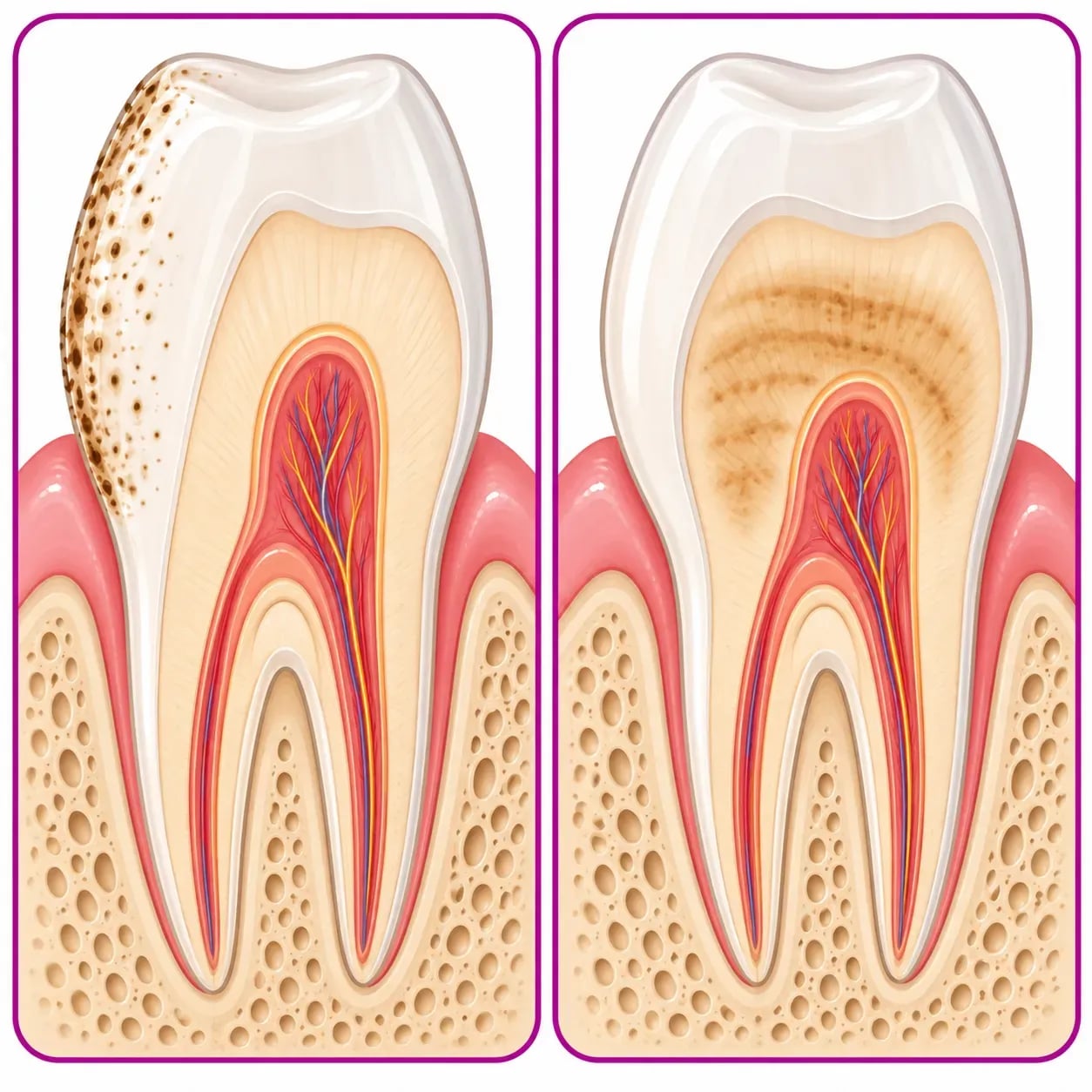
There are three different things people call yellow teeth, and whitening only deals with two of them.
Surface staining — works well. Coffee, tea, red wine, tobacco, curry. These sit on and just inside the enamel and lift readily.
Age-related yellowing — works well. Enamel thins over the years and the yellower dentine beneath shows through more. Whitening lightens this effectively.
Intrinsic discolouration — works poorly or not at all. Colour built into the structure of the tooth, from tetracycline taken in childhood, from fluorosis, or from trauma. Gel applied to the outside has little purchase on it, and the honest answer for these is usually veneers rather than whitening.
A single dark tooth that has had root canal treatment is a different case again. Internal whitening, done from inside the tooth, is sometimes possible and is assessed individually.
Which of these you have is established by looking at your teeth, not from a photograph of them. If the assessment says whitening will not achieve much, you will be told so before you travel.
What whitening will never change
Whitening acts on natural enamel and nothing else. It has no effect on:
Those are ceramic or composite. They hold their colour and the gel does not touch them.
What this means in practice. If you have a white filling or a crown on a front tooth, whitening the teeth around it will leave it looking darker than everything else, because it stays exactly as it was while its neighbours lighten. The difference may be slight or it may be obvious.
So tell us about any visible restoration on your front teeth before you book. It does not necessarily rule out whitening, but it changes the plan — the restoration may need replacing afterwards to match the new shade, and you should know that in advance rather than discover it in the mirror.
Whitening before veneers, never after
If you are considering both, the order is not negotiable.
Whiten first, then make the veneers to match. A veneer is manufactured in a chosen shade and keeps that shade permanently. Whitening the natural teeth afterwards lightens everything except the veneers, which then stand out as the dark ones.
The same applies to crowns and to any front-tooth filling.
This is a common and entirely avoidable mistake, and it is expensive to put right: the only remedy is replacing the restorations.
Whitening or veneers? Start with the least destructive
If you have been researching dental work abroad, you will have seen the photographs of teeth filed down to small pegs before crowns are fitted. That is a real thing and it is worth understanding why it matters.
These three treatments are not alternatives at the same level. They sit on a scale.
| Treatment | What it does to the tooth | Reversible |
| Whitening | Nothing is removed. Only the shade changes. | Yes — the colour simply fades back |
| Veneers | A layer of enamel is removed from the front of the tooth | No — the tooth will always need covering |
| Crowns | The tooth is reduced on all sides | No — and far more tooth is gone |
The rule worth applying: if the colour is the only thing that bothers you, whitening is the answer, and it is also the cheapest and the only one that takes nothing away. Veneers are for changing shape, closing gaps, or for discolouration that whitening cannot reach. Crowns are for teeth that are structurally damaged.
Be wary of anyone who proposes crowns on healthy front teeth for a cosmetic reason alone. That advice applies in Tunisia, in Turkey, in the UK and anywhere else. If a treatment plan involves more tooth removal than the problem requires, ask why, and get a second opinion.
Are you a candidate?
Whitening suits an adult with healthy teeth and gums, natural enamel on the front teeth, and expectations matched to the starting shade.
Treated first, or ruled out:
- Untreated decay
- Gum disease or inflammation
- A cracked or damaged tooth
- Significant existing sensitivity — whitening can make it worse
- Visible restorations on the front teeth, which change the plan rather than preventing it
Not during pregnancy or breastfeeding, as a precaution. It is a cosmetic treatment and it can wait.
And if your enamel is already pale, the gain will be modest. The shade guide taken before the session is what makes that conversation concrete rather than a matter of hope.
The scale and polish first, and why it matters
A scale and polish before whitening is €100, and it is strongly recommended rather than an upsell.
Plaque and tartar sit between the gel and the enamel. Whitening over them gives a patchy, unpredictable result: the gel reaches the clean areas and not the rest.
Removing them first means the gel works on the whole tooth surface evenly, which makes the result both better and more even. It also means the dentist can see the teeth and gums properly before deciding to go ahead.
Both can be done in the same visit, which is part of why the stay is 2 to 3 days rather than one.
The shade guide: how the result is measured
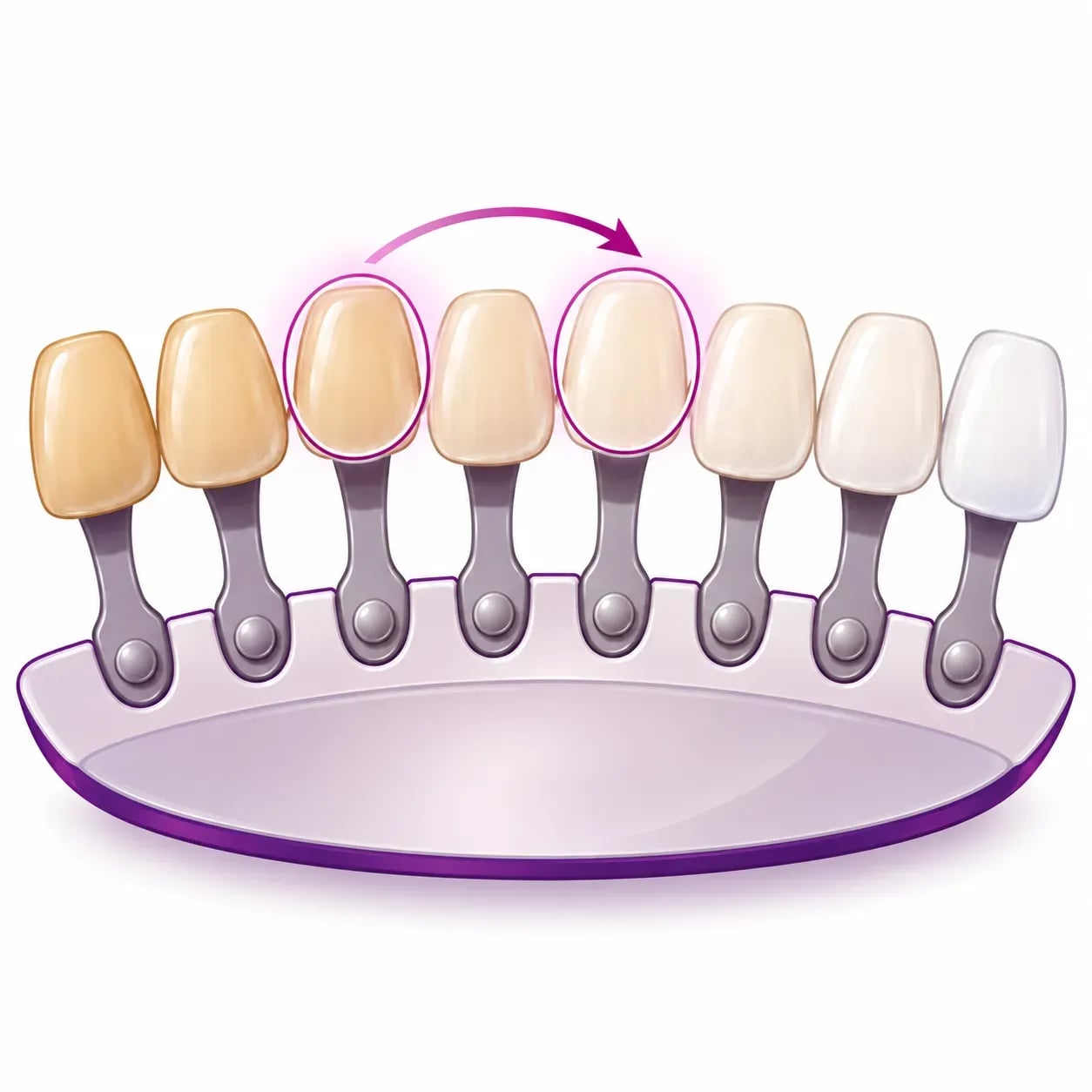
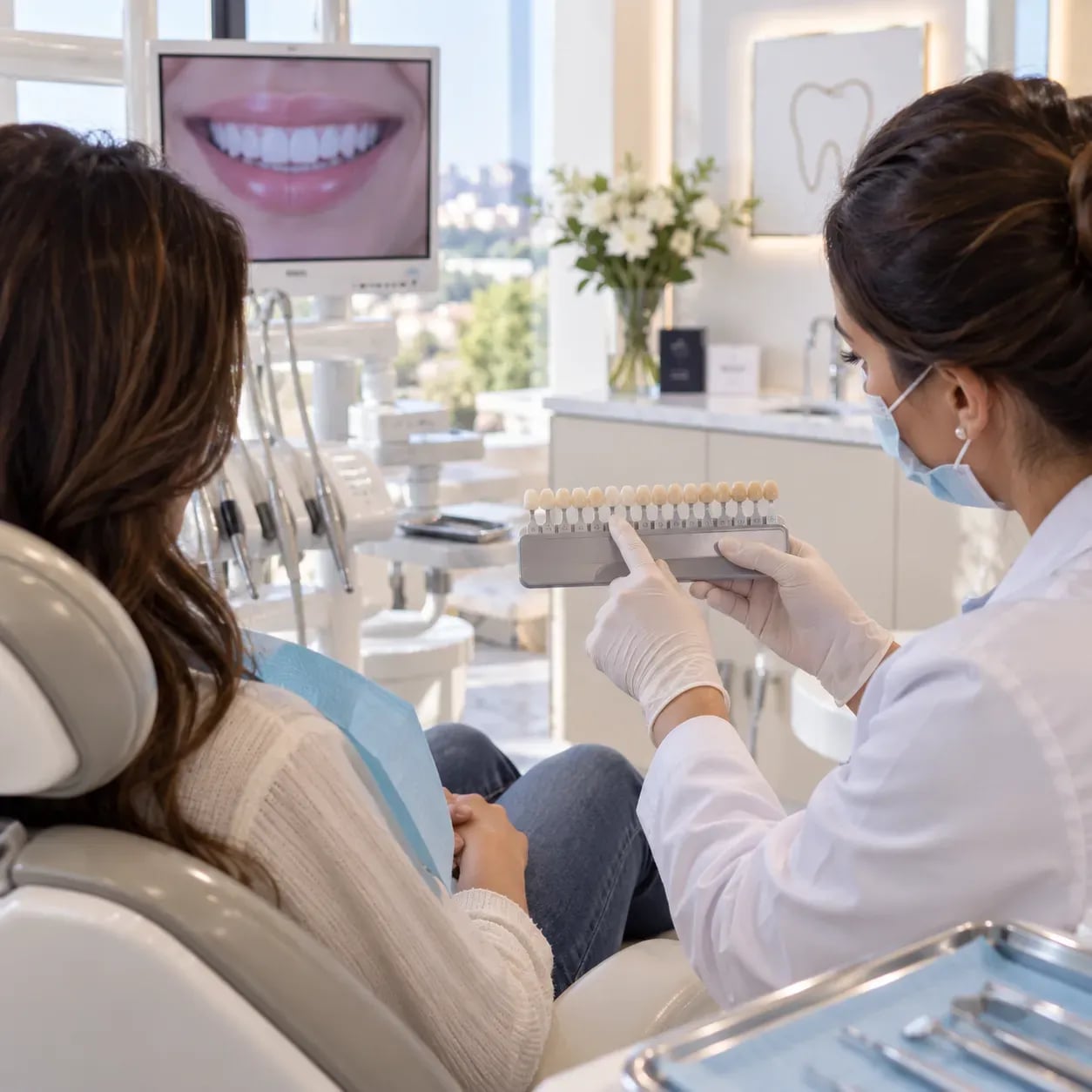
Your shade is recorded against a standard guide before the session and again afterwards. That is how the change is measured, and it is the only honest way to answer the question everyone asks.
Nobody can tell you in advance how many shades you will gain. It depends on your starting shade, the type of discolouration, and how your enamel responds — which varies between people and cannot be predicted from a photograph.
Someone starting from a deep yellow may see a dramatic change. Someone already fairly pale will see a subtle one. Both are normal results.
Be sceptical of a promised number of shades. If a clinic guarantees you a specific result before examining your teeth, they are guessing, and they are telling you something about how they work.
The 48 hours after
Sensitivity is common and temporary. Teeth often feel sensitive to cold for 24 to 48 hours afterwards. It comes from the enamel being briefly more permeable, it settles on its own, and it is more noticeable if you were already sensitive before.
Eat and drink pale things for two days. The enamel is temporarily more receptive, which is exactly what you do not want when it comes to colour.
Avoid for 48 hours: coffee, tea, red wine, cola, beetroot, tomato sauce, curry, soy sauce, berries — and tobacco, which is the worst of them.
Safe: water, milk, white fish, chicken, rice, pasta, potato, white cheese, bananas, apples.
Two days of beige food is a small price for not undoing what you just paid for.
How long it lasts, and how to keep it
One to three years, and the range is that wide because it depends almost entirely on you.
What shortens it: coffee, tea, red wine and tobacco, in roughly that order of frequency and in reverse order of damage. A heavy smoker will see the shade fade considerably faster than a non-smoker.
What extends it: an annual scale and polish, rinsing with water after anything strongly coloured, and using a straw for iced coffee and cola.
A top-up session is the same price as the first and is usually only needed when the shade has visibly dulled rather than on a schedule. Whitening repeatedly for its own sake is neither necessary nor advisable.
Your dentist
Dr Fedia Mtaallah practises cosmetic dentistry at Myron International Clinic, and handles whitening, veneers, crowns and implants.
That matters more than it sounds for this particular treatment: the person assessing whether whitening will work for you is also the person who would place veneers if it will not, and is therefore in a position to tell you which you actually need.
Send photographs of your teeth and you will have an opinion within 24 to 48 hours.
Your pathway, and getting there
- Send photographs of your teeth, front and smiling, in natural light without a filter. Mention any crown, veneer or visible filling on a front tooth. An opinion and a quote come back within 24 to 48 hours.
- Arrival. You are met at Tunis-Carthage and transferred.
- Examination, and the shade recorded on the guide.
- Scale and polish if you are having one.
- The whitening session, 45 minutes to an hour, no anaesthetic.
- The shade recorded again, and the 48-hour instructions.
- Home.
Getting to Tunisia: around three hours from London and connections from other UK and Irish airports; daily flights from Dubai, around six and a half to seven hours, and from Doha, around six; 1h30 to 3h from Paris, Brussels, Geneva, Lyon and Marseille; and regular connections from Dakar, Abidjan, Douala, Libreville and Casablanca.
Entry requirements follow your nationality, not your country of residence. A resident of Dubai or London holding an Indian, Pakistani, Nigerian or Filipino passport does not have the same conditions as a British or Emirati national, and a residence permit changes nothing. Check with the Tunisian embassy for your country of citizenship before booking.
At 2 to 3 days this is the shortest stay we organise. How long each treatment needs is in our guide to lengths of stay.
Before you travel: a checklist
- Documents: a passport valid well beyond your return date, and a visa if your nationality requires one.
- A dental check-up at home if you have not had one recently. Untreated decay or gum inflammation has to be dealt with first.
- Tell us about every crown, veneer, bridge and visible filling on a front tooth. This is the single most useful thing you can tell us, and the one most often left out.
- Tell us if your teeth are already sensitive. Whitening can increase it, and a desensitising toothpaste started a couple of weeks beforehand helps.
- Tell us about tetracycline in childhood, fluorosis, or any tooth that darkened after an injury. These change what whitening can realistically achieve.
- Plan two days of pale food after the session, including on the flight home. Airline coffee is not your friend here.
- If you are planning veneers as well, say so now — the whitening has to come first.
Request a quote and you will have an answer within 24 to 48 hours.









Breast Augmentation
I had my surgery with ServiHealth, and I highly recommend their services. The team was very professional, and I'm extremely satisfied with my experience. ServiHealth offers various breast surgery procedures, including breast augmentation and breast reduction, to meet different needs.

Cam Naf
FranceFrequently asked questions about Teeth Whitening in Tunisia
€350 per session with ServiHealth, covering the dentist's fees, the whitening product, airport pickup and assistance. A scale and polish, strongly recommended beforehand, is €100. Flights and accommodation are not included.
Usually not on its own. Once you have paid for flights and two or three nights, the saving against having it done at home is generally gone. It makes real financial sense as part of a stay you are already making — added to veneers, crowns, implants or a cosmetic procedure, it costs an hour and no extra travel.
One to three years. The range is wide because it depends almost entirely on habits: coffee, tea, red wine and tobacco all shorten it, and a heavy smoker will see the shade fade considerably faster. An annual scale and polish extends it.
No. Whitening acts on natural enamel only and has no effect on veneers, crowns, bridges, implant crowns or fillings, including white composite ones. If you have a visible restoration on a front tooth, whitening the teeth around it will leave it looking darker than its neighbours, so tell us about it before booking.
No. White composite fillings hold their colour and the gel does not affect them. A filling on a front tooth may need replacing after whitening to match the new shade, which is worth knowing in advance.
Always before. A veneer is made in a chosen shade and keeps it permanently, so whitening the natural teeth afterwards lightens everything except the veneers, which then look like the dark ones. The same applies to crowns and to any front-tooth filling. The only way to correct it afterwards is to replace the restorations.
If colour is the only thing that bothers you, whitening. It removes nothing from the tooth, it is the cheapest of the options, and the colour simply fades back over time. Veneers are for changing the shape of teeth, closing gaps, or for discolouration that whitening cannot reach, and they permanently remove a layer of enamel. Be wary of any plan that removes more tooth than the problem requires — in any country.
It works well on surface staining from coffee, tea, red wine, tobacco and curry, and on the yellowing that comes with age as enamel thins. It works poorly or not at all on discolouration built into the tooth structure, from tetracycline in childhood, fluorosis or trauma — for those the honest answer is usually veneers.
Sometimes. A tooth that has darkened after root canal treatment may be treatable with internal whitening, carried out from inside the tooth rather than on the surface. It is assessed individually.
No, when carried out in a dental practice with the gums isolated and after an examination of the mouth. The temporary sensitivity some people feel afterwards comes from the enamel being briefly more permeable, not from damage, and it settles on its own.
The session itself is not painful and needs no anaesthetic. Sensitivity to cold for 24 to 48 hours afterwards is common and temporary, and it is more noticeable if your teeth were already sensitive. Tell us beforehand if they are.
Nobody can tell you before examining your teeth. It depends on your starting shade, the type of discolouration and how your enamel responds. Your shade is recorded against a standard guide before and after, which is how the change is actually measured. Treat any clinic that guarantees a specific number of shades in advance with caution.
It is strongly recommended. Plaque and tartar sit between the gel and the enamel, so whitening over them gives a patchy result — the gel reaches the clean areas and not the rest. It also lets the dentist see the teeth and gums properly before going ahead. It is €100 and can be done in the same visit.
Two to three days, with or without the scale and polish. The session itself takes 45 minutes to an hour. It is the shortest stay we organise.
Pale food and drink for 48 hours, because the enamel is temporarily more receptive to colour. Avoid coffee, tea, red wine, cola, beetroot, tomato sauce, curry, soy sauce, berries and tobacco. Water, milk, white fish, chicken, rice, pasta, potato, white cheese, bananas and apples are all fine.
No, as a precaution, during pregnancy and breastfeeding. It is a cosmetic treatment and it can wait.
The concentration used in a dental practice is higher than anything sold over the counter, the gums are properly isolated, and the session follows an examination of your mouth. A low-concentration home kit will do something over several weeks; it will not do this.
Anyone with untreated decay, gum disease or inflammation, or a cracked tooth — those are treated first. Significant existing sensitivity may rule it out or need managing beforehand. It is not done during pregnancy or breastfeeding. Visible restorations on the front teeth change the plan rather than preventing it.
Yes. The session takes under an hour and needs no anaesthetic, so it fits easily into a stay you are already making. If surgery is planned, the timing is chosen according to the operation and your general condition. This is also when whitening makes the most financial sense.
Only when the shade has visibly dulled, not on a schedule. A top-up session is the same price as the first. Whitening repeatedly for its own sake is neither necessary nor advisable.
An annual scale and polish, rinsing with water after anything strongly coloured, and a straw for iced coffee and cola. Cutting down on tobacco makes more difference than everything else combined.
Every crown, veneer, bridge and visible filling on a front tooth; whether your teeth are already sensitive; and whether you had tetracycline as a child, have fluorosis, or have a tooth that darkened after an injury. Those are the things that change what whitening can realistically do for you, and they are the ones most often left out.