

Hair Transplant in Tunisia: Scalp, Beard and Eyebrows, Price and Technique
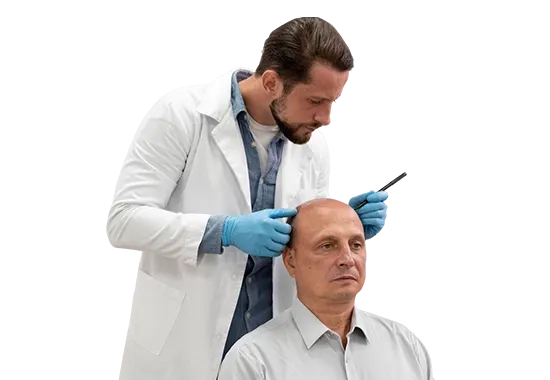
Hair transplant in Tunisia: the essentials
Follicles are taken from the donor area at the back and sides of the head, where hair is genetically resistant to loss, and placed where hair has gone. It redistributes the hair you have. It does not create new hair.
Scalp, beard and eyebrows are all treated. Eyebrows need no overnight stay at all.
Before the prices, read sections 2, 6 and 8. They are the three things that decide whether you are happy in two years, and they are the three that most clinics leave out.
Procedures take place at Myron International Clinic in Tunis, with English-speaking support throughout.
| Operating time | 6 to 8 hours scalp, 4 to 6 beard, 3 to 4 eyebrows |
| Anaesthetic | Local |
| Stay in Tunisia | 3 to 5 days; none for eyebrows |
| Back to work | 1 to 3 days |
| Final result | 12 to 18 months for the scalp |
| Price | From €2,400 scalp, €1,800 beard, €1,400 eyebrows |
Who actually performs your procedure?
If you have researched hair transplants in English, you have met this question whether you realised it or not. Ask it of every clinic you consider, including this one.
A hair transplant has three distinct stages: designing the hairline and assessing the donor area; extracting the follicular units; and creating the sites and placing the grafts. They require different skills and they are not always done by the same person.
In a significant part of the international market, a doctor designs the hairline and signs the file, and technicians do everything else — sometimes with very little supervision. That is the practice behind most of the hair transplant stories that reach the British press, and it is why the professional societies have campaigned on it for years.
It is not automatically wrong. Experienced technicians working under genuine medical supervision are standard in good clinics worldwide, and graft placement in particular is a skill built through repetition. What is wrong is not being told.
So ask, in writing, before you pay a deposit:
- Which stages does the doctor perform personally?
- Who extracts the grafts, and who places them?
- How many patients does the clinic operate on in a day?
- Will the doctor be present throughout my procedure?
A clinic that answers those four questions plainly is telling you how it works. One that answers vaguely, or redirects you to the price, is also telling you how it works.
How a hair transplant works
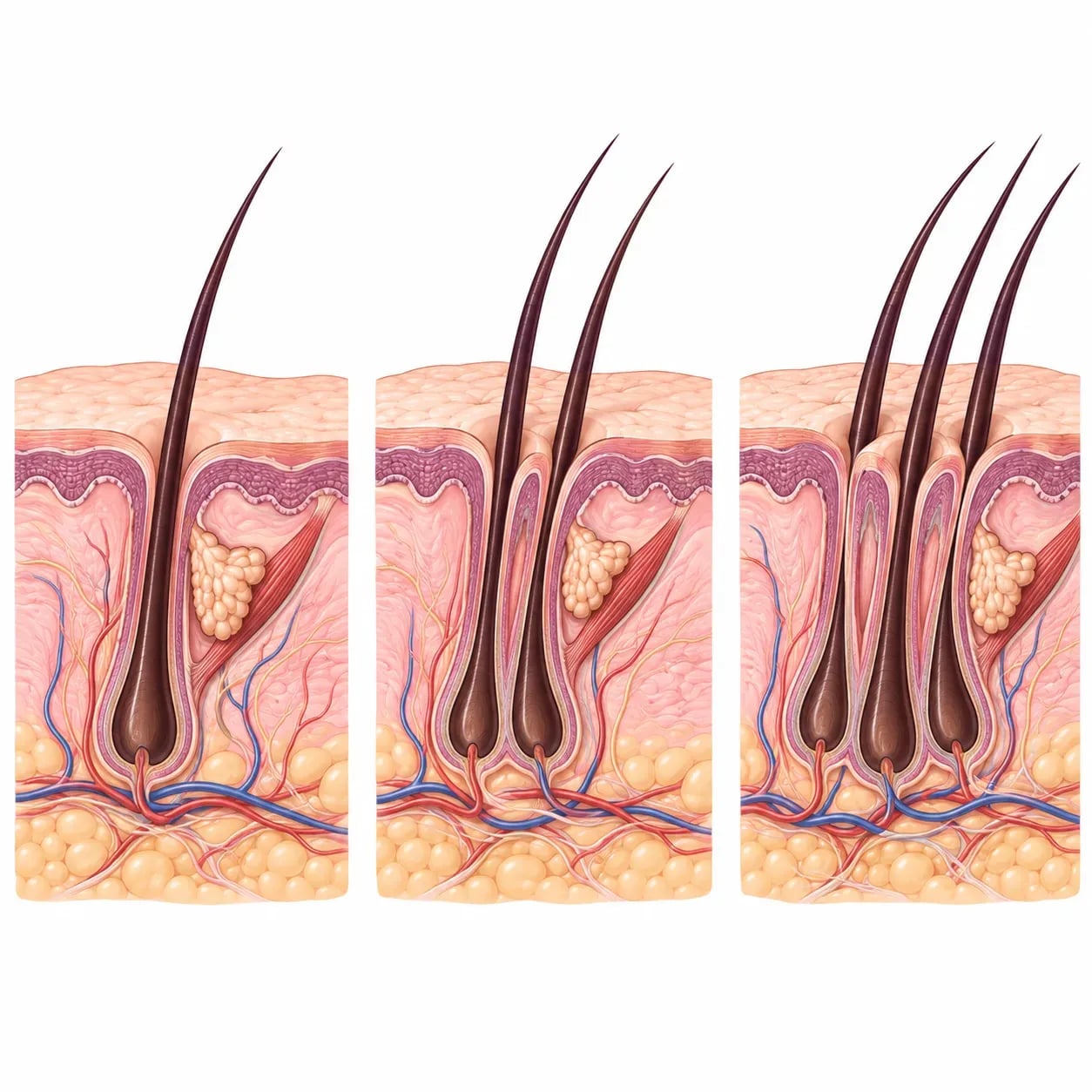
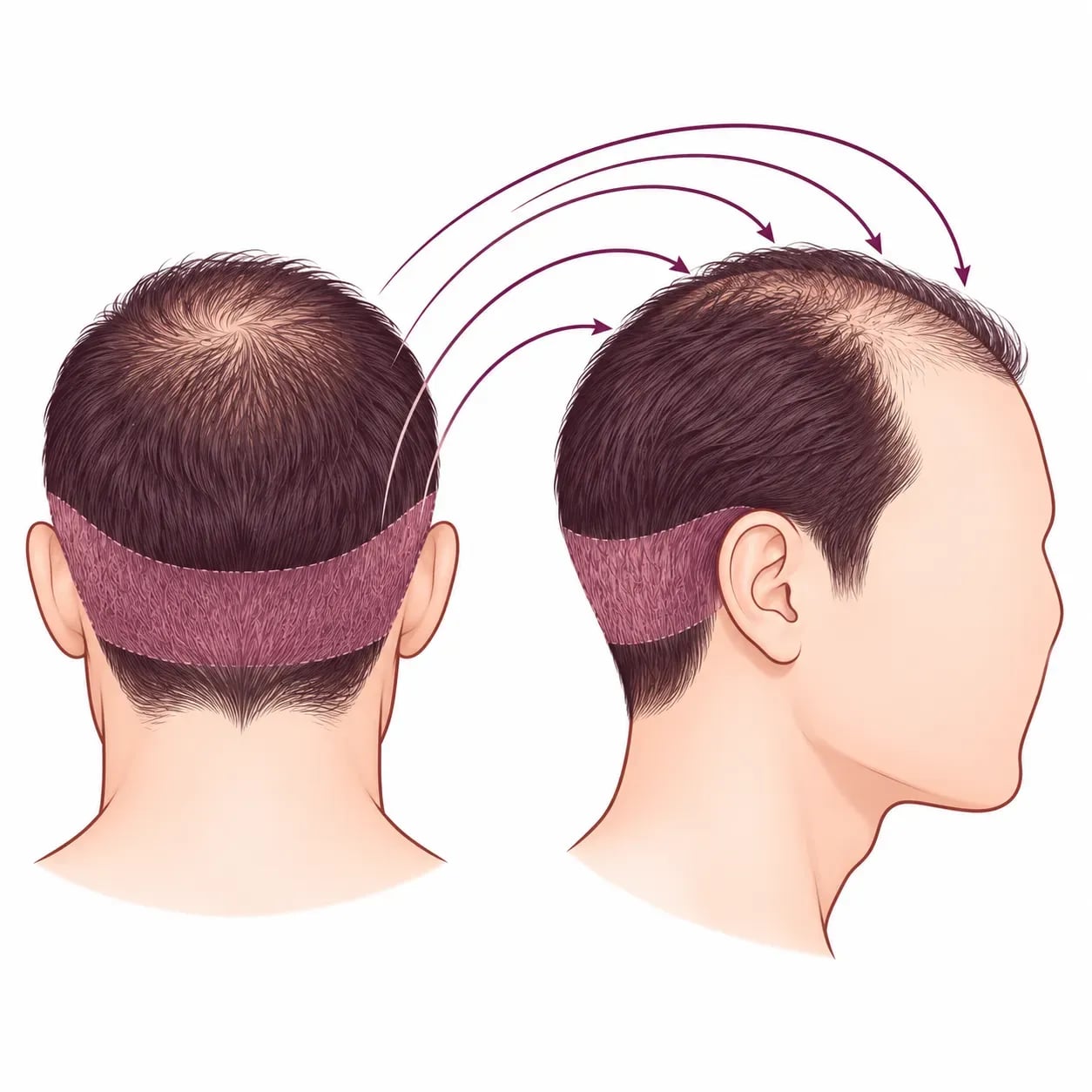
Follicular units are removed one by one from the donor area and reimplanted in the thinning zone. The transplanted follicles keep the genetic resistance of the area they came from, which is why they continue to grow where the original hair did not.
Nothing is created. The total amount of hair on your head does not increase; it is moved from where you have a surplus to where you have none. That single fact governs everything else on this page, including why the donor area matters so much.
The same principle applies to beard and eyebrow transplants, where the donor follicles usually come from the scalp.
A graft is not a hair
A graft — a follicular unit — contains 1 to 3 hairs. So 2,500 grafts is roughly 5,000 to 6,000 hairs.
This matters because some clinics quote in hairs rather than grafts, which makes a figure look two or three times larger than the equivalent quote elsewhere. Everything here is expressed in grafts.
When comparing any two quotes, confirm which unit each uses. It is the most common way hair transplant pricing is made to look better than it is.
And on density: a transplant aims for 30 to 45 grafts per cm², against 80 to 100 in undisturbed hair. The result is convincing coverage, not the density you had at twenty, and anyone promising the latter is promising something the donor supply cannot fund.
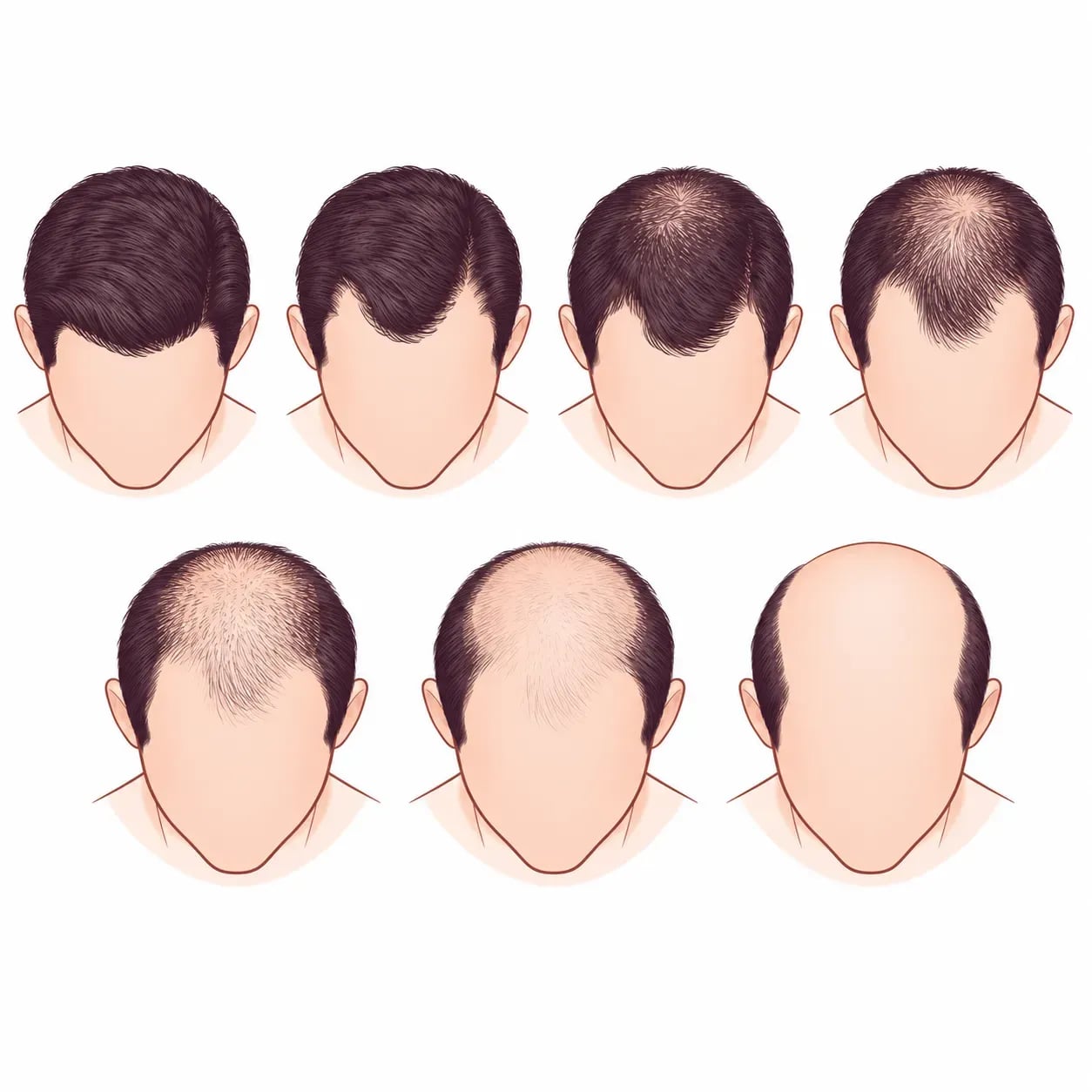
How many grafts? The Norwood scale
The Norwood scale runs from stage 1, an intact head of hair, to stage 7, extensive baldness. It is how hair loss is described clinically and it is worth knowing where you sit.
As a rough guide: 1,000 to 2,000 grafts for a limited area, 2,000 to 3,000 for a more advanced pattern, and more than 3,000 where the area is extensive.
The actual figure depends on the surface to be covered, the density of your donor area, your hair calibre, and the contrast between your hair and your scalp — fine dark hair on pale skin needs more grafts than thick hair on similar-toned skin to look equally full.
It is set by examination, not by a form. Send photographs of the top, the front, the crown and the back and you get a realistic estimate before you travel.
The donor area is finite, and « unlimited grafts » is not a thing
You have roughly 5,000 to 8,000 grafts that can be taken from your donor area across your entire lifetime. Not per session. In total.
The donor area does not regrow. A follicle moved to the front is gone from the back permanently.
Taking too many in one session permanently thins the donor area, and that damage shows: a back of the head that looks moth-eaten, visible when hair is cut short, and unfixable. It is one of the few genuinely irreversible outcomes in this field.
Which is why you should treat an offer of « unlimited grafts » as a warning. It is either marketing language with no content, or it describes a clinic willing to overharvest. Neither is what you want. The same applies to very large single sessions advertised as a selling point.
And it is why some supply should be left in reserve. Hair loss continues, and you may want a second procedure in ten years. A surgeon who uses everything available now is solving today's problem with tomorrow's resource.
If you are young, this section matters more than the price.
FUE or DHI?
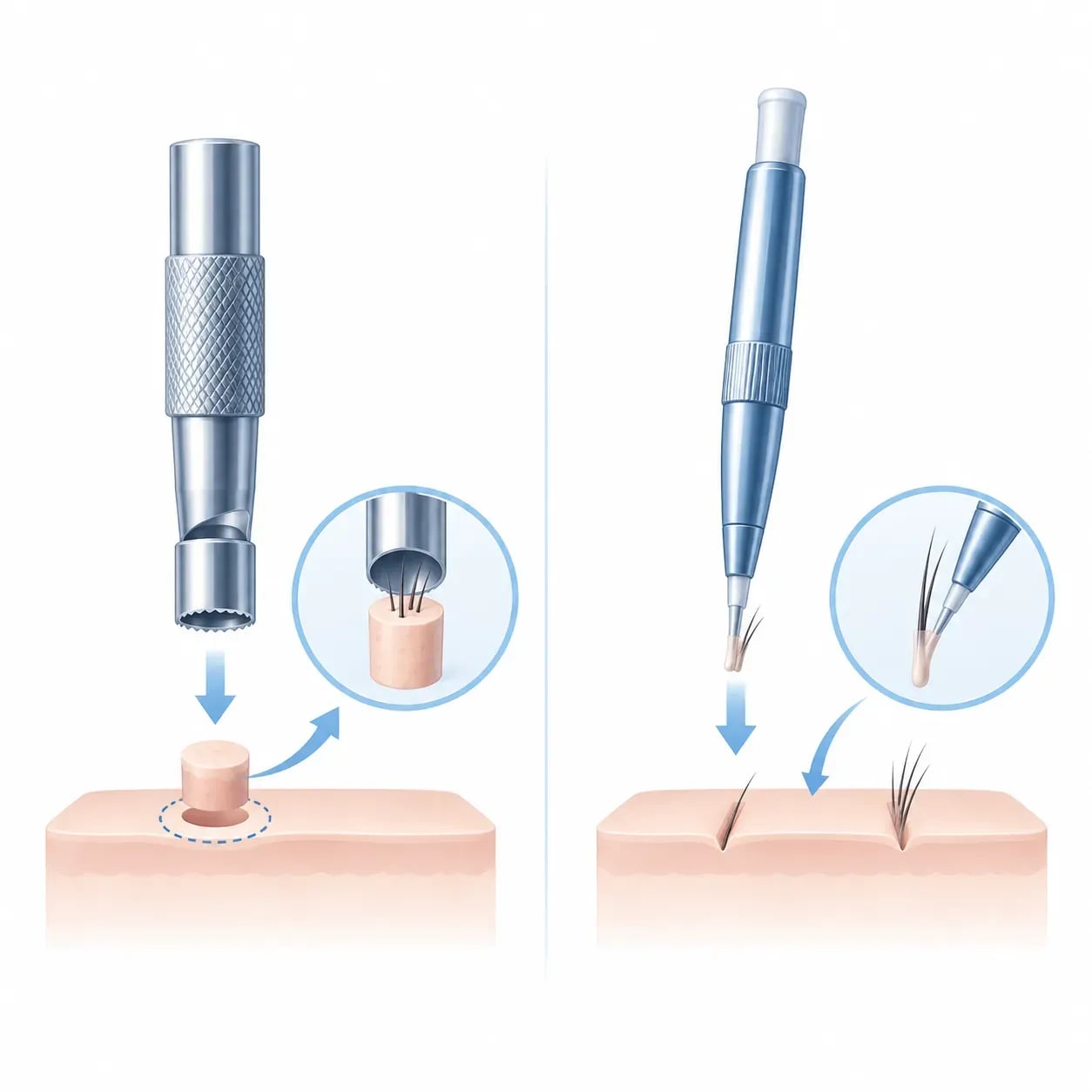
FUE — follicular unit extraction. Grafts are extracted, then the recipient sites are created, then the grafts are placed. Two distinct stages.
DHI — direct hair implantation. The graft is loaded into a pen-like implanter that creates the site and places the graft in one movement.
Neither is better in the abstract. DHI allows dense placement without shaving large areas and is often preferred for smaller zones and for women. FUE is efficient over large surfaces. The choice depends on the area, your hair, and whether shaving is acceptable to you.
A note on the marketing names. You will see « sapphire FUE », « micro FUE » and others. Most describe a variation in the blade or the tool rather than a different operation, and none of them substitutes for the two things that actually determine your result: the quality of the hairline design and the skill of whoever handles the grafts.
Both FUE and DHI are available here, on all three zones. Which is proposed is decided at the consultation.
What a transplant will not do
It does not stop your hair loss. This is the single most important sentence on this page and it is the one that causes the most regret when it is skipped.
A transplant moves resistant follicles into a bald area. The native hair around them carries on receding on its own schedule. Five years later you can have a transplanted zone that has worked perfectly, sitting in front of a gap where your own hair has gone since — which looks worse than either the before or the after.
That is why medical treatment to slow the underlying loss is part of the conversation, not an upsell. Some of it is prescription-only and is a matter for a doctor, in your own country or here, and it should be discussed before the transplant rather than after. Supportive treatments such as PRP and mesotherapy may also be proposed.
It is also why some donor supply should be kept in reserve, and why a second procedure years later is a normal part of the plan rather than a failure of the first.
If your hair loss has not yet stabilised, transplanting now means chasing it. The surgeon will say so.
Are you a candidate?
Two things are assessed, and both matter more than your age or your Norwood stage: the density of your donor area, and whether your hair loss has stabilised.
Reasons to wait:
- Hair loss that is still progressing rapidly, particularly if you are in your twenties. Transplanting an aggressively receding scalp means operating again, and again, and spending a finite donor supply on a moving target. Being told to come back in two years is the right answer, not a refusal.
- A donor area that is too thin to fund the coverage you want.
- Hair loss that is not pattern baldness — patchy loss, scarring, or sudden diffuse thinning needs a diagnosis before anything is transplanted.
For women, a medical workup is recommended first. Female hair loss has causes that are often treatable — thyroid, iron, hormonal — and those should be excluded before surgery is considered. Where a transplant is indicated, it is frequently possible without shaving.
Also declare: smoking, clotting disorders or anticoagulant treatment, any scalp condition, and any previous transplant including where and when.
What it costs
| Procedure | Price | Stay |
| Scalp, 2,000 to 2,500 grafts | €2,400 | 3 days |
| Scalp, more than 2,500 grafts | €2,800 | 5 days |
| Beard | €1,800 | 3 days |
| Eyebrows | €1,400 | None — same day |
Priced by band, not per graft. That means the figure does not climb as the count does within a band, and you are not negotiating per follicle on the day. Under 2,000 grafts is quoted individually.
Included: the consultation, the procedure, the local anaesthetic, airport transfers, the first wash and the aftercare instructions.
Not included: flights, and any medical treatment for the underlying hair loss.
Comparing quotes: check whether the other figure is in grafts or hairs, whether it is a band or per-graft, whether the first wash and follow-up are inside it, and how many patients the clinic takes in a day. Those four questions explain most of the price differences you will see.
All prices are on the prices page, and a quote reaches you within 24 to 48 hours of sending photographs.
| Procedure | Price | Stay |
|---|---|---|
| Hair Transplant (2,000 to 2,500 Grafts) | €2,400 | 3 days |
| Hair Transplant (More Than 2,500 Grafts) | €2,800 | 5 days |
| Beard Transplant | €1,800 | 3 days |
| Eyebrow Transplant | €1,400 | No stay required |
Beard transplant
€1,800, over a 3-day stay, 4 to 6 hours.
Follicles are taken from the scalp and placed along a design that follows the natural direction of beard growth — which is what separates a beard transplant that reads as a beard from one that reads as implanted hair. The angle matters more here than almost anywhere else.
It fills patchy areas, defines the jawline and cheek line, and covers scars.
Final result at 10 to 12 months, with the same shedding phase as a scalp transplant in the first weeks.
Eyebrow transplant
€1,400, in a single day, with no overnight stay. Three to four hours. It is the only hair transplant here that needs no stay at all, which makes it straightforward to add to a trip you are already making.
Follicles come from behind the ear or from an area of finer scalp hair, and are placed at the very flat angle eyebrow hair grows at.
One thing to know: transplanted eyebrow hair keeps the growth behaviour of the hair it came from, so it keeps growing and needs trimming. That is normal and permanent.
Final result at 8 to 10 months.
Your pathway, step by step
- Get in touch from home. Photographs of the top, front, crown and back in natural light, your history of hair loss and how fast it has moved, and any treatment you are on. An estimate of grafts and a quote come back within 24 to 48 hours.
- Ask the four questions in section 2, and get the answers in writing.
- Preparation. Blood tests, stop smoking, no alcohol or aspirin in the days before. Our preparation guide covers what applies to every procedure.
- Arrival and transfer.
- Consultation: scalp analysis, donor density measured, and the hairline designed and agreed with you before anything begins. Look at it in a mirror and say so if it is too low or too straight.
- The procedure, under local anaesthetic.
- The first wash, done for you, with the technique shown so you can repeat it.
- Home, with written aftercare and remote follow-up through the regrowth.
On the hairline design: it is the one decision you cannot revisit. A hairline placed too low looks fine at thirty-five and wrong at fifty, and it spends donor supply you will want later. A surgeon proposing something more conservative than you had in mind is protecting you.
The shedding before the regrowth
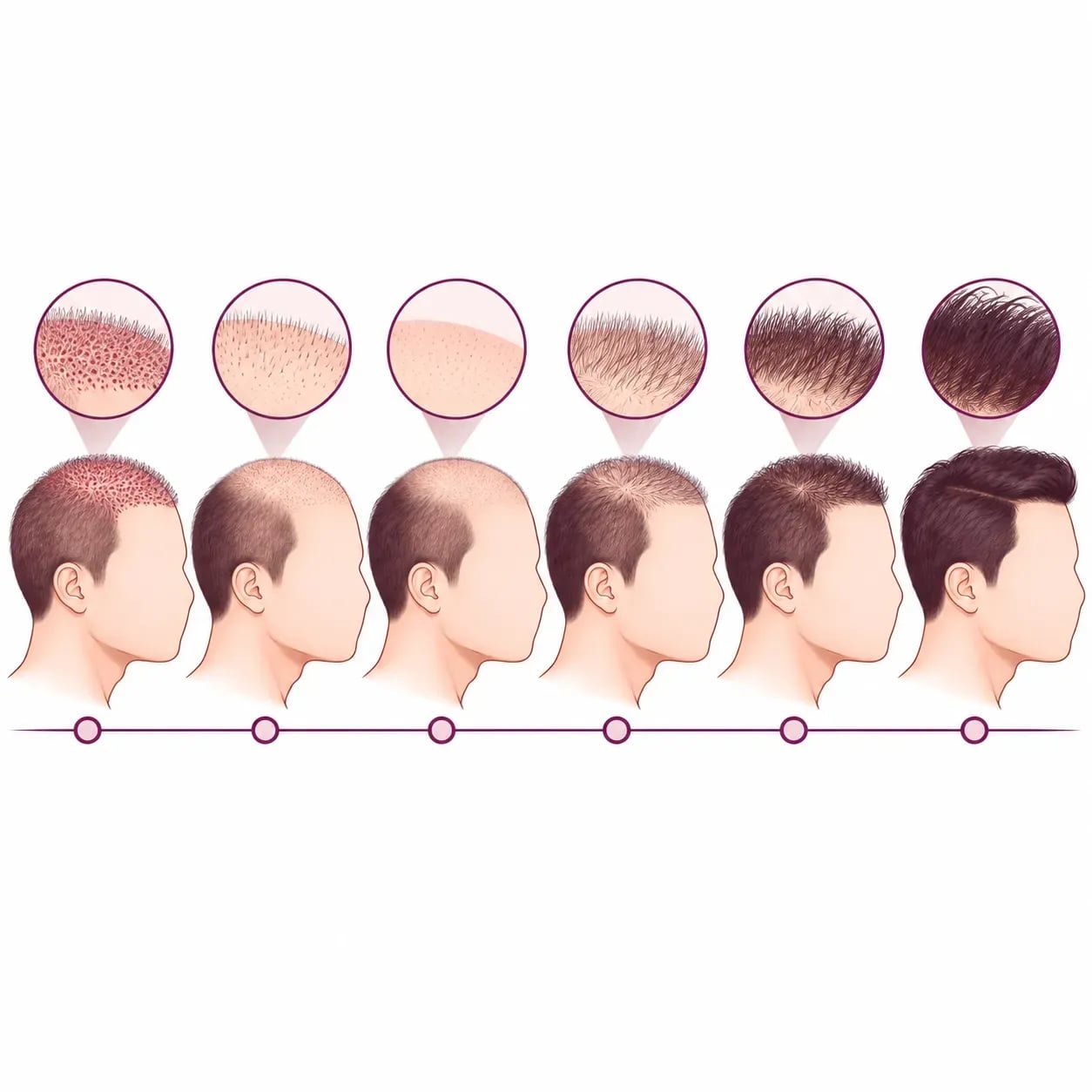
Between weeks 2 and 4, the transplanted hairs fall out. All of them, more or less.
This is normal and it is expected. It is called shock loss or effluvium: the hair shaft is shed while the follicle, which is what was actually transplanted, stays in place and enters a resting phase.
It is also the point at which people panic, conclude the procedure has failed, and contact us convinced something has gone wrong. Nothing has. Knowing the timetable in advance is the entire remedy, which is why it is on this page rather than buried in an aftercare leaflet.
Regrowth begins from month 3.
Aftercare
Sleep semi-upright for the first nights, which limits swelling.
Washing exactly as shown. The first wash is done for you before you leave, and the technique is demonstrated so you can repeat it at home. This is not the moment to improvise.
Crusts form over the first ten days and come away on their own. Do not pick them. A crust removed early can take the graft with it.
Itching is common as healing progresses. Do not scratch.
Swelling of the forehead in the first days is usual and settles.
No cap for ten days. A loose hood that does not touch the grafts is acceptable. This catches people out, so plan around it.
No sport, swimming, sauna or sun exposure for a month.
Back to work after 1 to 3 days, bearing in mind the area is visibly red in the first week.

The flight home
No cap. Nothing on your head, and nothing touching the grafts — not the headrest, not a hood pulled forward, not a neck pillow riding up.
Cabin air is very dry, which is uncomfortable on a freshly operated scalp. Drink water.
Avoid direct sun through the window and on the way to and from the airport.
From the Gulf the flight is six to seven hours, which is a long time being careful about your head. Book an aisle seat and give yourself room.
Month by month: what to expect
| When | What happens |
| Days 1 to 10 | Crusts form and come away. Redness. |
| Weeks 2 to 4 | The transplanted hairs shed. Expected. |
| Months 3 to 4 | First regrowth, fine and sparse. |
| Months 5 to 6 | Around half the final result. |
| Months 8 to 10 | Eyebrows final. |
| Months 10 to 12 | Beard final. |
| Months 12 to 18 | Scalp final: density and texture settled. |
Eighteen months is a long time to wait and it is the real timetable. Judging the result at six months, when half of it is there and the new hair is still fine, is the most common reason people are prematurely disappointed.
Your doctor
Dr Marwen Guesmi is the doctor responsible for hair surgery at Myron International Clinic, working in both FUE and DHI across the scalp, beard and eyebrows.
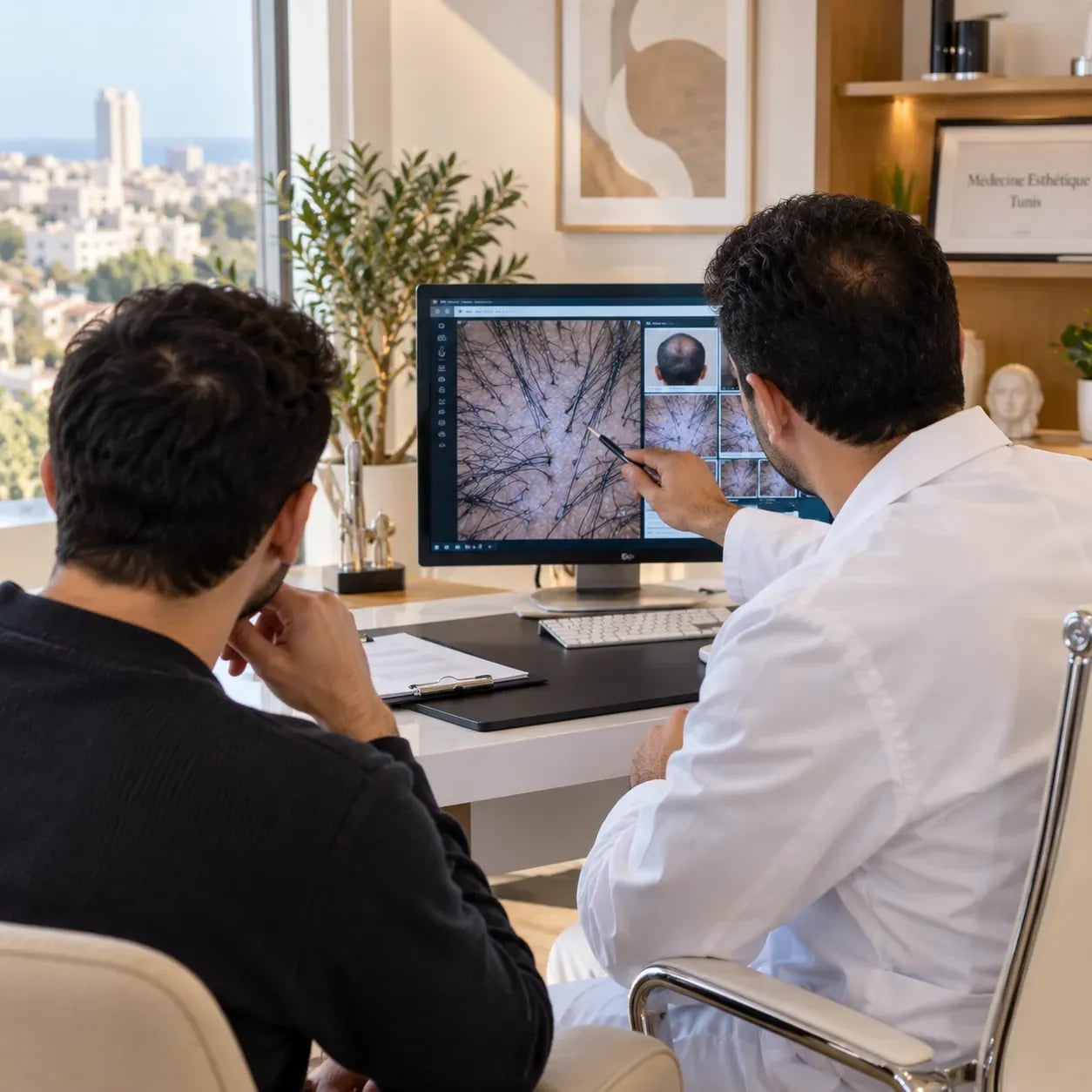
He analyses the scalp, measures the density of your donor area, and designs the hairline with you.
Use the consultation on the two things that decide your result: the hairline design, which you should look at and challenge before anything starts, and how many grafts will be taken against how many you have in total. Those are the questions worth your time.
Getting here, and before you travel
From the UK and Ireland: around three hours from London, with connections from other UK and Irish airports. From the Gulf: daily flights from Dubai, around six and a half to seven hours, and from Doha, around six. From continental Europe: 1h30 to 3h from Paris, Brussels, Geneva, Lyon and Marseille, with no visa for EU and Swiss nationals. From West and Central Africa: regular connections from Dakar, Abidjan, Douala, Libreville and Casablanca.
Entry requirements follow your nationality, not your country of residence. A resident of Dubai or London holding an Indian, Pakistani, Nigerian or Filipino passport does not have the same conditions as a British or Emirati national, and a residence permit changes nothing. Check with the Tunisian embassy for your country of citizenship before booking.
Your checklist:
- The four questions in section 2, answered in writing. Before the deposit.
- Documents: a passport valid well beyond your return date, and a visa if your nationality requires one.
- Photographs of the top, front, crown and back, in natural light, dry hair, no product.
- Your hair loss history: when it started, how fast it has moved, and whether anyone in your family went the same way.
- Any previous transplant — where, when, how many grafts.
- Blood tests as requested.
- Your medication and allergies, including anything you take for hair loss.
- Stop smoking, and no alcohol or aspirin in the days before.
- A loose, front-opening top for the journey home. Nothing goes over your head.
- No cap for ten days — plan your return and your first week at work around being visibly red.
How long each procedure needs is in our guide to lengths of stay. Request a quote and you will have an answer within 24 to 48 hours.








Breast Augmentation
I had my surgery with ServiHealth, and I highly recommend their services. The team was very professional, and I'm extremely satisfied with my experience. ServiHealth offers various breast surgery procedures, including breast augmentation and breast reduction, to meet different needs.

Cam Naf
FranceFrequently asked questions about Hair Transplant in Tunisia
€2,400 for 2,000 to 2,500 grafts over a 3-day stay, and €2,800 for more than 2,500 grafts over 5 days. A beard transplant is €1,800 over 3 days and an eyebrow transplant is €1,400 in a single day with no overnight stay. Under 2,000 grafts is quoted individually. Prices are by band rather than per graft.
€2,400 for 2,000 to 2,500 grafts over a 3-day stay, and €2,800 for more than 2,500 grafts over 5 days. A beard transplant is €1,800 over 3 days and an eyebrow transplant is €1,400 in a single day with no overnight stay. Under 2,000 grafts is quoted individually. Prices are by band rather than per graft.
Roughly 1,000 to 2,000 for a limited area, 2,000 to 3,000 for a more advanced pattern, and more than 3,000 where the area is extensive. It depends on the surface to be covered, your donor density, your hair calibre, and the contrast between your hair and your scalp. It is set by examination, and photographs of the top, front, crown and back give you a realistic estimate before travelling.
Roughly 1,000 to 2,000 for a limited area, 2,000 to 3,000 for a more advanced pattern, and more than 3,000 where the area is extensive. It depends on the surface to be covered, your donor density, your hair calibre, and the contrast between your hair and your scalp. It is set by examination, and photographs of the top, front, crown and back give you a realistic estimate before travelling.
No. You have roughly 5,000 to 8,000 grafts that can be taken across your entire lifetime — in total, not per session — and a follicle moved to the front is gone from the back permanently. Taking too many in one session permanently thins the donor area, which shows as a moth-eaten look when hair is cut short and cannot be fixed.
Treat it as a warning. The donor area is finite, so unlimited grafts is either marketing language with no content or a clinic willing to overharvest. The same applies to very large single sessions advertised as a selling point. Some supply should also be left in reserve, because hair loss continues and you may want a second procedure in ten years.
No, and this is the most important thing on this page. A transplant moves resistant follicles into a bald area; the native hair around them carries on receding. Five years later you can have a transplanted zone that worked perfectly sitting in front of a gap where your own hair has gone since. Medical treatment to slow the underlying loss should be discussed with a doctor before the transplant rather than after.
Yes, and it happens to almost everyone between weeks 2 and 4. It is called shock loss or effluvium: the hair shaft is shed while the follicle, which is what was transplanted, stays in place and rests. Regrowth begins from month 3. This is the point at which people conclude the procedure has failed, and nothing has gone wrong.
Months 12 to 18 for the scalp, 10 to 12 for a beard, and 8 to 10 for eyebrows. Around half the result is visible at months 5 to 6. Judging it at six months, when the new hair is still fine, is the most common reason people are prematurely disappointed.
With FUE the grafts are extracted, then the recipient sites are created, then the grafts are placed — two distinct stages. With DHI the graft is loaded into a pen-like implanter that creates the site and places the graft in one movement. Neither is better in the abstract: DHI allows dense placement without shaving large areas and is often preferred for smaller zones and for women, while FUE is efficient over large surfaces.
Most of these describe a variation in the blade or the tool rather than a different operation. None of them substitutes for the two things that actually determine your result: the quality of the hairline design and the skill of whoever handles the grafts.
No. A transplant aims for 30 to 45 grafts per cm² against 80 to 100 in undisturbed hair. The result is convincing coverage rather than the density you had at twenty, and anyone promising the latter is promising something the donor supply cannot fund.
What matters is whether your hair loss has stabilised and how dense your donor area is, far more than your age. But transplanting an aggressively receding scalp in your twenties means operating again and again, and spending a finite donor supply on a moving target. Being told to come back in two years is the right answer rather than a refusal.
Small punctate scars in the donor area, not a linear scar. They are not visible unless the head is shaved very short, which is worth bearing in mind if you wear your hair extremely short or might want to.
It is done under local anaesthetic, and the injections are the part you feel. Afterwards, sensitivity and numbness in the treated areas are possible for a while.
Three days for 2,000 to 2,500 grafts, five days for more than 2,500, three days for a beard, and no overnight stay at all for eyebrows.
Not for ten days. A loose hood that does not touch the grafts is acceptable in the meantime. This catches people out, so plan your return and your first week at work around it — the area is visibly red in the first week.
One month for sport, swimming, sauna and sun exposure. Work resumes after 1 to 3 days.
Yes, and a medical workup is recommended first. Female hair loss has causes that are often treatable — thyroid, iron, hormonal — and those should be excluded before surgery is considered. Where a transplant is indicated it is frequently possible without shaving.
Usually the scalp, and for eyebrows sometimes from behind the ear or an area of finer hair. Transplanted eyebrow hair keeps the growth behaviour of the hair it came from, so it continues to grow and needs trimming. That is normal and permanent.
Sometimes, either to increase density or because hair loss has progressed elsewhere. That is a normal part of the plan rather than a failure of the first procedure, and it is one of the reasons some donor supply should be kept in reserve.
Whether the figure is in grafts or hairs, whether it is a band price or per graft, whether the first wash and follow-up are included, and how many patients the clinic operates on in a day. Those four questions explain most of the price differences you will see.