

Gynaecomastia Surgery in Tunisia: Price, Technique and Results
Gynaecomastia surgery in Tunisia: the essentials
Gynaecomastia — spelled gynecomastia in American English — is enlargement of the male breast. It affects a great many men, it is not a reflection of fitness or discipline, and in most cases diet and training do nothing about it, for a reason explained in the next section.
Surgery removes the glandular tissue, the excess fat, or both, usually through a small incision at the edge of the areola.
If the fullness is purely fat and you are carrying weight generally, read section 2 first — liposuction or weight loss may be the whole answer.
It is performed by Dr Taher Djemal and Dr Abir Ben Ouaghrem at Myron International Clinic in Tunis, with English-speaking support throughout.
| Operating time | 1 to 2 hours |
| Anaesthetic | General |
| Stay in Tunisia | 3 days |
| Compression vest | 4 to 6 weeks, continuously |
| Back to work | About 1 week |
| Final result | 6 to 12 months |
| Price | €1,850 |
True gynaecomastia, or is it fat?
This is the distinction that explains why the gym has not worked, and it determines everything about the operation.
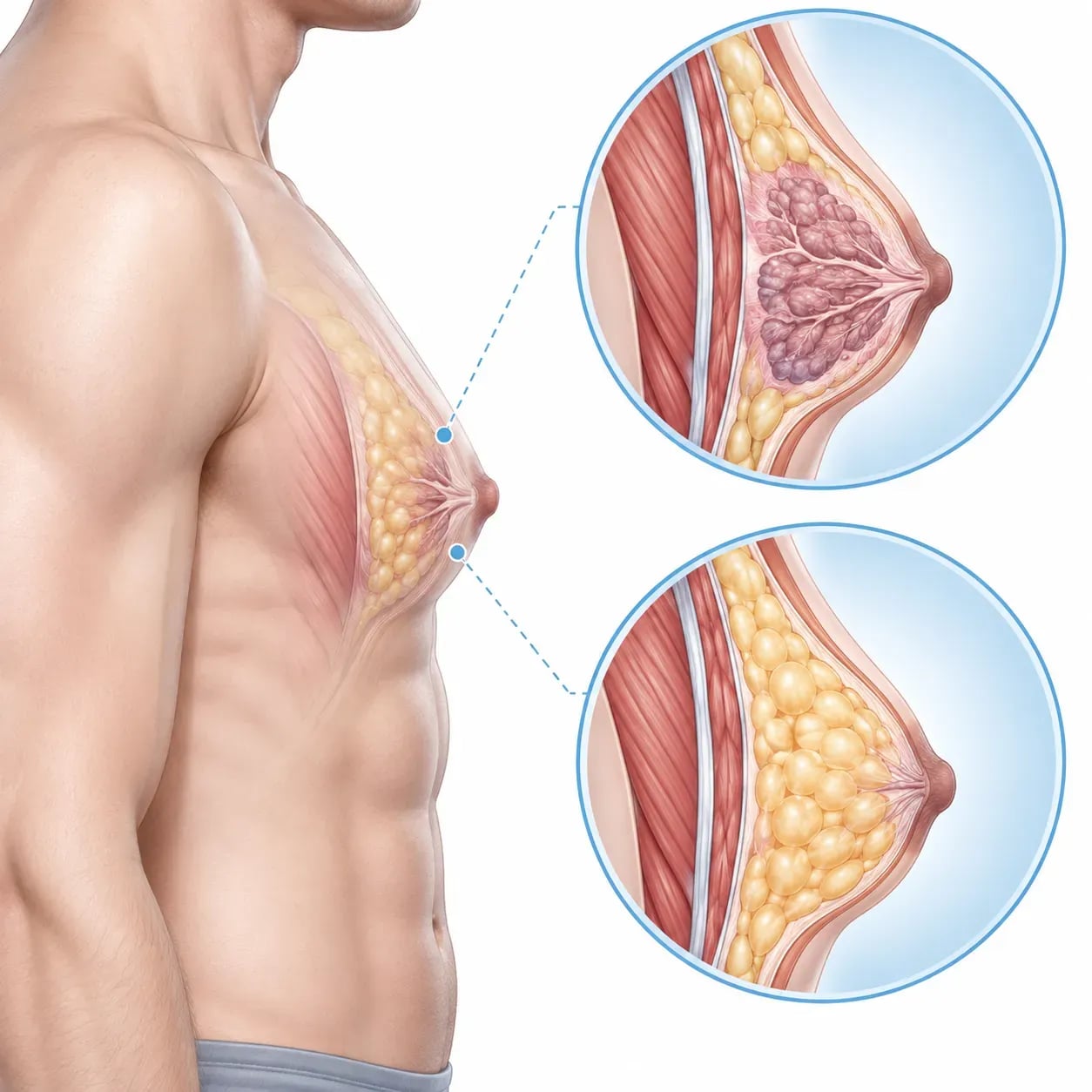
True gynaecomastia is growth of the glandular tissue itself. It feels firm, sometimes tender, and it is concentrated behind and around the areola rather than spread across the chest. Glandular tissue does not respond to diet or exercise. You can get genuinely lean and still have it, which is exactly what brings most men to this page after years of training.
Pseudogynaecomastia — also called adipomastia — is excess fat, usually alongside general excess weight. It is soft and diffuse. It does respond to weight loss, and to liposuction.
Mixed cases are the most common of all, in varying proportions.
Why it matters practically: if it is fat, surgery may not be the first answer. If it is glandular, no amount of training will touch it and you can stop blaming yourself for that. The surgeon establishes which by examining you, and photographs alone cannot settle it.
Before operating: find out why
Gynaecomastia is a sign, not just a shape. Several of its causes are treatable, and one is serious. This is why a blood test, and sometimes an ultrasound, come before any decision.
Hormonal causes. An imbalance between oestrogen and testosterone, from a testicular or pituitary problem among others. Treating the cause sometimes resolves the gynaecomastia without surgery.
Medication. A number of commonly prescribed drugs can cause it — among them certain cardiac, urological and psychiatric treatments. Bring a complete list of everything you take, including anything from a pharmacy without a prescription. Where a medicine is responsible, your own doctor may be able to change it.
Anabolic steroids and cannabis, covered in the next section.
Liver and thyroid conditions, which the blood work also looks at.
And the one to take seriously. Male breast cancer is rare, but it exists, and the workup exists partly to exclude it. Tell us without waiting — and see a doctor where you live before travelling — if you have a lump on one side only that feels hard or fixed, any discharge from the nipple, a nipple that has pulled inward, skin dimpling or ulceration, or a lump in the armpit. None of those is typical of ordinary gynaecomastia and none should be assumed to be cosmetic. This is not a reason to be alarmed; it is a reason to be checked first rather than operated on first.
Significant excess weight is also addressed before surgery, because losing it changes what is left to treat. If weight is the larger issue, a conversation with Dr Sofiene Ayadi about a sleeve may come before anything else.
Anabolic steroids: the one that matters most
If you use or have used anabolic steroids, say so at the first contact. It will not change how you are treated and it changes the plan entirely.
Steroid-induced gynaecomastia is common in the gym-going population, and it is the most frequent cause of recurrence after surgery — and the one that is entirely avoidable.
Operating on someone who is still using means operating again. The gland regrows. The money and the recovery are spent twice.
Stopping sometimes produces partial regression on its own, particularly if the gynaecomastia is recent. Where it is established, it does not go on its own and surgery is the reliable answer — but only once use has stopped, and stopped for good.
This is a medical conversation, not a moral one. Nobody is going to lecture you, and withholding it only costs you a second operation.
Liposuction, excision, or both?
Liposuction alone where the excess is mainly fat. Small incisions, minimal scarring, and it also addresses the surrounding chest contour.
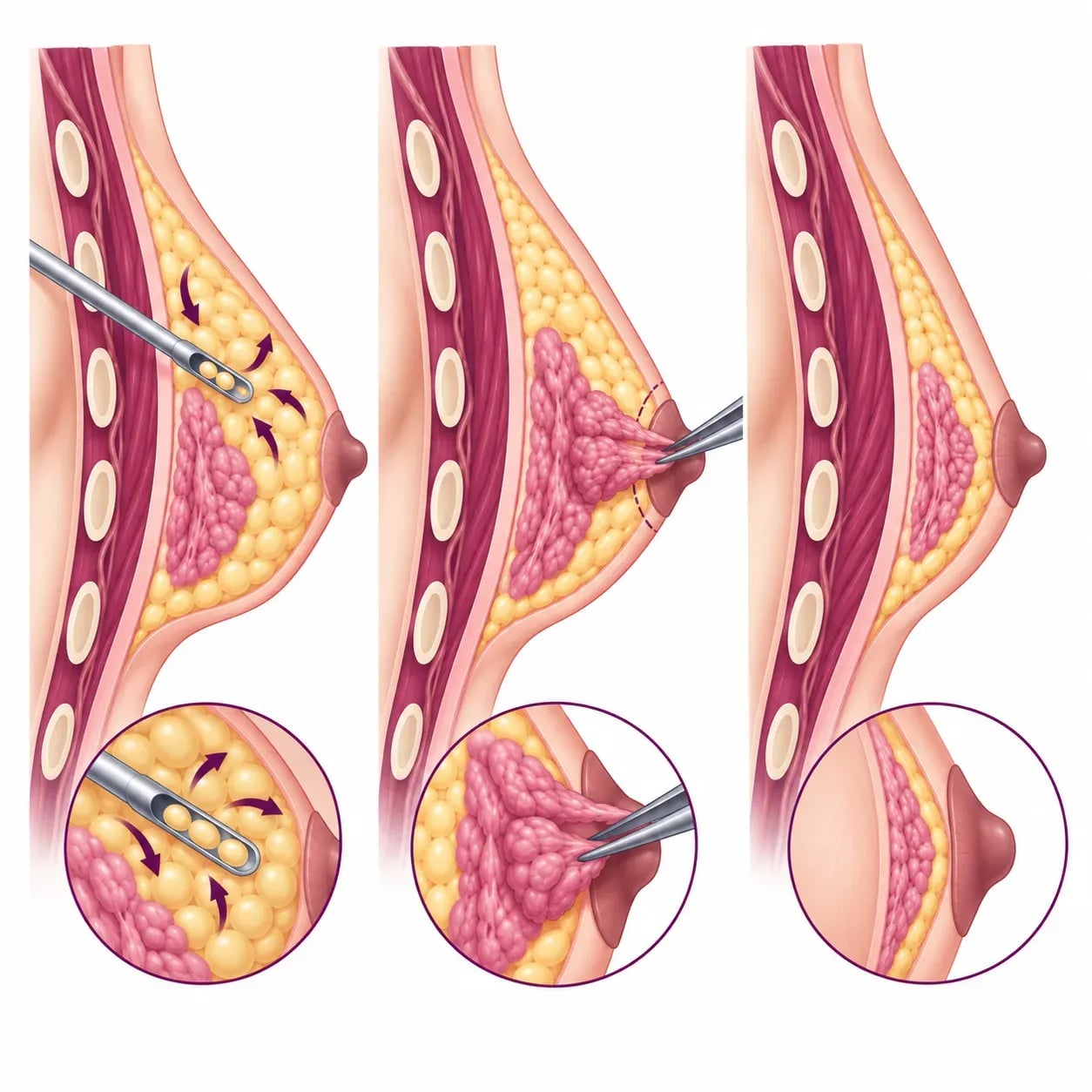
Surgical excision where glandular tissue is developed. The gland is firm and fibrous and liposuction does not remove it — it has to be cut out, through an incision at the edge of the areola.
Both together in mixed cases, which are the majority: the gland excised, the surrounding fat suctioned so the chest blends rather than leaving a flat patch in a fuller chest.
VASER and J-Plasma may be used on the liposuction side depending on your skin and the volume treated. Which technique is used is decided at the consultation, on examination.
Never remove the whole gland
This is the detail that separates a good result from one that is worse than the starting point, and it is counter-intuitive.
A thin layer of glandular tissue is deliberately left behind the areola. Taking everything out leaves the areola sitting directly on the chest wall with nothing beneath it, which produces a visible dish or crater where the breast was.
That deformity is difficult to correct afterwards — it generally means fat grafting to rebuild what was removed, and the result is never as good as not having done it.
So if your expectation is total removal, understand that the aim is a flat, natural male chest contour, not an empty one. A surgeon who agrees to take everything is agreeing to something you will regret.
Where the scar goes
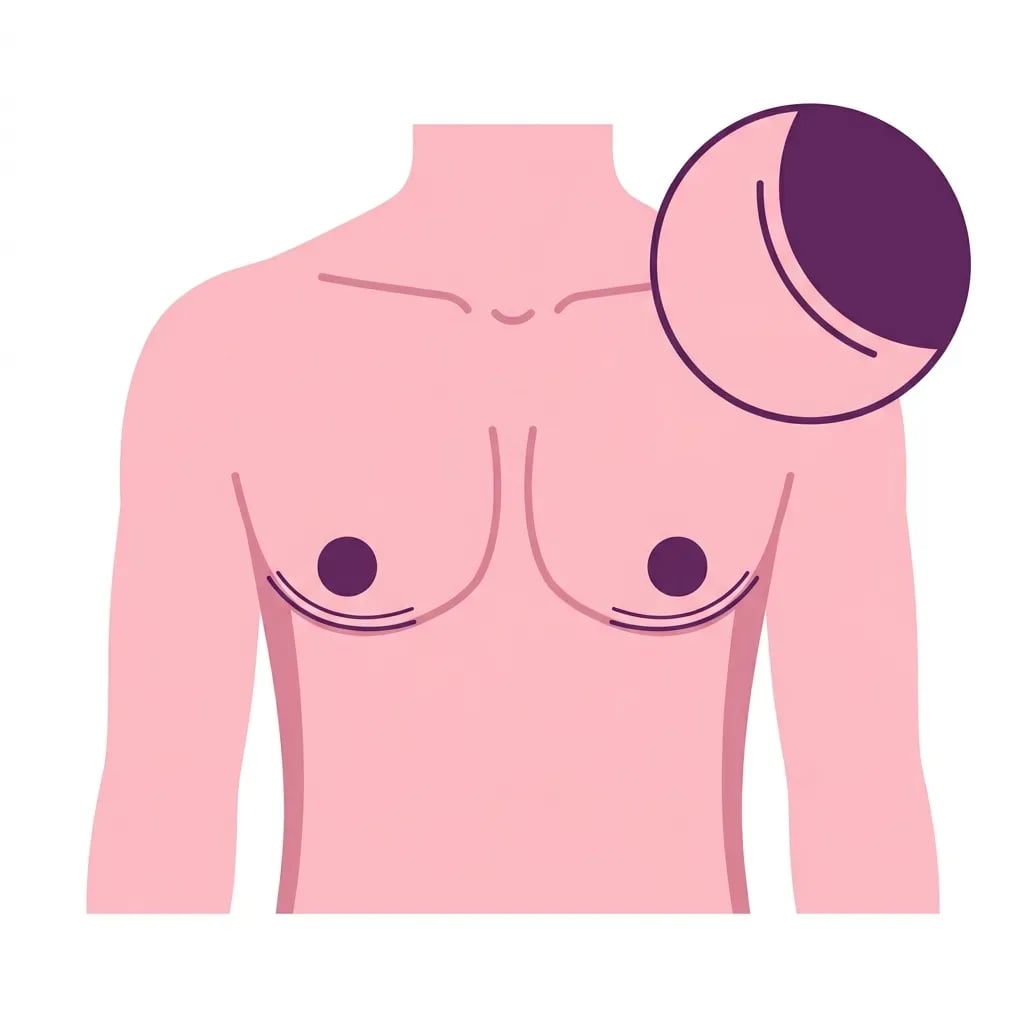
In most cases, at the lower edge of the areola, where the colour change hides it. It fades over the following months and is generally difficult to see.
Where there is significant excess skin — usually after major weight loss, or in long-standing severe cases — more skin has to be removed and the scarring is correspondingly longer and more visible. There is no way around that, and the surgeon will show you where the scars would fall before you decide.
If that applies to you, ask specifically at the consultation. It is better to see the trade-off drawn on your own chest than to discover it afterwards.
Gynaecomastia in teenagers
It is common in adolescence and it frequently resolves on its own. Hormonal change during puberty causes temporary glandular development in a large proportion of boys, and in most of them it settles within one to two years without any treatment.
Operating too early is a real mistake. While hormonal development is still under way the gynaecomastia can still change, and surgery performed during that period may need redoing.
What is worth doing is a consultation, even if the answer is to wait. It establishes that nothing else is going on, gives a timeframe, and — this matters more than it sounds — tells a teenager who is miserable about it that it is recognised, common, and likely to pass.
To parents: the psychological weight of this at fifteen is not trivial and should not be dismissed. Being taken seriously and told it will probably resolve is itself worth the appointment.
Are you a candidate?
Surgery suits an adult at a stable weight, with established gynaecomastia, in good general health, where the cause has been looked for.
Reasons to postpone:
- Anabolic steroid use that has not stopped. Non-negotiable.
- Hormonal development still ongoing in an adolescent.
- Significant excess weight not yet addressed — losing it changes what remains to treat.
- A treatable cause not yet investigated, including a medication that could be changed.
- Anything suspicious as described above, which needs a diagnosis first.
- Current smoking, a clotting disorder, or anything contraindicating general anaesthesia.
There is no upper age limit. Men have this done at every age, and a good proportion of patients are in their forties and fifties having lived with it since adolescence.
What it costs, and will the NHS pay?
€1,850, for a 3-day stay.
Included: the surgeon's and anaesthetist's fees, the consultation, the operation, the anaesthetic, the hospital stay, your compression vest, hotel accommodation, airport transfers and follow-up.
Not included: flights, the pre-operative tests you have done at home, and a second compression vest — buy one before you travel so you can alternate while the other is washed.
| Procedure | Price | Stay |
| Gynaecomastia surgery | €1,850 | 3 days |
| Liposuction, 1 area | €1,700 | Short stay |
| Liposuction, 2 to 3 areas | €2,250 | Short stay |
On funding at home. In some European countries, documented true gynaecomastia can be covered. In the UK, NHS funding is restricted and granted only in limited circumstances; cosmetic cases are not funded, and nothing performed abroad is funded anywhere.
If you think you might qualify at home, find out before paying privately — here or anywhere. It costs you a GP appointment and it is worth the question.
All prices are on the prices page, and a personalised quote reaches you within 24 to 48 hours.
| Procedure | Price | Stay |
|---|---|---|
| Gynecomastia Surgery (Male Breast Reduction) | €1,850 | 3 days |
Your pathway, step by step
- Get in touch from home. Photographs from the front and both sides, arms down and arms raised; how long you have had it; a complete list of your medication; and whether you have used anabolic steroids. A quote comes back within 24 to 48 hours.
- Investigations. Hormonal blood tests, and an ultrasound where indicated, done at home.
- Preparation. Pre-operative tests around fifteen days before, stop smoking several weeks beforehand, and buy a second compression vest. Our preparation guide covers what applies to every procedure.
- Arrival. You are met at Tunis-Carthage and transferred.
- Consultation with the surgeon and the anaesthetist, confirming glandular, fatty or mixed, and the technique.
- The operation, 1 to 2 hours under general anaesthetic.
- Convalescence in Tunisia, with the vest fitted and a check before you fly.
- Home, with remote follow-up.
Risks
Common to any surgery: haematoma, infection, healing problems, and the risks of general anaesthesia.
Change in nipple sensation, most often temporary.
The aesthetic risks, which are the ones that matter here:
- A dished or cratered areola from removing too much gland — the one described above, and the hardest to correct.
- Asymmetry. The two sides are assessed and treated separately because they are rarely identical to begin with.
- Residual fullness, where too little has been removed.
What reduces all of them: establishing glandular versus fatty before operating, leaving a layer behind the areola, treating each side on its own merits, and blending the edges into the surrounding chest.
Contact us without waiting if you have a fever, increasing pain, one side suddenly swollen or firm, spreading redness, or any discharge from the wound.
Recovery and the compression vest
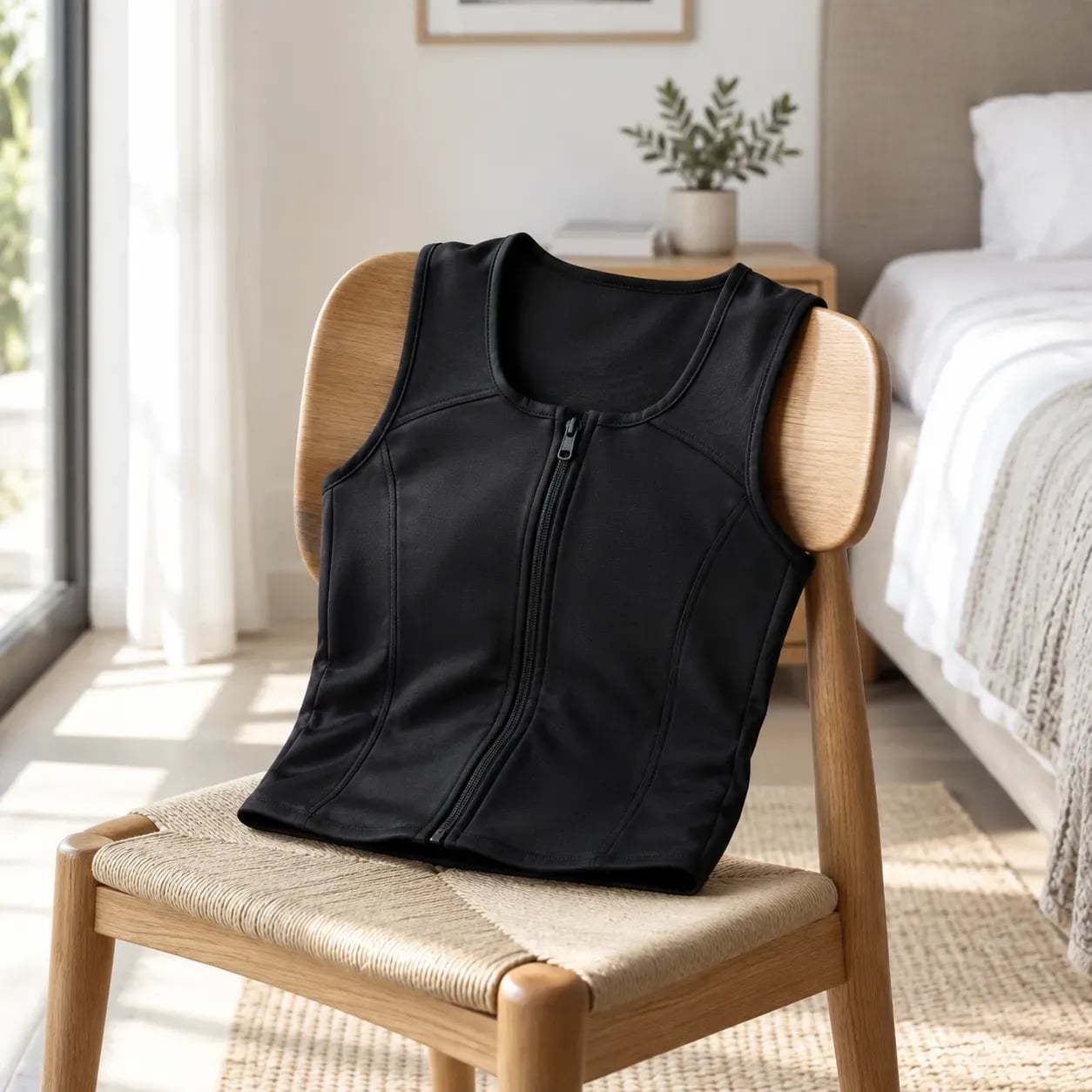
The compression vest is worn continuously for 4 to 6 weeks. Not most of the time — continuously, including at night.
It does real work: it controls swelling, holds the tissue against the chest wall while it heals, and is a significant part of how flat the final contour is. Buy a second one before you travel so you are never without it while one is being washed. One is provided; the alternate is on you.
It is worn under clothing and is not visible.
Tightness and aching in the first days, well managed with the prescribed painkillers.
Back to non-physical work after about a week.
No training for 4 to 6 weeks, on your surgeon's advice. Chest work comes back last, and pushing it early is the most common way men compromise their own result.
The final result at 6 to 12 months. Swelling has to resolve completely before the contour is real, and the chest looks firmer and less defined for the first months than it eventually will.
Can it come back?
Yes, in three situations, and two of them are in your control.
Resuming anabolic steroids. The most frequent cause of recurrence, and completely avoidable.
An underlying hormonal cause that was never treated. Which is the argument for investigating properly before surgery rather than going straight to the operation.
Significant weight gain, which brings back the fatty component.
Absent those, the glandular tissue that has been removed does not grow back. The result is durable.
The part nobody puts on a price list
Men live with this for years, often from adolescence. They stop swimming, they do not take their shirt off on a beach, they choose what they wear around it, and they rarely talk about it — including to a doctor, which is one reason treatable causes go unfound.
That is worth saying plainly on a page like this, because the volume of tissue involved is frequently small and the effect on how someone lives is not.
If it has weighed on you for a long time, surgery addresses the chest. It does not, on its own, undo years of avoiding things, and some men find support alongside it useful. There is nothing unusual in that, and it is worth mentioning at the consultation.
Your surgeons
Dr Taher Djemal has practised as a plastic surgeon in Tunisia since the early 1990s. He trained in Tunis, Paris and Nancy, with further experience at Foch Hospital in Paris and in Baltimore.
Dr Abir Ben Ouaghrem works toward a natural male chest contour rather than maximum removal.
Consultations are possible by video call before you travel. Three questions worth asking: is mine glandular, fatty or mixed; how much gland will you leave behind the areola; and where exactly will the scars be in my case.
Getting to Tunisia, and before you travel
From the UK and Ireland: around three hours from London, with connections from other UK and Irish airports. From the Gulf: daily flights from Dubai, around six and a half to seven hours, and from Doha, around six. From continental Europe: 1h30 to 3h from Paris, Brussels, Geneva, Lyon and Marseille, with no visa for EU and Swiss nationals. From West and Central Africa: regular connections from Dakar, Abidjan, Douala, Libreville and Casablanca.
Entry requirements follow your nationality, not your country of residence. A resident of Dubai or London holding an Indian, Pakistani, Nigerian or Filipino passport does not have the same conditions as a British or Emirati national, and a residence permit changes nothing. Check with the Tunisian embassy for your country of citizenship before booking.
Your checklist:
- Documents: a passport valid well beyond your return date, and a visa if your nationality requires one.
- Photographs from the front and both sides, arms down and arms raised, in natural light.
- Your hormonal blood tests, and an ultrasound if one has been requested. Bring the originals.
- A complete list of your medication, including anything bought without a prescription and any supplement.
- Declare any anabolic steroid use, current or past. This is the single most useful thing you can tell us.
- Anything unusual — a hard lump on one side, nipple discharge, skin changes. See a doctor at home first.
- Stop smoking several weeks beforehand.
- A second compression vest, bought before you travel.
- Loose, front-opening tops. Nothing goes over your head comfortably in the first days.
- Book about a week off work, and clear 4 to 6 weeks of training.
How long each procedure needs is in our guide to lengths of stay. Request a quote and you will have an answer within 24 to 48 hours.







Breast Augmentation
I had my surgery with ServiHealth, and I highly recommend their services. The team was very professional, and I'm extremely satisfied with my experience. ServiHealth offers various breast surgery procedures, including breast augmentation and breast reduction, to meet different needs.

Cam Naf
FranceFrequently asked questions about Gynaecomastia Surgery in Tunisia
€1,850 with ServiHealth for a 3-day stay. That covers the surgeon's and anaesthetist's fees, the consultation, the operation, the anaesthetic, the hospital stay, your compression vest, hotel accommodation, transfers and follow-up. Flights, the pre-operative tests you have at home and a second compression vest are not included.
True gynaecomastia is growth of the glandular tissue itself: firm, sometimes tender, concentrated behind and around the areola, and it does not respond to diet or exercise. Pseudogynaecomastia, or adipomastia, is excess fat: soft, diffuse, usually alongside general excess weight, and it does respond to weight loss and liposuction. Mixed cases are the most common. Only an examination settles which you have.
If it is glandular tissue, because glandular tissue does not respond to training or to diet. You can get genuinely lean and still have it, which is what brings most men here after years of effort. If it is fat, weight loss does work — which is why establishing the difference comes before anything else.
Yes. Hormonal blood tests, and sometimes an ultrasound, to look for a treatable cause — hormonal, a medication, a thyroid or liver condition — and to exclude anything serious. Treating the cause occasionally resolves the gynaecomastia without surgery at all.
Before travelling, if you have a lump on one side only that feels hard or fixed, any discharge from the nipple, a nipple that has pulled inward, dimpling or ulceration of the skin, or a lump in the armpit. None of those is typical of ordinary gynaecomastia. Male breast cancer is rare but it exists, and anything suspicious needs a diagnosis rather than cosmetic surgery.
Yes, at the first contact. It will not change how you are treated and it changes the plan entirely. Steroid-induced gynaecomastia is the most frequent cause of recurrence after surgery and the one that is entirely avoidable: operating on someone still using means operating again, because the gland regrows. Surgery is the reliable answer, but only once use has stopped for good.
In three situations: resuming anabolic steroids, which is the most frequent and the most avoidable; an underlying hormonal cause that was never treated; and significant weight gain, which brings back the fatty component. Absent those, the glandular tissue removed does not grow back and the result is durable.
Liposuction alone where the excess is mainly fat, with small incisions and minimal scarring. Surgical excision where glandular tissue is developed, because the gland is firm and fibrous and liposuction does not remove it. Both together in mixed cases, which are the majority — the gland excised and the surrounding fat suctioned so the chest blends rather than leaving a flat patch.
No, deliberately. A thin layer is left behind the areola. Removing everything leaves the areola sitting directly on the chest wall, producing a visible dish or crater where the breast was, and that deformity is difficult to correct afterwards — it generally means fat grafting to rebuild what was taken out. A surgeon who agrees to remove everything is agreeing to something you will regret.
In most cases at the lower edge of the areola, where the colour change hides it, and it fades over the following months. Where there is significant excess skin — usually after major weight loss or in long-standing severe cases — more skin has to be removed and the scarring is longer and more visible. Ask to be shown where the scars would fall in your case before deciding.
Three days. That covers the consultation with the surgeon and the anaesthetist, the operation, and a check with the vest fitted before you fly.
Four to six weeks, continuously, including at night. It controls swelling and holds the tissue against the chest wall while it heals, and it is a significant part of how flat the final contour is. One is provided; buy a second before you travel so you are never without it while the other is washed.
Four to six weeks, on your surgeon's advice, and chest work comes back last. Pushing it early is the most common way men compromise their own result.
About a week for non-physical work.
Tightness and aching rather than sharp pain, well managed with the prescribed painkillers.
Six to twelve months. Swelling has to resolve completely before the contour is real, and the chest looks firmer and less defined for the first months than it eventually will.
Yes, frequently. Each side is assessed and treated separately, and the less affected side may be adjusted slightly so the two match. A lump on one side only that feels hard or fixed is a different matter and needs investigating first.
Sometimes. Pseudogynaecomastia linked to excess weight responds to weight loss. Recent gynaecomastia, especially in adolescents, often resolves on its own. Where a medication or a hormonal problem is responsible, treating the cause can resolve it. Established glandular gynaecomastia in an adult does not go on its own.
Usually not yet. Gynaecomastia is common in adolescence and frequently resolves within one to two years without treatment. Operating while hormonal development is still under way risks having to redo it. A consultation is still worth having — it establishes that nothing else is going on, gives a timeframe, and tells a teenager who is miserable about it that it is recognised and likely to pass.
No. Men have this done at every age, and a good proportion of patients are in their forties and fifties having lived with it since adolescence.
In some European countries documented true gynaecomastia can be covered. In the UK, NHS funding is restricted and granted only in limited circumstances, and cosmetic cases are not funded. Nothing performed abroad is funded anywhere. If you think you might qualify at home, find out before paying privately — it costs you a GP appointment.
It can, and it is most often temporary. It is one of the recognised risks and worth raising at the consultation if it concerns you.