

Dental Veneers in Tunisia: Composite or E-max Ceramic, Price per Pack

Dental veneers in Tunisia: the essentials
A veneer is a thin shell bonded to the front face of a tooth. It changes colour, shape, small gaps and minor defects on the teeth that show when you smile. It does not go on molars and it does not straighten a crooked bite.
Only the colour bothering you? Whitening is cheaper, removes nothing from the tooth, and should always be considered first.
Treatment is carried out by Dr Fedia Mtaallah at Myron International Clinic in Tunis, with English-speaking support throughout.
| Appointments | 2 to 3 over several days |
| Anaesthetic | Light local |
| Stay in Tunisia | 5 to 7 days |
| Result | Immediate at fitting |
| Lifespan | 5 to 8 years composite, 10 to 20 years E-max ceramic |
| Reversible | No, in almost all cases |
| Price | From €200 composite, €300 E-max, per tooth |
Are these veneers, or are they crowns?
Ask this before anything else, of us and of every other clinic you are considering. If you have seen the photographs of teeth filed down to small pointed stumps that circulate under the phrase « Turkey teeth », this is the question behind them.
They are not the same treatment, and the difference is most of your tooth.
| Veneer | Crown | |
| Covers | The front face only | The whole tooth, all four sides |
| Tooth removed | A thin layer of enamel from the front | Reduction on every surface |
| Tooth structure kept | Most of it | Substantially less |
| Indicated for | Healthy teeth, cosmetic change | Badly damaged, root-filled or weakened teeth |
Why it matters commercially, not just clinically. Crowns work on any tooth whatever its condition, they can be made faster, and they deliver a uniform result with less planning. That makes them attractive to sell. But reducing a healthy tooth on all four sides takes away structure that never comes back, and it raises the chance that the tooth needs root canal treatment later.
What we do here are veneers. They cover the visible face and keep the bulk of the tooth. Where a crown is genuinely the right answer — a tooth that is already badly damaged or root-filled — that is what is proposed, and it is called a crown.
Three questions to ask any dentist, anywhere, before you agree: are these veneers or crowns; how much of each tooth will be removed; and may I see my prepared teeth before the final ones are fitted. Nobody working properly minds being asked.
What a veneer is
A thin shell, made of ceramic or built up directly in composite, bonded to the front of the tooth.
What it corrects well: colour that whitening cannot reach, worn or chipped edges, small gaps, minor irregularities in shape, and teeth that are slightly out of line.
What it does not do: straighten significantly crooked teeth, fix a bite problem, treat gum disease, or replace a missing tooth. Those are orthodontics, a bite assessment, periodontal treatment and implants respectively, and no veneer substitutes for any of them.
Veneers go on the teeth that show when you smile — typically the upper front teeth, sometimes the lower ones too. They do not go on molars, which take the chewing load.
Composite or E-max ceramic?
| Composite | E-max ceramic | |
| Price per tooth | €200 | €300 |
| Appointments | One — built directly on the tooth | Two — impression, laboratory, fitting |
| Lifespan | 5 to 8 years | 10 to 20 years |
| Staining | Stains over time, like natural enamel | Does not stain |
| Appearance | Good | Better light behaviour, closer to enamel |
| Repair | Can often be patched in place | Replaced rather than repaired |
The honest arithmetic: ceramic lasts up to three times as long for about one and a half times the price. Over fifteen years, ceramic is usually the cheaper of the two.
Composite makes sense if you want a single appointment, a lower outlay now, or a result you are prepared to redo sooner. It also stains, which matters if you drink a lot of coffee or smoke.
Which suits you is decided at the consultation, and it is reasonable to mix the two across different teeth.
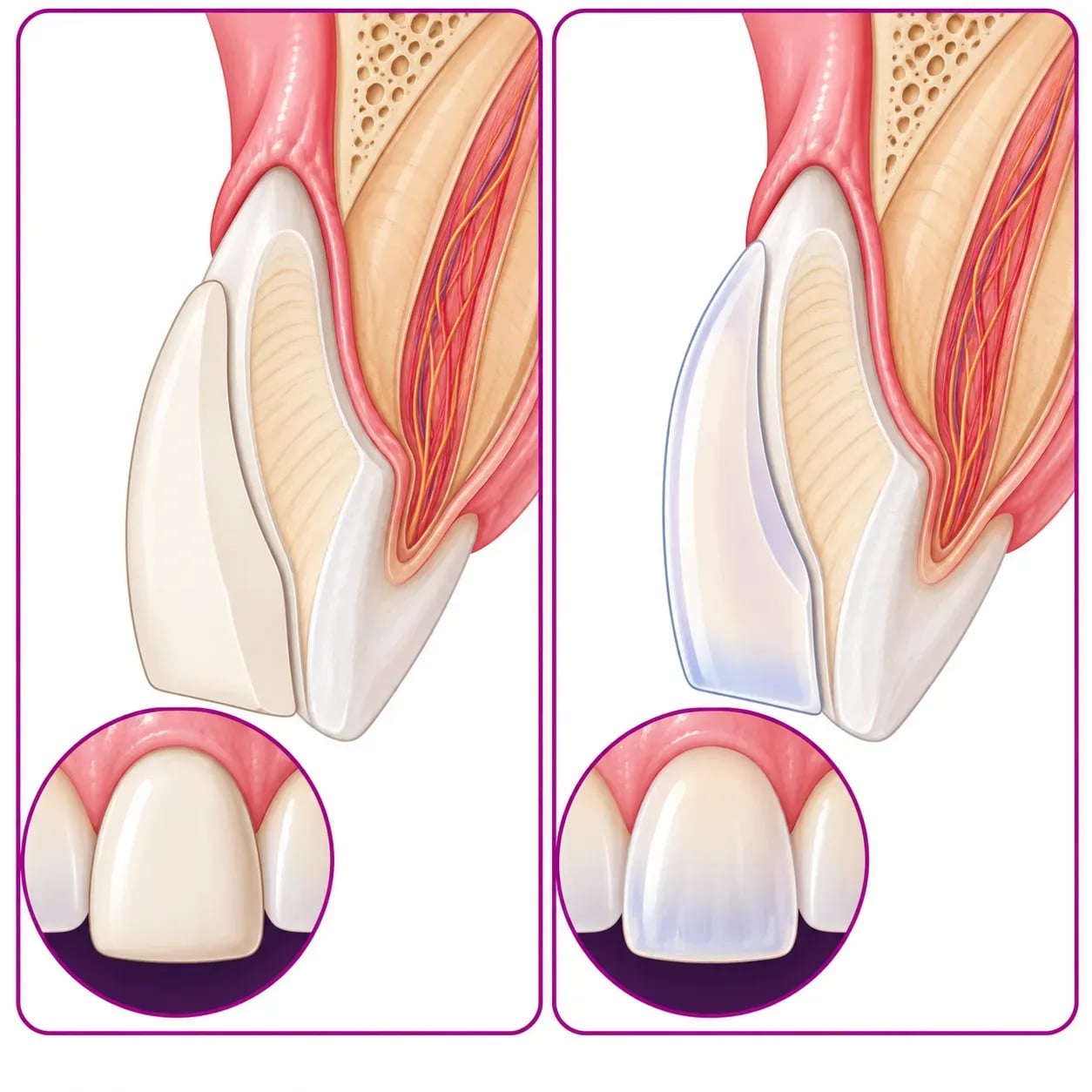
How many veneers do you need?
Usually 6 to 10, mostly on the upper teeth and sometimes on the lower ones as well.
The number is set by your smile line — how many teeth actually show when you smile and when you talk. Doing fewer than that leaves a visible transition between treated and untreated teeth, which is the most common way a veneer job looks like a veneer job.
More is not better. Veneering teeth that never show is spending money and removing enamel for nothing. A dentist proposing twenty when your smile shows eight is not planning around your face.
The number is decided at the consultation, by looking at your smile rather than by choosing a package.
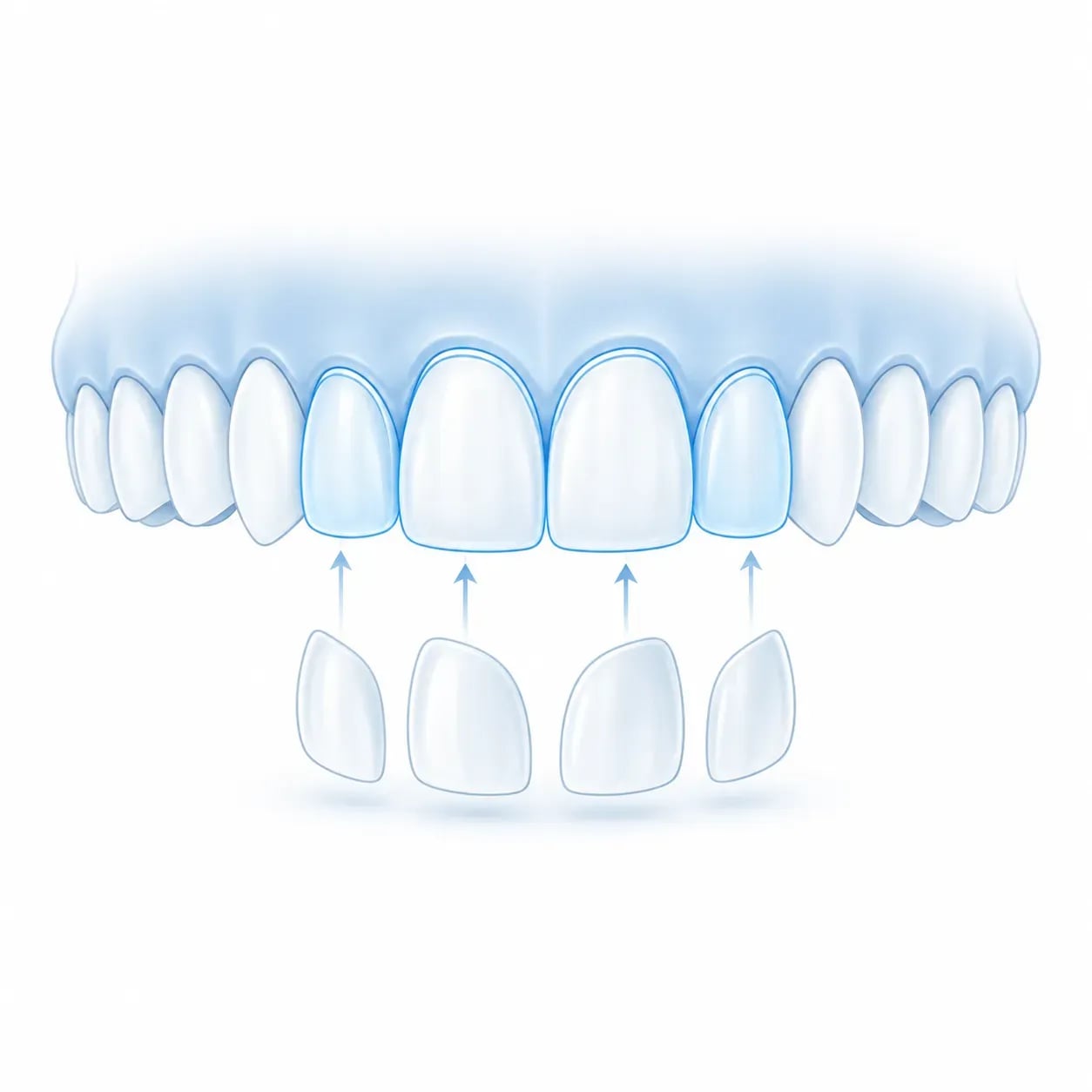
What veneers cost, and how that compares
€200 per tooth for composite, €300 for E-max ceramic, with an automatic discount from 6 teeth treated together.
| Teeth | Composite | E-max | You save |
| 1 | €200 | €300 | — |
| 6 | €1,100 | €1,700 | €100 |
| 8 | €1,400 | €2,200 | €200 |
| 10 | €1,700 | €2,700 | €300 |
| 16 | €2,600 | €4,200 | €600 |
| 20 | €3,000 | €5,000 | €1,000 |
Included: the consultation, the preparation, the fitting and immediate follow-up.
Not included: flights and accommodation.
How this compares in the UK. Published UK price guides put porcelain veneers at roughly £500 to £1,200 per tooth privately, and composite at £150 to £400. Veneers are not funded by the NHS for cosmetic reasons.
Two things to hold in mind about that comparison. First, it is drawn from a published UK price guide rather than from a survey, and UK pricing varies widely by city — check against two or three actual quotes near you. Second, and more importantly, a price comparison is the wrong basis for this decision: what matters is whether you need veneers at all, how much tooth comes off, and who maintains them for the next twenty years. Settle those first and the price becomes the easy part.
All prices are on the prices page, and a quote reaches you within 24 to 48 hours of sending photographs.
| Number of Teeth | Composite Veneers — Standard Price | Composite Veneers — Package Price | Composite Veneers — Savings | Porcelain (E-Max) Veneers — Standard Price | Porcelain (E-Max) Veneers — Package Price | Porcelain (E-Max) Veneers — Savings |
|---|---|---|---|---|---|---|
| 1 tooth | €200 | €200 | — | €300 | €300 | — |
| 6 teeth | €1,200 | €1,100 | €100 | €1,800 | €1,700 | €100 |
| 8 teeth | €1,600 | €1,400 | €200 | €2,400 | €2,200 | €200 |
| 10 teeth | €2,000 | €1,700 | €300 | €3,000 | €2,700 | €300 |
| 16 teeth | €3,200 | €2,600 | €600 | €4,800 | €4,200 | €600 |
| 20 teeth | €4,000 | €3,000 | €1,000 | €6,000 | €5,000 | €1,000 |
This cannot be undone
Preparing a tooth for a veneer means removing a thin layer of enamel, and enamel does not grow back.
That one sentence is the whole of this decision. Everything else — material, shade, number of teeth — is detail by comparison.
What it commits you to. Once the enamel is off, that tooth needs covering for the rest of your life. Not having veneers is no longer an option: a prepared tooth left uncovered is sensitive, vulnerable and visibly reduced. So you are not buying veneers, you are buying veneers and every replacement set after them.
Ultra-thin techniques exist that limit the preparation considerably, and they are worth asking about at the consultation. They are not suitable for every case, and they cannot correct as much.
And it is why whitening comes first. If colour is the only thing that bothers you, whitening achieves it, costs a fraction, removes nothing and simply fades back. Being told that instead of being sold veneers is the right outcome, and we would rather tell you.
Veneers, crowns or whitening?
| Whitening | Veneers | Crowns | |
| Corrects | Colour only | Colour, shape, small gaps, worn edges | Badly damaged or weakened teeth |
| Tooth removed | None | A thin layer at the front | Reduction on all sides |
| Reversible | Yes — the shade fades back | No | No |
| Lasts | 1 to 3 years | 5 to 8 years composite, 10 to 20 ceramic | Long, then replaced |
| From | €350 per session | €200 per tooth | €400 per tooth |
Work down the table, not up. Start with the least destructive option that solves your actual problem. Whitening if it is colour. Veneers if it is shape as well, or colour that whitening cannot reach. Crowns only where the tooth is genuinely damaged.
A treatment plan that removes more tooth than the problem requires is a plan worth questioning, in any country.
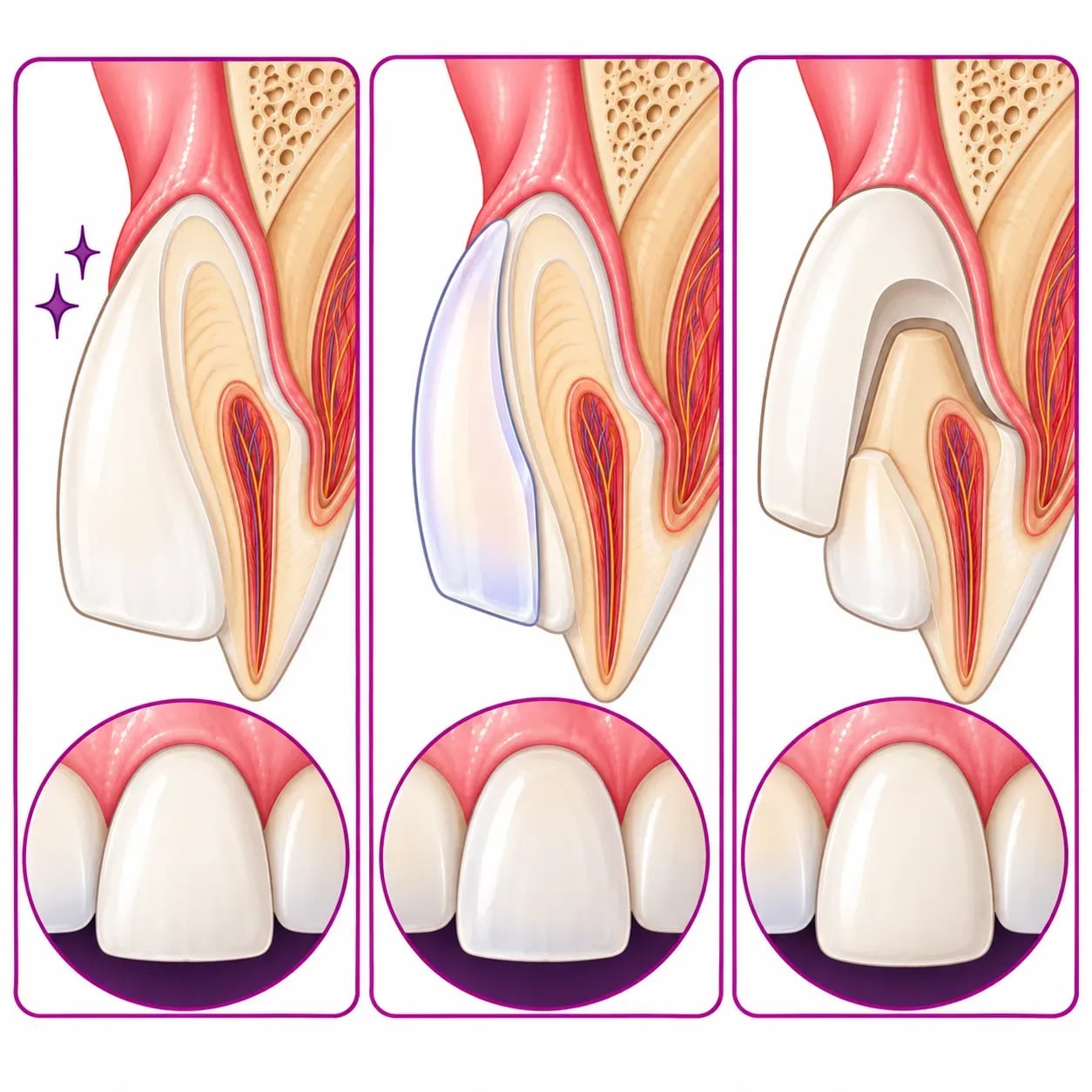
Are you a candidate?
Veneers suit someone with healthy teeth, healthy gums and enough enamel to bond to.
Treated before anything else:
- Decay
- Gum disease or inflammation
- Poor oral hygiene — veneers on unhealthy gums fail
Reasons you may be directed elsewhere:
- Significant misalignment. Veneers mask a slight irregularity. They do not straighten teeth, and using them to do so means removing a great deal more enamel. Orthodontics first, veneers afterwards if still wanted — frequently they are not.
- Bruxism. Grinding fractures veneers. It is not an absolute barrier, but a night guard becomes compulsory rather than advisable, and you should know that before committing.
- Too little enamel to bond to, from wear or previous work.
- Colour alone — whitening.
Have a dental check-up at home before you travel, and bring a recent X-ray. Discovering a problem on arrival costs you days of your stay.
The mock-up: seeing it before committing
Before any enamel is touched, a temporary simulation is placed over your teeth so you can see the proposed shape, length and shade on your own face.
Use it properly. Look at it in daylight as well as in the surgery. Smile, talk, take photographs. Ask for the edges to be shorter or longer if that is what you think. This is the stage where changes cost nothing.
And say so if you do not like it. The mock-up exists precisely so that disagreement happens before the irreversible part, not after. A dentist who treats your hesitation at this stage as an obstacle is telling you something.
If you are not sure after the mock-up, that is a legitimate reason to go home and think. It is a better outcome than a set of veneers you did not want.
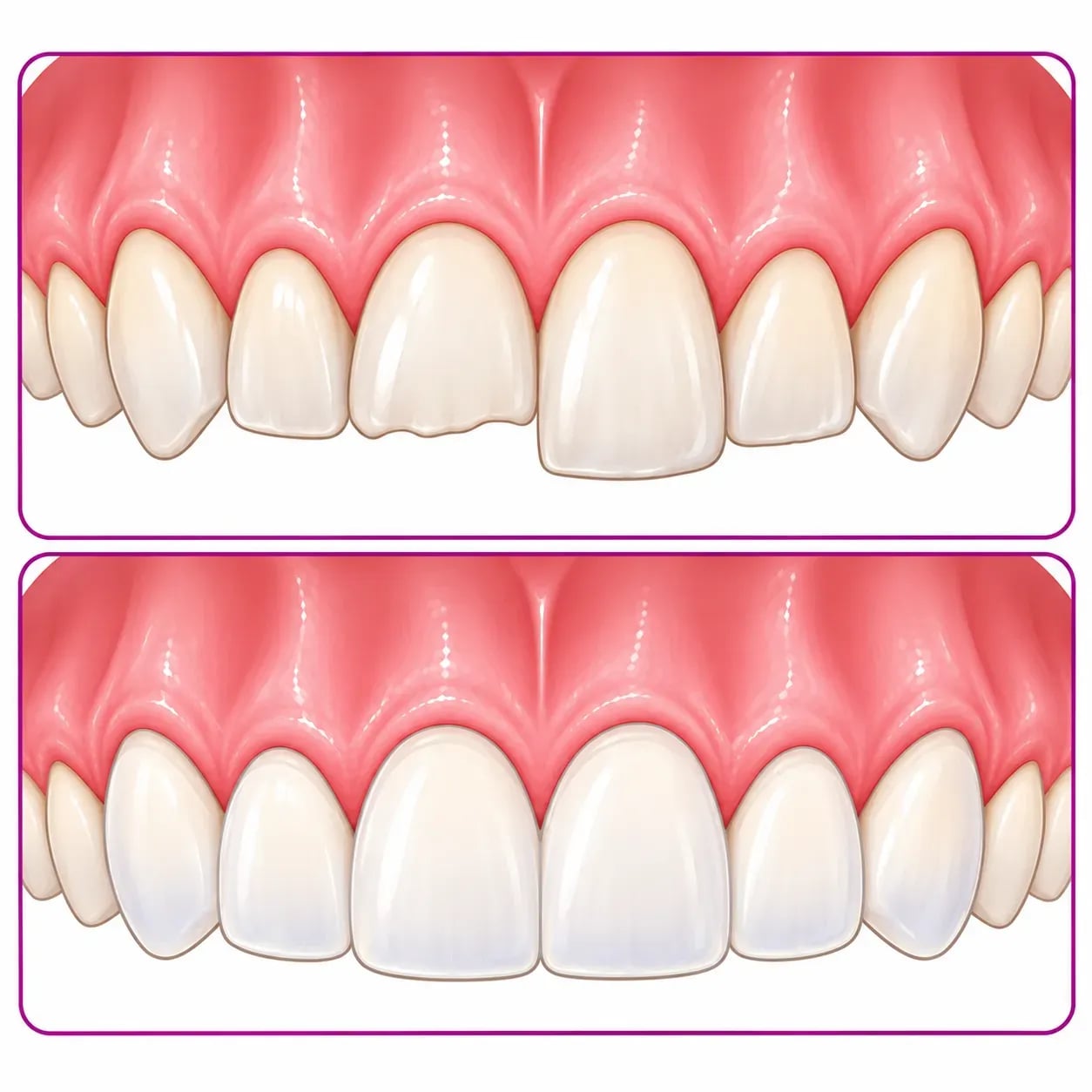
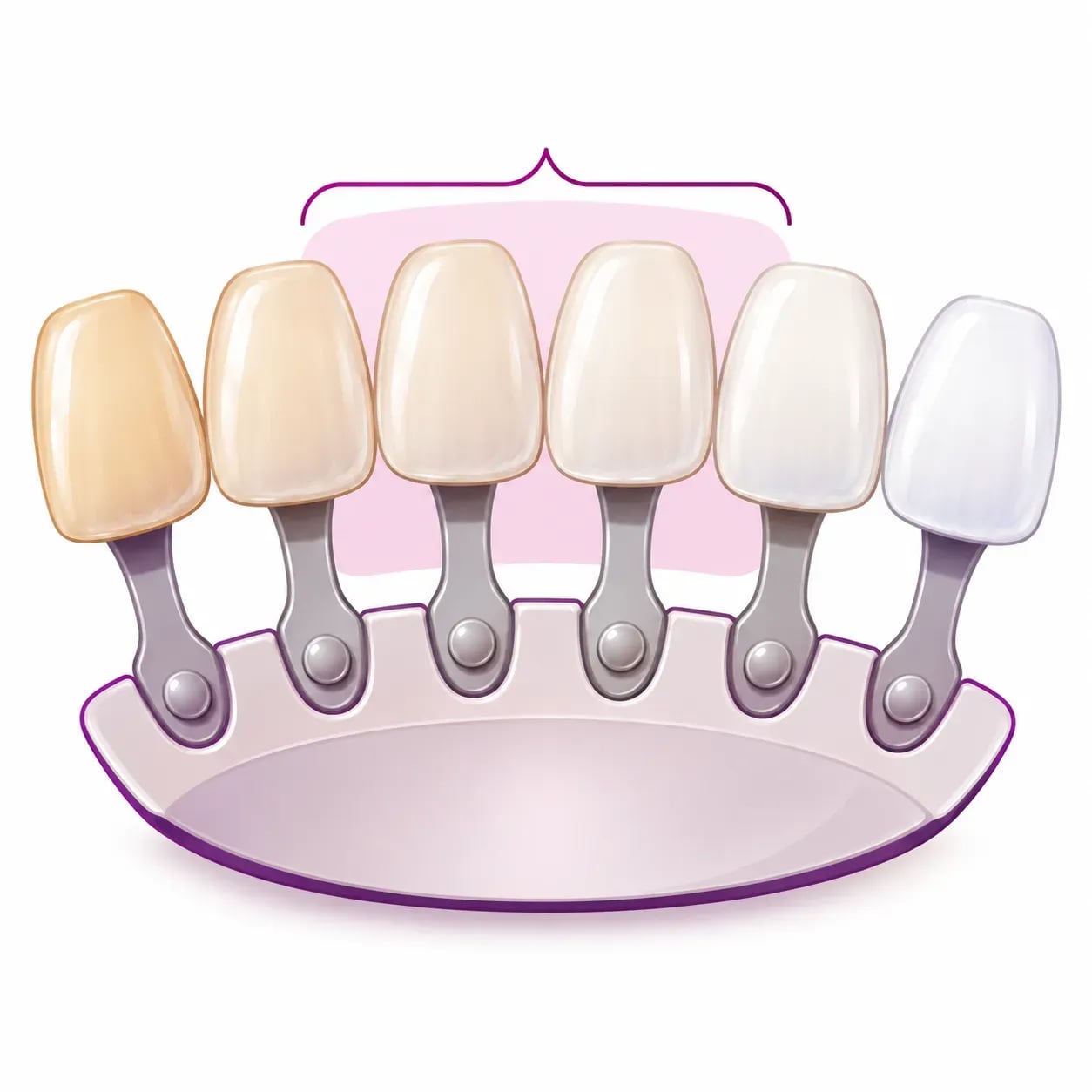
Choosing the shade: the too-white trap
The shade is permanent. Veneers cannot be whitened afterwards — whitening gel has no effect on ceramic or composite. What you choose is what you keep until they are replaced.
Too white and too uniform is instantly recognisable, and it is the single most common regret. Natural teeth are not one flat colour: they vary slightly between teeth, they are more translucent at the edges, and they are not brighter than the whites of your eyes.
What should influence the choice: your remaining natural teeth, your skin tone, your age, and what you do. A shade that reads as healthy at forty-five looks artificial at sixty.
And whiten first if you are going to. If you want your untreated teeth lighter, have whitening done before the veneers are made, so they are matched to the final shade. Doing it afterwards lightens everything except the veneers.
Your pathway, step by step
- Get in touch from home. Photographs of your teeth and your smile in natural light without a filter, plus a recent X-ray and any dental history. A quote comes back within 24 to 48 hours.
- Preparation. A dental check-up at home, any decay or gum problem treated, and whitening done first if you want it.
- Arrival. You are met at Tunis-Carthage and transferred.
- Consultation, with the examination and the plan agreed — how many teeth, which material, what shade.
- The mock-up, and your chance to change anything.
- Preparation of the teeth under light local anaesthetic.
- Impressions and temporaries, for ceramic, while the laboratory makes the final veneers.
- Fitting, with final adjustments.
- Home, with the material and shade details recorded, and remote follow-up.
This is why the stay is 5 to 7 days rather than two: the laboratory stage for ceramic cannot be compressed, and a clinic that promises ceramic veneers in 48 hours is cutting something.
The first days after fitting
Sensitivity to hot and cold is common and temporary.
A feeling of bulk for the first days, as your tongue and lips adjust to a slightly different shape. It passes quickly and it always feels more pronounced to you than it looks to anyone else.
Your gums may be tender where the veneers meet them. That settles. Gums that stay red or bleed are worth reporting.
Be careful for the first week. Nothing very hard, nothing you have to tear at.
Then, permanently: do not bite your nails, do not open packaging with your teeth, and do not chew ice. Veneers are strong in the direction they are designed for and they chip under a sideways load.
Report without waiting any sharp edge, any bite that does not feel right, or any veneer that feels loose.
Care and how long they last
Day to day, brush and floss exactly as you would natural teeth. Veneers do not decay, but the tooth underneath and the gum around it very much can, and that is how veneers are usually lost.
Regular dental check-ups continue as normal, wherever you live.
Staining: composite picks up colour over the years, like enamel. E-max ceramic does not.
A night guard if you grind. Not optional once you have veneers.
Lifespan: 5 to 8 years for composite, 10 to 20 for E-max ceramic, with good care. Those numbers assume you look after them; they are not a warranty.
Replacement: the long-term arithmetic
This is the part most people do not calculate before committing, and it is worth doing now.
Veneers are replaced at the end of their life, not removed. The enamel is gone, so the teeth stay covered permanently.
Do the maths for your own age. Someone having ten E-max veneers at thirty should expect to replace them perhaps three times before they are eighty. With composite at 5 to 8 years, considerably more often.
That is not an argument against veneers. It is an argument for choosing ceramic over composite if you are young, for veneering only the teeth that show, and for being certain you want them at all.
And it is a reason to settle who maintains them before you travel, which is the next section.
If a veneer breaks after you get home
What to do immediately: contact us with photographs, keep the veneer if it has come off in one piece because it can sometimes be re-bonded, and avoid chewing on that side.
A local dentist can re-bond or repair temporarily in the meantime. We provide the material and shade details so they know what they are working with.
Where the problem relates to the veneer, its manufacture or its fitting, a solution is proposed after review of your file, and any revision in Tunisia is coordinated by us. Travel and accommodation are not covered unless specifically agreed.
Where the damage follows an impact, unprotected grinding, poor oral hygiene or work by another practitioner, it is not automatically treated as a defect. That is the honest position and you should read any other provider's terms with the same attention.
Arrange your maintenance dentist before you travel, not after. UK dentists are frequently reluctant to take on remedial work on treatment carried out abroad, and NHS dentistry does not redo private cosmetic work. Find a private dentist near you who is willing to see you for check-ups and small repairs, and ask them before you book. If none will, that is genuine information about whether to do this abroad.
Your dentist
Dr Fedia Mtaallah practises cosmetic dentistry at Myron International Clinic and handles veneers, whitening, crowns and implants.
That range matters here. The person deciding whether you need veneers is also the person who would whiten instead, or place a crown where a tooth is genuinely damaged — so there is no reason to steer you toward the most extensive option.
Send photographs of your teeth and your smile and you will have an opinion within 24 to 48 hours.
Getting here, and before you travel
From the UK and Ireland: around three hours from London, with connections from other UK and Irish airports. From the Gulf: daily flights from Dubai, around six and a half to seven hours, and from Doha, around six. From continental Europe: 1h30 to 3h from Paris, Brussels, Geneva, Lyon and Marseille, with no visa for EU and Swiss nationals. From West and Central Africa: regular connections from Dakar, Abidjan, Douala, Libreville and Casablanca.
Entry requirements follow your nationality, not your country of residence. A resident of Dubai or London holding an Indian, Pakistani, Nigerian or Filipino passport does not have the same conditions as a British or Emirati national, and a residence permit changes nothing. Check with the Tunisian embassy for your country of citizenship before booking.
Your checklist:
- A dentist at home who will maintain them. Confirmed before you book, for the reasons above.
- A dental check-up and a recent X-ray. Bring the originals.
- Documents: a passport valid well beyond your return date, and a visa if your nationality requires one.
- Photographs of your teeth and your smile, natural light, no filter.
- Your dental history: previous crowns, root canals, orthodontics, any tooth that has been traumatised.
- Tell us if you grind your teeth, and bring your night guard if you have one.
- Whitening done first if you want your other teeth lighter.
- Your medication and allergies.
- Reference photographs of smiles you like — and of ones you do not. The second set is more useful.
- Keep 5 to 7 days genuinely free. The laboratory stage cannot be rushed and the fitting cannot be moved forward.
How long each treatment needs is in our guide to lengths of stay. Request a quote and you will have an answer within 24 to 48 hours.









Breast Augmentation
I had my surgery with ServiHealth, and I highly recommend their services. The team was very professional, and I'm extremely satisfied with my experience. ServiHealth offers various breast surgery procedures, including breast augmentation and breast reduction, to meet different needs.

Cam Naf
FranceFrequently asked questions about Dental Veneers in Tunisia
Veneers. A veneer covers the front face of the tooth and keeps most of its structure; a crown covers all four sides and removes substantially more. Crowns are proposed only where a tooth is genuinely damaged, root-filled or weakened. Ask this question of every clinic you consider, because crowns work on any tooth, can be made faster and deliver a uniform result, which makes them easier to sell than veneers.
€200 per tooth for composite and €300 for E-max ceramic, with an automatic discount from 6 teeth treated together: 8 E-max veneers are €2,200 instead of €2,400, and 20 are €5,000 instead of €6,000. The price includes the consultation, the preparation, the fitting and immediate follow-up. Flights and accommodation are not included.
Published UK price guides put porcelain veneers at roughly £500 to £1,200 per tooth privately and composite at £150 to £400, and the NHS does not fund veneers for cosmetic reasons. UK pricing varies widely by city, so check against two or three actual quotes near you. More importantly, price is the wrong basis for this decision: what matters is whether you need veneers at all, how much tooth comes off, and who maintains them for the next twenty years.
No, in almost all cases. Preparing a tooth means removing a thin layer of enamel, and enamel does not grow back. Once it is off, that tooth needs covering permanently, so you are committing to veneers and to every replacement set after them. Ultra-thin techniques that limit the preparation exist and are worth asking about, but they are not suitable for every case.
A veneer covers the visible front face and removes a thin layer of enamel from it. A crown covers the whole tooth on all four sides and requires reduction on every surface, taking away considerably more structure and raising the chance the tooth needs root canal treatment later. Crowns are for teeth that are already badly damaged or weakened, not for healthy teeth being improved cosmetically.
Ceramic lasts 10 to 20 years, does not stain, looks closer to natural enamel and needs two appointments. Composite lasts 5 to 8 years, is built in a single appointment, costs €100 less per tooth and stains over time like natural enamel. Ceramic lasts up to three times as long for about one and a half times the price, so over fifteen years it is usually the cheaper option.
Usually 6 to 10, mostly upper and sometimes lower as well. The number is set by your smile line — how many teeth actually show when you smile and talk. Fewer than that leaves a visible transition between treated and untreated teeth. More is not better: veneering teeth that never show spends money and removes enamel for nothing.
5 to 8 years for composite and 10 to 20 years for E-max ceramic, with good care. Those figures assume you look after them and wear a night guard if you grind; they are not a warranty.
Yes, at the end of their life, and permanently — the enamel is gone so the teeth stay covered. Someone having ten ceramic veneers at thirty should expect to replace them perhaps three times before eighty, and considerably more often with composite. It is worth doing that arithmetic for your own age before committing.
No. Whitening gel has no effect on ceramic or composite. The shade you choose is permanent until they are replaced, which is why any whitening of your other teeth must be done before the veneers are made.
You live with it until they are replaced, which is why this is the decision to take slowly. Too white and too uniform is instantly recognisable and the most common regret. Natural teeth vary slightly between each other, are more translucent at the edges, and are not brighter than the whites of your eyes. Your skin tone, your age and your remaining natural teeth should all influence the choice.
A temporary simulation placed over your teeth before any enamel is touched, so you can see the proposed shape, length and shade on your own face. Look at it in daylight, smile, talk, take photographs, and ask for changes — at this stage they cost nothing. If you do not like it, say so: that is exactly what it is for, and going home to think about it is a legitimate outcome.
Five to seven days, over 2 to 3 appointments. The laboratory stage for ceramic cannot be compressed, which is the reason for the length. A clinic promising ceramic veneers in 48 hours is cutting something.
No. The preparation is done under light local anaesthetic. Sensitivity to hot and cold afterwards is common and temporary, as is a feeling of bulk for the first days while your tongue and lips adjust.
Only if the misalignment is slight. Veneers mask a small irregularity; they do not straighten teeth, and using them to do so means removing considerably more enamel. For marked misalignment the answer is orthodontics first, and veneers afterwards if you still want them — frequently you will not.
Possibly, but grinding fractures veneers, so a night guard becomes compulsory rather than advisable. Tell us before you book and bring your guard if you have one. Damage from unprotected grinding is not treated as a manufacturing defect.
They remove a thin layer of enamel that does not grow back, but they keep the bulk of the tooth, unlike a crown. The tooth underneath and the gum around it can still decay, which is how veneers are usually lost, so brushing, flossing and check-ups continue exactly as before.
Contact us with photographs, keep the veneer if it is in one piece because it can sometimes be re-bonded, and avoid chewing on that side. A local dentist can re-bond or repair temporarily, and we provide the material and shade details. Where the problem relates to the veneer, its manufacture or its fitting, a solution is proposed after review; travel and accommodation are not covered unless specifically agreed.
A dentist where you live, and you should arrange this before you travel. UK dentists are frequently reluctant to take on remedial work on treatment carried out abroad, and NHS dentistry does not redo private cosmetic work. Find a private dentist willing to see you for check-ups and small repairs, and ask them before you book. If none will, that is genuine information about whether to do this abroad.
Yes, if you want your untreated teeth lighter. Whitening must be done before the veneers are made so they can be matched to the final shade. Doing it afterwards lightens everything except the veneers, which then look like the dark ones.
Only on the teeth that show when you smile — typically the upper front teeth and sometimes the lower ones. They do not go on molars, which take the chewing load, and they do not replace a missing tooth, which is what an implant is for.
Whether these are veneers or crowns, how much of each tooth will be removed, whether whitening alone would achieve what you want, how many teeth actually show when you smile, and whether you may see your prepared teeth before the final ones are fitted. Nobody working properly minds being asked any of those.