

Thread Lift in Tunisia: Areas, Price and How Long It Lasts

Thread lift in Tunisia: the essentials
Absorbable threads are placed under the skin through a fine needle. Barbed threads reposition tissue upward; all of them stimulate collagen along their path. The thread dissolves over months and the firming effect outlasts it.
It is a modest, temporary improvement. That is said at the top of this page on purpose, and the next section explains why.
Significant sagging, or loose skin already established? That is a face and neck lift, and no number of threads substitutes for one.
| Session | 30 to 45 minutes |
| Anaesthetic | Local, at the entry points |
| Stay in Tunisia | None — same day, no overnight |
| Visible | Immediately, settling over days; optimal at 4 to 6 weeks |
| Lasts | 12 to 18 months |
| Price | €300 per pair of threads |
The honest version, before anything else
Thread lifts were sold throughout the 2010s as a « non-surgical facelift ». They are not one, they never were, and the gap between that promise and the result is why many surgeons are sceptical of the treatment to this day.
What a thread lift actually does: it repositions moderately lax tissue by a few millimetres and stimulates collagen along the thread path. On the right face that is a genuine, visible improvement — a cleaner jawline, a slightly lifted cheek, a softer jowl.
What it does not do: remove excess skin, tighten a neck that has already gone, or produce anything resembling a facelift. On a face with significant sagging, threads achieve very little and the money is wasted.
So treat « non-surgical facelift » as a warning about the provider using it. Here or anywhere.
The most common bad outcome of a thread lift is not a complication. It is disappointment, and it comes almost entirely from treating a face that needed something else. Where the assessment shows that, we say so and decline rather than take the booking.
What a thread lift is
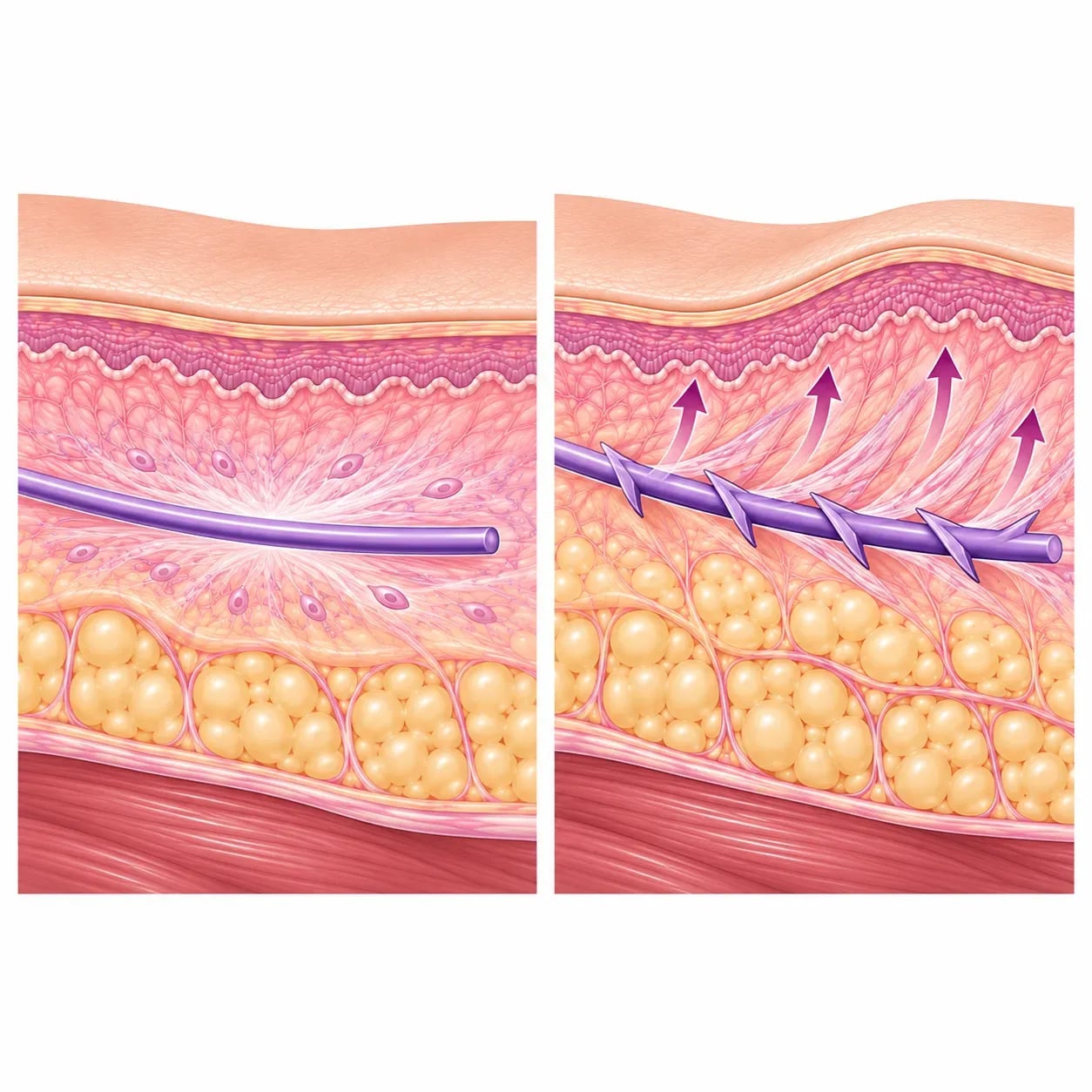
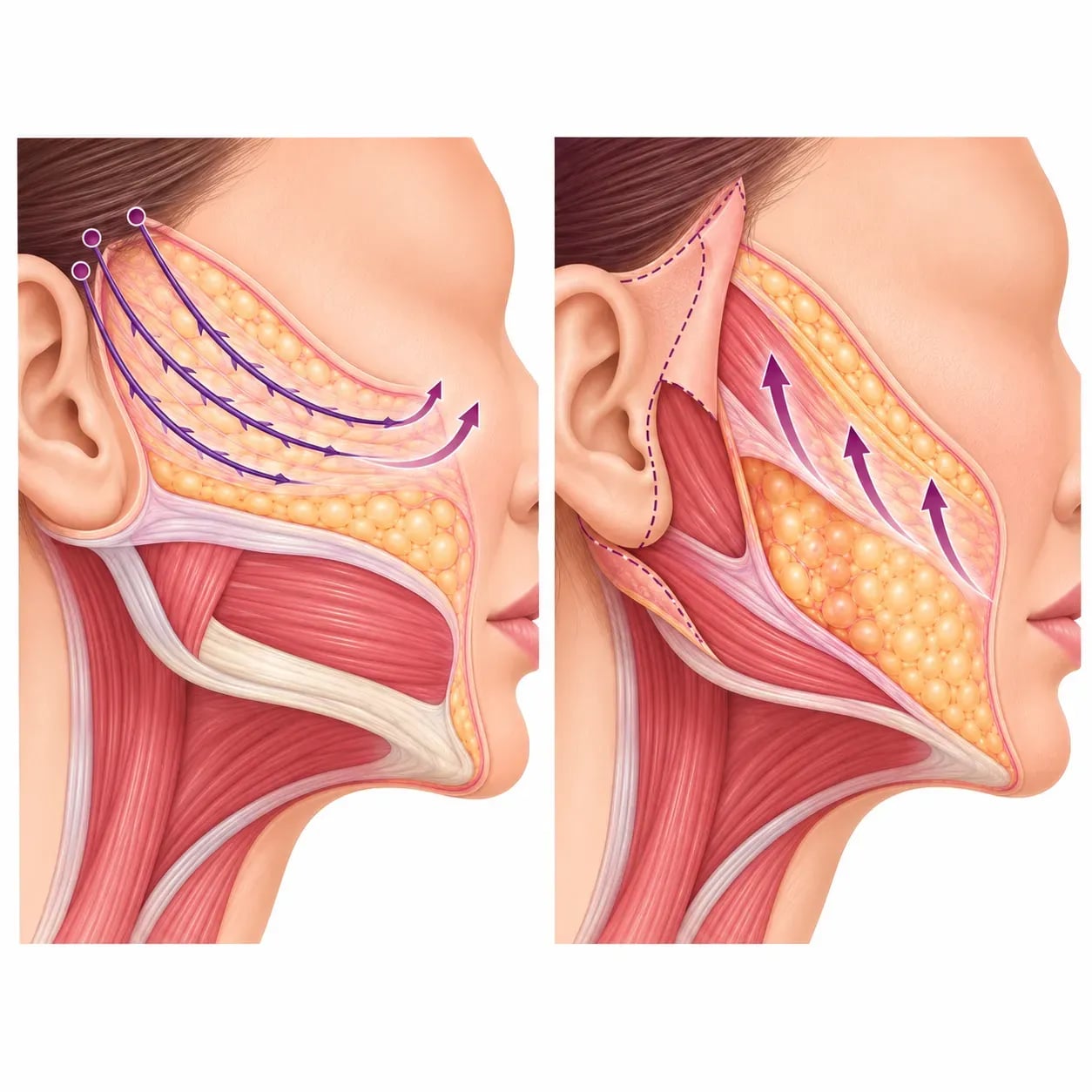
The threads are absorbable, most often made of PDO. They are introduced under the skin with a fine needle along a planned path, and the barbs grip the tissue so it can be drawn upward and held.
Two things happen, on two timescales.
Immediately: the mechanical lift from the barbs. You see it on the table.
Over the following weeks: the body lays down collagen along the thread path. This is why the effect outlasts the thread itself — the material is gone within months, and the firming continues for 12 to 18.
Nothing is cut and nothing is removed. There are entry points rather than incisions, and no scar.
Smooth or barbed threads?
Two different products that get sold under the same name, and the difference matters.
Smooth threads have no barbs. They stimulate collagen and improve skin quality and texture. They do not lift. Anyone offering you smooth threads for a sagging jawline is offering you the wrong product.
Barbed threads grip the tissue and reposition it, as well as stimulating collagen. These are what a thread lift means.
They are frequently combined: barbed where tissue needs moving, smooth where the skin itself needs improving. Which, and where, is decided at the consultation.
Ask which you are being given. It is a reasonable question and the answer should be specific.
Which areas can be treated
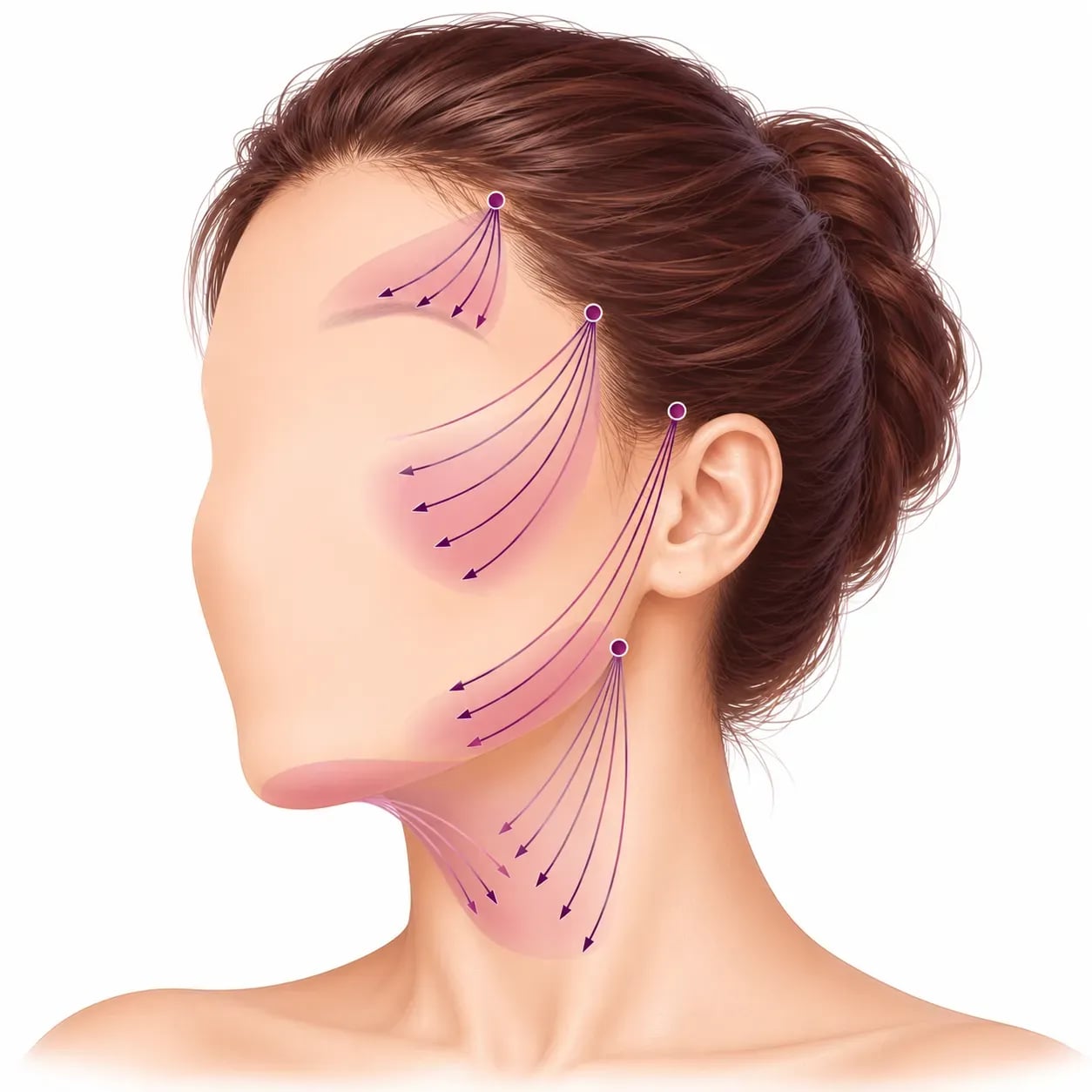
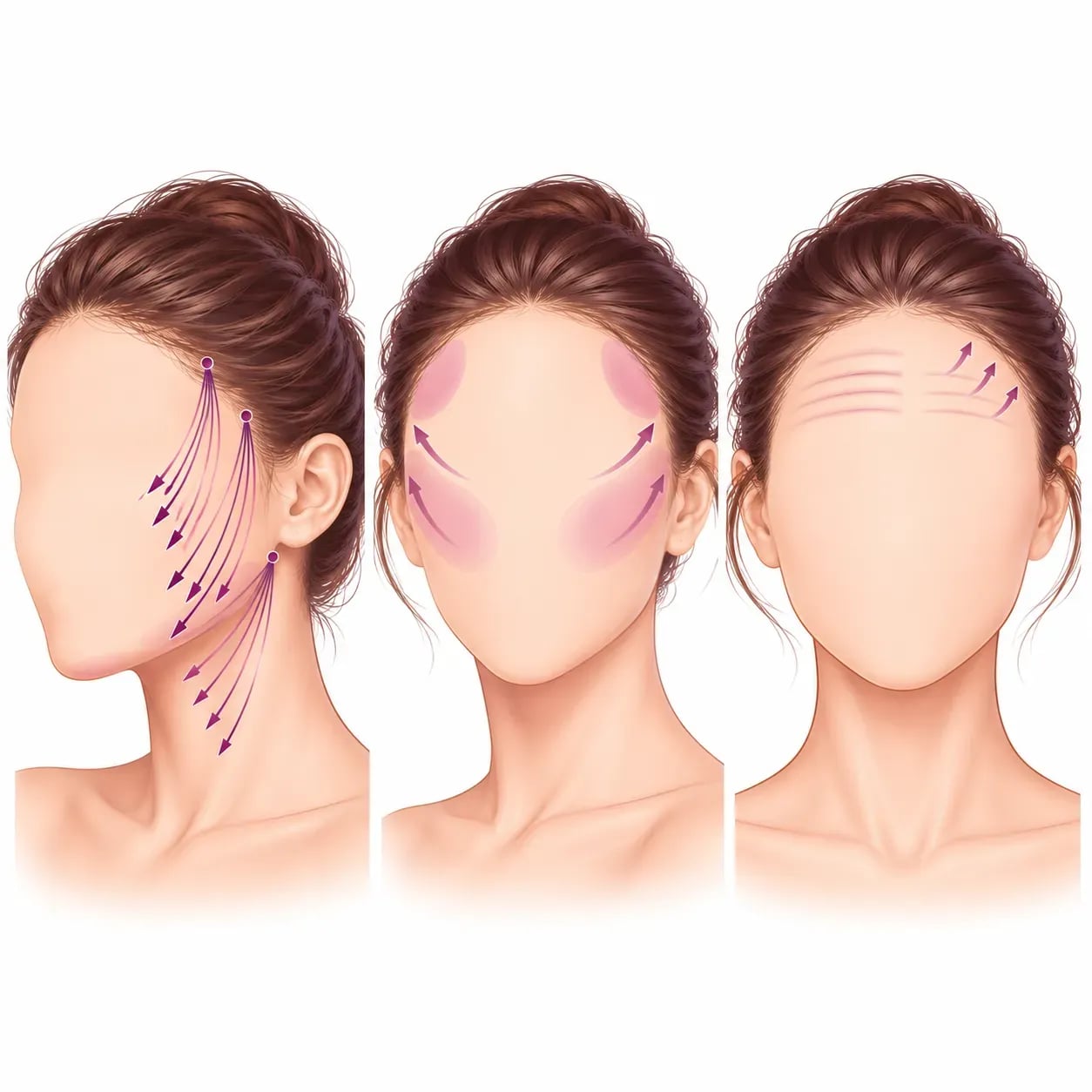
The jawline and jowls — the main request, and where threads do their most convincing work.
Cheekbones — repositioning the midface upward.
Eyebrows — a subtle lift of the brow tail. If heaviness of the upper lid is the real issue, read our page on eyelid surgery first: the brow and the lid are different problems and threads address neither as well as people hope.
Neck and under the chin — for mild laxity only. An established neck is surgical.
Body areas such as arms or inner thighs, where the same logic applies and considerably more threads are needed.
What makes any of these work is tissue with elasticity left in it. The thread provides the traction; the skin has to be able to hold it.
What it costs, and how many pairs you need
€300 per pair of threads, consultation and placement included, in a single day with no overnight stay.
How many pairs is the whole question, and it is why a price per pair tells you almost nothing on its own.
| Area | Pairs | Budget |
| Eyebrows | 1 | €300 |
| Cheekbones | 1 to 2 | €300 to €600 |
| Jawline and jowls | 2 to 4 | €600 to €1,200 |
| Neck and under the chin | 2 to 3 | €600 to €900 |
| Full face | 4 to 6 | €1,200 to €1,800 |
| Arms or thighs | 4 to 8 | €1,200 to €2,400 |
A single pair rarely justifies a flight. Where this makes sense is a multi-pair treatment, or added to a stay you are already making for something else — a session takes well under an hour and needs no overnight.
All prices are on the prices page, and a quote reaches you within 24 to 48 hours of sending photographs.
| Treatment Area | Number of Thread Pairs | Estimated Price |
|---|---|---|
| Eyebrows | 1 pair | €300 |
| Cheekbones | 1 to 2 pairs | €300 to €600 |
| Jawline and Jowls | 2 to 4 pairs | €600 to €1,200 |
| Neck and Under-Chin Area | 2 to 3 pairs | €600 to €900 |
| Full Face (Cheekbones and Jawline) | 4 to 6 pairs | €1,200 to €1,800 |
| Arms or Thighs | 4 to 8 pairs | €1,200 to €2,400 |
Threads or a facelift? Do the ten-year arithmetic
| Thread lift | Face and neck lift | |
| Degree of sagging | Mild to moderate | Moderate to marked |
| Excess skin | Not removed | Removed |
| The neck | Mild laxity only | Treated properly |
| Anaesthetic | Local | General |
| Scars | None | Yes, placed to be concealed |
| Recovery | 2 to 3 days | 2 to 3 weeks |
| Lasts | 12 to 18 months | Generally 8 to 10 years |
| Price | €600 to €1,800 | From €2,400 |
Now the arithmetic nobody does. A full-face thread treatment at €1,200 to €1,800, repeated every 12 to 18 months, comes to somewhere between €8,000 and €18,000 over ten years. A face and neck lift is €2,400 once and lasts 8 to 10 years.
That does not mean threads are a bad choice. There are entirely legitimate reasons to prefer them: you may not want general anaesthesia, you may not want scars, you may not be ready for surgery, you may want to see what a lift looks like before committing to one, or your sagging may simply be too mild for a facelift to be appropriate.
What it does mean is that « cheaper than a facelift » is only true for the first session. If you are considering threads mainly on cost, and you expect to keep having them, the maths points the other way. Decide knowing that, rather than finding it out at the fourth session.
Are you a candidate?
Threads suit mild to moderate sagging in tissue that still has elasticity. That is a narrower group than the marketing suggests.
Threads are the wrong answer if:
- Your skin is very thin and very lax. It will not hold the traction, and the threads simply crease it. This is the clearest contraindication and the one most often ignored elsewhere.
- There is established excess skin. Threads do not remove skin. Only surgery does.
- Your neck has already gone. Mild laxity, yes. An established neck, no.
- What you have lost is volume rather than position. That is filler or fat transfer, and lifting an empty face does not fill it.
Contraindications: pregnancy or breastfeeding, an autoimmune condition in an active phase, a clotting disorder or anticoagulant treatment, and any known allergy to the thread material.
If the assessment says threads will disappoint you, you will be told. That is a better outcome than a treatment you paid to be unhappy with.
Combining threads with other treatments
Threads address position. They do not address volume or movement, and most faces have more than one thing going on.
Threads — position. Tissue that has descended.
Hyaluronic acid filler — volume. Hollows, flattened cheekbones, a chin that lacks projection.
Botulinum toxin — movement. The lines that expression creates.
The three are frequently combined in a single session, which takes about an hour to an hour and a half: filler and threads first, then the toxin.
This is often the better plan, because lifting a face that has lost volume produces a tighter version of the same tired look. A good assessment usually proposes a combination rather than more of one thing.
Risks, including the most likely one
The most common bad outcome is disappointment, not a complication, and it comes from treating a face that needed something else. That is why the assessment matters more here than the technique.
In the first week or two:
- Small irregularities or puckering along the thread path. Usually settle on their own.
- Bruising and swelling at the entry points.
- A pulling sensation, which is normal and covered in the next section.
Less common:
- Asymmetry — generally correctable.
- A palpable thread, or a visible one under very thin skin.
- Extrusion — one end of a thread working its way to the surface. The thread has to be removed, which is a simple procedure but has to be done promptly.
- Infection, rare.
- Pain persisting beyond two weeks, which should be reported rather than endured.
And the practical point if you are travelling: extrusion and persistent pain can present after you are home, and extrusion needs attention quickly. Know who you would see — a doctor or aesthetic clinic near you — before you book. It is a short conversation and it is worth having.
The first two weeks, honestly
This is the part people are not warned about, and it is the main reason to plan the timing properly.
A pulling or tight sensation for one to two weeks, most noticeable when you open your mouth wide — yawning, eating, laughing. It is normal, it is not a sign anything is wrong, and it settles. But it is a real sensation and nobody mentions it.
For two weeks, avoid: strong facial movements, facial massage, dental treatment, intense exercise, sauna and steam room.
Sleep on your back with your head slightly raised for the first two weeks.
The immediate result may look slightly overdone. The traction is at its strongest on day one and relaxes over the following days. That is expected.
The real result is at 4 to 6 weeks, once the collagen response has developed. Judging it at two weeks tells you nothing useful.
Timing it before an event
One month minimum. Six weeks to two months is better.
Two reasons. Bruising and small irregularities need time to resolve, and the result is not at its best until 4 to 6 weeks.
A thread lift three weeks before a wedding gives you the version with the puckering still settling, and none of the collagen benefit. Plan backwards from the date.
Your pathway
- Get in touch. Photographs from the front and both sides in natural light without makeup, plus every previous facial treatment you have had — threads, filler, toxin, surgery. A quote comes back within 24 to 48 hours.
- Plan it around a stay you are already making, where possible.
- Arrival, and the consultation with the facial assessment and the thread paths planned.
- The session, 30 to 45 minutes under local anaesthetic at the entry points.
- Immediate aftercare instructions. No overnight stay.
- The first two weeks, with the restrictions above.
- A review at six weeks, remotely or in person, when the result is actually there.
Can you have them done again?
Yes, and repeat sessions are normal. The usual timing is around months 12 to 18, before the effect has fully faded — a repeat on a face that still has some lift generally needs fewer threads.
There is no fixed limit on how many times. But effectiveness falls as sagging progresses: threads that worked well at fifty do less at sixty, because the tissue they are gripping has changed.
And repeating annually eventually costs more than a facelift that lasts eight to ten years. There comes a point where continuing is the more expensive and less effective choice, and it is worth revisiting the question rather than booking the next session automatically.
If you stop, nothing deteriorates. There is no rebound and no penalty. Your face simply resumes its natural course from wherever it is. Anyone suggesting you will be worse off for stopping is wrong.
Your doctors
Dr Marwen Guesmi determines the number and type of threads from the facial assessment — which is the decision that makes or breaks this treatment.
Dr Walid Saidane focuses on the thread paths, which is what determines whether the lift sits where you wanted it.
Treatments take place at Myron International Clinic.
Ask two things at the consultation: how many pairs and why that number, and whether a thread lift is genuinely the right treatment for your face rather than filler, surgery, or nothing at all. The second question is the one that protects you.
Getting here, and before you come
There is no overnight stay, which makes a thread lift straightforward to add to a trip you are already making.
From the UK and Ireland: around three hours from London. From the Gulf: daily flights from Dubai, around six and a half to seven hours, and from Doha, around six. From continental Europe: 1h30 to 3h from Paris, Brussels, Geneva, Lyon and Marseille, with no visa for EU and Swiss nationals. From West and Central Africa: regular connections from Dakar, Abidjan, Douala, Libreville and Casablanca.
Entry requirements follow your nationality, not your country of residence. A resident of Dubai or London holding an Indian, Pakistani, Nigerian or Filipino passport does not have the same conditions as a British or Emirati national, and a residence permit changes nothing. Check with the Tunisian embassy for your country of citizenship before booking.
Before you come:
- Documents: a valid passport, and a visa if your nationality requires one.
- Photographs from the front and both sides, natural light, no filter, no makeup.
- Every previous facial treatment, with dates — threads, filler, toxin, surgery. Previous threads matter particularly.
- Your medication and allergies, flagging anticoagulants and regular aspirin.
- Any autoimmune condition, and whether it is currently active.
- Get dental treatment out of the way beforehand, not after — you will be avoiding it for two weeks.
- Come without makeup on the day.
- Clear two weeks of intense exercise, sauna and anything requiring you to open your mouth very wide in public.
- Allow a month before anything that matters, six weeks to two months ideally.
- Know who you would see at home if a thread extrudes.
How long each treatment needs is in our guide to lengths of stay. Request a quote and you will have an answer within 24 to 48 hours.









Breast Augmentation
I had my surgery with ServiHealth, and I highly recommend their services. The team was very professional, and I'm extremely satisfied with my experience. ServiHealth offers various breast surgery procedures, including breast augmentation and breast reduction, to meet different needs.

Cam Naf
FranceFrequently asked questions about Thread Lift in Tunisia
€300 per pair of threads, consultation and placement included, in a single day with no overnight stay. How many pairs you need is the whole question: 1 pair for eyebrows, 1 to 2 for cheekbones, 2 to 4 for the jawline and jowls, 2 to 3 for the neck, 4 to 6 for a full face at €1,200 to €1,800, and 4 to 8 for arms or thighs.
No, and that phrase is a warning about whoever uses it. A thread lift repositions moderately lax tissue by a few millimetres and stimulates collagen. It does not remove excess skin, it does not tighten a neck that has already gone, and it produces nothing resembling a facelift. On the right face it is a genuine improvement; on a face with significant sagging it achieves very little.
12 to 18 months. The threads themselves dissolve within months, but the collagen stimulated along their path extends the firming effect beyond that.
Threads suit mild to moderate sagging with no excess skin, under local anaesthetic, with no scars and 2 to 3 days of recovery. A facelift suits moderate to marked sagging, removes excess skin, treats the neck properly and lasts 8 to 10 years. On cost: a full-face thread treatment repeated every 12 to 18 months comes to €8,000 to €18,000 over ten years against €2,400 once for a facelift. There are legitimate reasons to prefer threads anyway — avoiding general anaesthesia, avoiding scars, not being ready for surgery — but "cheaper than a facelift" is only true for the first session.
Smooth threads stimulate collagen and improve skin quality but do not lift. Barbed threads grip the tissue and reposition it as well as stimulating collagen, and they are what a thread lift means. Anyone offering smooth threads for a sagging jawline is offering the wrong product. The two are frequently combined, and you are entitled to ask which you are getting.
It depends on the area and the degree of sagging, decided at the consultation. As a guide: 1 pair for eyebrows, 1 to 2 for cheekbones, 2 to 4 for the jawline and jowls, 2 to 3 for the neck and under the chin, 4 to 6 for a full face, and 4 to 8 for arms or thighs. A price per pair tells you very little until you know the number.
The placement is done under local anaesthetic at the entry points and is generally well tolerated. The aftermath is the harder part: a pulling or tight sensation for one to two weeks, most noticeable when you open your mouth wide to yawn, eat or laugh. It is normal and it settles, but almost nobody warns you about it.
In the first weeks, small irregularities or puckering along the thread path, which usually settle, plus bruising and swelling. Less commonly: asymmetry, which is generally correctable; a palpable or visible thread under very thin skin; extrusion, where a thread end works to the surface and has to be removed promptly; rare infection; and pain persisting beyond two weeks, which should be reported. The most likely bad outcome, though, is disappointment from an inappropriate indication.
One end of a thread working its way to the skin surface. Removing it is a simple procedure, but it has to be done promptly. If you are travelling for this, know who you would see at home before you book — extrusion can present after you have flown back.
Anyone whose skin is very thin and very lax, because it will not hold the traction and the threads simply crease it. Anyone with established excess skin, which only surgery removes. Anyone whose neck has already gone. And anyone whose problem is lost volume rather than descended position, which is filler or fat transfer. Contraindications include pregnancy and breastfeeding, an active autoimmune condition, a clotting disorder or anticoagulant treatment, and allergy to the thread material.
The lift is visible immediately and may look slightly overdone on day one, relaxing over the following days. The real result is at 4 to 6 weeks, once the collagen response has developed. Judging it at two weeks tells you nothing useful.
One month minimum, and six weeks to two months is better. Bruising and small irregularities need time to resolve, and the result is not at its best until 4 to 6 weeks. Three weeks before a wedding gives you the version with the puckering still settling and none of the collagen benefit.
For two weeks: strong facial movements, facial massage, dental treatment, intense exercise, sauna and steam room. Sleep on your back with your head slightly raised for the same period.
No. The session takes 30 to 45 minutes and is done in a single day, which is what makes it easy to add to a trip you are already making. A single pair rarely justifies a flight on its own.
Yes, and repeat sessions are normal, usually around months 12 to 18 before the effect has fully faded — a repeat on a face that still has some lift generally needs fewer threads. There is no fixed limit, but effectiveness falls as sagging progresses, and repeating annually eventually costs more than a facelift lasting eight to ten years.
Nothing deteriorates. There is no rebound effect and no penalty: your face resumes its natural course from wherever it is. Anyone suggesting you will be worse off for stopping is wrong.
Yes, and it is often the better plan. Threads address position, filler addresses volume, and botulinum toxin addresses movement. All three can be done in one session of about an hour to an hour and a half, with filler and threads first and the toxin afterwards. Lifting a face that has lost volume produces a tighter version of the same tired look, which is why a combination is usually proposed.
Only mild laxity. A neck that has already lost its definition is a surgical problem, and threads placed there will disappoint you.
A subtle lift of the brow tail is possible. But if what bothers you is heaviness of the upper eyelid, establish first whether that is the brow or the lid — they are different problems, and threads address neither as well as people hope. Our eyelid surgery page covers the distinction.
No. They are absorbable, most often made of PDO, and dissolve within months. The firming effect lasts longer than the material because of the collagen laid down along the thread path.
They should not be. Under very thin skin a thread can occasionally be felt or, rarely, seen. That is one of the reasons very thin, very lax skin is a contraindication rather than simply a harder case.
Usually, but tell us everything you have had and roughly when, at the first contact rather than on the day. Previous threads matter particularly, because they change what the tissue will do.