

MicroAire Power-Assisted Liposuction in Tunisia: Large Volumes, Revisions and Price
MicroAire power-assisted liposuction in Tunisia: the essentials
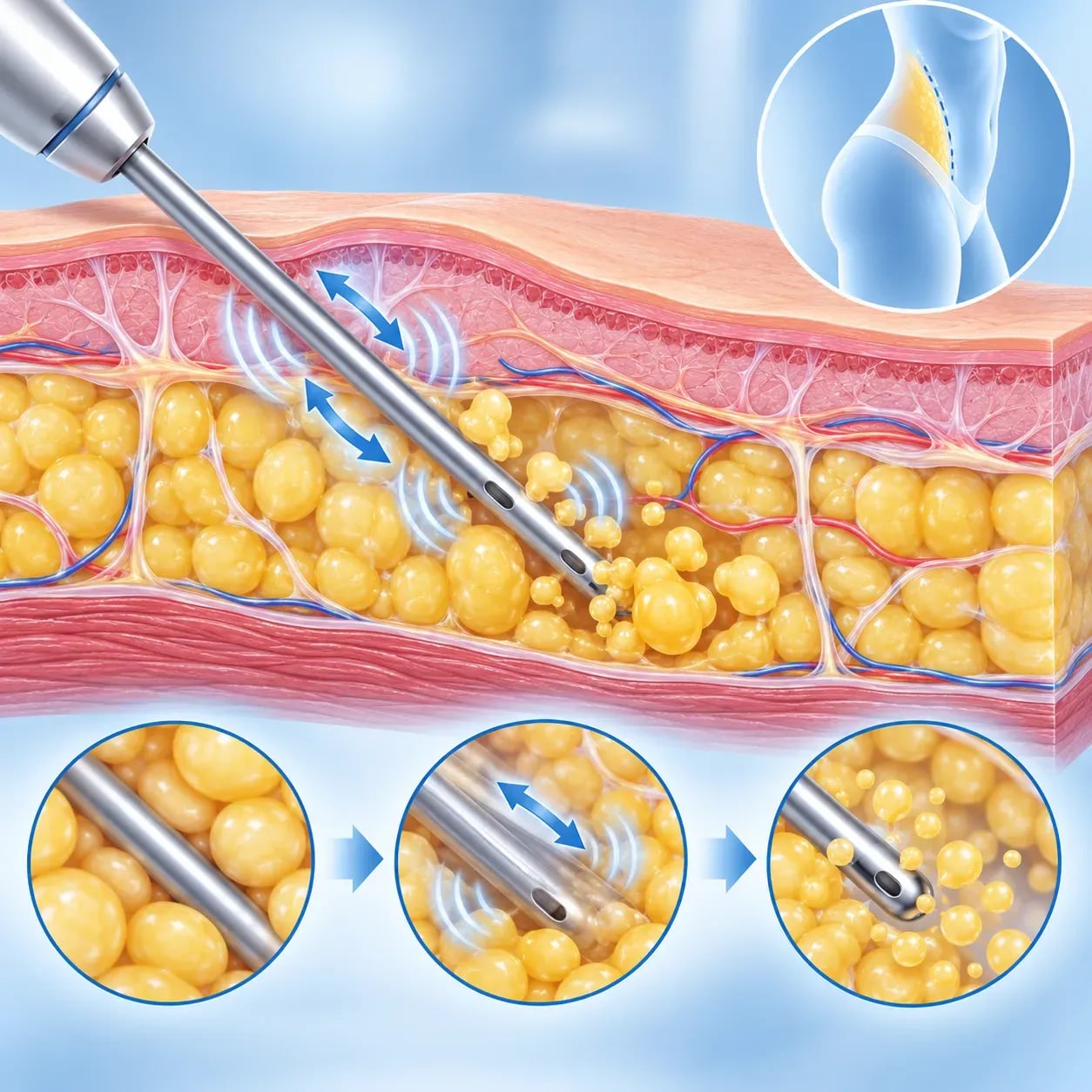
MicroAire is power-assisted liposuction (PAL). A small motor makes the cannula move rapidly back and forth, so it advances through fat with far less physical effort from the surgeon. No energy is delivered into your tissue — no ultrasound, no heat, no plasma. The mechanism is purely mechanical.
That single fact explains both of its uses. Large volumes and several areas in one session, because the surgeon's pass stays consistent from the first area to the last rather than degrading over three hours of manual work. And revision of a previous liposuction, because tissue that has already been operated on is fibrous and scarred, and an assisted cannula moves through it more evenly than one driven by hand alone.
What MicroAire does not do is anything to your skin. If your skin is loose, a vibrating cannula will not tighten it — that is Renuvion J-Plasma, or a lifting procedure. And it will not make your recovery easier: expect the same aches as conventional liposuction.
At ServiHealth it is performed at the Clinique Internationale Myron in Tunis, from €2,200 to €3,000 according to the number of areas, with a stay of 3 to 5 days. The arithmetic is simple: MicroAire adds a flat €500 to any standard liposuction package. One to three hours, under general or deep local anaesthesia.
And one honest note about price. MicroAire is the cheapest of the three assisted techniques, and that is because the technology costs less, not because it does a worse job. For a large multi-area procedure it is frequently the right choice on its merits, whatever the grid says.
What is MicroAire power-assisted liposuction?
In conventional liposuction the surgeon drives the cannula through the fat by hand, with repeated forward and backward movements. Across a long procedure covering several areas, that is physically demanding work, and fatigue is one of the things that makes a pass less even at the end than at the beginning.
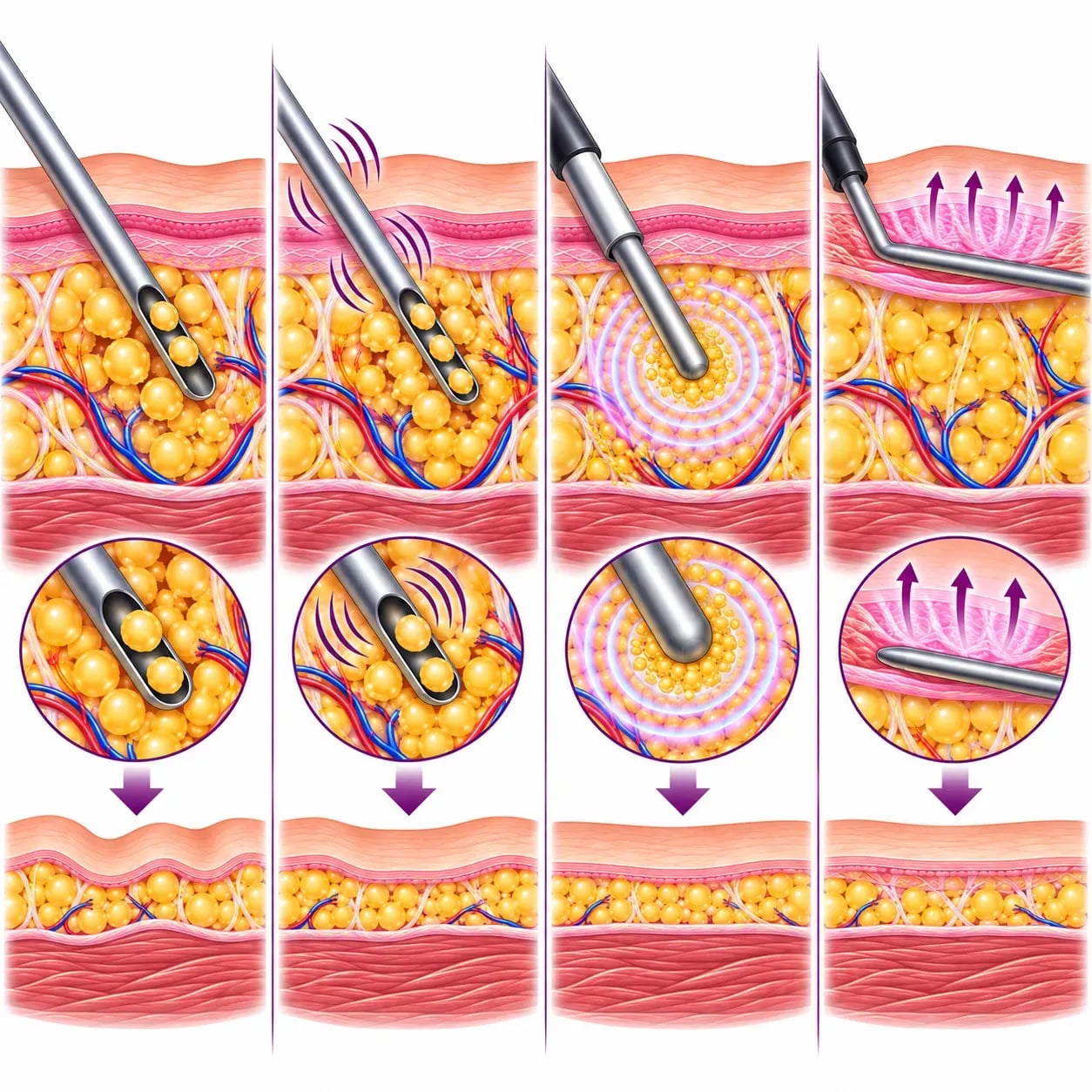
MicroAire puts a small motor behind the cannula. The tip vibrates rapidly, so it advances through tissue largely under its own movement. The surgeon guides direction and depth rather than supplying the force. This is what the abbreviation PAL — power-assisted liposuction — refers to.
What that changes, honestly stated:
- Consistency over a long operation. The pass at the end of a three-hour multi-area procedure is more like the pass at the start.
- Fibrous tissue becomes workable. Scar tissue from a previous liposuction, and naturally dense areas, resist a hand-driven cannula far more than a vibrating one.
- No thermal energy enters the tissue, so there is no risk of thermal burn. Ultrasound and plasma systems both deliver energy and both carry that risk.
And what it does not change, which matters just as much:
- It does not tighten skin. Nothing mechanical does.
- It does not make recovery easier. Expect the same swelling, bruising and aching as conventional liposuction.
- It does not remove the common risks of liposuction, including contour irregularity.
Power-assisted liposuction is long established in plastic surgery. It is a mechanical refinement of a standard operation rather than a new category of treatment, which is also why it carries no device-specific safety warnings of the kind attached to energy-based systems.
Which areas can be treated?
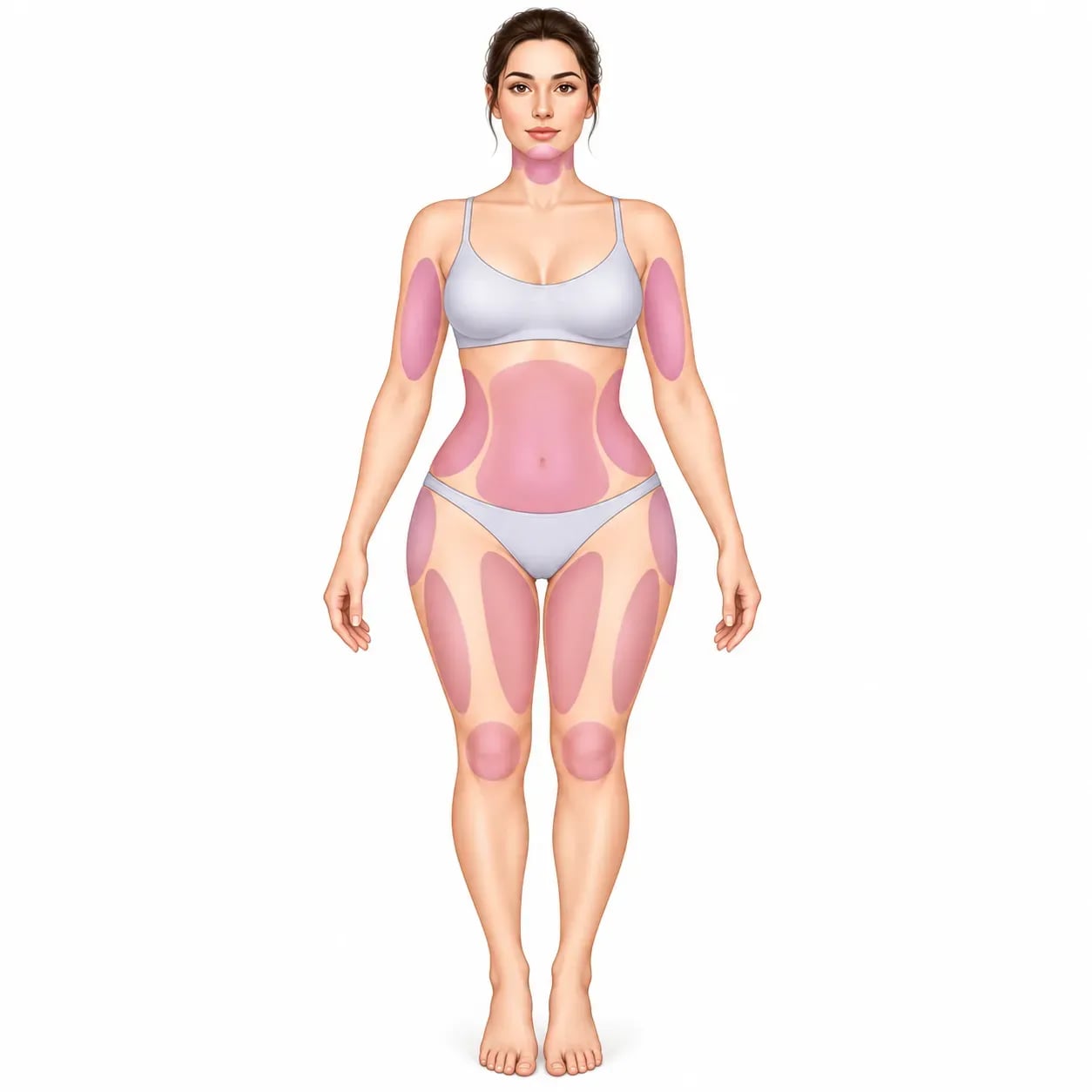
Abdomen and waist, flanks and back, hips and saddlebags, thighs and knees, arms, and the neck and under the chin. In practice MicroAire is most often chosen when several of these are treated in one session, which is exactly the situation it is designed for.
| Area | Notes |
| Abdomen and waist | The commonest request. Stretched skin or separated muscles after pregnancy call for a tummy tuck instead. |
| Flanks and back | Dense, fibrous fat that resists a hand-driven cannula — a good fit for an assisted one. |
| Hips and saddlebags | Often treated with the abdomen and flanks as a 360° package. |
| Thighs and knees | Where the skin is also slack, your surgeon may propose combining with J-Plasma; for real excess, a thigh lift. |
| Arms | Marked laxity of the inner arm is an arm lift, not a liposuction. |
| Neck and under the chin | Small volumes, where the skin still has good elasticity. |
Notice the pattern in that right-hand column. Every limit on this page is a skin limit, not a fat limit. MicroAire removes fat efficiently wherever there is fat to remove; what decides whether you are happy is whether the skin over it can retract. That is assessed by examination, never from a photograph.
The real ceiling on how many areas you treat at once is not the package but the volume of fat that can be aspirated safely in one operation. Your surgeon sets it, and it does not move because of the technique.
What is MicroAire best suited to?
Two situations, and they are the reason this page exists separately from the one on standard liposuction.
1. Large volumes and several areas in one session
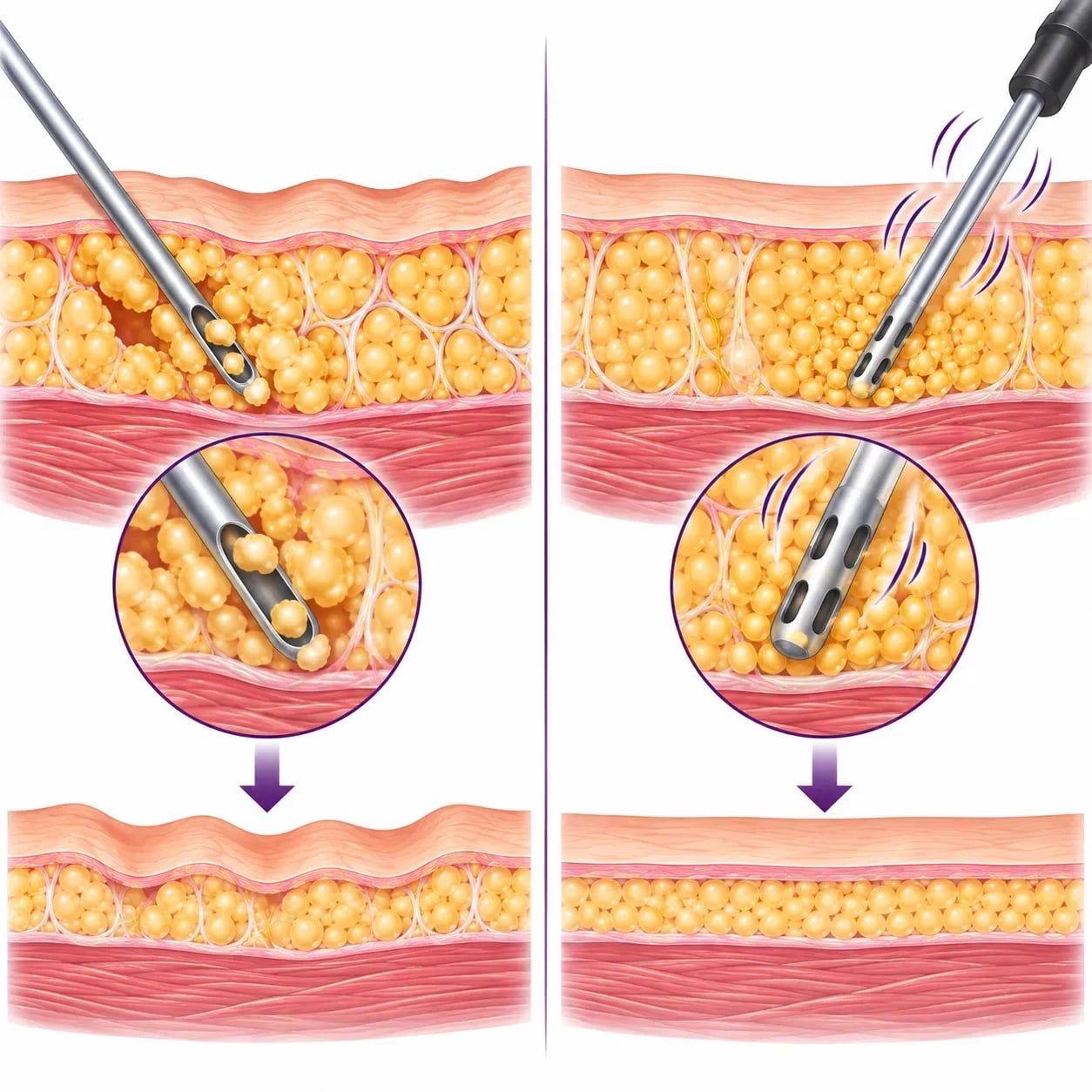
A liposuction covering the abdomen, waist, flanks and back is three hours of repetitive manual work. The pass a surgeon makes in the third hour is not identical to the one made in the first, and unevenness is how contour irregularity happens. An assisted cannula supplies the movement, so the surgeon supplies only direction and judgement, and consistency holds across the whole operation.
This is why MicroAire is so often the technique behind a 360° procedure or a five-area package.
2. Revision of a previous liposuction
Tissue that has been operated on once is not the tissue it was. Scarring makes it fibrous and uneven, and a hand-driven cannula tends to skip over the dense parts and catch on the soft ones — which is precisely what you do not want when you are correcting an irregularity rather than creating one. A vibrating cannula advances through scarred tissue far more evenly.
Revision is covered in full further down this page, because it deserves more than a paragraph and because the expectations around it need setting honestly.
And what it is not for
- Loose skin. No mechanical technique tightens skin. That is J-Plasma for mild laxity, or a lifting procedure for real excess.
- Fine muscular definition. Sculpting an already-lean patient is where ultrasound-assisted VASER is usually preferred.
- A single small area on firm skin. Standard liposuction does that perfectly well, and the €500 buys you nothing.
A surgeon who tells you the standard technique is enough for your case is giving you the better answer, not the cheaper one.
Are you a candidate?
The procedure suits someone in good health, at a stable weight, with localised fat that has resisted diet and exercise — and, specifically for this technique, either a significant volume to remove, several areas to treat, or a previous liposuction to correct.
| If this is you | What usually fits better |
| One small area, firm skin | Standard liposuction — the assistance earns nothing on a short, simple case |
| Your skin is slack as well as the fat being excess | Liposuction with J-Plasma for mild laxity |
| Real excess skin, after pregnancy or major weight loss | A tummy tuck, arm lift or thigh lift |
| Significant excess weight | Weight management first — gastric balloon, gastric band or gastric bypass in Tunisia |
| You want the harvested fat used | MicroAire combined with a BBL in the same session |
The procedure is postponed or ruled out in these situations, each assessed individually by the surgeon and the anaesthetist:
- Obesity or significant excess weight
- Skin lax enough to need removing rather than retracting
- Pregnancy or breastfeeding
- Active smoking that has not been stopped beforehand
- A bleeding or clotting disorder
- Any condition that contraindicates general anaesthesia
If you are considering this for a revision, say so from the first contact and send the operative report of the first procedure if you have it, together with photographs from before it. A revision assessed without that history is being assessed half-blind.
How much does MicroAire liposuction cost in Tunisia?
From €2,200 to €3,000, depending on how many areas are treated, with a stay of 3 to 5 days.
Read it as a surcharge and it becomes simple: MicroAire adds a flat €500 to any standard liposuction package. Nothing else about the operation changes — same areas, same anaesthesia, same stay, same recovery. The €500 buys the assisted handpiece and what it allows the surgeon to do over a long procedure.
So the question is narrow and answerable: is your case one where that assistance matters? Several areas, a large volume, or a revision — usually yes. One small area on firm skin — usually no, and your surgeon should say so.
What the price covers: the consultation, the procedure, the anaesthesia, the compression garment, the transfers and the follow-up after you return home.
What it does not cover: flights and the pre-operative tests, which you have done in your own country around fifteen days before.
Budget separately for a second compression garment, so you can alternate over four to six weeks, and for lymphatic drainage sessions near you if your surgeon recommends them. Ask us to confirm the accommodation line in writing for your own case before you book.
| Package | Areas | With MicroAire | Standard liposuction | Stay |
|---|---|---|---|---|
| Simple | 1 to 2 areas | 2200 € | 1700 € | 3 days |
| Medium | 3 to 4 areas | 2750 € | 2250 € | 4 days |
| 360° | Abdomen, waist, flanks, back | 2850 € | 2350 € | 4 days |
| Complete | 5 areas or more | 3000 € | 2500 € | 5 days |
MicroAire, VASER, J-Plasma or standard liposuction: which one?
They are not four grades of the same thing. They do different jobs, and the price order is not a quality order.
The useful way to decide is to ask what the obstacle is in your case. Is it the amount of fat and the number of areas? Is it fibrous or dense tissue, or fine definition on an already-lean body? Or is it the skin?
- Volume and several areas, or a revision → MicroAire. Mechanical assistance, no energy in the tissue.
- Fibrous zones and fine sculpting → VASER. Ultrasound breaks the fat up before it is removed.
- Mild to moderate skin laxity → J-Plasma. The only one of the four that addresses skin at all.
- One or two areas, firm skin → standard liposuction. Nothing else is needed, and nothing else should be sold to you.
Two of them can be combined: MicroAire removes the fat and J-Plasma tightens the skin over it, in the same operation, when both problems are present.
And the honest note on price. The grid runs from standard at €1,700 up to J-Plasma at €3,200 for the same single-area package, and it is tempting to read that as cheapest-to-best. It is not. It is a list of different tools with different costs. Paying €1,500 more for skin tightening you do not need buys you nothing, and the surgeon who tells you so is the one worth travelling to.
| Technique | How it works | Best suited to | From (1–2 areas) |
|---|---|---|---|
| Standard liposuction | Manual mechanical aspiration | Most volume-reduction requests, on firm skin | 1700 € |
| MicroAire (PAL) | Mechanical vibration, no thermal energy | Large volumes, several areas, revision liposuction | 2200 € |
| VASER | Ultrasound, selective fat fragmentation | Fibrous areas, sculpting and muscular definition | 2700 € |
| J-Plasma | Cold plasma, collagen contraction | Mild to moderate skin laxity | 3200 € |
Disappointed by a previous liposuction? Revision surgery
This section is for people who have already had a liposuction and are unhappy with it. Read the first paragraph before anything else.
Do not act quickly. Swelling after liposuction takes three to six months to resolve, and irregularity that looks permanent at eight weeks very often is not. A great many people who conclude their liposuction failed are looking at a result that has not finished arriving. Wait at least six months before judging it, and longer before operating on it.
Once it has genuinely stabilised, revision can address:
- Contour irregularity — dips, ridges and unevenness in the treated area
- Under-treated areas, where too little was removed
- Asymmetry between the two sides
And here is what it cannot do, stated plainly because nobody else will: revision works on what is still there. Fat that was removed cannot be put back by a liposuction — correcting an over-resected area means grafting fat into it, which is a different operation with its own uncertainties. Skin that has lost its elasticity will not regain it. And a second operation on scarred tissue is less predictable than the first was.
Why MicroAire for this. Previously operated tissue is fibrous and irregular. A hand-driven cannula tends to skip the dense parts and catch the soft ones, which is the opposite of what you want when you are smoothing a contour rather than reducing a volume. An assisted cannula advances through scar tissue far more evenly.
What to bring: the operative report of the first procedure if you have it, photographs taken before it, and photographs of the current result in consistent light. A revision assessed without that history is being assessed half-blind, and the honest surgeon will tell you so.
Expect a frank consultation. Some results can be substantially improved, some can be partly improved, and some are best left alone. You are entitled to be told which of the three you are.
Your pathway, step by step
ServiHealth organises and coordinates the stay. The medical decisions belong to the surgeon and the anaesthetist; everything around them is our work.
| Stage | What happens |
| First contact | You send photographs of the areas concerned and your medical history. For a revision, send the operative report of the first procedure and photographs from before it. A first review is carried out remotely before you spend anything. |
| Quote | A written quote naming the package, the areas planned, the technique recommended, what the price covers and what it does not. |
| Preparation | Pre-operative tests around 15 days before surgery, in your own country, following the protocol you are given. Dates and flights fixed. |
| Arrival | You are met at Tunis-Carthage airport. Send us your boarding pass and a photograph of what you are travelling in, so we can find you quickly. |
| Consultation | Examination by the surgeon: the areas, the texture of the fat, the quality of the skin, and whether the assisted technique is warranted in your case. The anaesthetic consultation follows. |
| Procedure | One to three hours at the Clinique Internationale Myron, under general or deep local anaesthesia. |
| Afterwards | A few hours of monitoring, or one night, depending on the extent. The compression garment is fitted. |
| Rest of the stay | Post-operative checks before you fly home. Three to five days in total according to your package. |
| After you return | Remote follow-up with a contact you can reach. Lymphatic drainage where recommended, arranged near you. The result is assessed from six months. |
The consultation can change the plan, and on this page it changes it in a particular direction: a surgeon who examines you may conclude that standard liposuction is enough, which costs you €500 less. That is the consultation working.
Tell us straight away about anything affecting the journey — a delayed flight, a changed booking, a missed connection, lost luggage.
Is MicroAire liposuction safe? Risks and precautions
MicroAire removes one category of risk and leaves all the others. Both halves of that sentence matter.
What it removes: because no thermal energy is delivered into the tissue, there is no risk of thermal burn. Ultrasound-assisted and plasma-assisted systems both deliver energy and both carry that risk. The page on J-Plasma sets out what that means in practice.
What remains, in full:
- Contour irregularities. The commonest imperfection after any liposuction. Assistance helps consistency; it does not eliminate the risk.
- Haematoma.
- Seroma — fluid collecting in the treated area. Generally less frequent than with ultrasound-assisted techniques.
- Temporary loss of sensation, common and usually resolving within weeks.
- Healing problems and, uncommonly, infection.
- Complications of anaesthesia, assessed at the anaesthetic consultation.
The volume removed in one session is capped by safety thresholds, and that limit does not move because the cannula is assisted. Aspirating large volumes shifts fluid in the body, and the complications that follow are the serious ones. A clinic willing to exceed that limit because you asked is not being accommodating.
Smoking deserves its own line. Nicotine narrows the small vessels the skin needs to heal and retract over the new contour. Stopping for the period your surgeon specifies is the most useful thing you can do for your own result.
Declare in full: all medication including anticoagulants, any bleeding or clotting disorder, all allergies, and every previous operation on the areas concerned — with dates, and with the operative report if it was a liposuction.
And the expectation to set honestly: no technique guarantees a smooth result. Results vary from one patient to another, and your surgeon will tell you at the consultation what is realistic for your skin and your anatomy.
How long is recovery?
Back to non-strenuous work in five to ten days, sport at three to four weeks, and four to six weeks in the compression garment. Recovery is comparable to conventional liposuction — the technique changes how the surgeon works, not how you feel afterwards.
| When | What to expect |
| First days | Swelling, bruising and strong aches in the treated areas. Prescribed painkillers are generally sufficient. Walking from the first day. |
| Around 1 week | The aching eases noticeably. |
| 5 to 10 days | Back to work, provided it involves no physical effort. |
| Weeks 1 to 6 | Compression garment worn continuously, then tapered as your surgeon directs. Lymphatic drainage in the early weeks if recommended. |
| 3 to 4 weeks | Sport resumes, on your surgeon's advice. |
Because MicroAire is often chosen for several areas at once, plan for more immobility than you would after a single-area liposuction. Four areas means four sore areas, and getting out of a chair is harder than you expect in the first week.
Wear the garment. Four to six weeks continuously controls swelling and helps the skin settle evenly over the new contour — it is one of the main things separating a smooth result from an irregular one. Pack a second one so you can alternate while the first is washed.
Lymphatic drainage may be recommended in the first weeks, at your surgeon's discretion. It happens after you are home, so check what is available near you before you travel.
When will I see the final result?
Between six and twelve months. That is longer than most people expect, and it is the single most useful thing on this page for anyone planning around a date.
What happens in between:
- First weeks. Swelling hides the new shape entirely. You may look larger than before the operation. This is normal.
- Three months. The outline begins to be visible. Minor unevenness is common at this stage and often resolves on its own.
- Six months. Close to the result. This is the earliest point at which judging it is meaningful — and the earliest point at which a revision should even be discussed.
- Twelve months. Settled.
Photograph yourself before you travel, in consistent light and the same positions, and again at three, six and twelve months. By the time the result arrives you will have stopped remembering accurately what you started with, and people routinely underestimate their own outcome for exactly that reason.
About durability: the fat cells removed do not grow back, but the ones that remain can enlarge if you gain weight, and new weight tends to settle in the areas that were not treated. The result holds as long as your weight does.
Results vary from one patient to another, and your surgeon will tell you at the consultation what is realistic in your case.
Your surgeons
MicroAire liposuction at ServiHealth is performed by qualified plastic surgeons at the Clinique Internationale Myron in Tunis.
- Dr Taher Djemal — plastic and aesthetic surgery, practising in Tunisia since the early 1990s, who uses MicroAire in particular for large-volume procedures.
- Dr Abir Ben Ouaghrem — plastic and aesthetic surgery, with particular attention to revision surgery and fibrous tissue.
The surgeon assigned to your case is named in your quote before you travel, and you meet them in person before anything is decided.
Questions worth asking at that consultation:
- Does my case actually warrant the assisted technique, or would standard liposuction do the same job?
- How many areas would you treat in one session, and what volume do you expect to remove?
- Looking at my skin, do you expect it to retract well over the areas we are treating?
- If this is a revision: what can realistically be improved, and what cannot?
- What would make you advise against operating on me?
The first question is the one that tells you most. A surgeon willing to say that the €500 surcharge would buy you nothing is a surgeon whose other advice you can rely on.
Which technique to use, on which areas, and whether to operate at all is a medical decision and belongs to the surgeon, not to ServiHealth.
Why have MicroAire liposuction in Tunisia?
Tunisia has run an organised medical travel sector for decades: private clinics built around international patients, surgeons trained to European standards, and costs that reflect Tunisian overheads rather than shortcuts in the operation.
What matters specifically for this technique:
- Multi-area procedures become affordable. This is where the price difference compounds: a five-area MicroAire liposuction at €3,000 is a different proposition from the same operation priced in Western Europe.
- Revision is often where patients travel. A second operation at home, on top of what the first one cost, is what stops many people from correcting a result they dislike.
- Distance. Two to three hours from most of Western Europe, with direct connections from several Gulf hubs.
- English throughout, from the first exchange to the follow-up after you are home.
Three things to weigh honestly:
- The result takes six to twelve months and you will spend it at home. Everything that decides whether you are happy — the garment, the swelling, the drainage, the skin settling — happens where you live.
- Several areas means a harder first week. Plan for genuine help at home, not just time off.
- If this is already a second attempt, be clear about what happens if it is not enough. Ask before you book, and get the answer in writing.
Many patients combine this with a BBL, using the harvested fat — and with a large-volume liposuction there is often more of it to work with. That is sensible when surgically coherent and poor when driven by the travel budget. Your surgeon decides what can reasonably be done in one session.
Before you travel: a checklist
Work through this before you book, not the week before you fly.
| Category | What to do |
| Documents | A valid passport, and a visa if your nationality requires one for Tunisia. Check the expiry date. |
| Photographs | Recent photographs of each area, front and side, in natural light — and keep them. The result takes six to twelve months and you will not remember accurately what you started with. |
| If this is a revision | The operative report of the first procedure, and photographs taken before it. Send them with your first message, not on arrival. |
| Pre-operative tests | Completed in your own country around 15 days before, following the protocol you are given. |
| Medication and allergies | A full list, anticoagulants included, plus any bleeding or clotting disorder. |
| Previous surgery | Every previous operation on the areas concerned, with dates. |
| Weight | Stable for several months, with no strict diet in the preceding weeks. |
| Smoking | Stop for the period your surgeon specifies. |
| Lymphatic drainage | Check what is available near you and what it costs, in case it is recommended. The sessions happen after you are home. |
| To pack | The compression garment is provided — bring a second one so you can alternate over four to six weeks. Loose, comfortable clothing that fits over it. |
| Help at home | If several areas are being treated, arrange for someone to be around for the first few days. Getting out of a chair is harder than you expect. |
| Your calendar | Five to ten days before desk work, three to four weeks before sport, and no dated event you want to look your best for inside six months. |
Considering more than one procedure in the same stay? Read the relevant pages first: standard liposuction, Renuvion J-Plasma, BBL, tummy tuck or arm lift in Tunisia. What can reasonably be combined in one session is decided by your surgeon.







Breast Augmentation
I had my surgery with ServiHealth, and I highly recommend their services. The team was very professional, and I'm extremely satisfied with my experience. ServiHealth offers various breast surgery procedures, including breast augmentation and breast reduction, to meet different needs.

Cam Naf
FranceFrequently asked questions about MicroAire Power-Assisted Liposuction in Tunisia
From €2,200 to €3,000, depending on how many areas are treated, with a stay of 3 to 5 days. The simplest way to read it: MicroAire adds a flat €500 to any standard liposuction package. The price covers the consultation, the procedure, the anaesthesia, the compression garment, the transfers and the follow-up after you return. Flights and the pre-operative tests are not included.
No. It costs less than VASER or J-Plasma because the technology costs less, not because it does a worse job. The three are not ranked on one scale: MicroAire assists the mechanical removal of fat, VASER breaks fat up with ultrasound before removing it, and J-Plasma adds energy to tighten skin. For a large-volume or multi-area procedure, MicroAire is frequently the right choice regardless of price.
They solve different problems. MicroAire is a vibrating cannula that moves through fat more easily, with no energy delivered into the tissue — chosen for large volumes, several areas in one session, and revision surgery. VASER uses ultrasound to break up fat before it is aspirated, and is favoured for fibrous areas and fine definition. J-Plasma adds plasma energy under the skin to tighten mild laxity, and does nothing for fat that liposuction has not already removed. The surgeon chooses after examining you.
The assistance makes the surgeon's pass through the tissue more regular, which helps over a long procedure across several areas. It does not eliminate the risk: contour irregularity remains the commonest imperfection after any liposuction, and wearing the compression garment as instructed matters at least as much as the technique. No technique guarantees a smooth result.
Power-assisted liposuction is long established and widely used in plastic surgery. It is a mechanical refinement of conventional liposuction rather than a new category of treatment, which is also why it carries no device-specific safety warnings of the kind attached to energy-based systems.
It is one of the techniques most often chosen for it. Tissue that has already been operated on is fibrous and scarred, and a cannula that advances under its own vibration passes through it more easily and more evenly than one driven by hand alone. Revision is more demanding than a first operation and the results are less predictable, so the consultation matters more, not less.
It is not safer overall, and anyone telling you otherwise is simplifying. What is true is specific: MicroAire delivers no thermal energy into the tissue, so it carries no risk of thermal burn, which ultrasound and plasma systems do. It also carries every risk common to liposuction — irregularities, haematoma, fluid collection, temporary numbness, anaesthetic complications. The right comparison is which technique suits your case, not which is safest in the abstract.
Yes, and that is one of the reasons it is chosen. Because the cannula advances with less effort, the surgeon's pass stays more consistent across a long operation covering several areas. The ceiling is not the number of areas but the volume of fat that can be removed safely in one session, which your surgeon sets after examining you.
Three to five days, depending on the package: 3 days for simple, 4 for medium and 360°, 5 for the complete package. That covers the consultation, the procedure, the monitoring and the first post-operative checks before you fly home.
First, do not act quickly. Swelling takes three to six months to settle and irregularity often improves on its own in that time, so a result that looks wrong at two months is frequently not the final one. Once it has genuinely stabilised, a revision can address contour irregularities, areas that were under-treated, and asymmetry. Bring the operative report of the first procedure if you have it, and photographs from before it. Be told honestly what revision can and cannot fix: it works on what is there, and it cannot undo tissue that was removed.
Usually at least six months, and often longer. Two reasons: the result is not final before then, and the tissue needs time to settle before being operated on again. A surgeon who offers to revise at three months is working on something that is still changing. Use the waiting time to document the result properly with photographs in consistent light.
Expect strong aches in the treated areas, comparable to conventional liposuction rather than milder. Prescribed painkillers are generally sufficient and the discomfort usually eases after the first week. The technique changes how the surgeon works, not how recovery feels — and we would rather tell you that than promise an easier recovery you will not get.
It is one of its principal uses. Over a long procedure removing a large volume, the assisted cannula reduces the physical effort of each pass and helps keep the surgeon's movement consistent from the first area to the last. The volume removable in one session is still capped by safety thresholds, and that limit does not move because of the technique.
Yes. The fat removed can be purified and used to reshape the buttocks in the same session — and because MicroAire is often chosen for larger-volume procedures, there is frequently more harvested fat to work with. Whether it suits your anatomy is decided by the surgeon at the consultation.