

Gastric Band in Tunisia: Reversible, Adjustable, and Its Limits

Gastric band in Tunisia: the essentials
The gastric band is the only weight-loss operation that is fully reversible and adjustable. Nothing is cut, nothing is removed, and if it does not suit you it can be taken out and your stomach returns to its original shape.
It is also the operation that has fallen furthest out of favour. Across the UK, Europe and the United States it is now placed far less often than it was fifteen years ago, because weight loss is slower and more modest than with a gastric sleeve or a gastric bypass, and because more bands need a second operation over the long term.
We have kept this page honest rather than promotional, because this is a decision where the drawbacks matter as much as the advantages. If a band is not right for you, we would rather you knew that before booking a flight.
Gastric Band in Tunisia: Key Information
| Procedure Details | Information |
|---|---|
| Operating time | About 1 hour, by keyhole surgery |
| Anaesthetic | General |
| Stay in Tunisia | 5 days |
| Expected weight loss | 40 to 60% of excess weight, gradually |
| Off work | 1 to 2 weeks |
| Price | €3,400 |
Should you still have a gastric band?
The honest answer is: only in specific circumstances, and only if one practical condition is met.
The band may be the right choice if reversibility genuinely matters to you, if you are not willing to have part of your stomach permanently removed, if gradual weight loss suits you better than rapid loss, or if another procedure has been ruled out.
The band is probably the wrong choice if you want the largest and most durable weight loss available, if you would struggle to attend regular adjustment appointments, or if you want something you can have done and then forget about. A band is not a one-off operation. It is a device that needs managing for as long as it is in place.
And one condition decides everything: you must know who will adjust your band once you are home. A band nobody can adjust is worse than no band at all. There is a full section on this below, and we would ask you to read it before anything else on this page.
If after reading it you are not certain, say so when you contact us. A sleeve, a bypass or a gastric balloon may suit remote follow-up considerably better, and Dr Ayadi will tell you so directly.
How a gastric band works
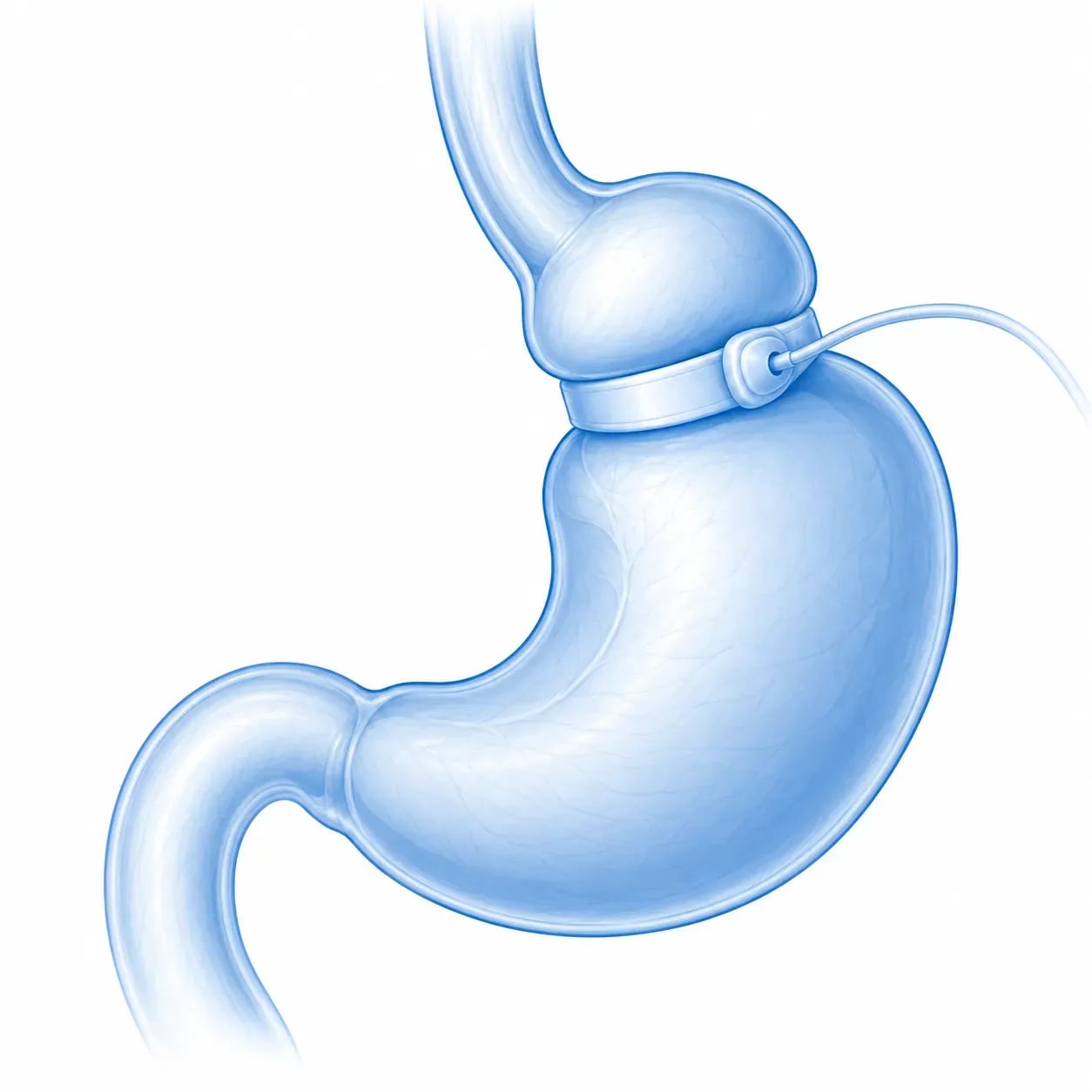
A soft silicone ring is placed around the upper part of the stomach, creating a small pouch above it. Food reaches that pouch first, and because it is small, you feel full after a much smaller meal.
Nothing is cut and nothing is removed. The stomach is unchanged underneath the band, which is exactly why the procedure is reversible. This is the single feature that distinguishes it from every other weight-loss operation.
The band is placed by keyhole surgery through several small incisions, not through one long one, and the operation takes around an hour.
It is a purely mechanical device. It does not alter the hormones that govern hunger, which is why weight loss is slower than with a sleeve or a bypass, and why what you eat and how you eat it matter more here than with any other procedure.
Gastric band or weight-loss injections?
This is now the first question most people ask, and it deserves a straight answer rather than a sales pitch.
The injections — semaglutide and tirzepatide, sold as Wegovy and Mounjaro — work on appetite hormones, require no operation and no anaesthetic, and can be stopped. They have changed what a realistic non-surgical option looks like, and for many people they are a sensible first step. They also have to be taken continuously, cost money every month for as long as you take them, cause side effects in a significant number of people, and weight is commonly regained once they are stopped.
A band is a one-off cost and a physical restriction that does not depend on remembering a weekly injection. It also involves surgery, a device that stays in your body, adjustment appointments, and a real chance of further surgery years later.
They are not mutually exclusive. Some people use medication first and consider surgery later; others have surgery and use medication afterwards if weight loss stalls. If you have not yet tried medical treatment and you are at the lower end of the weight range, trying it first is a reasonable thing to do, and any surgeon worth consulting will say so.
This is a conversation to have with a doctor who knows your full history, not a comparison to settle from a web page.
Band, sleeve, bypass or balloon: what actually differs
| Band | Sleeve | Bypass | Balloon | |
|---|---|---|---|---|
| What happens | A ring around the upper stomach | Part of the stomach permanently removed | Stomach and intestine rerouted | A balloon placed in the stomach by endoscopy |
| Surgery | Keyhole | Keyhole | Keyhole | No surgery, no incision |
| Reversible | Yes, fully | No | Complex | Yes, it is removed |
| Adjustable | Yes | No | No | No |
| Weight loss | Gradual, more modest | Greater and faster | Greater and faster | Temporary, while in place |
| Follow-up needed | Regular adjustments | Nutritional | Nutritional, lifelong supplements | Short term |
| Further surgery later | Most likely of the four | Less common | Less common | Not applicable |
| Price | €3,400 | €3,950 | €4,150 | €2,500 or €2,800 |
There is no procedure that is best for everyone. The band wins on reversibility and on nothing else; the sleeve and the bypass win on weight loss; the balloon avoids surgery entirely but is temporary. All prices are on the prices page.
The question that decides it: who adjusts your band at home?
Read this section before you decide anything else.
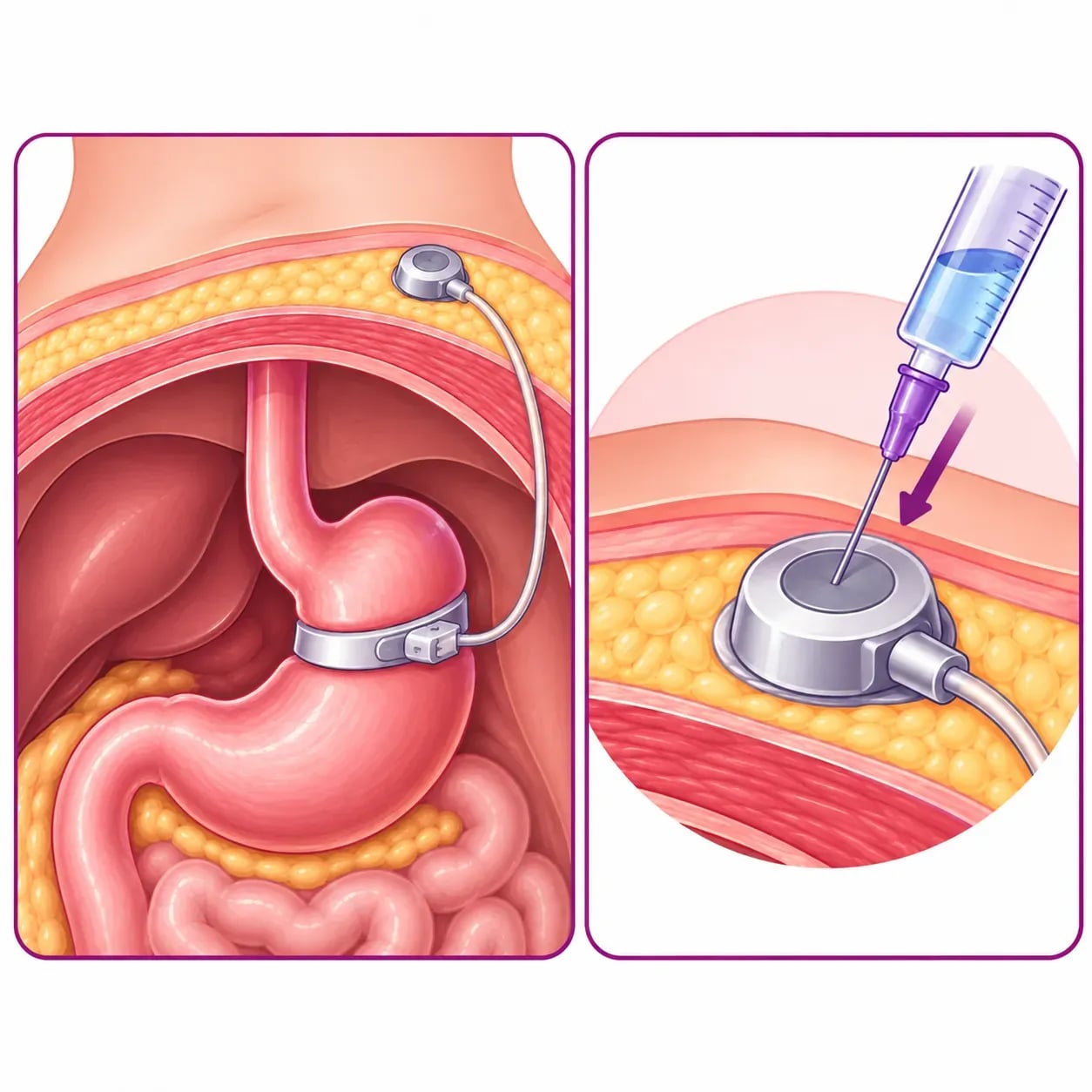
A small port sits under the skin of your abdomen, connected to the band by a thin tube. Tightening or loosening the band means adding or removing fluid through that port with a needle. It is quick, it is done in a consultation or under X-ray guidance, and it must be done by a trained health professional.
You will need several adjustments in the first year. A band left too loose does nothing at all. A band left too tight causes vomiting and can make slippage more likely. Getting it right takes repeated small changes over months.
Do not assume the NHS will take this on. Aftercare for surgery carried out privately abroad is not guaranteed, policies differ between trusts, and a band placed overseas can be difficult to get adjusted on the NHS. The same uncertainty applies to many private insurers. In the Gulf, private bariatric clinics are generally easier to arrange this with, but it still needs confirming rather than assuming.
So, before you book: find the clinic or practitioner who will adjust your band, and get it confirmed in writing, with the cost per adjustment. If you cannot find one, tell us. We will say plainly that the band is not the right procedure for you, and discuss a sleeve or a bypass instead.
What we do during your stay: the band is placed with little or no filling. Your first adjustment is usually needed four to eight weeks later, typically around week six, so it will take place at home rather than in Tunisia.
What you take home: a technical document giving the band model, its reference, the fill volume and our contact details. Keep it as you would an implant card. Whoever adjusts your band will need it.
How you will know an adjustment is due: if you stop feeling full and your weight stalls, the band is probably too loose. If you are vomiting, struggling to swallow or getting reflux, it is probably too tight. Contact us in both cases — the second is more urgent than the first.
Who is a candidate, and what the guidelines say
A band may suit someone who wants a reversible procedure, who prefers gradual weight loss, who does not want part of their stomach removed, and who has reliable access to adjustments.
On weight thresholds. The 2022 ASMBS and IFSO guidelines recommend weight-loss surgery from a BMI of 35 regardless of other conditions, and recommend considering it from a BMI of 30 where there is metabolic disease such as type 2 diabetes, or where non-surgical treatment has not produced lasting results. For people of Asian background the threshold considered is 27.5. In the UK, NICE applies its own criteria, which are stricter again for NHS treatment.
What this means in practice: your eligibility is assessed against your BMI, your medical history, your previous attempts at weight loss and your general health, and the decision belongs to the surgeon after a full consultation. Nobody can tell you from a web page whether you qualify, and you should be cautious of any provider who says yes before examining you.
A band is less likely to be the right answer if you have significant reflux, a large hiatus hernia, an eating pattern built around grazing or sweet foods, or no realistic access to adjustments.
What a gastric band costs in Tunisia
€3,400, for a 5-day stay.
Included: the surgeon's and anaesthetist's fees, the CE-certified band itself, the hospital stay, hotel accommodation, airport pickup and transfers, and assistance throughout your stay.
Not included: flights, your pre-operative tests at home, and — importantly — your adjustments once you are home, which are charged by whoever carries them out, at their own rates. Factor that into the total before you compare prices.
Also not included: long-term nutritional follow-up, which continues with your own doctor.
| Procedure | Price | Stay |
|---|---|---|
| Gastric band | €3,400 | 5 days |
| Gastric sleeve | €3,950 | 5 days |
| Gastric bypass | €4,150 | 5 days |
| Gastric balloon, 6 months | €2,500 | Short stay |
| Gastric balloon, 12 months | €2,800 | Short stay |
| Sleeve revision | €4,200 | 5 days |
Band removal is quoted individually after your case has been reviewed, including for a band placed by another clinic. Send us the operative report and we will come back with a figure. The full list is on the prices page, and a personalised quote takes 24 to 48 hours.
| Procedure | Price | Stay |
|---|---|---|
| Gastric Band | €3,400 | 5 days |
Your pathway, step by step
- Get in touch from home. Tell us your height, weight, medical history and what you have already tried. A quote and an initial opinion come back within 24 to 48 hours.
- Confirm who adjusts your band at home before you book anything else. This step is not optional.
- Preparation. Pre-operative tests around fifteen days before you travel, and stop smoking several weeks beforehand. Our preparation guide covers what applies to every procedure.
- Arrival. You are met at Tunis-Carthage and transferred.
- Consultation with Dr Sofiene Ayadi and the anaesthetist, who confirm that the band is the right procedure for you.
- The operation, about an hour under general anaesthetic at Myron International Clinic.
- Hospital stay, then a post-operative check and the start of your new eating pattern.
- Home, with your band document, dietary instructions and remote follow-up.
Two risks specific to the band
Beyond the risks common to any operation under general anaesthetic, two problems belong specifically to the band, and they are the main reason it is placed less often than it used to be.
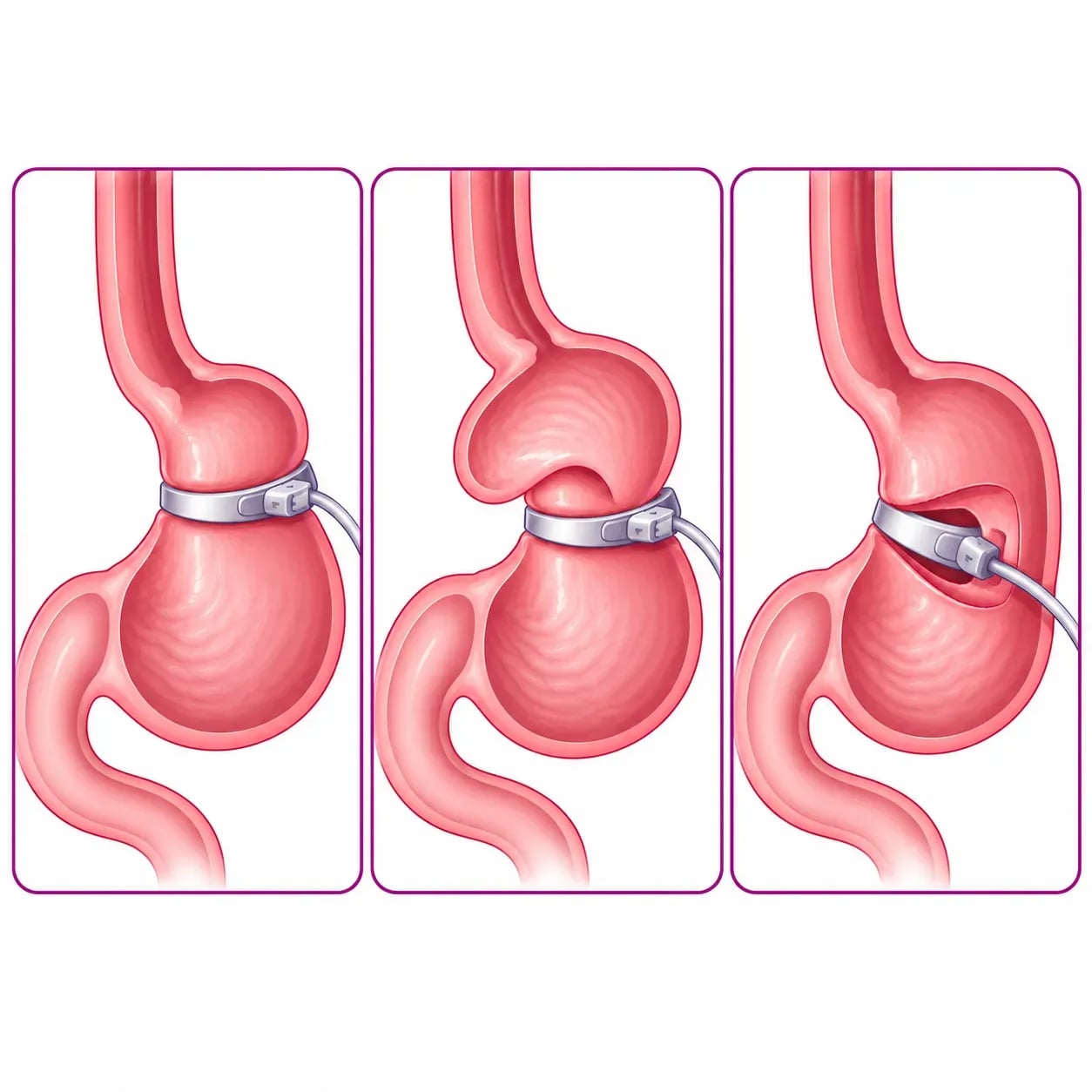
Slippage. Part of the stomach moves up through the band, which changes how it works and usually causes vomiting or difficulty eating. It generally requires a further operation to reposition or remove the band. Persistent over-tightening and repeated vomiting make it more likely, which is why adjustment matters so much.
Erosion. The band gradually works its way into the stomach wall. It is rarer, it develops slowly, and it means the band has to be removed.
Neither can be ruled out, and no honest surgeon will promise you otherwise. What reduces them is correct adjustment, eating slowly and in small quantities, and reporting symptoms early rather than putting up with them.
Tell us about: frequent vomiting, difficulty swallowing, new or worsening reflux, pain, or redness and swelling over the port. None of those are things to live with.
Living with a band day to day
A band changes how you eat more than it changes how hungry you feel, which means your habits do much of the work.
The rules that matter: eat slowly, chew far more than feels necessary, stop at the first sense of fullness rather than at the plate being empty, do not drink while eating, and keep moving.
Foods that commonly get stuck: fresh bread, fibrous meat, rice, sticky pasta, citrus segments and anything stringy. Tolerance varies between people and usually improves over the first months.
If something sticks: stop eating, stay calm, sip warm water and wait. It passes. Seek medical advice if it lasts several hours or if you cannot swallow your own saliva.
Vomiting is never normal. An occasional episode after eating too fast is a lesson. Frequent vomiting means the band is too tight or has slipped, and it needs reporting rather than tolerating.
The port under your skin can sometimes be felt, particularly if you are slim. It does not restrict movement or exercise.

Pregnancy with a band
Pregnancy is possible with a band, and the band can be loosened during it and tightened again afterwards. That adjustability is a genuine advantage over a sleeve or a bypass.
Pregnancy is generally advised 12 to 18 months after the operation, once your weight has stabilised. Tell your midwife and obstetrician that you have a band, and make sure you know who can loosen it — this is another reason access to adjustments matters.
If significant loose skin remains after you have finished losing weight and having children, a tummy tuck may be discussed later, once your weight has been stable for several months.
Band removal, and conversion to a sleeve or bypass
Removing a band is a planned, straightforward keyhole operation, and it is a normal part of the band's life rather than a failure.
Reasons bands are removed: slippage, erosion, intolerance, a problem with the port, or weight loss that has not been enough.
Weight is commonly regained after removal unless eating habits have genuinely changed. This is worth knowing before the band goes in, not after it comes out.
Conversion. Removal can be combined with, or followed by, a sleeve or a bypass. Whether it is done in one operation or two is a decision for the surgeon, based on the state of the stomach wall.
If your band was placed somewhere else, including in the UK, Ireland or elsewhere in Europe, we can review it for removal or conversion. Send the operative report and the band's model document if you have them, and photographs are not needed for this. We will come back with an opinion and a quote.
Your surgeon
Dr Sofiene Ayadi is the bariatric surgeon at Myron International Clinic and performs band, sleeve and bypass procedures.
He will compare the three with you directly, including the drawbacks of each, and he will tell you if the band is not the right choice for your situation. On a procedure like this, a surgeon willing to talk you out of something is the one you want.
Getting to Tunisia
From the UK and Ireland: around three hours from London, with connections from other UK and Irish airports. British and Irish passport holders do not currently need a visa for a short tourist stay — but see the note below.
From the Gulf: daily flights from Dubai with Emirates, around six and a half to seven hours, and from Doha with Qatar Airways, around six. Tunisia is two to three hours behind the Gulf, so follow-up calls fall inside the working day at both ends.
From continental Europe: direct flights of 1h30 to 3h from Paris, Brussels, Geneva, Lyon and Marseille, with no visa for EU and Swiss nationals.
From West and Central Africa: regular connections from Dakar, Abidjan, Douala, Libreville and Casablanca, with help on visa formalities where needed.
Entry requirements follow your nationality, not your country of residence. This catches expatriates out constantly: a resident of Dubai or London holding an Indian, Pakistani, Nigerian or Filipino passport does not have the same conditions as a British or Emirati national, and a residence permit changes nothing. Check with the Tunisian embassy for your country of citizenship before booking.
How long each procedure needs is set out in our guide to lengths of stay.
Before you travel: a checklist
- Your adjustment provider, confirmed in writing, with the cost per visit. The single most important item on this list.
- Documents: a passport valid well beyond your return date, and a visa if your nationality requires one.
- Your digestive history: reflux, hiatus hernia, previous abdominal surgery, swallowing problems. Tell us all of it — some of it changes the recommendation.
- Pre-operative tests done at home around fifteen days before.
- A written list of your medication, supplements and allergies.
- Contraception, and tell us if you are planning a pregnancy.
- Stop smoking several weeks beforehand.
- Tell your GP before you go, not after. Give them the band document when you return.
- Prepare for the post-operative diet: liquids, then puree, then soft food. Stock up before you travel rather than after.
- Loose clothing, with nothing tight across the abdomen.
- On the flight home: aisle seat, get up and walk regularly, drink water.
- Book one to two weeks off work.
Request a quote and you will have an answer within 24 to 48 hours.









Breast Augmentation
I had my surgery with ServiHealth, and I highly recommend their services. The team was very professional, and I'm extremely satisfied with my experience. ServiHealth offers various breast surgery procedures, including breast augmentation and breast reduction, to meet different needs.

Cam Naf
FranceFrequently asked questions about Gastric Band in Tunisia
A gastric band is €3,400 with ServiHealth for a 5-day stay. That covers the surgeon's and anaesthetist's fees, the CE-certified band, the hospital stay, hotel accommodation, airport transfers and assistance. Flights, your pre-operative tests and your adjustments once you are home are not included.
The band is placed far less often than it was fifteen years ago, because weight loss is slower and more modest than with a sleeve or bypass, and because more bands need further surgery over the long term. It still suits people who specifically want a reversible, adjustable procedure and who have reliable access to adjustments. If you do not have that access, a sleeve or bypass is usually the better choice.
Weight-loss injections require no surgery and can be stopped, but they have to be taken continuously, cost money every month, and weight is commonly regained when they stop. A band is a one-off cost and a physical restriction, but it involves surgery, a device that stays in your body, regular adjustments and a real chance of further surgery later. If you have not yet tried medical treatment and you are at the lower end of the weight range, trying it first is reasonable. Discuss it with a doctor who knows your full history.
You must arrange this before you travel. Adjustments are made by a trained health professional, in a consultation or under X-ray guidance, and you will need several in the first year. Do not assume the NHS will take it on: aftercare for surgery carried out privately abroad is not guaranteed and policies differ between trusts. Find your provider, confirm it in writing with the cost per visit, and tell us if you cannot — we will recommend a different procedure.
Several during the first year, then occasional ones. The first is usually needed four to eight weeks after the operation, so it takes place at home rather than in Tunisia. The aim is enough fullness to eat less while still eating normally, and it takes repeated small changes to get there.
No. Adjustments carried out in your own country are charged by whoever performs them, at their own rates. An adjustment during a dedicated return stay in Tunisia carries a separate fee, stated on your quote. Include this in the total before you compare prices.
Yes, fully. The band can be removed by keyhole surgery and the stomach returns to its original shape, because nothing was cut or removed when it was placed. This is the one thing the band does that no other weight-loss operation does.
Typically 40 to 60% of excess weight, lost gradually rather than quickly. How much you actually lose depends heavily on how you eat and on the band being correctly adjusted, more so than with any other procedure. Nobody can give you a guaranteed figure.
A band is a ring placed around the upper stomach: nothing is removed, and it is reversible and adjustable. A sleeve permanently removes part of the stomach and cannot be reversed. The sleeve generally produces greater and faster weight loss; the band offers reversibility and little else in its favour.
Slippage is when part of the stomach moves up through the band, usually causing vomiting or difficulty eating, and it generally needs further surgery. Erosion is when the band gradually works into the stomach wall; it is rarer, develops slowly and means the band must be removed. Both are the main reason the band is placed less often today.
No. An occasional episode after eating too quickly is a lesson about eating more slowly. Frequent vomiting means the band is too tight or has slipped, and it should be reported rather than tolerated, because repeated vomiting itself makes slippage more likely.
Fresh bread, fibrous meat, rice, sticky pasta, citrus segments and anything stringy are the usual culprits. Tolerance differs between people and generally improves over the first months. The rules that matter most are eating slowly, chewing thoroughly and stopping at the first sense of fullness.
Stop eating, stay calm, sip warm water and wait — it passes. Seek medical advice if it lasts several hours or if you cannot swallow your own saliva.
The 2022 ASMBS and IFSO guidelines recommend weight-loss surgery from a BMI of 35 regardless of other conditions, and recommend considering it from a BMI of 30 where there is metabolic disease such as type 2 diabetes or where non-surgical treatment has not worked; for people of Asian background the threshold considered is 27.5. NICE applies its own, stricter criteria for NHS treatment in the UK. Your own eligibility is assessed by the surgeon against your full history, not against a number alone.
Not for surgery performed abroad. In the UK the NHS funds bariatric surgery only against NICE criteria and through its own pathway, and private medical insurance often excludes it. Check with your GP or insurer before assuming either way, and ask specifically about aftercare, which is a separate question from funding the operation.
Yes. The band can be loosened during pregnancy and tightened afterwards, which is a genuine advantage over a sleeve or bypass. Pregnancy is generally advised 12 to 18 months after the operation, once your weight has stabilised. Make sure you know who can loosen it, and tell your midwife and obstetrician that you have a band.
Yes. We review bands placed elsewhere, in the UK, Ireland or anywhere else, for removal or for conversion to a sleeve or bypass. Send the operative report and the band's model document if you have them, and we will come back with an opinion and a quote.
Weight is commonly regained after removal unless eating habits have genuinely changed. This is worth knowing before the band is placed rather than after it comes out. Where appropriate, conversion to a sleeve or bypass is discussed at the same time.
Yes. It can be done in a single operation or in two, and the surgeon decides based on the condition of the stomach wall. Sleeve revision is priced at €4,200; a conversion from a band is quoted individually once your case has been reviewed.
The small port can sometimes be felt, particularly if you are slim, but it does not restrict movement or exercise. Report any pain, redness or swelling over it.
Five days. That covers the consultation with Dr Ayadi and the anaesthetist, the operation, the hospital stay and a post-operative check before you fly. Your first band adjustment will be needed four to eight weeks later, at home.
No. Keep your band's technical document with you when you travel in any case, as it identifies the model and fill volume and is what any clinician treating you will ask for.