

Dentures, Crowns and Bridges in Tunisia: Removable, Fixed or Implant-Retained
Dentures, crowns and bridges in Tunisia: the essentials
Replacing missing teeth comes down to three routes, and the right one depends less on your budget than on how many teeth are gone and what state the remaining ones are in.
- Removable — a partial or full denture, resting on the gum. No surgery. From €650 for a partial, €750 for a full arch.
- Fixed — a crown or a bridge, cemented in place. €450 per unit.
- Implant-retained — a denture clipped onto implants, or a fixed arch screwed onto them. From €2,490 to €4,490 per arch.
The stay is 5 to 10 days with 2 to 4 appointments, depending on what is being made: assessment, extractions if needed, impressions, a try-in, then fitting and adjustments.
Each route has a cost that is not on the price list, and this page states all three. A bridge means cutting down the healthy teeth either side of the gap, permanently. A removable denture sits on bone that slowly shrinks once the roots are gone, so the fit loosens over the years and needs relining. An implant avoids both but costs more and involves surgery.
What matters for a patient travelling is the practical consequence: a prosthesis is not finished when you fly home. Dentures need adjusting, relining after a few years, and an annual check even if you have no natural teeth left. Before you book, know who will do that where you live and what it will cost.
If you are weighing this against fixed teeth on implants, read our page on dental implants in Tunisia.
Removable or fixed: the main families
Four families, and the examination decides which apply to you. Most patients end up choosing between two of them rather than four.
| Type | What it is | Suits |
| Crown | A cap cemented over a damaged tooth that still has a usable root. | One broken or heavily restored tooth. |
| Bridge | Replacement teeth carried by crowns on the teeth either side of the gap. Fixed, never removed. | One or two missing teeth with sound teeth either side. |
| Partial denture | Removable, in resin or on a metal framework, clasping onto the remaining teeth. | Several missing teeth, or gaps too spread out for a bridge. |
| Full denture | A complete arch, held by suction on the gum. Removable. | A jaw with no teeth left. |
The resin versus metal-framework choice on a partial denture is worth two sentences. Resin (€650) is thicker and is often used as a transitional solution. A metal framework (€850) is thinner, more rigid and more comfortable to wear long term, and it distributes the load better across the remaining teeth. If this is a prosthesis you expect to wear for years, the €200 is usually well spent.
Above these four sits a fifth option — a denture retained by implants — which solves the stability problem that removable prostheses have. It has its own section below.
How much does a dental prosthesis cost in Tunisia?
Prices are per item, so a quote is built from what you actually need rather than from a package.
How a bridge is counted. At €450 per unit, and the count includes the anchor teeth, not just the gap. One missing tooth means three units — the two teeth either side plus the replacement — so €1,350. Two missing teeth side by side means four units, €1,800. Every clinic costs bridges this way; knowing it makes quotes comparable.
A worked example. A full upper denture with three extractions: €750 + (3 × €120) = €1,110.
What the price covers: the consultation, the dental assessment, the impressions, the laboratory work, the try-in, the fitting, the adjustments during your stay, and the transfers.
What it does not cover: flights, accommodation, extractions (listed separately above), any preliminary treatment your mouth needs first, and personal expenses.
Two questions to settle in writing before you travel, because they are the ones that change the real total. Does anything need treating before the prosthesis can be made — decay, gum disease, an infection? And what would a reline cost later, here or where you live? A denture that fits perfectly today will need refitting in a few years; that is not a defect, it is how jaws behave.
| Type of prosthesis or treatment | Price |
|---|---|
| Single crown | 450 € |
| Bridge, per unit | 450 € |
| Partial denture, resin | 650 € |
| Partial denture, metal framework | 850 € |
| Full denture, one arch | 750 € |
| Full denture, both arches | 1 350 € |
| Simple extraction | 120 € |
| Denture reline | 200 € |
Prosthesis or implant: what is the difference?
An implant replaces the root. Everything else replaces only what shows. That single distinction explains every other difference between them.
| Bridge or denture | Implant | |
| What is replaced | The visible tooth | The root and the tooth |
| Neighbouring teeth | A bridge requires cutting them down, permanently | Untouched |
| The bone | Continues to shrink where roots are missing | Stimulated by the implant, which limits the loss |
| Surgery | None, apart from any extractions | Yes, with healing time |
| Cost | Lower up front | Higher up front |
The row that decides it for most people is the third one. Bone shrinks where there is no root, steadily and permanently. A denture sits on that bone and follows it down; an implant slows the process in the area around it. Over ten or fifteen years that is not a cosmetic detail — it changes the shape of the lower face and how well anything removable can fit.
Which does not mean the implant is always the answer. It costs more, it requires surgery and healing, it needs enough bone to begin with, and it is not suitable for everyone. The useful comparison is not price today but what you will be doing about this in ten years, and that is a conversation to have at the consultation with your X-ray in front of you.
Read our page on dental implants in Tunisia for what that route involves.
Implant-retained dentures and All-on-4
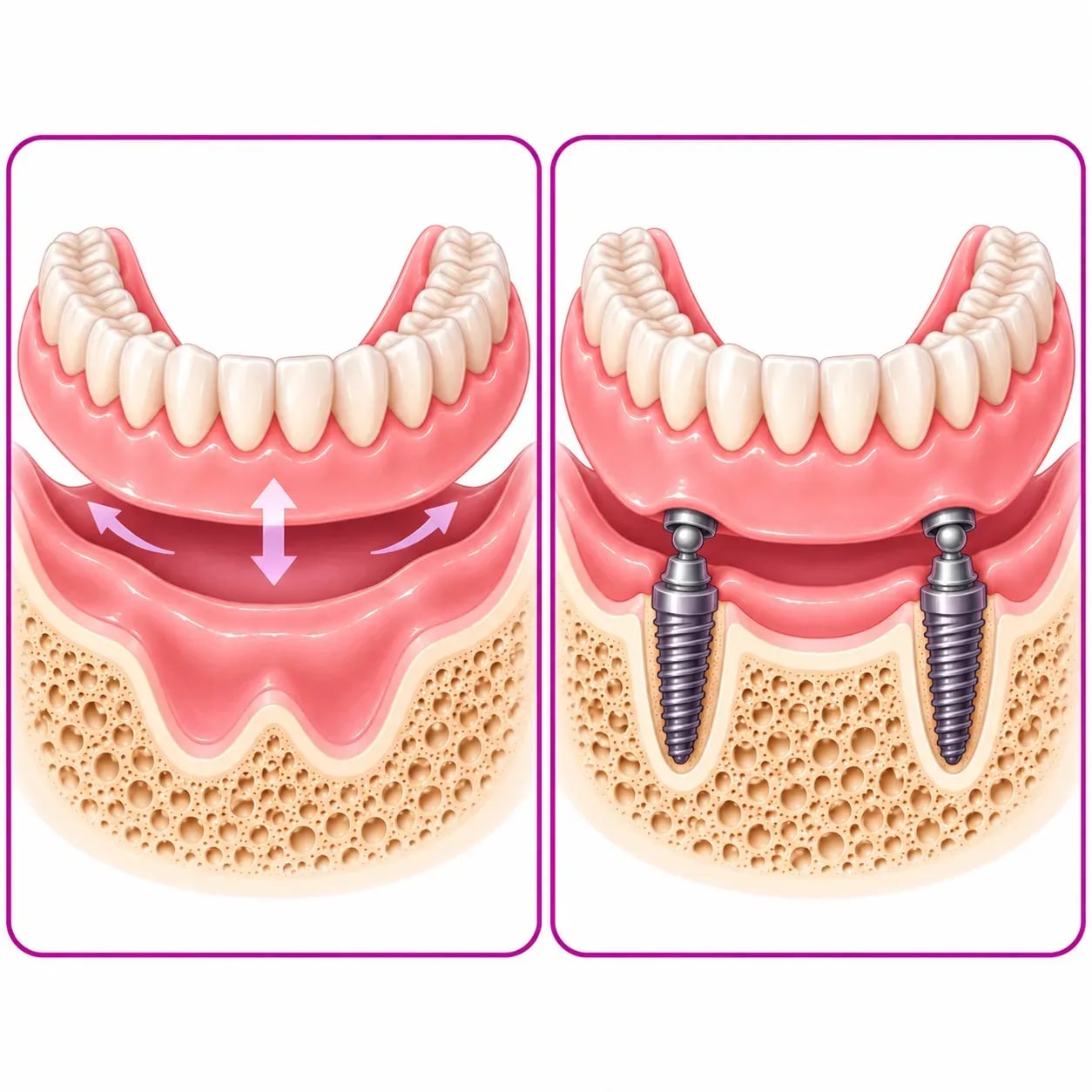
Between a denture that rests on the gum and a fixed arch screwed into the jaw, there is a range — and for many patients with no teeth left, the middle of that range is the sensible place to be.
What the implants buy is stability, which is the thing conventional dentures are worst at. A lower denture in particular has very little to hold onto, and the difference between one that moves when you eat and one clipped onto two implants is the difference between managing your food and forgetting about your teeth.
Clipped, or All-on-4?
A clipped denture — on two implants at €2,490, or four at €3,490 — still comes out for cleaning. Many people find that easier to keep hygienic, and it costs less. The denture is held firmly in place while you wear it and unclips when you want it out.
All-on-4, at €4,490 for the arch, is a complete set of fixed teeth screwed onto four implants. You never remove it; it is cleaned in the mouth, like natural teeth. It is the closest of all these options to having your own teeth back, and it is the one that most changes what you can eat.
Neither is better in the abstract. All-on-4 suits someone who wants to stop thinking about a removable prosthesis altogether; a clipped denture suits someone who prefers to clean it out of the mouth, or whose budget settles the question. Both stop the denture moving, which is the problem they exist to solve.
All implant-retained options, All-on-4 included, require enough bone to place the implants in, and that is assessed on an X-ray before anything is promised. If the bone is not there, the options are grafting or a conventional denture, and your dentist will say which.
Read our page on dental implants in Tunisia for what placing the implants involves.
| Full-arch solution | How it is held | Price |
|---|---|---|
| Conventional full denture | By suction on the gum | 750 € |
| Denture stabilised on 2 implants | Clipped onto 2 implants, removable | 2 490 € |
| Denture stabilised on 4 implants | Clipped onto 4 implants, removable | 3 490 € |
| All-on-4, fixed solution | Screwed in place, never removed by you | 4 490 € |
Fixed bridges: what it costs the neighbouring teeth
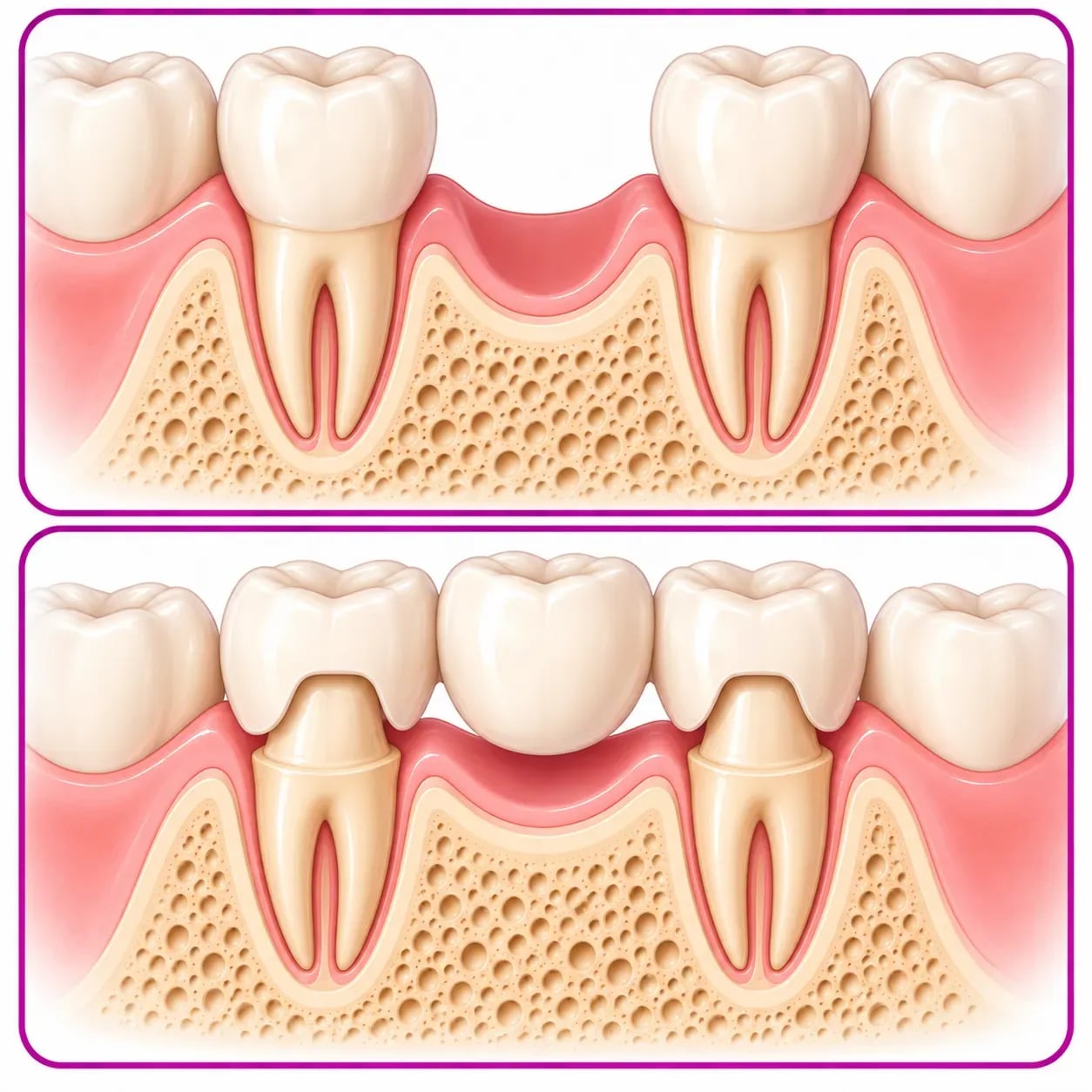
A bridge does not float. It is carried by the teeth either side of the gap, and to carry it, those teeth are cut down so crowns can be fitted over them. That enamel does not grow back.
This is the honest trade-off of a bridge, and it is not a reason to rule one out — it is a reason to know which situation you are in:
- The neighbouring teeth are already crowned, heavily filled or damaged. Then little is being sacrificed; they were going to need work anyway, and a bridge treats all three teeth at once. Here a bridge is often the obvious answer.
- The neighbouring teeth are intact and healthy. Then you are cutting two sound teeth to replace a third. That is a real price, and it is the single strongest argument for an implant, which leaves them untouched.
Two further points that rarely get said. A crowned tooth can still decay underneath, at the margin where the crown meets the tooth, and that decay is harder to spot. And if one anchor tooth fails later, the whole bridge usually has to come off, which means the problem is no longer confined to one tooth.
Against that, a bridge is quicker, needs no surgery, costs less up front and lasts ten to fifteen years with good care. Both sets of facts are true. Your dentist will tell you which weighs more in your mouth, after looking at your X-ray.
Removable dentures and what happens to the bone
This is the part of removable dentures that is least often explained, and the one that determines what your next ten years look like.
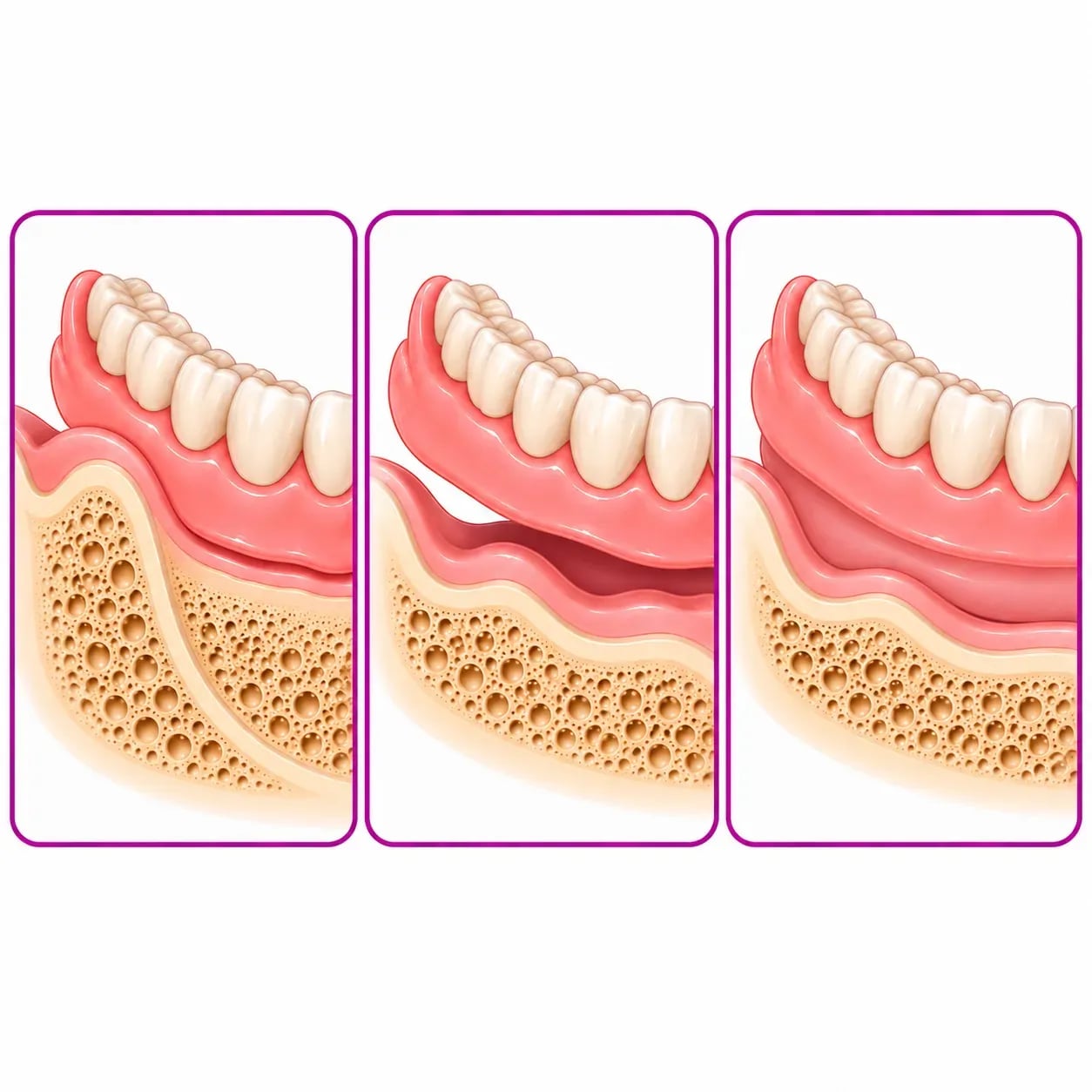
Tooth roots keep the jawbone alive. Every time you bite, the roots transmit load into the bone and the bone maintains itself in response. Remove the roots and that stimulus disappears, so the ridge the denture rests on slowly shrinks. The process is fastest in the first year after extractions and continues, more slowly, for the rest of your life.
Three consequences follow:
- The denture loosens. It has not changed shape; your mouth has. A denture that fitted perfectly at delivery can be moving noticeably three or four years later.
- Relining becomes necessary. The inner surface is re-adapted to the new shape of the gum, for €200, rather than the whole prosthesis being remade.
- Eventually it is replaced, typically after five to eight years.
None of this is a fault in the prosthesis. It is the predictable consequence of having no roots, and any clinic that does not mention it is leaving you to discover it on your own.
It is also the strongest practical argument for implants, in the one place where it is often affordable: two implants under a lower denture both stabilise it and slow the bone loss in that area. At €2,490 for the arch, that is a different calculation from full fixed teeth.
Whichever route you take, plan for a review. A denture is not a one-off purchase, and budgeting for a reline in a few years is realism rather than pessimism.
Should teeth be extracted before the prosthesis?
Both sequences work, and they suit different situations. The choice is made on your X-ray, not in advance.
| Extractions at home, months ahead | Extractions during the stay | |
| The gum | Has healed and settled before impressions are taken | Is still changing shape when the prosthesis is made |
| The fit | Generally better, and stable sooner | Needs more adjustment, and relining sooner |
| Logistics | Two separate processes, in two countries | Everything in one stay — €120 per simple extraction |
| In the meantime | You spend those months with the gaps | An immediate provisional prosthesis can be fitted straight away, or after a few days |
An immediate prosthesis is a provisional one. It is fitted over a gum that is still healing, so it does its job — you are not left without teeth — but it will need adjusting and, in time, relining or replacing. It is not the finished article and should not be sold to you as one.
What must happen before any prosthesis, in either sequence: active decay treated, gum disease treated, any infection or abscess cleared. Building a prosthesis over untreated disease is building on sand, and it is why the assessment comes first.
And a tooth that can be saved is generally worth saving, because its root preserves the bone around it. The decision to extract is clinical, not a shortcut.
Are you a candidate?
Almost anyone missing teeth is a candidate for something — the question is which of the options fits your mouth, not whether you qualify. Removable prostheses in particular need very little preparation and involve no surgery.
What has to be dealt with first:
- Active decay
- Untreated gum disease
- Any infection or abscess
- Poor oral hygiene, which has to be addressed before fixed work in particular
What to declare at the consultation, because each of these changes the plan:
- Anticoagulants and any bleeding disorder, especially if extractions are planned
- Diabetes, which affects healing of the gums
- Bisphosphonates or any bone-related medication, current or past. This matters a great deal if extractions or implants are being considered, and it is often forgotten because the medicine has nothing to do with teeth.
- Allergies, including to metals and resins
What each option needs specifically: a bridge needs healthy enough teeth either side of the gap to carry it. Implant-retained options need enough bone. A conventional denture needs neither, which is why it remains the answer in situations where nothing else is possible.
All of this is assessed from a recent panoramic X-ray. Send one with your first message if you have it — it is the difference between a reliable quote and an estimate.
Your pathway, step by step
ServiHealth organises and coordinates the stay. The clinical decisions belong to the dentist; everything around them is our work.
| Stage | What happens |
| First contact | You send a recent panoramic X-ray if you have one, photographs of your smile and both arches, and your medical history. This is what makes a reliable quote possible. |
| Quote | In writing, itemised: what is planned, how many units, what is included and what is not. Ask for the length of stay in writing at this point, before booking flights. |
| Preparation | Any infection treated at home beforehand. Extractions done in advance if that is the plan agreed. |
| Arrival and assessment | You are met at Tunis-Carthage. The dentist examines you and confirms, adjusts or reconsiders the plan. |
| Extractions, if needed | €120 per simple extraction. A provisional prosthesis may be fitted immediately or after a few days. |
| Impressions | Taken for the laboratory, which makes the prosthesis to measure. |
| Try-in | Shape, fit, colour and bite are checked and corrected before the prosthesis is finished. |
| Fitting and adjustments | Placement, then the adjustments that make it comfortable. These are part of the stay — use them. |
| After you return | Remote follow-up with a contact you can reach. Keep your treatment record for the dentist where you live. |
Two to four appointments across 5 to 10 days, depending on what is being made. A single crown is at the short end; a full arch with extractions is at the long one.
The days between appointments are the laboratory's. Ask when you book how your particular case is scheduled, so you know which days are free and which are not — it makes a real difference to how the stay feels.
Use the adjustment appointments before you fly. A pressure point corrected in Tunis takes five minutes. The same pressure point at home is a dentist you have to find, explain yourself to, and pay.
The adaptation period
A new prosthesis feels wrong before it feels right, and that is not a sign that it is wrong.
For most people, days to a few weeks. For a first full denture, two to three months is entirely normal. Knowing that figure in advance is the difference between persevering and giving up in week two.
What to expect, and what to do about it:
- Pressure points. Small painful spots where the prosthesis presses. These are adjusted, not endured — say so during your stay and it is corrected the same day.
- Increased saliva, or a feeling of bulk. Both settle as the mouth stops treating the prosthesis as a foreign object.
- Speech. Certain sounds are awkward at first. Reading aloud for a few minutes a day, alone, genuinely accelerates this.
- Eating. Start with soft food cut small, and chew on both sides at once rather than one — that is the single most useful habit with a removable denture, and it is the opposite of what feels natural.
Do not stop wearing it because it is uncomfortable. The mouth adapts to what is there, and a denture left in a drawer for a week sets the process back to the beginning. The exception is genuine pain or an ulcer, which needs adjusting rather than tolerating.
And one honest limit: a removable denture will never feel exactly like your own teeth. Very hard, very sticky and very chewy foods stay harder. That gap is precisely what implant-retained options close, and it is why they exist.
Daily care
How long a prosthesis lasts depends more on this section than on anything else on the page.
A removable denture
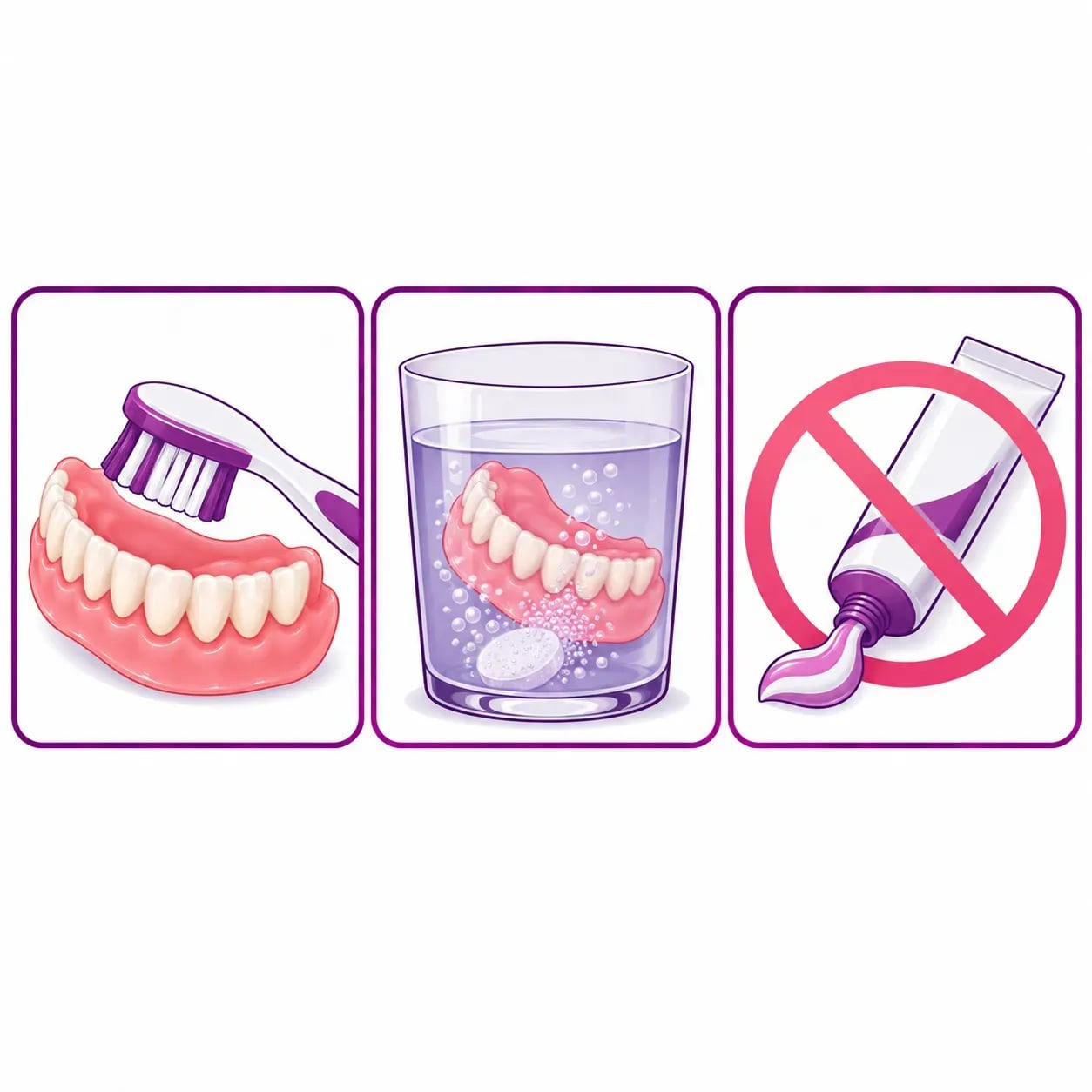
- Take it out and clean it after meals, with a brush kept for that purpose.
- Use a product intended for dentures, not ordinary toothpaste. Toothpaste is abrasive: it creates micro-scratches that hold stain and bacteria, and it dulls the surface permanently.
- Clean over a basin of water or a folded towel. Most dentures that break, break on a bathroom floor.
- Clean your gums and any remaining teeth separately, with a soft brush. The prosthesis is not the only thing in your mouth.
- At night, follow your dentist's instruction on whether to remove it, and if you do, keep it in water or solution so it does not dry out and distort.
Crowns and bridges
- Brush twice a day as normal. A crowned tooth can still decay at the margin where the crown meets the tooth.
- Clean under a bridge. This is the part people skip and the part that matters: floss threaders or interdental brushes reach beneath the replacement tooth, where a normal floss cannot go. Ask to be shown how before you leave the clinic.
Everyone
An annual check, even with no natural teeth left. The dentist verifies the fit against a jaw that keeps changing, examines the gums, and looks at the soft tissues of the mouth for things that have nothing to do with teeth. Having nothing left to fill is not a reason to stop being examined.
Repairs, relines and replacement
A prosthesis is maintained, not simply bought. Three things happen over its life, and it helps to know the vocabulary before you need it.
| What it is | When | |
| Adjustment | A pressure point relieved, a small correction to the fit. | During your stay, and in the weeks after. |
| Reline — €200 | The inner surface is re-adapted to a gum that has changed shape. The prosthesis is refitted, not replaced. | Typically after a few years, as the bone reduces. |
| Replacement | A new prosthesis. | Removable: 5 to 8 years. Fixed bridge: 10 to 15 years. |
If it breaks: do not glue it. Household adhesives are toxic in the mouth, they make a proper laboratory repair far harder and sometimes impossible, and a badly reassembled denture no longer fits — which damages the gum underneath it. Keep every fragment and take it to a dentist.
Where the work gets done matters practically. A reline or a repair does not require flying back: a dentist where you live can do both, and that is usually the sensible answer two or three years after your stay. Keep your treatment record — what was made, from what, when — and give it to them. It saves time and avoids guesswork.
If something does not feel right once you are home, contact us rather than waiting for the annual check. Most fit problems are small if addressed early and become larger if they are not.
Your dentist
Dental prosthetic work at ServiHealth is carried out by Dr Fedia Mtaallah, at the Clinique Internationale Myron in Tunis.
You meet her at the start of the stay. She examines you, reviews your X-ray, and confirms, adjusts or reconsiders what was planned remotely — the first opinion is based on images and what you describe, and the plan is set in person.
Questions worth asking at that appointment:
- Which option would you choose if this were your own mouth?
- What material is my crown or bridge being made from?
- Looking at my X-ray, can the teeth either side carry a bridge, or should I be considering an implant?
- How many units is my bridge being costed at, and which teeth are included?
- How long before this needs relining, and what should I expect to pay for that at home?
- What would you treat first, before making anything?
The second question is one patients rarely ask and should. A crown at €450 can be made from several different materials, and they do not look the same, wear the same or cost the laboratory the same. Ask what yours is, and have it written on your quote.
What to make, from what, and whether anything needs treating first is a clinical decision and belongs to the dentist, not to ServiHealth.
Why have dental work in Tunisia?
Tunisia has run an organised medical travel sector for decades, with clinics built around international patients and costs that reflect Tunisian overheads rather than shortcuts in the work.
What matters specifically for prosthetic dentistry:
- The arithmetic works on quantity. One crown is rarely worth a flight. A full arch, several crowns or a bridge plus extractions is a different calculation entirely, and that is who this page is for.
- Everything happens in one stay. Assessment, extractions, impressions, try-in, fitting and adjustments across 5 to 10 days, rather than appointments spread over months.
- Adjustments are included while you are there, which is when a prosthesis actually becomes comfortable.
- English throughout, from the first exchange to the follow-up after you are home.
Three things to settle honestly before you book, because they are specific to having dental work abroad:
- Who adjusts it in month three? Pressure points and small fit problems appear after you are home. Identify a dentist where you live who is willing to see you, before you travel rather than after.
- What happens if something fails? Ask what the arrangement is if a crown debonds or a denture cracks in the first year, and get the answer in writing. This is a fair question and a clinic should have a clear answer.
- Keep your records. Your treatment record, your quote and your X-rays. Any dentist who treats you afterwards will need them, and reconstructing the information later is difficult.
None of that argues against travelling. It argues for arranging the after, before.
Before you travel: a checklist
Work through this before you book, not the week before you fly. On dental work, what you send in advance decides how accurate your quote is.
| Category | What to do |
| A recent panoramic X-ray | The single most useful thing you can send. It shows the teeth, the roots and the bone, and it is what turns an estimate into a reliable quote. Ask your own dentist for a copy. |
| Photographs | Your smile, and both arches, in natural light. |
| Documents | A valid passport, and a visa if your nationality requires one for Tunisia. |
| Treat infections first | Any abscess, active decay or gum disease, dealt with at home before you travel. Nothing can be made over untreated disease. |
| Your current prosthesis | Bring it, even if you no longer wear it. It tells the dentist a great deal about what has and has not worked for you. |
| Medication and allergies | A full list. Anticoagulants, diabetes and bisphosphonates in particular — the last one is routinely forgotten and matters most if extractions are planned. |
| Extractions | Agree in advance whether they happen at home months ahead or during the stay, and have it written on the quote. |
| Your quote, itemised | How many units, what material, what is included, how many days, how many appointments. In writing before you book flights. |
| A dentist at home | Identify who will adjust or reline it later, and roughly what they charge. Arrange this before you travel. |
| Your calendar | 5 to 10 days in Tunisia with 2 to 4 appointments, and realistic expectations for the weeks after: adaptation takes days to weeks, and two to three months for a first full denture. |
Considering other dental work during the same stay? Read our pages on dental implants, dental veneers and teeth whitening in Tunisia first. What can reasonably be combined in one stay is decided by your dentist.









Breast Augmentation
I had my surgery with ServiHealth, and I highly recommend their services. The team was very professional, and I'm extremely satisfied with my experience. ServiHealth offers various breast surgery procedures, including breast augmentation and breast reduction, to meet different needs.

Cam Naf
FranceFrequently asked questions about Dentures, Crowns and Bridges in Tunisia
A removable denture comes out: it rests on the gum, or clips onto implants, and you take it out to clean it. A bridge is fixed: it is cemented onto the teeth either side of the gap and stays in permanently. The bridge feels more like your own teeth, and it costs you the neighbouring teeth, which have to be cut down to carry it. The denture costs those teeth nothing, and asks you to live with something removable.
An implant replaces the root of the tooth and is the closest thing to a natural tooth. It costs more, requires surgery and healing time, and — the point that matters — it touches none of the neighbouring teeth. A bridge is quicker and cheaper but requires cutting the two teeth beside the gap. A denture requires no surgery at all. There is no universally better answer: it depends on how many teeth are missing, the state of the ones remaining, your bone, and your budget.
A crown is €450 and a bridge €450 per unit. A partial denture is €650 in resin or €850 on a metal framework. A full denture is €750 for one arch and €1,350 for both. A simple extraction is €120 and a reline €200. Implant-retained options run from €2,490 to €4,490 for a full arch. The full price list is in the section above.
Take it out and clean it after meals, with a brush kept for that purpose and a product intended for dentures — not ordinary toothpaste, which is abrasive and scratches the surface over time. Clean your gums and any remaining teeth separately. Keep it in water or in a solution overnight if your dentist advises it, so it does not dry out. And handle it over a basin of water or a folded towel: most dentures that break, break on a bathroom floor.
Because the bone underneath it slowly shrinks. Natural tooth roots stimulate the jawbone; once they are gone, that stimulation stops and the ridge the denture rests on gradually reduces. The denture does not change shape — the mouth does, and the fit between the two loosens. This is normal, it is not a fault in the prosthesis, and it is why relining exists.
They are cut down, which is irreversible. To carry a bridge, the teeth either side of the gap are reduced so crowns can be fitted over them, and that enamel does not grow back. If those teeth were already crowned or heavily filled, little is lost. If they are healthy and untouched, it is a real price to weigh — and it is the main argument for an implant, which leaves them alone.
Five to ten days, with two to four appointments depending on what is being made. The sequence is assessment, extractions if needed, impressions, a try-in, then fitting and adjustments. The length of your stay is confirmed once the plan is set, so ask for it in writing before you book flights.
Per unit, at €450 each — and the count includes the anchor teeth, not only the gap. One missing tooth needs a three-unit bridge: the two teeth either side plus the replacement, so €1,350. Two missing teeth side by side need four units, so €1,800. This is how bridges are costed everywhere, and it is worth understanding before comparing quotes.
Days to a few weeks for most people. For a first full denture, two to three months is normal, and that is not a sign that something is wrong. Speech and eating both take practice, and pressure points are expected early — they are adjusted rather than endured.
Pressure points are common with a new denture and they are adjusted, not tolerated. During your stay, say so and it is corrected the same day — that is part of what the appointments are for. Once you are home, do not file or trim it yourself and do not simply stop wearing it: contact us, and a small adjustment can usually be made by a dentist near you.
Relining re-adapts the inner surface of an existing denture to a gum that has changed shape, so it fits and holds again. It does not replace the denture — it refits it. At ServiHealth it costs €200, and it can also be done by a dentist where you live, which is often the practical answer two or three years after your stay.
Close to normally, with an adjustment period and some lasting limits. Start with soft food cut small, chew on both sides at once rather than one, and reintroduce harder textures gradually. Very hard, very sticky or very chewy foods remain more difficult with a removable denture than with your own teeth or with an implant-retained prosthesis — that difference is one of the honest arguments for the implant options.
Both are possible. Having extractions done at home a few months in advance lets the gum heal and settle before impressions are taken, which generally gives a better-fitting final prosthesis. Having them during the stay is simpler logistically and costs €120 per simple extraction; in that case an immediate provisional prosthesis may be fitted straight away, or after a few days. Your dentist decides which suits your case once she has seen your X-ray.
A removable denture, five to eight years. A fixed bridge, ten to fifteen. Both depend on how they are cared for and on how the bone underneath changes — a denture usually needs relining well before it needs replacing. These are averages, not promises, and your own figure depends on your hygiene and your anatomy.
Usually yes, in a laboratory. One thing matters more than anything else here: do not glue it yourself. Household adhesives are toxic, they make a proper repair far harder and sometimes impossible, and a badly reassembled denture no longer fits — which damages the gum underneath it. Keep every piece and take it to a dentist.
It depends on what remains and on what it would be supporting. A tooth that can be saved is generally worth saving, because its root preserves the bone around it. A tooth that is loose, infected or too broken down to be restored compromises whatever is built on it, and keeping it can cost you more later. This is a clinical judgement made on examination and on an X-ray, not from a photograph.
Yes, once a year. The dentist checks the fit of the prosthesis against a jaw that keeps changing, examines the gums and the soft tissues of the mouth, and screens for anything that needs attention — including conditions that have nothing to do with teeth. Having no teeth left removes the reason for fillings, not the reason for a check-up.
Because of where the clinic and the laboratory operate, not because of what is used or what is left out. The comparison worth making is like for like: ask what material is used, how many units a bridge is costed at, whether extractions and adjustments are included, and what a reline would cost later. Here the consultation, the assessment, the impressions, the laboratory work, the fittings, the placement, the adjustments during the stay and the transfers are inside the price; flights, accommodation, extractions and any preliminary treatment are not.