

Tummy Tuck in Tunisia
Tummy tuck in Tunisia: the essentials
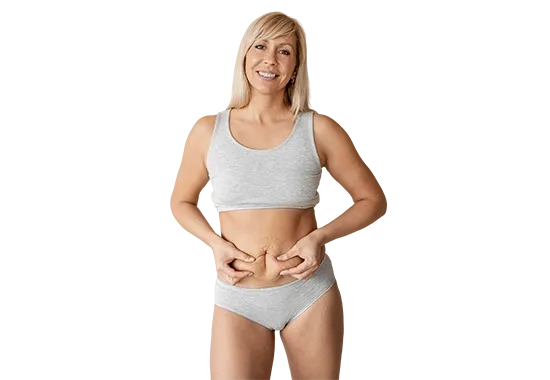
Loose skin that will not tighten after pregnancy. Abdominal muscles that have separated and never come back together. An overhang that stays after you have lost four stone and done everything right. These are not weight problems, and they do not respond to the gym.
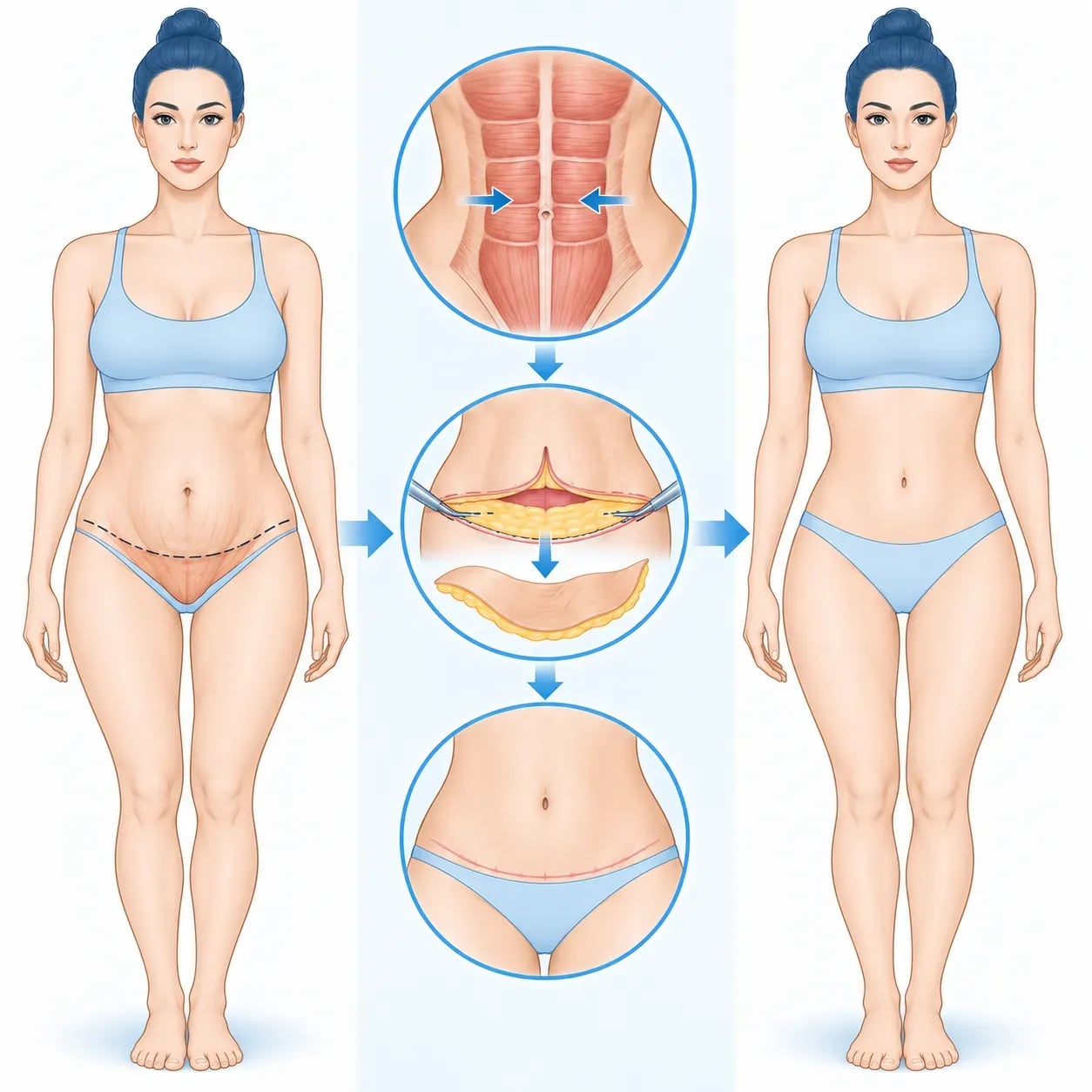
A tummy tuck — abdominoplasty, clinically — removes that excess skin, repairs the separated muscle underneath where it needs repairing, and leaves a flatter, firmer abdominal wall. It is a real operation with a real scar, and it is the only thing that addresses skin which has already stretched.
Is it fat rather than loose skin that bothers you, with the skin above it still firm? See our page on liposuction.
With ServiHealth the procedure is performed by Dr Taher Djemal and Dr Abir Ben Ouaghrem at Myron International Clinic in Tunis, with English-speaking support before, during and after your stay.
| Operating time | 2 to 4 hours |
| Anaesthetic | General |
| Stay in Tunisia | 5 days |
| Final result | 6 to 12 months, as the scar fades |
| Back to desk work | 2 to 3 weeks |
| Price | From €2,200 |
What a tummy tuck actually does
Two things happen during the operation, and most people only know about one of them.
The skin. Excess skin and fat are removed from the lower abdomen, and what remains is pulled down and re-draped. The scar sits low and horizontal, below the bikini line.
The muscle. If your abdominal muscles have separated — diastasis recti, the gap many women are told about at their postnatal check and then never hear about again — they are stitched back together. This is the part no amount of core work fixes, because the problem is the connective tissue between the muscles, not the muscles themselves.
The navel. In a full tummy tuck the navel is repositioned, leaving a small scar around it, so that it sits naturally once the skin has been tightened. A mini tummy tuck does not move it.
Three versions:
- Full tummy tuck — from the navel down, with muscle repair and the navel repositioned. This is the one most people have.
- Mini tummy tuck — where the loose skin is confined to below the navel. Shorter scar, no muscle repair, navel untouched.
- With liposuction — adding the flanks and waist in the same operation, for a fuller reshaping.
Which one you need is decided by the surgeon, from how much skin is loose and how far the muscles have separated. It is not a menu choice, and it cannot be judged from a photograph.
The overhang, and why exercise will not shift it
An abdominal apron — the fold of skin that hangs over the pubic area — is what often brings people to this operation. It follows major weight loss, or several pregnancies, or both.
It is not only about how it looks. It traps moisture, causes rashes and recurrent skin infections underneath, gets in the way of exercise and makes clothes a daily negotiation. People live with it for years before mentioning it to a GP, usually because they assume the answer will be to lose more weight.
It will not go with exercise. The skin has lost its elasticity and there is nothing underneath it to tighten. This is the single clearest indication for a tummy tuck, and the one where patients are most consistently satisfied afterwards.
Where the loose skin continues round to the hips and back, a wider procedure may be discussed at the consultation.
Are you a candidate?
This operation suits people troubled by excess abdominal skin or by muscle separation, whose weight has been stable and whose general health allows a general anaesthetic. The surgeon confirms that after examining you — not before.
Reasons it may be postponed, or declined:
- You are planning a pregnancy in the next few years
- Your weight is still moving, or you are mid-way through losing a significant amount
- You smoke and have not stopped
- You have a clotting disorder, or you are taking an anticoagulant
- A heart or lung condition, or anything else that contraindicates a general anaesthetic
- A history of significant healing problems, such as extensive keloid scarring — assessed individually
Weight matters more here than for most procedures. A tummy tuck is a contouring operation, not a weight-loss one, and operating at an unstable weight means operating on a body that is about to change again.
Being told to come back in a year is not a rejection. It is the assessment you came for.
What a tummy tuck costs in Tunisia
Tummy tuck: €2,200, for a 5-day stay.
With multi-area liposuction: €2,950, for a 6-day stay.
Included: the consultation with the surgeon and the anaesthetist, the operation, the anaesthetic, the hospital stay, the drains, the compression garment, airport transfers, and follow-up after you return home.
Not included: flights, hotel accommodation, and the pre-operative tests you have done at home.
| Procedure | Price | Stay |
|---|---|---|
| Tummy tuck | €2,200 | 5 days |
| Tummy tuck with multi-area liposuction | €2,950 | 6 days |
How this compares. In the UK, private clinics typically quote around £6,500 to £8,500 for a full abdominoplasty. The more important difference is what that figure covers: UK quotes frequently state the surgeon's fee alone, with the anaesthetist, the theatre, the overnight stay, the compression garment and the pre-operative tests added separately — often another £2,000 to £4,000. Read any quote, here or at home, for what it excludes.
Your own figure depends on how much skin has to come out, how much muscle repair is involved and whether anything is combined with it. A detailed quote reaches you within 24 to 48 hours.
Your pathway, step by step
- Get in touch from home. Send photographs and tell us what bothers you, by WhatsApp or email. A medical opinion and a quote come back within 24 to 48 hours.
- Arrange the trip. Flights, accommodation, and visa formalities if your passport requires them.
- Arrival. You are met at the airport, then seen in person for the consultation and the pre-operative assessment — bloods and a clinical examination.
- The operation, under general anaesthetic, usually 2 to 4 hours.
- In hospital. One to two nights, with drains in place, and your first short walk the day after surgery.
- Convalescence in Tunisia. Check-ups, removal of the drains (usually 3 to 7 days post-op), positioning instructions, and the compression garment fitted.
- Home, and remote follow-up by photograph or video call.
Is it safe? What is done to reduce the risk
A tummy tuck is one of the longer operations in cosmetic surgery, and it carries a genuine circulatory risk. Nobody can promise an uncomplicated recovery. What can be set out is what is done to reduce the risk, and you should expect that from any provider you talk to.
The surgeons are qualified plastic surgeons, experienced in muscle repair and in the complications specific to this operation.
The facility. Myron International Clinic is a private multidisciplinary hospital with 7 operating theatres and a 20-bed intensive care unit. On an operation of this length, that is not a detail.
A full pre-operative assessment in every case, reviewed on arrival.
Drains are placed during the operation and removed before you fly home, which is one of the reasons the stay is five days rather than three.
Clot prevention. Compression stockings, getting up and walking from the day after surgery, and preventive anticoagulant treatment where the surgeon considers it necessary. The risk of deep vein thrombosis after an abdominoplasty is real, and it is the reason you are made to walk when you would rather not.
Someone who answers in English, before, during and after your stay.
Recovery: the first weeks, honestly
You will be bent forward. For the first days you walk and sleep slightly folded, upper body and knees raised, so there is no tension on the repair. Arrange extra pillows before you travel — this is the thing people are least prepared for.
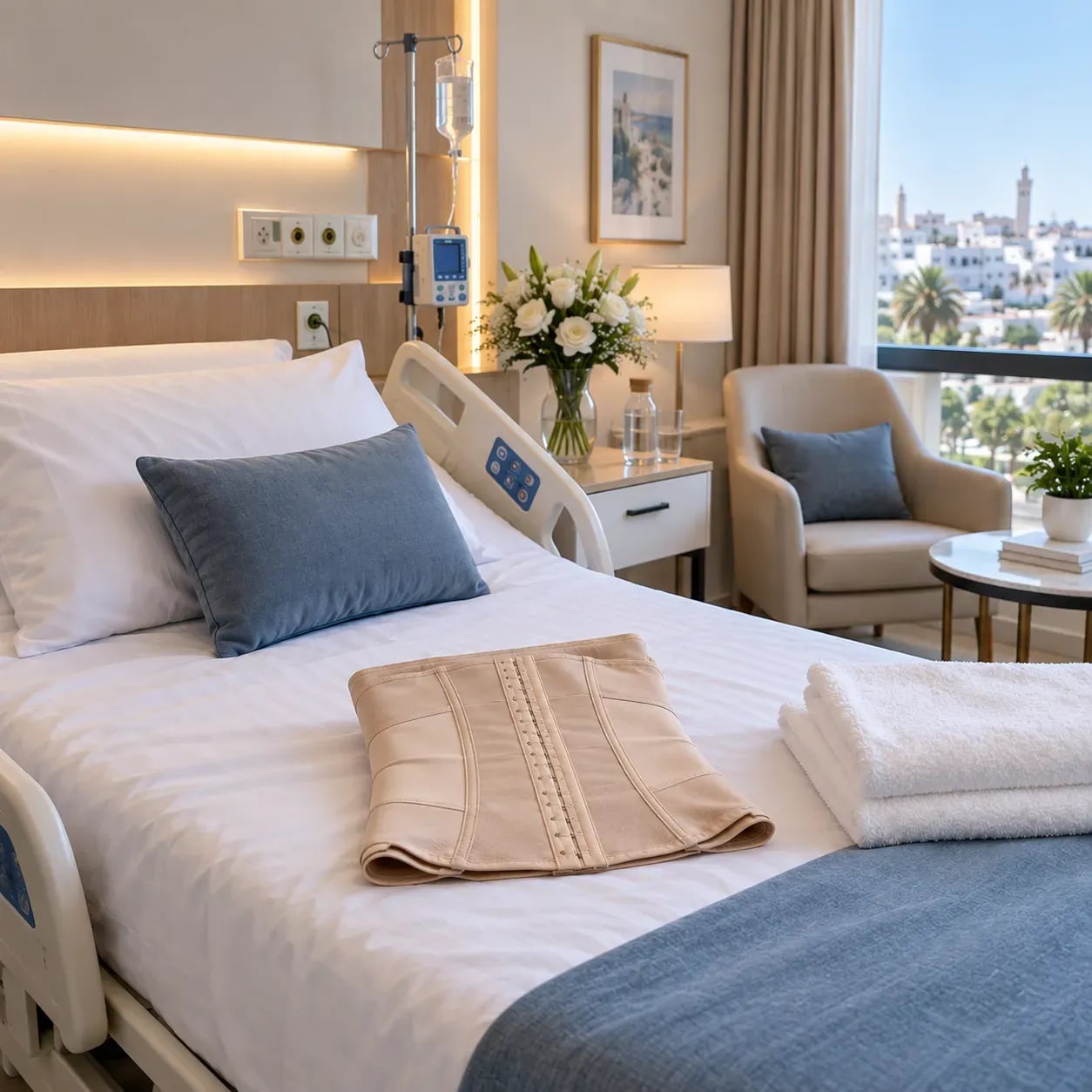
The compression garment is worn continuously for several weeks.
The drains come out before you fly home.
Swelling takes several weeks to settle, and the scar keeps changing for 6 to 12 months. It usually looks worse between the third and sixth month before it starts to pale — knowing that in advance is what stops people panicking at month four.
Desk work after 2 to 3 weeks.
No lifting and no real exercise for 6 to 8 weeks, on your surgeon's advice. That includes picking up a toddler, which is the restriction people underestimate and the one that matters most if you are having this done after children. Work out who is doing the lifting before you book.
Tummy tuck or liposuction?
Liposuction removes fat. That is all it does. It is the right operation when the skin above the fat is still elastic and will shrink back once the fat has gone.
A tummy tuck is what you need when there is excess skin, or separated muscle, or both. Liposuction cannot tighten skin, and taking fat out from under loose skin makes the sagging more obvious rather than less.
The surgeon decides by pinching the skin and examining the abdominal wall, not by looking at the volume. If someone offers you liposuction for an overhang after major weight loss, get a second opinion.
Tunisia or Turkey?
If you are in the UK or Ireland you have almost certainly been shown Turkish clinics first — it is the larger market by a wide margin, and it includes both excellent surgeons and operations you would not want.
What Tunisia offers specifically: a shorter flight from Europe than many assume, a direct flight from the main Gulf cities, support in English and Arabic, and a stay organised around one clinic rather than assembled from separate providers.
But the honest answer is that the country matters far less than two things: which surgeon operates on you, and in what facility. A good surgeon in Istanbul is a better choice than a poor one in Tunis, and the reverse is equally true. Ask for the surgeon's name and the hospital's name before you ask about the price, in either country, and be wary of any provider who will not give you both.
Mummy makeover: tummy tuck with breast surgery
A mummy makeover combines a tummy tuck with breast surgery — an uplift, an augmentation, or both — either in one operation or in two closely spaced ones.
It is assessed individually, on your general health and on the total anaesthetic time the surgeon considers reasonable in a single session. Combining is not automatically better: it means one recovery instead of two, but a longer operation and a heavier first week.
If you are travelling a long distance, doing both in one trip is an obvious practical advantage. That is a logistical argument, not a medical one, and the medical assessment comes first.

Your surgeons
Dr Taher Djemal has practised as a plastic surgeon in Tunis since 1992, with a particular focus on body contouring. He trained in Tunis, Paris and Nancy, with further experience at Foch Hospital in Paris and in Baltimore.
Dr Abir Ben Ouaghrem pays particular attention to skin quality and to the state of the abdominal wall during the assessment, which is what determines the technique used.
You are directed to whichever of them suits your case after a consultation, by video call or in person in Tunis. Ask them anything you would ask a surgeon at home — a surgeon who answers questions properly is the one you want.
Why have your abdominoplasty in Tunisia?
From Europe: a direct flight of 1h30 to 3h from Paris, Brussels, Geneva, Lyon or Marseille. No visa is required for EU and Swiss nationals.
From the Gulf: Emirates flies daily from Dubai in around six and a half to seven hours, and Qatar Airways daily from Doha in around six. The time difference is two to three hours, which means your follow-up calls after you return fall within the working day at both ends.
From West and Central Africa: regular connections from Dakar, Abidjan, Douala, Libreville and Casablanca, with help on visa formalities where they are needed.
Entry requirements depend on your nationality, not on where you live. If you hold a passport from a country other than your country of residence — which is the case for most expatriates in the Gulf — check with the Tunisian embassy or consulate for your country of citizenship before booking anything.
What we commit to: qualified surgeons, an accredited clinic, transparent pricing, and follow-up that continues after you are home.
Getting to Tunisia
From the UK and Ireland: Tunis is around three hours from London, with onward connections from other UK and Irish airports. British and Irish passport holders do not currently need a visa for a short tourist stay, but check before you book — see the note below.
From the Gulf: Emirates flies daily from Dubai in around six and a half to seven hours, and Qatar Airways flies daily from Doha in around six. Tunisia is two to three hours behind the Gulf, which means your follow-up video calls after you get home fall inside the working day at both ends.
From continental Europe: direct flights of 1h30 to 3h from Paris, Brussels, Geneva, Lyon and Marseille. No visa for EU and Swiss nationals.
From West and Central Africa: regular connections from Dakar, Abidjan, Douala, Libreville and Casablanca, with help on visa formalities where they are required.
Your entry requirements depend on your nationality, not on where you live. This catches out expatriates constantly: a resident of Dubai or London holding an Indian, Pakistani, Nigerian or Filipino passport does not have the same conditions as a British or Emirati national, and a residence permit does not change what Tunisia asks of your passport. Check with the Tunisian embassy or consulate for your country of citizenship before booking anything.
Before you travel: a checklist
- Documents: a passport valid well beyond your return date, a visa if your nationality requires one, and recent photographs from the front and the side.
- Bloods done at home where possible — confirm the exact list with the team first.
- A written list of your medication and allergies, including supplements and anything herbal. These are the ones people forget, and some of them affect bleeding.
- Stop smoking, ideally several weeks beforehand. This is not a formality on this operation.
- Loose clothing, with nothing tight at the waist, and shoes you do not have to bend down to fasten.
- Book at least two weeks off work, and arrange for someone else to do any lifting — including children — for several weeks.
- On the flight home, aisle seat, get up and walk regularly, and drink water.









Frequently asked questions about Tummy Tuck in Tunisia
A tummy tuck is €2,200 with ServiHealth for a 5-day stay, and €2,950 combined with multi-area liposuction for a 6-day stay. That covers the consultation, the operation, the anaesthetic, the hospital stay, the drains, the compression garment, transfers and post-operative follow-up. Flights, hotel accommodation and the pre-operative tests are not included.
UK private clinics typically quote around £6,500 to £8,500 for a full abdominoplasty. The bigger difference is what the figure covers: UK quotes often state the surgeon's fee alone, with the anaesthetist, theatre, overnight stay, compression garment and pre-operative tests charged separately, frequently adding another £2,000 to £4,000. Compare what is excluded, not just the headline number.
It carries risks, as all surgery does. The most frequent are a collection of fluid under the skin, known as a seroma, haematoma, healing problems and, more rarely, compromised blood supply to the skin. Because it is a long operation followed by reduced mobility, there is also a genuine risk of blood clots, which is managed with routine preventive measures. Your pre-operative assessment and consultation establish the risks specific to you.
Deep vein thrombosis is a real risk after an abdominoplasty, because the operation is long and movement is limited afterwards. It is reduced by compression stockings, getting up and walking from the day after surgery, and preventive anticoagulant treatment where the surgeon considers it necessary. Breathlessness, chest pain, or pain and swelling in one calf are medical emergencies at any point, including after you are home.
A flatter abdomen, skin that has been tightened and, where there was a separation, muscle that has been repaired. The shape is visible within the first few weeks once the swelling settles, and the scar continues to fade over 6 to 12 months.
Liposuction removes fat only. It corrects neither loose skin nor separated muscle. A tummy tuck addresses both, which is why it is the operation indicated after pregnancy or significant weight loss, when the skin has lost its elasticity. Removing fat from under loose skin makes the sagging more obvious, not less.
It depends on how much skin is loose and how far the muscles have separated. A mini tummy tuck is enough when the excess is confined to below the navel; a full tummy tuck is needed when the whole abdominal wall is involved. This is decided at the consultation and cannot be determined without a physical examination.
Yes. Repairing a diastasis recti is part of a full tummy tuck: the separated muscles are stitched back together. This is the part that exercise cannot fix, because the problem is the connective tissue between the muscles rather than the muscles themselves. A mini tummy tuck does not include the repair.
In a full tummy tuck, yes: the navel is repositioned so that it sits naturally once the skin has been tightened, leaving a small scar around it. In a mini tummy tuck it is not moved.
The drains placed during the operation are removed during your stay in Tunisia, before you fly home. Exactly when depends on how the healing is going and how much fluid is draining, and the surgeon decides. This is one of the reasons the stay is five days.
Five days for a tummy tuck, and six days if it is combined with liposuction. That covers the pre-operative consultation with the surgeon and the anaesthetist, the operation, the hospital stay, removal of the drains and a check before you fly. Your surgeon confirms the return date according to how you are healing, so book a flexible return.
Yes, and it frequently is. Liposuction of the flanks or waist in the same operation gives a more complete reshaping where the surgeon considers it appropriate. The price is then €2,950 for a six-day stay.
A tummy tuck combined with breast surgery, which is frequently requested after children. It is not automatic: it is assessed individually according to your general health and the total anaesthetic time considered reasonable in one operation. It means one recovery instead of two, but a longer operation and a harder first week.
The scar is horizontal and placed as low as possible, so it sits below most underwear and swimwear. It fades over the first year, and it usually looks worse between the third and sixth month before it starts to pale. There is also a small scar around the navel in a full tummy tuck.
The first two or three days are the hardest: a strong sensation of tightness across the abdomen, which is why you stay bent slightly forward. The painkillers prescribed are matched to that, and the discomfort reduces markedly from the first week. It is more uncomfortable than painful after the first few days.
An abdominal apron is a fold of skin hanging over the pubic area, usually after major weight loss or several pregnancies. No exercise removes it, because the skin has lost its elasticity. A tummy tuck does remove it, and this is one of the clearest indications for the operation.
You can, but a pregnancy stretches the abdominal wall again and can undo the muscle repair. The operation is therefore recommended once you have finished having children. If you are planning a pregnancy in the next few years, the usual advice is to wait.
Walking is encouraged from the day after surgery. Lifting and real exercise are avoided for 6 to 8 weeks, on your surgeon's advice. Abdominal work is the last thing to come back, because of the muscle repair, and your surgeon will tell you when.
Not for a procedure performed abroad, and private medical insurance generally excludes cosmetic surgery wherever it is done. In the UK the NHS funds abdominoplasty only in restricted circumstances, typically after major weight loss where the excess skin causes documented functional or medical problems, and the criteria vary between areas. Check with your GP or your insurer before assuming either way.
After very significant weight loss, loose skin often affects the hips, back, thighs and arms as well. The surgeon assesses the whole picture and tells you what can be treated, in one operation or in several, and in what order.
The shape appears within the first few weeks, once the swelling settles. The scar keeps refining for 6 to 12 months. Judging the result at three weeks tells you nothing useful.
Yes, semi-reclined with your upper body and knees slightly raised, for around a week, to keep tension off the repair. Sort out extra pillows before you travel rather than after.