

Liposuction in Tunisia: Areas, Techniques, Price and Recovery
Liposuction in Tunisia: the essentials
Liposuction removes localised fat deposits through small incisions, using a cannula. It targets the fat that stays put whatever you do in the gym — the lower abdomen, the flanks, the outer thighs, the back.
It is not a weight-loss operation, and that is not a caveat buried in the small print — it is the definition. Liposuction is for someone already at a stable weight who has a shape problem in one or two places. Used as a substitute for losing weight it gives a poor result and a worse risk profile.
And the fat is not what decides whether you like the outcome. Your skin is. Liposuction takes the volume out and relies on the skin retracting over the new contour. Skin with good elasticity does that well. Skin already stretched by pregnancy or major weight loss often does not, and emptying it can leave it looking slacker than before. This is assessed by examination, never from a photograph.
At ServiHealth the procedure is carried out at the Clinique Internationale Myron in Tunis, from €1,700 to €2,500 according to the number of areas, with a stay of 3 to 5 days. Hotel, transfers and the compression garment are included. It takes one to three hours, under general anaesthesia or deep local anaesthesia depending on how much is treated.
Two things worth knowing before you book. You will be in a compression garment for four to six weeks — that is the real commitment, not the four days in Tunisia. And the result is not visible until three to six months, so do not book this against a dated event in the calendar.
What is liposuction, and which technique?
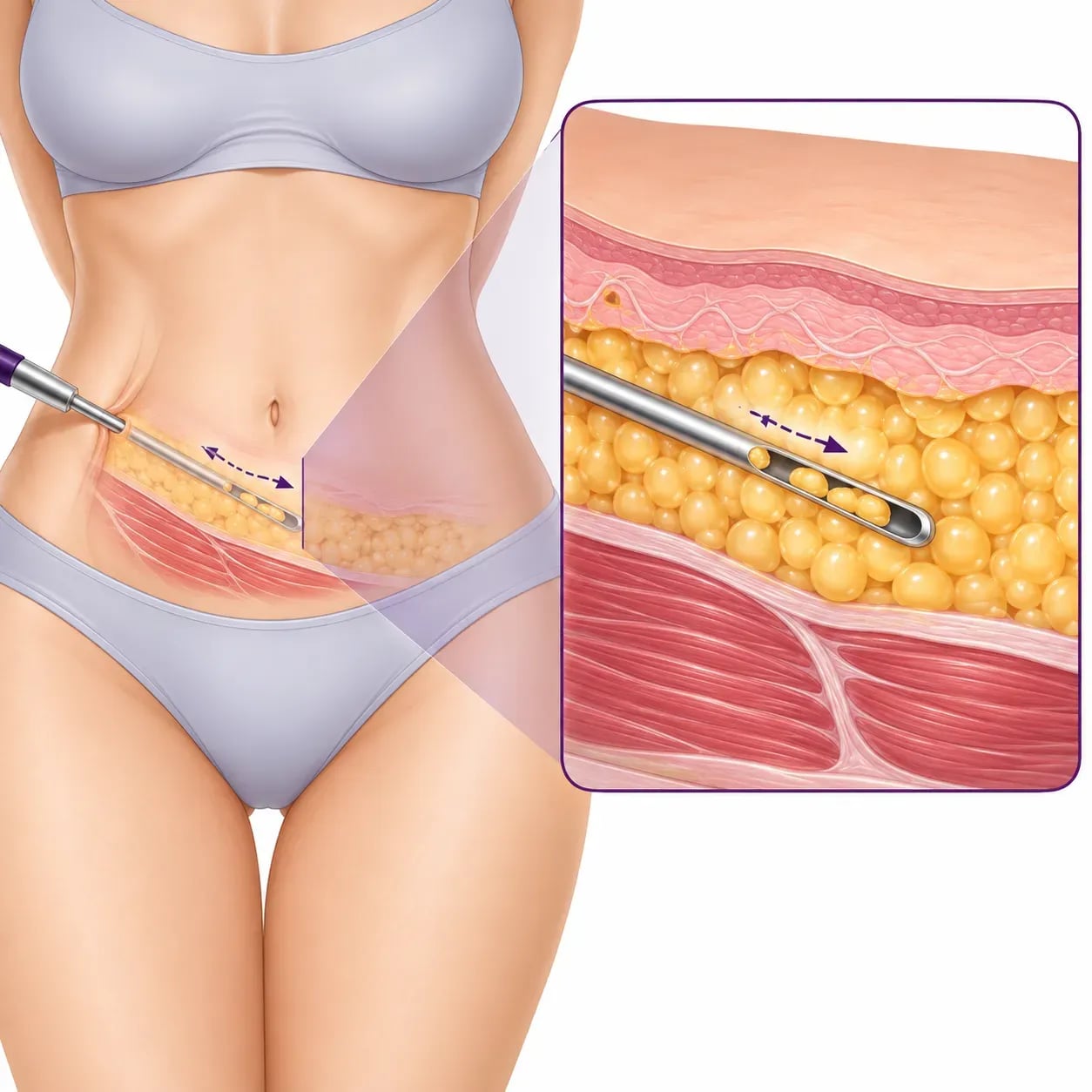
Liposuction removes fat through a cannula — a thin tube inserted through incisions a few millimetres long, placed where a fold or clothing will hide them. Fluid is infiltrated into the area first, which limits bleeding and pain. That is the tumescent technique, and it is the reference method everything else builds on.
It takes one to three hours depending on the areas, under general anaesthesia or deep local anaesthesia. You are monitored for a few hours or stay one night, depending on how much was treated.
The fat cells removed do not grow back. You can still gain weight afterwards, and when you do it settles in the untreated areas or more evenly across the body. The result holds as long as your weight does.
The techniques, and what each one actually changes
| Technique | How it works | When it is chosen |
| Tumescent (classic) | Fluid infiltrated before suction, limiting bleeding and pain | The reference technique, suitable for most areas and most patients |
| MicroAire | A vibrating cannula, which passes through tissue with less force | Larger volumes, and revision surgery on an area already operated on |
| VASER | Ultrasound breaks up the fat before it is aspirated | Fibrous areas such as the back, and fine definition in patients who are already lean |
| J-Plasma | Adds energy intended to help the skin retract | Moderate skin laxity — not a substitute for a lifting procedure |
| 360° | Not a technique: the whole circumference of the trunk treated as one area | Can be performed with any of the above |
No technique is better in general. The surgeon chooses by area, by the texture of the fat and by the quality of the skin, and that choice is made after examining you. A clinic that sells you a named technology before it has looked at you is selling the technology, not the result.
Three things liposuction is routinely expected to do and does not: it does not tighten skin, it only removes what is underneath; it does not treat cellulite, which comes from fibrous bands tethering the skin rather than from the fat beneath it; and it does not replace weight loss, because the volume removable in one session is capped by a safety threshold rather than by preference.
Which areas can be treated?
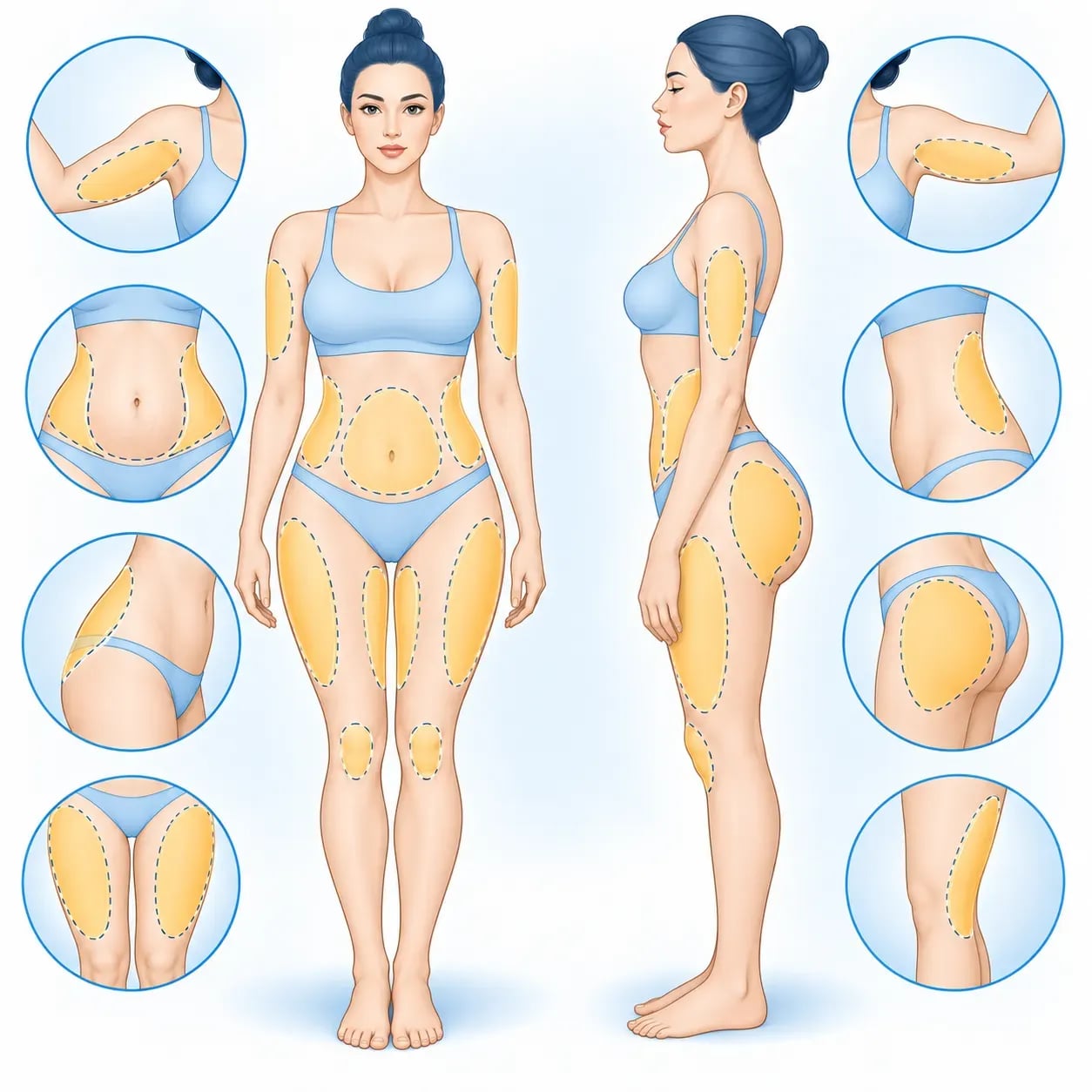
Abdomen, flanks (love handles), thighs, arms, back, knees, calves and under the chin. Most patients treat two or three of them in one session, and the price packages are built around how many.
| Package | What it covers |
| Simple | One to two areas |
| Medium | Three to four areas |
| 360° | Abdomen, waist, flanks and back, treated as one circumferential area |
| Complete | Five areas or more |
What "360" actually means. It is a scope of treatment, not a technology: the whole circumference of the trunk rather than the front only. It exists because treating the abdomen alone on someone whose flanks and back also carry fat produces a flat front and an unchanged outline from the side. It can be performed with any of the techniques described in the next section.
Two limits worth understanding. The number of areas is not the real ceiling — the safe volume of fat that can be aspirated in one operation is, and your surgeon sets it after examining you. And treating fewer areas properly beats treating more of them partially, which is why a surgeon may recommend a smaller package than you asked for.
Fullness under the chin, in the arms or at the inner thigh is sometimes a skin problem rather than a fat one. If so, see arm lift or thigh lift in Tunisia.
Liposuction for men
Men are a significant share of liposuction patients, and the areas are usually the abdomen, the flanks and the chest. The operation itself is the same; what differs is where fat sits and what is actually causing the shape.
The point that matters most, and the one most often missed: fullness of the male chest is frequently glandular tissue, not fat. Glandular tissue does not respond to diet, to training, or to liposuction. That condition is gynaecomastia, and it is treated by removing the gland, sometimes together with liposuction. A man who has a chest reduced by suction alone when the problem was glandular ends up with the same shape and a scar he did not need.
An examination settles it. If you have spent years training without the chest changing, that is itself a clue — and it is also a reason not to blame yourself for it.
Read our page on gynaecomastia surgery in Tunisia.
Male abdominal fat is also more often visceral — sitting behind the muscle wall, around the organs, rather than under the skin. Liposuction can only reach fat that lies under the skin. A firm, rounded abdomen that does not pinch between the fingers is visceral fat, and no cannula reaches it; that responds to weight loss, and to nothing else. Here too the examination gives you the answer in a minute.
Are you a candidate for liposuction?
The procedure suits someone at a stable weight, in good health, with localised fat deposits that have resisted diet and exercise, and with skin that still has good elasticity. If that is you, liposuction does its job well. If it is not, it is better to find out now than after a flight.
| If this is you | What usually fits better |
| You are significantly overweight and want the operation to address that | Medical or surgical weight management first — see gastric balloon, gastric band or gastric bypass in Tunisia. Liposuction is a shaping operation, not a weight-loss one. |
| Your abdominal skin is stretched, or your abdominal muscles have separated after pregnancy | A tummy tuck, which removes the skin and repairs the muscle wall |
| Your skin is markedly lax on the arms or thighs | An arm lift or a thigh lift, which remove the excess rather than what is under it |
| You want the fat removed and used elsewhere | Liposuction combined with a BBL or breast fat transfer, in the same session |
The procedure is postponed or ruled out in these situations, each assessed individually by the surgeon and the anaesthetist:
- Significant excess weight or obesity
- Markedly lax skin in the area concerned
- Unstable weight, or weight loss still in progress
- Pregnancy or breastfeeding
- Active smoking
- A bleeding disorder, or treatment with anticoagulants
- Heart or lung conditions that contraindicate anaesthesia
Arrive at a weight you can hold for months rather than one you reached last week. A result sculpted on a body that is still changing changes with it.
How much does liposuction cost in Tunisia?
From €1,700 to €2,500, depending on how many areas are treated, with a stay of 3 to 5 days.
All four packages include the same things: the consultations with the surgeon and the anaesthetist, the procedure, the anaesthesia, the compression garment, the hotel, the transfers, and the follow-up after you return home. They differ only in how many areas are treated and how long you stay.
Not included: flights, and the pre-operative tests, which you have done in your own country around fifteen days before.
Two costs that are not on the list. Lymphatic drainage sessions, if your surgeon recommends them, happen after you are home and are arranged where you live. And a second compression garment, so you can alternate while one is washed, over four to six weeks of continuous wear.
On comparing with a quote at home: the gap comes from where the clinic operates, not from what is left out of the operation. The useful comparison is inclusions against inclusions. A quote that looks higher elsewhere may exclude the garment, the hotel and the transfers that are inside this one, and a quote that looks lower may be for fewer areas than you need.
Which package applies to you is confirmed after the surgeon has examined you. A remote review from photographs is a first opinion, not a quote you should treat as final.
| Package | Areas | Price | Stay |
|---|---|---|---|
| Simple liposuction | 1 to 2 areas | 1700 € | 3 days |
| Medium liposuction | 3 to 4 areas | 2250 € | 4 days |
| Liposuction 360° | Abdomen, waist, flanks and back | 2350 € | 4 days |
| Complete liposuction | 5 areas or more | 2500 € | 5 days |
Your pathway, step by step
ServiHealth organises and coordinates the stay. The medical decisions belong to the surgeon and the anaesthetist; everything around them is our work.
| Stage | What happens |
| First contact | You send photographs of the areas concerned and your medical history. A first review is carried out remotely and we tell you whether the procedure appears appropriate before you spend anything. |
| Quote | A written quote naming the package, the areas planned, what the price covers and what it does not. |
| Preparation | Pre-operative tests around 15 days before surgery, in your own country, following the protocol you are given. Dates and flights fixed. |
| Arrival | You are met at Tunis-Carthage airport and taken to your hotel. Send us your boarding pass and a photograph of what you are travelling in, so we can find you quickly. |
| Consultation | Examination by the surgeon: the areas, the texture of the fat, the quality of your skin, and the technique. The anaesthetic consultation follows. The plan is confirmed, adjusted or reconsidered here. |
| Procedure | One to three hours at the Clinique Internationale Myron, under general or deep local anaesthesia. |
| Afterwards | A few hours of monitoring, or one night, depending on the extent. The compression garment is fitted. |
| Rest of the stay | Post-operative checks before you fly home. Three to five days in total according to your package. |
| After you return | Remote follow-up with a contact you can reach. Lymphatic drainage where recommended, arranged near you. The result is assessed at three to six months. |
Tell us straight away about anything affecting the journey — a delayed flight, a changed booking, a missed connection, lost luggage. Nearly all of it is easy to absorb if we know in time.
And expect the consultation to be able to change the plan. A surgeon who examines you may recommend fewer areas, a different technique, or a different operation altogether. That is the consultation working, not a sales tactic in reverse.
Is liposuction safe? Risks and precautions
Liposuction is a well-established operation, and it is still surgery under anaesthesia. The risks belong on the page, before you book.
- Contour irregularities. The commonest imperfection, generally caused by uneven suction. Careful technique and a well-fitted compression garment worn as instructed are what reduce it. Minor unevenness often softens over the following months.
- Haematoma and fluid collection in the treated area.
- Temporary loss of sensation, which is common and usually resolves within weeks, occasionally over a few months.
- Infection, uncommon and treatable.
- Fluid and volume imbalance related to the amount aspirated. This is why the volume removable in one session is capped by a safety threshold, and why a surgeon who refuses to remove as much as you asked for is doing their job.
- Complications of anaesthesia, assessed at the anaesthetic consultation.
The safety limit is not negotiable, and it is worth understanding why. Aspirating large volumes shifts fluid in the body, and the complications that follow are the serious ones. Any clinic willing to exceed that limit because you asked is not being accommodating.
Smoking deserves its own line. Nicotine narrows the small vessels that skin depends on to heal and retract over the new contour. It raises the complication rate and worsens the result. Stopping for the period your surgeon specifies is the most useful thing you can do for yourself.
Declare, in full: all medication including anticoagulants, any bleeding disorder, any heart or lung condition, all allergies, and any previous surgery on the areas concerned.
And one expectation to set honestly: a perfectly smooth result is not guaranteed by anyone. Results vary from one patient to another, and your surgeon will tell you at the consultation what is realistic for your skin and your anatomy.
How long is recovery?
Back to non-physical work in about five to ten days, sport at three to four weeks, and the final result between three and six months. The part that lasts longest is the compression garment: four to six weeks of continuous wear, sometimes longer after VASER.
| When | What to expect |
| First days | Swelling, bruising and soreness, usually described as severe muscle ache rather than sharp pain. Generally milder than after a tummy tuck or a BBL. Walking from the first day. |
| 5 to 10 days | Back to work, provided it involves no physical effort. |
| Weeks 1 to 6 | Compression garment worn continuously, then tapered as your surgeon directs. Numbness in the treated areas is normal and fades. |
| 3 to 4 weeks | Sport resumes, with your surgeon's approval. |
| 3 to 6 months | Swelling fully resolved. This is the result. Minor unevenness that was present earlier has often softened by now. |
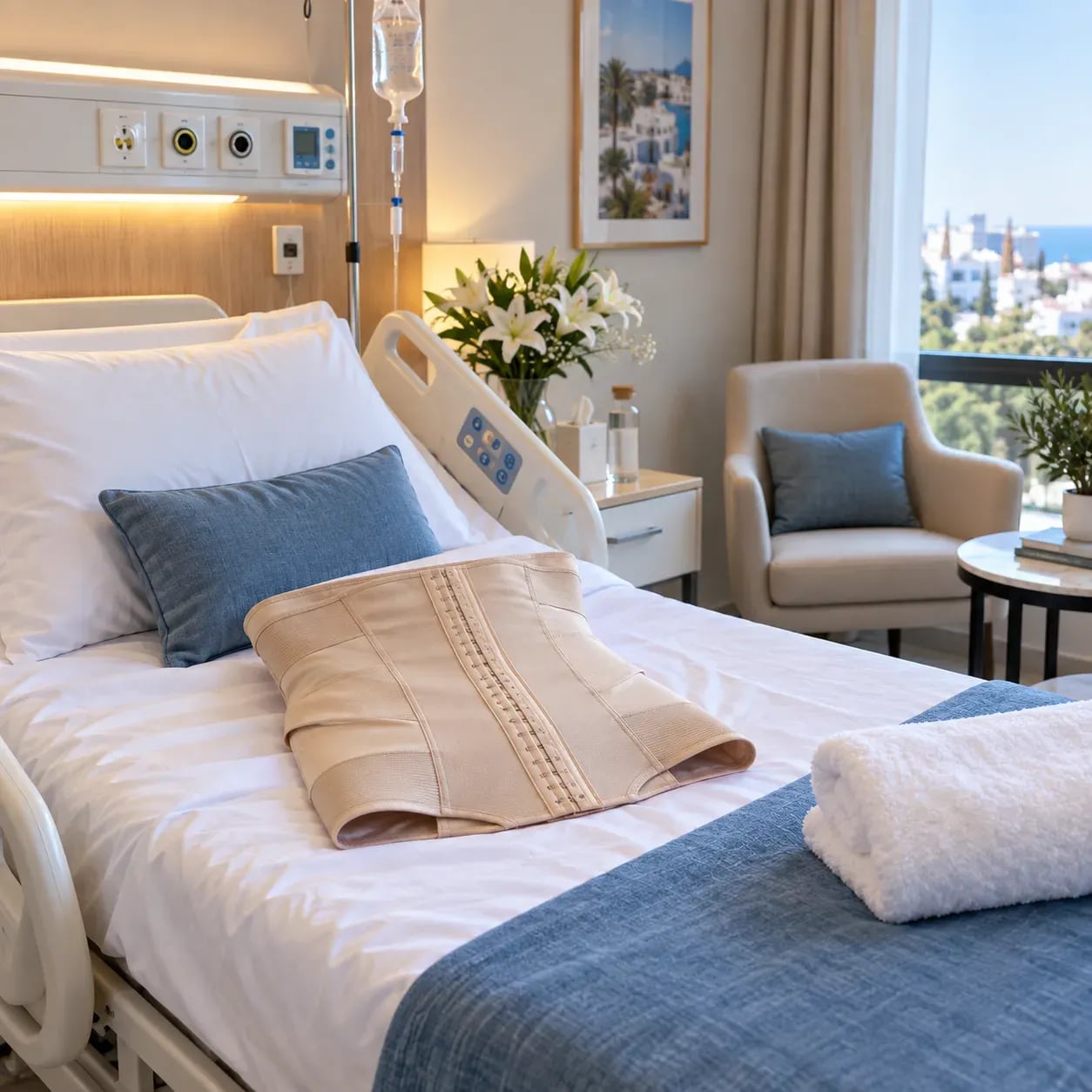
Wear the garment. It is part of the operation. It controls swelling and helps the skin settle evenly over the new contour, and it is one of the main things separating a smooth result from an irregular one. Pack a second one so you can alternate while the first is washed.
Lymphatic drainage is often recommended, at your surgeon's discretion, to help swelling resolve and reduce the risk of fluid collecting. It happens after you are home, so arrange the sessions where you live before you travel. It supplements the garment rather than replacing it.
And the expectation that matters most for anyone booking around a date: at three weeks you will look swollen and feel disappointed, and that is normal. Nothing you see before three months is the outcome.
Liposuction, tummy tuck, BBL or cryolipolysis: which one?
They are not competing versions of the same thing. Each answers a different question, and the examination tells you which question is yours.
| Your problem | The operation that answers it |
| Localised fat, firm skin, stable weight | Liposuction |
| Stretched skin, or abdominal muscles separated after pregnancy | Tummy tuck, which removes the skin and repairs the muscle wall |
| You want the fat removed and the buttocks reshaped with it | BBL, often in the same session as the liposuction |
| Loose skin on the arms or the thighs | Arm lift or thigh lift |
| A small area, and you will not consider surgery | Cryolipolysis or radiofrequency — limited, less predictable, several sessions needed |
| Excess weight rather than a shape problem | Weight management first, medical or surgical |
Liposuction and BBL are the pairing that comes up most, because a BBL needs harvested fat and liposuction produces it. Done together, the waist comes in and the buttocks fill out in one operation, which is a different result from either alone.
Liposuction and tummy tuck are frequently confused and should not be. The test is simple: pinch the skin of your abdomen. If what you feel is a layer of fat over a firm wall, liposuction is the operation. If the skin itself is loose and crepey, or your abdomen domes when you sit up, removing the fat underneath will make it look emptier rather than flatter.
Your surgeon makes this call after examining you. A page cannot.
Your surgeons
Liposuction at ServiHealth is performed by qualified plastic surgeons at the Clinique Internationale Myron in Tunis.
- Dr Taher Djemal — plastic and aesthetic surgery, practising in Tunisia since the early 1990s.
- Dr Abir Ben Ouaghrem — plastic and aesthetic surgery, with particular attention to skin quality and the distribution of fat when planning the areas.
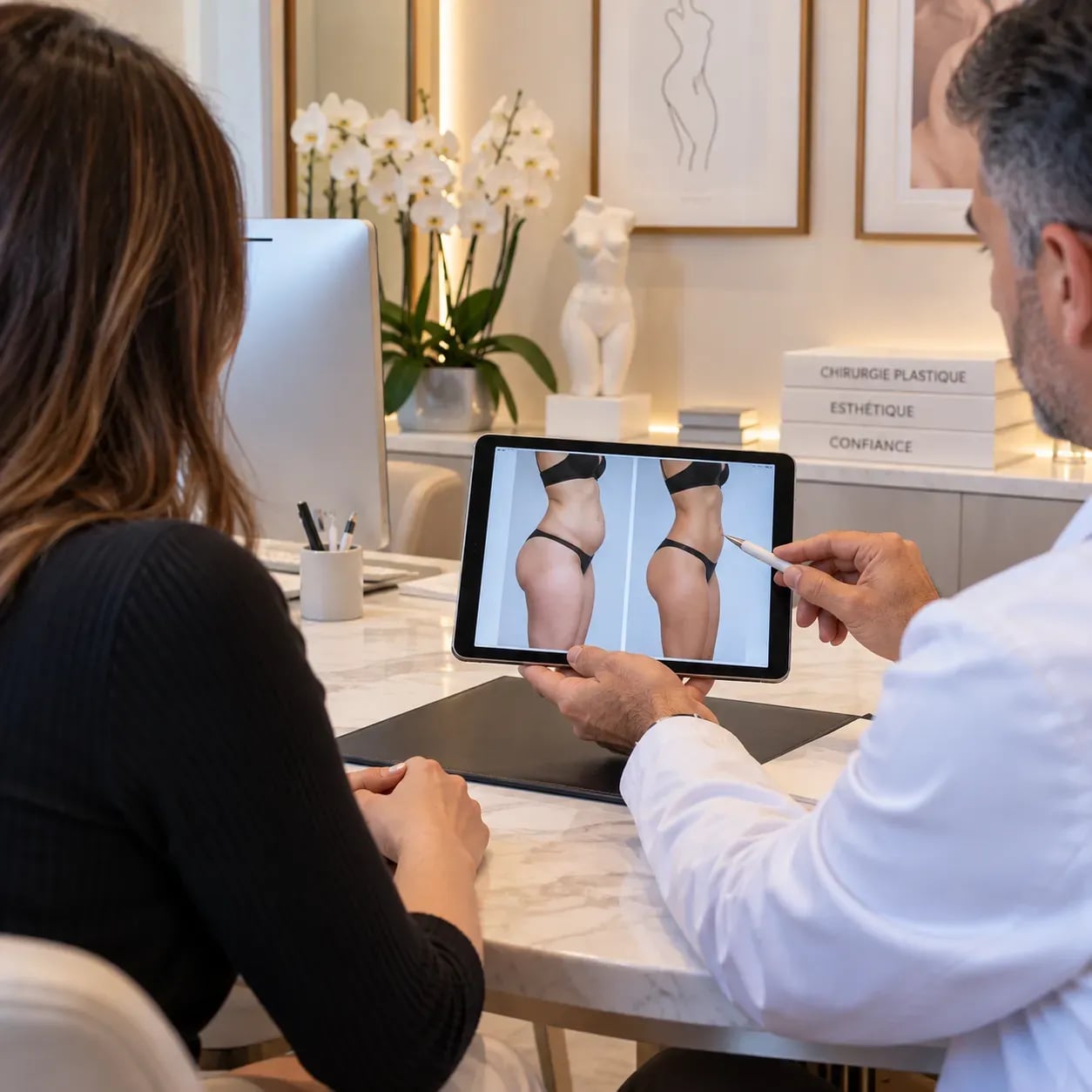
The surgeon assigned to your case is named in your quote before you travel, and you meet them in person before anything is decided.
Questions worth asking at that consultation, because the answers tell you more than a gallery:
- Looking at my skin, do you expect it to retract well over the areas we are treating?
- Which technique are you proposing, and why that one for me?
- How many areas would you treat, and which would you leave alone?
- What would make you advise against operating on me?
- How long do you want me in the garment, and do you recommend lymphatic drainage?
A surgeon who answers the first and fourth questions readily is usually the one you want. Which areas to treat, with which technique, and whether to operate at all is a medical decision and belongs to them, not to ServiHealth.
Why have liposuction in Tunisia?
Tunisia has run an organised medical travel sector for decades: private clinics built around international patients, surgeons trained to European standards, and costs that reflect Tunisian overheads rather than shortcuts in the operation.
What matters specifically for this procedure:
- Distance. Two to three hours from most of Western Europe, with direct connections from several Gulf hubs. A short flight three to five days after surgery, rather than a long-haul one.
- Hotel and transfers inside the price. On a 3 to 5 day stay that is a real part of the total rather than a detail, and it makes the quote comparable.
- The compression garment is provided and fitted before you leave, by people who have seen the result.
- English throughout, from the first exchange to the follow-up after you are home.
Three things to weigh honestly, because they are specific to liposuction rather than to Tunisia:
- The operation lasts six months, the trip lasts four days. Everything that determines whether you are happy — the garment, the swelling, the drainage sessions, the skin settling — happens where you live. Make sure you know who you contact.
- Lymphatic drainage, if recommended, is arranged by you at home. Find out whether it is available near you, and what it costs, before you travel rather than after.
- Revision is a second trip. Minor irregularity usually softens on its own by six months. If it does not, ask before you book what happens then and in what timeframe, and get the answer in writing.
Many patients combine liposuction with another procedure in one stay — most often a BBL, which uses the harvested fat. That is sensible when it is surgically coherent and poor when it is driven by the travel budget. Your surgeon decides what can reasonably be done in one session.
Before you travel: a checklist
Work through this before you book, not the week before you fly.
| Category | What to do |
| Documents | A valid passport, and a visa if your nationality requires one for Tunisia. Check the expiry date. |
| Photographs | Recent photographs of each area you want treated, front and side, in natural light. Take them before you travel as well — in six months you will not remember accurately what you started with. |
| Pre-operative tests | Blood tests and the rest of the work-up, done in your own country around 15 days before, following the protocol you are given. Send the results in advance. |
| Medication and allergies | A full list, anticoagulants included, plus any bleeding disorder and any heart or lung condition. Follow your surgeon's instructions on what to stop and when. |
| Previous surgery | Any previous liposuction or other operation on the areas concerned, with dates. It changes what is usable and which technique suits. |
| Weight | Stable for several months, with no strict diet in the preceding weeks. Arrive at a weight you can hold, not one you reached last week. |
| Smoking | Stop for the period your surgeon specifies. It affects healing and how well the skin retracts. |
| Lymphatic drainage | Check what is available near you and what it costs, in case your surgeon recommends it. The sessions happen after you are home. |
| To pack | The compression garment is provided — bring a second one so you can alternate over four to six weeks. Loose clothing that fits over it, and nothing with a waistband that digs in. |
| Your calendar | Five to ten days before work without physical effort, three to four weeks before sport, and no dated event you want to look your best for inside three months. |
Considering more than one procedure in the same stay? Read the relevant pages first: BBL, tummy tuck, arm lift, thigh lift or gynaecomastia surgery in Tunisia. What can reasonably be combined in one session is decided by your surgeon.








Frequently asked questions about Liposuction in Tunisia
From €1,700 to €2,500 at ServiHealth, depending on how many areas are treated: €1,700 for one to two areas with a 3-day stay, €2,250 for three to four areas over 4 days, €2,350 for 360° over 4 days, and €2,500 for five or more areas over 5 days. The price covers the consultations with the surgeon and the anaesthetist, the procedure, the anaesthesia, the compression garment, the hotel, the transfers and the follow-up after you return. Flights and the pre-operative tests are not included.
No, and this is the most important sentence on the page. Liposuction removes localised fat deposits that resist diet and exercise in someone who is already at a stable weight. It is not a treatment for being overweight, and using it as one gives a poor result and a worse risk profile. If weight is the issue, the relevant options are medical and surgical weight management, not this operation.
Very little, and you should not judge the operation on the scales. What changes is shape, not mass: a waist that comes in, a flank that no longer rolls over a waistband, a thigh gap that was not there. The volume removed in one session is also capped by safety limits, not by what you would like removed. Weigh yourself less and photograph yourself more.
It is a real operation with real risks, carried out under anaesthesia, and the volume removed in one session is limited by safety thresholds rather than by preference. Performed on an appropriate candidate, by a qualified surgeon, within those limits, it is a well-established procedure. The risks that matter are listed in full in the safety section further up this page — read them before booking, not after.
Yes, and it is the commonest imperfection after liposuction. It generally comes from uneven suction, and it is reduced by good technique and by wearing the compression garment exactly as instructed. Minor unevenness often softens over the following months. This is one of the reasons the garment is not optional.
Numbness in the treated areas is common and expected. It usually resolves within weeks, sometimes over a few months. Permanent change in sensation is uncommon but possible, and your surgeon will discuss it with you before you consent.
A clearer outline rather than a different body. Areas that resisted training look flatter and the silhouette reads smoother. What liposuction does not do is tighten skin, remove cellulite, or produce weight loss. The final result is visible between three and six months, once the swelling has fully resolved — judging it at three weeks tells you nothing.
Liposuction removes fat and leaves the skin to retract on its own. A tummy tuck removes stretched skin and, where needed, repairs separated abdominal muscles. If your problem is a layer of fat over a firm abdomen, liposuction is the operation. If your skin is stretched or your muscles have separated, usually after pregnancy, liposuction alone will disappoint you.
Cryolipolysis and radiofrequency are non-surgical, need no anaesthetic and no recovery, but give limited and less predictable results and usually require several sessions. Liposuction is surgery, with anaesthesia and weeks in a compression garment, and it removes considerably more fat in one go with a far more predictable outcome. The honest way to choose is by how much you want changed, not by which sounds easier.
That is what the four packages describe: one to two areas, three to four, 360°, or five and above. The practical ceiling is not the package but the safe volume of fat that can be removed in one operation, which your surgeon sets at the consultation after examining you. Treating fewer areas properly beats treating more of them partially.
Three to five days, depending on how many areas are treated: 3 days for the simple package, 4 for medium and 360°, 5 for the complete package. That covers the consultation, the procedure, the monitoring afterwards and the first post-operative checks before you fly home.
Because of where the clinic operates, not because something is left out. Tunisian overheads — premises, salaries, insurance — are a fraction of Western European ones, while the surgeon, the theatre and the anaesthetist are the same categories of cost anywhere. What varies between quotes is what is bundled: here the hotel, the transfers, the compression garment and the follow-up are inside the price, and flights and pre-operative tests are not. Compare inclusions before you compare totals.
The fat cells that are removed do not grow back. You can still gain weight afterwards, and when you do it tends to settle in the areas that were not treated, or more diffusely across the body. The result holds as long as your weight does, which is why a stable weight before the operation matters more than most people expect.
Yes, and the two are natural partners: a BBL uses purified fat taken by liposuction, so the fat removed from the waist and flanks becomes the material that reshapes the buttocks. They are frequently performed in the same session. Whether it applies to you depends on your fat reserve and your anatomy, and your surgeon decides at the consultation.
No. Cellulite is caused by fibrous bands tethering the skin to deeper tissue, not by the volume of fat underneath, so removing fat does not release it. The appearance sometimes improves slightly, and it can also look unchanged. Anyone promising you that liposuction clears cellulite is describing a result they cannot deliver.
Expect soreness rather than sharp pain — most patients describe it as severe muscle ache, and it is generally milder than after a tummy tuck or a BBL. Swelling and bruising are part of it. Prescribed painkillers are usually sufficient. The lasting inconvenience is the compression garment, not the pain.
Not your decision, and that is the honest answer. Tumescent liposuction is the reference technique. MicroAire uses a vibrating cannula and suits larger volumes and revision work. VASER uses ultrasound to break up fat first and is favoured for fibrous areas such as the back, and for fine definition in patients who are already lean. J-Plasma adds energy intended to help skin retract and is reserved for moderate laxity. None of them is superior in general: the surgeon chooses by area, fat texture and skin quality. Be wary of any clinic that sells you a technology before examining you.
Then this is the conversation that decides whether you are happy. Liposuction removes fat and relies on the skin retracting afterwards. Skin with good elasticity does that well. Skin that has already been stretched by pregnancy or major weight loss often does not, and removing the fat underneath can leave it looking emptier rather than smoother. For moderate laxity a surgeon may propose an energy-assisted technique; for genuine excess skin the answer is a lifting procedure — a tummy tuck, an arm lift or a thigh lift — not liposuction. Only an in-person examination settles this.
Yes, and men are a significant share of patients. The usual areas are the abdomen, the flanks and the chest. One point specific to men: fullness of the chest is often glandular tissue rather than fat, and glandular tissue does not respond to liposuction or to training — that is gynaecomastia, and it is treated differently. An examination tells you which you have.
It is often recommended, at your surgeon's discretion, to help swelling resolve and to reduce the risk of fluid collecting. It is not a substitute for the compression garment. If it is recommended for you, arrange the sessions where you live before you travel — they happen after you are home, not during the stay.
Around four to six weeks continuously, sometimes longer after VASER, then tapering as your surgeon directs. Treat this as part of the operation rather than an accessory to it: the garment is what controls swelling and helps the skin settle evenly over the new contour, and it is one of the main things separating a smooth result from an irregular one.
All four include the same thing and differ only in how many areas are treated and how long you stay. Each covers the consultations with the surgeon and the anaesthetist, the procedure, the anaesthesia, the compression garment, the hotel, the transfers and the follow-up after your return. Flights and the pre-operative tests, which you have done at home around fifteen days before, are not included. Which package applies to you is confirmed after the surgeon has examined you, not from a photograph.