

Thigh lift in Tunisia: the scar, the clot risk and what it costs
Thigh lift in Tunisia: the essentials
A thigh lift removes the skin on the inner thigh that no longer retracts, and suspends what is left from the deeper tissue. It is the operation for skin that hangs, chafes and makes walking uncomfortable — not for fat, which is a different problem with a different answer.
It is also the body-contouring operation with the most demanding trade-off, and this page is built around saying so clearly. You are exchanging loose skin for a permanent scar in the groin, in the one area of the body that is moist, mobile and rubbed with every step you take. People who understand that beforehand are glad they had it. People who do not are the ones who write to us in month three.
Surgery is carried out by Dr Taher Djemal and Dr Abir Ben Ouaghrem at the Clinique Internationale Myron in Tunis.
| Operating time | 1 hour 30 to 3 hours, depending on the extent |
| Anaesthetic | General |
| In hospital | One to two nights |
| Recommended stay in Tunisia | 4 days (5 days combined with an arm lift) |
| Back to non-physical work | 2 to 3 weeks |
| Compression garment | Several weeks |
| Scar matures | 12 to 18 months |
| Price | €2,050, or €2,750 with an arm lift |
What a thigh lift is
The surgeon removes the excess skin from the inner thigh and then suspends the remaining tissue from the deep structures, so that the result holds rather than descending again within a year. Liposuction is often done at the same time, to thin the area before the skin is closed.
What it corrects is mechanical before it is cosmetic: skin that rubs and macerates in hot weather, thighs that chafe when you walk any distance, clothes that do not sit, and the fold that remains after major weight loss even when the weight itself has gone.
What it does not do is reduce the circumference of a thigh that is large because of fat. For that, see liposuction. The two are frequently combined, and the examination decides which is doing the work in your case.
Where the scar sits, and how it changes
Read this section twice before booking anything. The scar is the price of the operation and it is permanent.
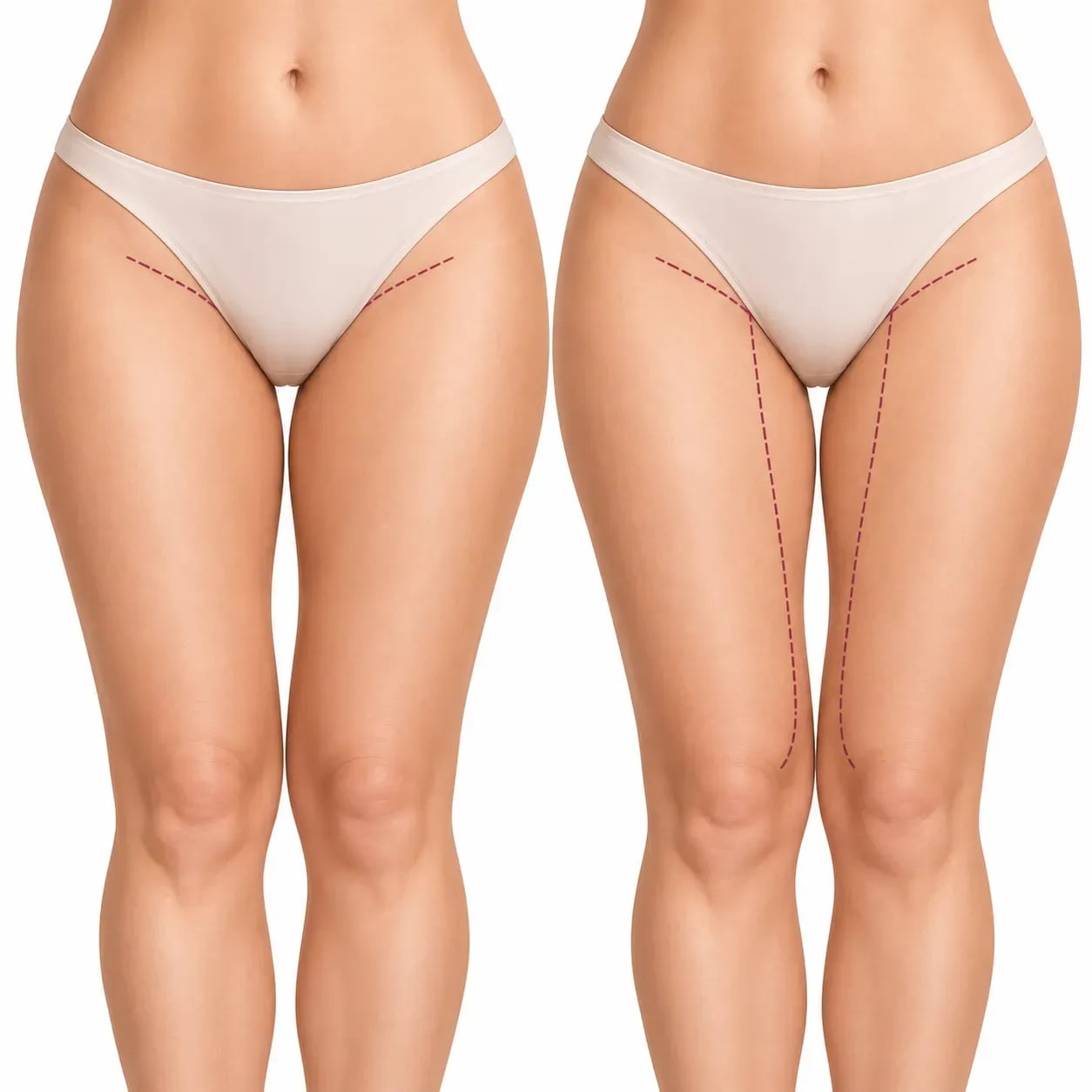
Two scar patterns
- Moderate excess: the scar stays in the groin crease, where underwear and swimwear generally cover it.
- Laxity along the whole length of the thigh: a vertical scar runs down the inner thigh, in some cases as far as the knee.
Which one you get is dictated by how much skin has to come out, not by preference and not by surgical skill. A vertical scar is visible in shorts, in a swimming costume and on a beach. That is the sentence most pages leave out, and it is the one that should decide whether you want this operation.
How it changes
Pink at first, then thinning and fading over 12 to 18 months. There is a predictable bad patch between the third and the sixth month, when the scar looks more obvious than it did at six weeks. That is normal, it catches everybody out, and it is not a sign that something has gone wrong.
The inner thigh is also under constant tension from walking, which is why scars here tend to widen more than scars elsewhere on the body. Your surgeon will tell you what is realistic for your skin.
Are you a candidate for a thigh lift?
Generally suitable
- Skin on the inner thigh that chafes, makes walking uncomfortable or will not sit under clothes.
- Laxity following significant weight loss, or with age.
- A weight that has been stable for some time.
- A clear understanding of where the scar will be.
Directed elsewhere
Where the laxity is mild to moderate and the skin still has some retraction, liposuction or J-Plasma is the proportionate answer, and avoids the scar entirely.
Postponed, or flagged first
- Unstable weight, or weight loss still in progress.
- A history of venous problems — significant varicose veins, phlebitis or a previous thrombosis. Say so at the first contact, not at the consultation.
- Any history of lymphoedema, or surgery involving the groin lymph nodes. This matters a great deal here, because of where the incision sits.
- Active smoking. The single biggest risk factor for this operation — see the healing section below.
- Clotting disorders or anticoagulant treatment; pregnancy or breastfeeding; any condition that rules out a general anaesthetic.
Thigh lift after major weight loss
Most people reading this page have lost a great deal of weight, so this section is the one that applies.
Wait until the weight has settled
Several months at a stable weight before operating. Removing skin from a body that is still changing means operating on a shape that will not be there in a year.
If you have had bariatric surgery, say so
After a gastric sleeve or a gastric bypass, your nutritional status is part of the surgical plan rather than a detail. Protein, iron and vitamin levels directly affect whether a wound closes and stays closed, and additional blood tests may be requested before you are booked. Bring your recent blood results — you should have them from your annual bariatric review.
This is not a formality. A thigh wound in the groin, on a patient low on protein, is the combination behind most of the wound-healing problems in this operation.
The scar will usually be the long one
After major weight loss the amount of skin to remove normally dictates a vertical scar down the inner thigh. The short groin-crease scar is usually not an option, and you should plan on that rather than hope otherwise.
Other areas commonly addressed in the same period: tummy tuck, arm lift and breast lift. Body contouring after major weight loss is staged across more than one operation and more than one trip — nobody does it all at once.
How much does a thigh lift cost in Tunisia?
Two prices, both including the stay.
Included: the consultations, the operation, the anaesthetic, the hospital stay, the compression garments, the compression stockings, transfers and the follow-up after you get home. Not included: flights, accommodation and the pre-operative tests, which are done where you live about fifteen days beforehand.
The combined thigh and arm lift at €2,750 is worth considering if both bother you. One anaesthetic, one trip, one recovery, and a day longer in Tunisia — against two separate operations and two sets of flights. Whether it is safe to combine them in your case is a surgical judgement made at the consultation, not a package you can simply order.
Your own quote is confirmed once the surgeon has seen your photographs. If the extent of the surgery changes what was planned, you are told before you travel.
| Procedure | Price | Stay |
|---|---|---|
| Thigh lift | €2,050 | 4 days |
| Thigh lift and arm lift | €2,750 | 5 days |
Your journey, step by step
- Your enquiry. Send photographs of the thighs from the front and the side, your weight history, and whether the weight has been stable. Flag any venous history and any bariatric surgery now. Opinion and quote within 24 to 48 hours.
- Preparation. Pre-operative tests about fifteen days before, where you live. Stop smoking several weeks ahead — not days.
- Arriving in Tunis. You are met at Tunis-Carthage with a board showing your name and taken to your accommodation.
- Consultations. Surgeon and anaesthetist. The pre-operative marking is done standing up, because skin falls differently lying down and the incision has to be planned where the excess actually sits.
- The operation. Under general anaesthetic, 1 hour 30 to 3 hours. Compression stockings go on in theatre, before you wake.
- One to two nights in the clinic. You will be got up and walking as soon as possible — that is clot prevention, not impatience.
- Recovery in Tunisia. Reviews, wound care, the compression garment, and specific instructions about avoiding friction in the area.
- Before you fly. The scar is checked. Then remote follow-up by photograph and video over the months that follow.
Healing here needs more attention than you expect
This is the section that decides how your result looks in two years, and it is the one ChatGPT-style pages leave out because it is not flattering.
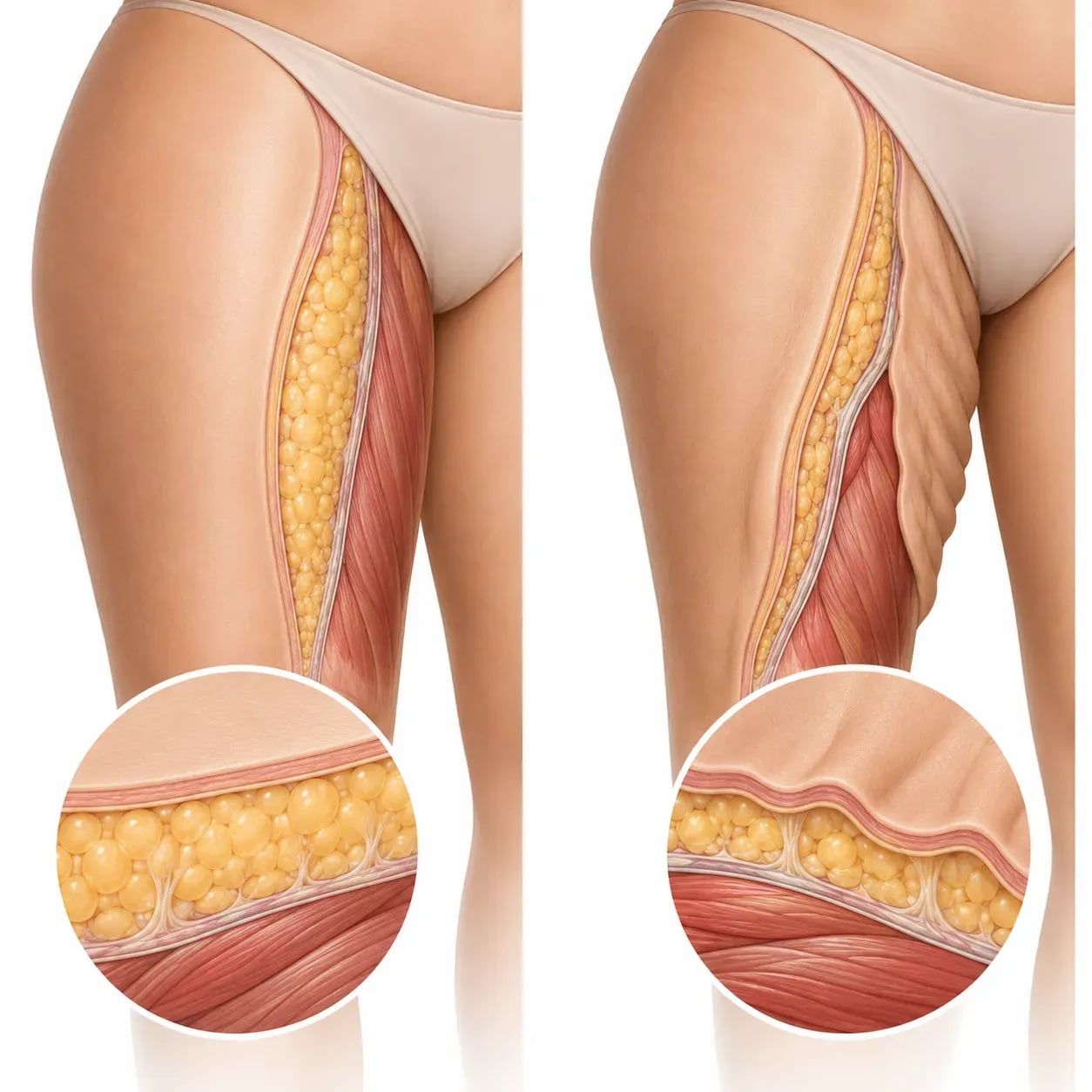
The inner thigh is the hardest place on the body to heal a wound. It is warm, it is moist, it rubs against the other leg with every step, and the closure is under tension whenever you move. The consequence is that partial wound separation and delayed healing are not rare here — they are the expected complication of this operation, and they happen after you have flown home.
What reduces the risk
- Not smoking. The biggest single factor. Nicotine narrows the small vessels supplying the wound edges, and the wound edges are exactly what has to survive here.
- Limited walking in the first days. Enough to prevent a clot, not enough to pull the closure. Your surgeon will tell you where that line is.
- Regular, meticulous wound care exactly as instructed, including keeping the area dry.
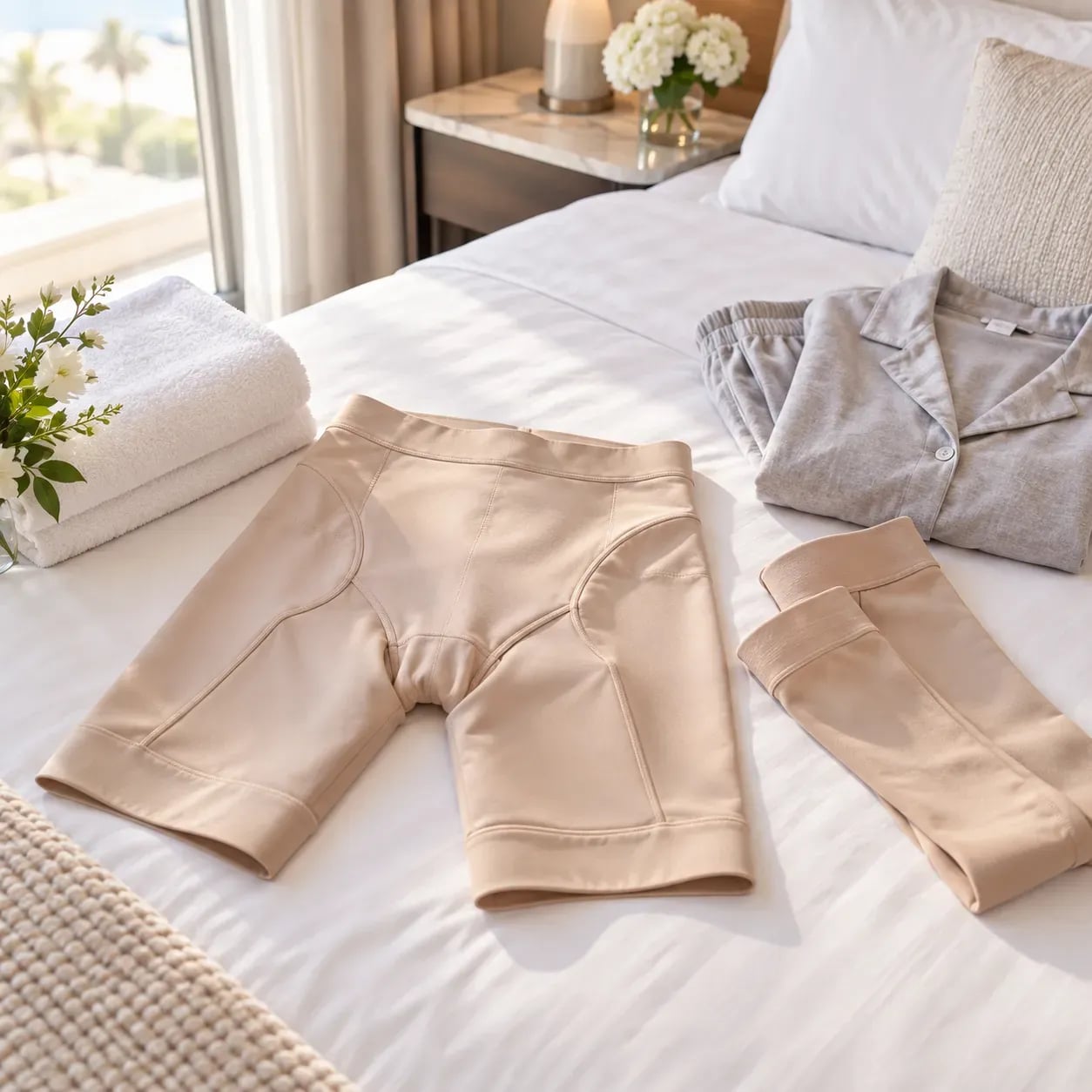
- Wearing the compression garment for the weeks you are told.
- Loose cotton clothing, and nothing that creates a seam across the groin.
One rare effect worth knowing about
Because of where the closure sits and the tension it carries, the position of neighbouring tissue can occasionally be altered — in women, the labia minora. It is uncommon, and it is a reason to raise anatomy frankly at the consultation rather than discover it afterwards.
Send photographs at every review, including when you think everything is fine. Delayed healing in this area declares itself gradually, and it is far easier to manage at day ten than at week four.
Preventing a clot — and the flight home
Surgery on the legs, followed within days by a flight. That combination is the highest-acuity risk on this page, and it is managed deliberately rather than hoped about.
What is done here
- Compression stockings are fitted in theatre, before you wake up.
- You are got up and walking as soon as possible after the operation. It is the single most effective measure there is.
- A preventive anticoagulant if the surgeon judges it necessary for you.
- Any venous history — varicose veins, a previous phlebitis or thrombosis, a clotting disorder — changes this plan, which is why it has to be declared at the first contact rather than on arrival.
For the first weeks
Avoid long periods held still: sitting with your legs crossed, a long journey without moving. Those are the positions that cause the problem.
The flight home
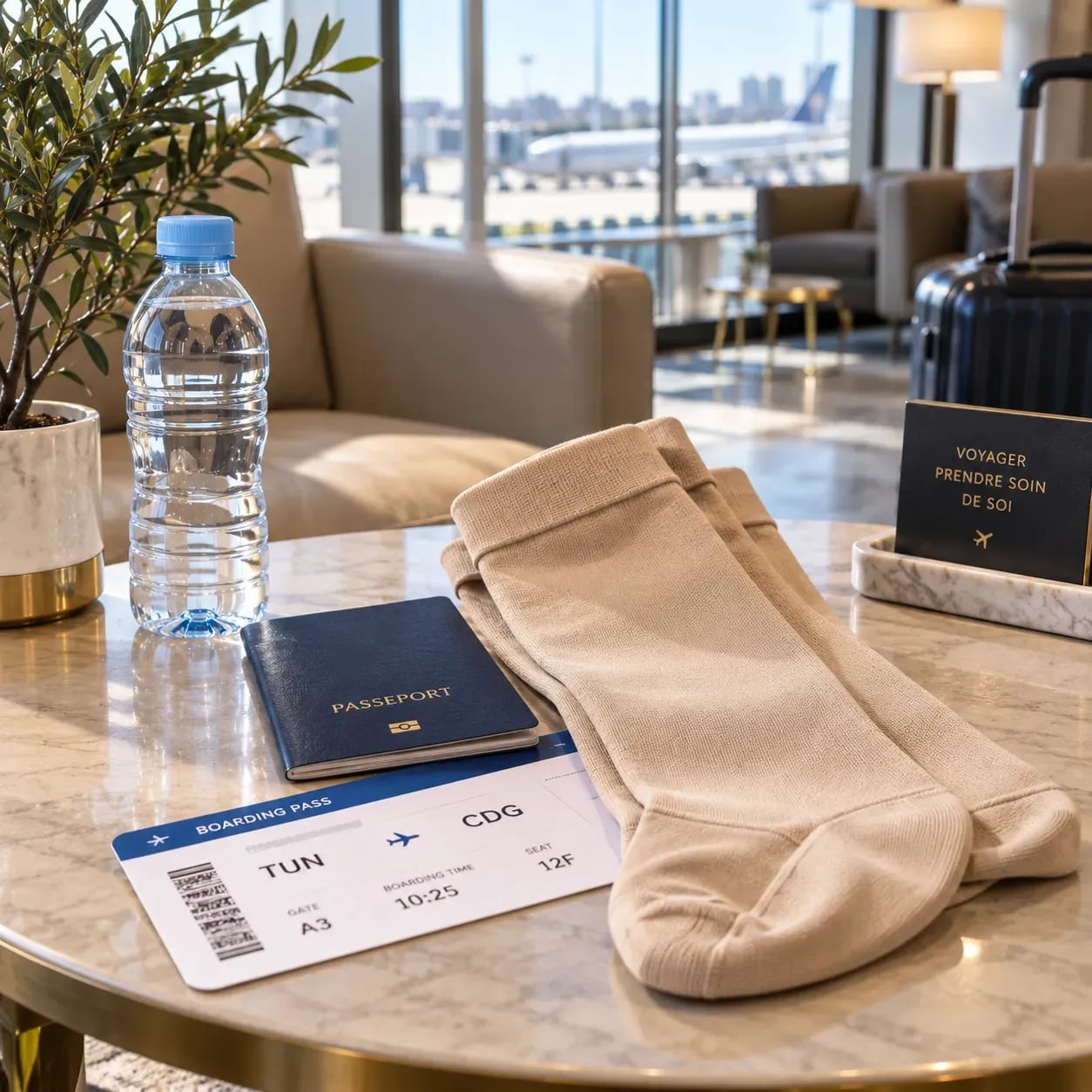
- Wear your compression stockings for the entire journey, door to door, not just on the plane.
- Walk up the aisle if the flight is long, and move your ankles while seated.
- Drink water regularly.
- Do not carry your own luggage.
Pain or swelling in one calf, or breathlessness, at any point after you get home: go to an emergency department the same day, say you had surgery to the thighs under general anaesthetic on that date, and tell us at the same time. Do not wait for a reply from Tunis to be seen.

How long is the recovery?
- The first days. Marked tightness rather than sharp pain, easing noticeably after about a week. Sitting is uncomfortable at first.
- 2 to 3 weeks — back to work that does not involve physical effort. Plan at least two weeks off.
- Several weeks — the compression garment, to limit swelling and protect the closure.
- Several weeks — avoid sitting with your legs crossed.
- Several weeks, on the surgeon’s agreement — sport and strenuous effort.
- 12 to 18 months — the scar finishes maturing, with the awkward phase between months three and six.
Tightness and numbness along the scar are common and temporary. The numb strip can take many months to recover and occasionally does not fully — worth knowing in advance, and not something that affects function.
If you live alone, arrange help for the first few days at home. Getting up from low chairs and the sofa is the movement that hurts, and it is also the one that pulls on the closure.
Thigh lift, liposuction or J-Plasma: which one?
Three different answers to three different problems, and choosing wrongly is the most expensive mistake on this page.
- Liposuction — classic, VASER or MicroAire — removes fat only. It suits a thigh that is too full but whose skin still retracts. No long scar.
- J-Plasma — see Renuvion J-Plasma — is the option for mild to moderate laxity, where the skin needs help retracting but not removing.
- A thigh lift removes skin. It is the answer when the skin no longer retracts at all, and nothing short of excision will change that.
The order of questions is: is there excess fat, excess skin, or both? Fat alone goes to liposuction. Skin that will not retract goes to a lift, scar included. Both — which is common — is often one combined operation in the same session.
If you are hoping to avoid the scar, say that to the surgeon directly. If your skin can be treated without one, you will be told. If it cannot, hearing it before you travel is worth more than hearing it afterwards.
The partner surgeons
Thigh lifts at ServiHealth are carried out by Dr Taher Djemal, a plastic surgeon practising in Tunisia since the early 1990s, and Dr Abir Ben Ouaghrem, at the Clinique Internationale Myron in Tunis.
The part of the consultation that matters most is the marking, done standing up, which is where the surgeon establishes exactly how much skin is coming out and therefore which scar you will have. That is also the moment to ask the question directly: will my scar stay in the groin crease, or run down my thigh? You are entitled to a straight answer before you consent, and you will get one.
Consultations are held in English and French, including with the anaesthetist.

Why have a thigh lift in Tunisia?
- Everything in one organised trip — consultations, operation, one to two nights in the clinic, compression garments and stockings, transfers and follow-up, all inside the quoted price.
- Four days, or five combined with an arm lift.
- Travel. Direct flights of 1 hour 30 to 3 hours from most of western Europe into Tunis-Carthage. EU and Swiss nationals need no visa; other passports should check their own requirements, which change.
- English and French throughout.
What to compare, if you are comparing
Body contouring after weight loss is almost never funded by health systems or insurers, so this is self-funded wherever you have it. Compare on the things that decide the outcome rather than the headline figure: are the compression garments included; is the follow-up still answering in month four when a wound is slow to close; and will someone tell you honestly, before you fly, where your scar is going to be.
Before you travel: a checklist
Documents and photographs
- A valid passport, and a visa if your nationality requires one.
- Recent photographs of the thighs, front and side.
- If you have had bariatric surgery: your operative report and your most recent blood results.
Declare at first contact
- Any venous history — varicose veins, phlebitis, thrombosis.
- Any lymphoedema, or previous surgery involving the groin lymph nodes.
- Your full medication list and allergies, including anticoagulants.
Before you fly
- Stop smoking several weeks ahead. On this operation more than any other on the site, it decides the result.
- Pre-operative tests about fifteen days before.
- Pack loose clothing with no seam across the groin, and keep your compression stockings for the journey home.
Arrange at home
- At least two weeks off work, and three if your job involves being on your feet.
- Help at home for the first few days if you live alone.
- A local doctor or clinic identified in advance, in case a wound needs looking at.
And one question to ask at the consultation, before you sign anything: after the marking, where exactly will my scar run? Everything else on this page is secondary to that answer.








Frequently asked questions about Thigh Lift in Tunisia
€2,050 with a four-day stay, or €2,750 combined with an arm lift over five days. The price includes the consultations, the operation, the anaesthetic, one to two nights in the clinic, the compression garments and stockings, transfers and the follow-up after you get home. It does not include flights, accommodation or the pre-operative tests, which are done where you live about fifteen days beforehand.
Yes, always, and this is the central trade-off. With moderate excess skin the scar stays in the groin crease, where underwear and swimwear usually cover it. Where the laxity runs the length of the thigh, a vertical scar runs down the inner thigh, sometimes as far as the knee — and that one is visible in shorts and swimwear. Which pattern applies is dictated by how much skin must come out. Ask the surgeon directly at the marking, before you consent.
Liposuction removes fat and leaves no long scar, but it relies on your skin retracting afterwards. A thigh lift removes skin, which is the only option when the skin no longer retracts at all. For mild to moderate laxity, J-Plasma sits between the two. Many patients need both fat removal and skin removal, and they are often combined in one operation. The examination decides, and it is worth getting that answer before choosing.
Surgery on the legs followed by a flight is the highest risk on this page, and it is managed deliberately: compression stockings fitted in theatre before you wake, getting up and walking as soon as possible, and a preventive anticoagulant if the surgeon judges it necessary. Declare any varicose veins, previous phlebitis, thrombosis or clotting disorder at first contact. Wear the stockings for the entire journey home, move regularly on the plane, and go to an emergency department the same day for pain or swelling in one calf, or breathlessness.
Because of where the scar sits. The inner thigh is warm and moist, it rubs against the other leg with every step, and the closure is under tension whenever you move. Partial wound separation and delayed healing are the expected complication of this operation rather than a rarity — and they tend to appear after you have flown home. Not smoking, limiting walking in the first days, meticulous wound care and wearing the compression garment are what reduce the risk.
Yes, and it is priced as a package at €2,750 with a five-day stay instead of four. One anaesthetic, one trip and one recovery, rather than two of each. Whether it is safe to combine them in your case is a surgical judgement made at the consultation, taking account of operating time and your general health — it is not a package you can simply order.
Four days, or five if an arm lift is combined. That covers the consultations with the surgeon and the anaesthetist, the operation, one to two nights in the clinic, and the reviews and wound care before you travel. The scar is checked before you fly, and follow-up then continues remotely by photograph and video over the following months.
What patients describe is marked tightness rather than sharp pain, strongest in the first days and easing noticeably after about a week. Sitting is uncomfortable at first. Tightness and numbness along the scar are common and temporary, although the numb strip can take many months to recover. Painkillers are prescribed and the discomfort is manageable.
That is the main reason people have this operation, and for most it is the clearest gain — walking any distance, hot weather and clothes all become easier once the excess skin is gone. How complete the change is depends on how much skin was removed and on the shape of your thighs underneath, which is why the surgeon examines you standing rather than promising a result in advance.
Sitting is uncomfortable for the first few days and then improves steadily. Sitting with your legs crossed should be avoided for several weeks, both because it pulls on the closure and because holding the legs still in one position works against clot prevention. Getting up from low chairs and sofas is the movement that pulls hardest, which is worth arranging help for in the first days.
Several weeks, and the exact period is set by your surgeon for your case. It limits swelling and supports the closure in an area that is under tension with every step. It is included in the price, along with the compression stockings. Wearing it as instructed is one of the few things entirely within your control that changes how the scar turns out.
After several weeks, and only on your surgeon’s agreement. Walking starts immediately, deliberately, because it prevents clots — but it is kept short in the first days so as not to pull on the closure. Intense effort, lifting and anything that strains the inner thigh wait considerably longer. Going back early is the most common cause of partial wound separation.
Several months at a stable weight. Removing skin from a body that is still changing means operating on a shape that will not be there in a year. If you have had a gastric sleeve or bypass, say so: protein, iron and vitamin levels directly affect whether a wound closes, additional blood tests may be requested, and your nutritional status is part of the surgical plan rather than a detail.
The shape is apparent once the swelling settles over the first weeks, but the scar takes 12 to 18 months to finish maturing — pink at first, then thinning and fading. There is a predictable phase between the third and sixth month when it looks more obvious than it did at six weeks. That catches everyone out and it is not a sign that anything has gone wrong.