

Arm lift in Tunisia: the scar, the price and who should think twice
Arm lift in Tunisia: the essentials
An arm lift — brachioplasty — removes the loose skin on the inner arm between the armpit and the elbow and re-tensions what is left. Liposuction is often combined with it. It is the only thing that works when skin has stopped retracting, and no amount of training will do it instead.
The trade is a scar, and it behaves in a particular way: invisible with your arms by your side, visible every time you raise them. Reaching a high shelf, waving, holding a rail on a train, a sleeveless top. That is the honest description, and it is the thing to be sure about before you book.
Surgery is carried out by Dr Taher Djemal and Dr Abir Ben Ouaghrem at the Clinique Internationale Myron in Tunis.
| Operating time | 1 hour 30 to 2 hours 30, depending on the extent |
| Anaesthetic | General |
| In hospital | One night, sometimes with temporary drains |
| Recommended stay in Tunisia | 4 days (5 days combined with a thigh lift) |
| Back to non-physical work | 2 weeks |
| No lifting or wide arm movements | 4 to 6 weeks |
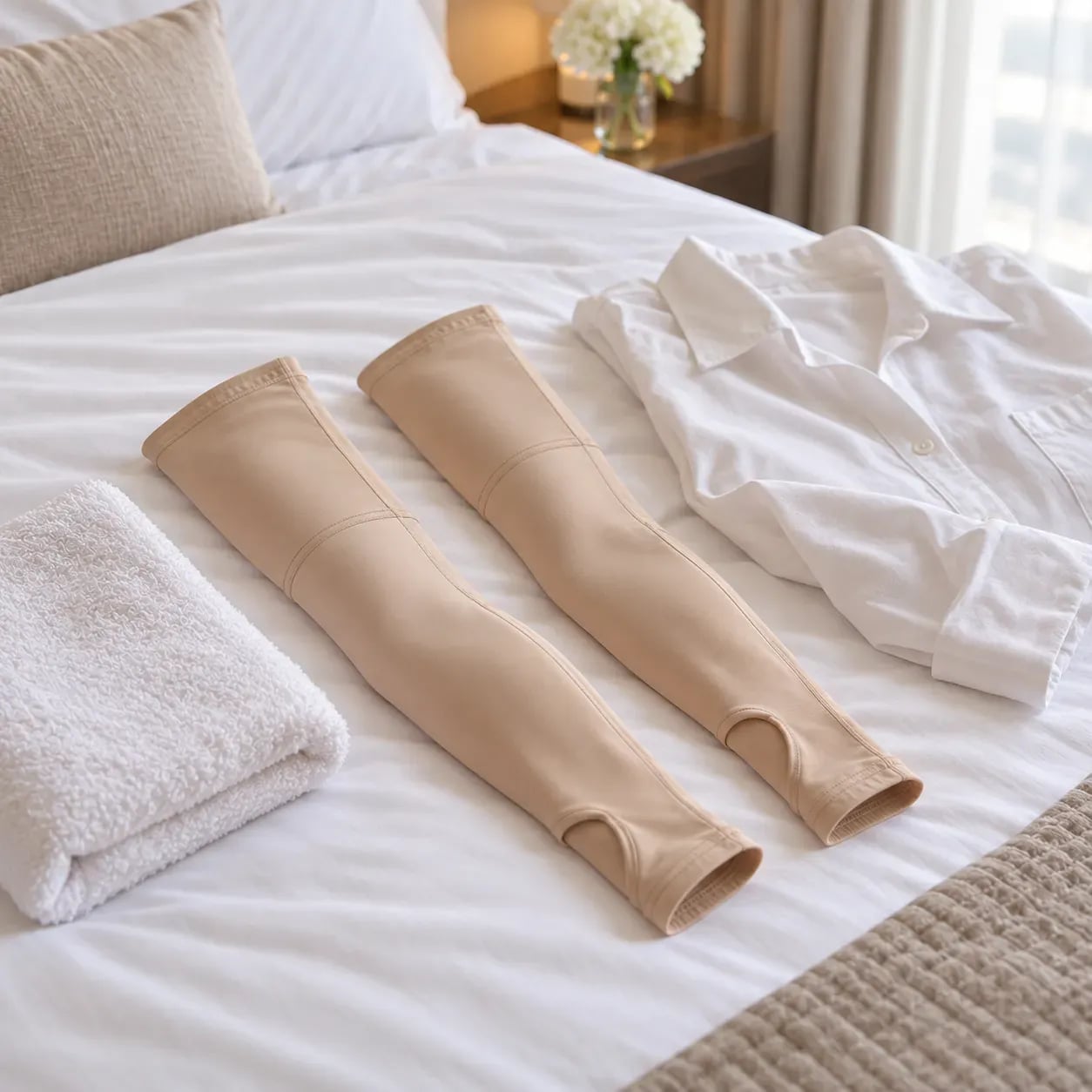
| Compression sleeves | Several weeks, continuously at first |
| Scar matures | 12 to 18 months |
| Price | €2,050, or €2,750 with a thigh lift |
What an arm lift is — and is not
The surgeon removes the excess skin from the inner surface of the arm, between the armpit and the elbow, and re-tensions the remaining tissue. Where there is also fat, liposuction is carried out in the same operation through incisions of a few millimetres that add no meaningful scar.
It is worth being clear about what this does not do. An arm lift does not build muscle, it does not replace exercise, and beyond what liposuction can remove it does not change the volume of fat in the arm. It removes skin. If what bothers you is tone rather than hanging skin, this is not your operation and a good surgeon will say so.
The indication is skin that no longer retracts — most often after losing several stone, whether through bariatric surgery or sustained dieting, and sometimes simply with age.
Where the scar runs, and how it changes
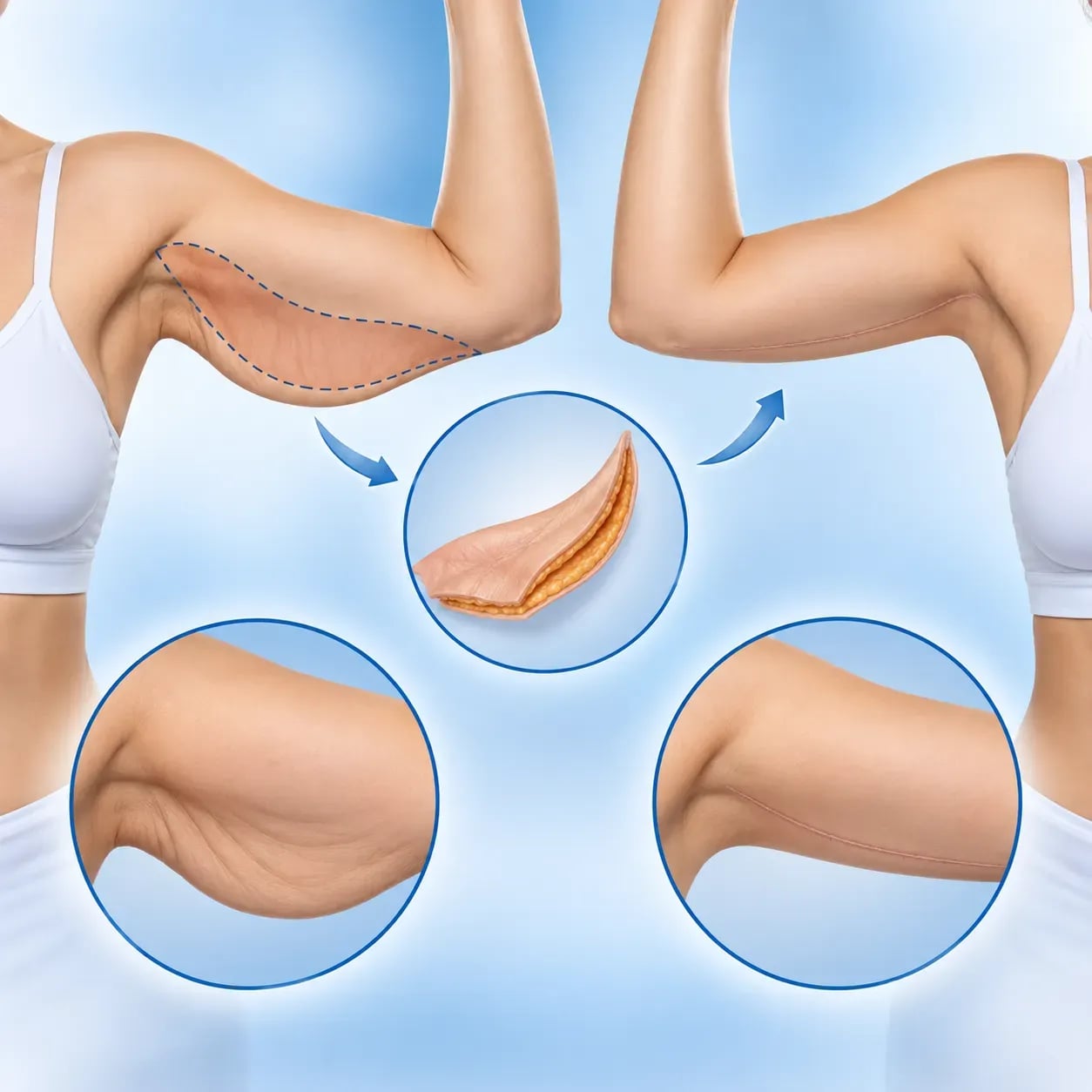
The scar is the price of this operation, so here is exactly where it goes and what it does over time.
Where it runs
Along the inner surface of the arm, from the armpit to the elbow in a full arm lift; confined to the armpit fold or just below it in a mini-lift. It sits where your arm touches your body, which is why it disappears with your arms down and appears when you lift them.
How it changes
- First weeks: pink, sometimes thick and tender.
- Months 3 to 6: the colour deepens and the scar looks worse than it did at six weeks. This phase catches everyone out and is not a sign of a problem.
- 12 to 18 months: it pales and settles. That is when it is judged.
What the result depends on
Your skin quality, how you have scarred before, whether you smoke, and whether you follow the instructions. Some scars stay wider or thicker than others, and no surgeon can promise you which you will get. Tell the surgeon at the consultation if you have ever had a keloid or a hypertrophic scar — it changes the conversation and sometimes the recommendation.
Sun protection for several months after surgery. A fresh scar exposed to sun darkens and stays darker.
Mini-lift or full arm lift?
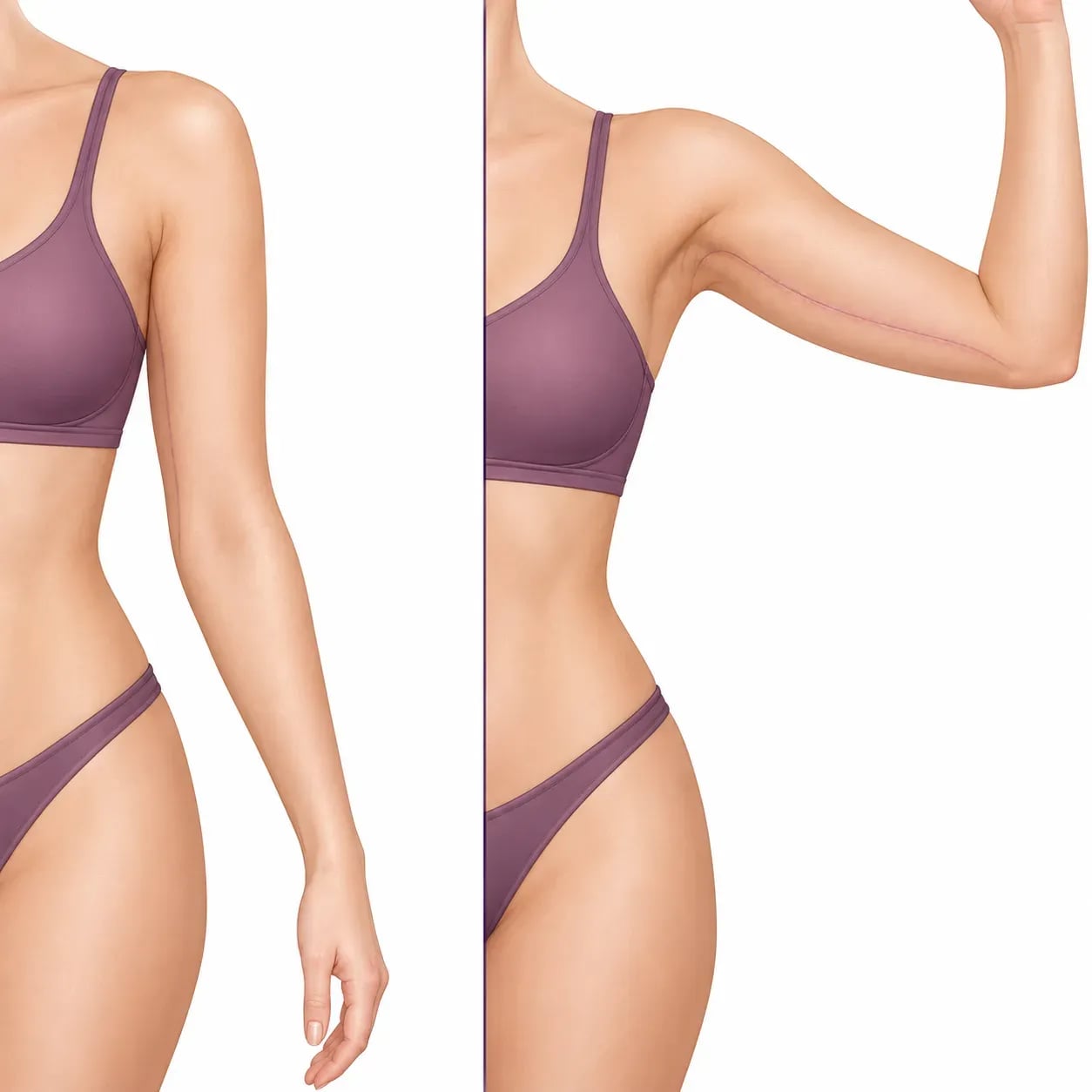
Two techniques, and the amount of loose skin decides which, not preference.
Mini-lift
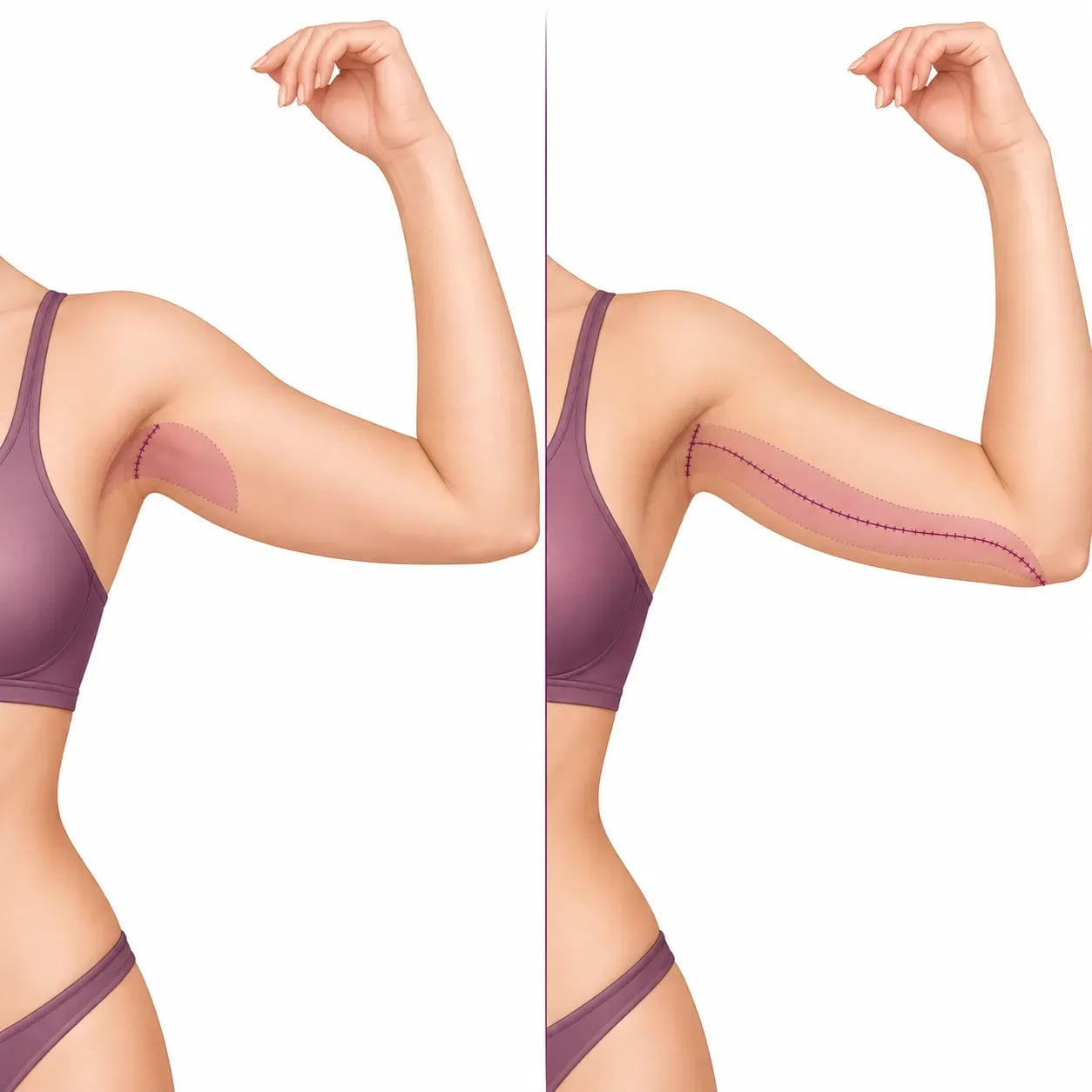
A short scar hidden in the armpit fold or just below it. Reserved for excess confined to the upper third of the arm. If you qualify for it, it is by far the better deal — a nearly hidden scar for a real improvement.
Full arm lift
The scar runs from the armpit to the elbow. This is the technique after significant weight loss, because the excess extends the length of the arm and there is no way to remove it through a short incision.
With liposuction
Added where there is fat as well as skin, through millimetre incisions that leave no significant additional scar.
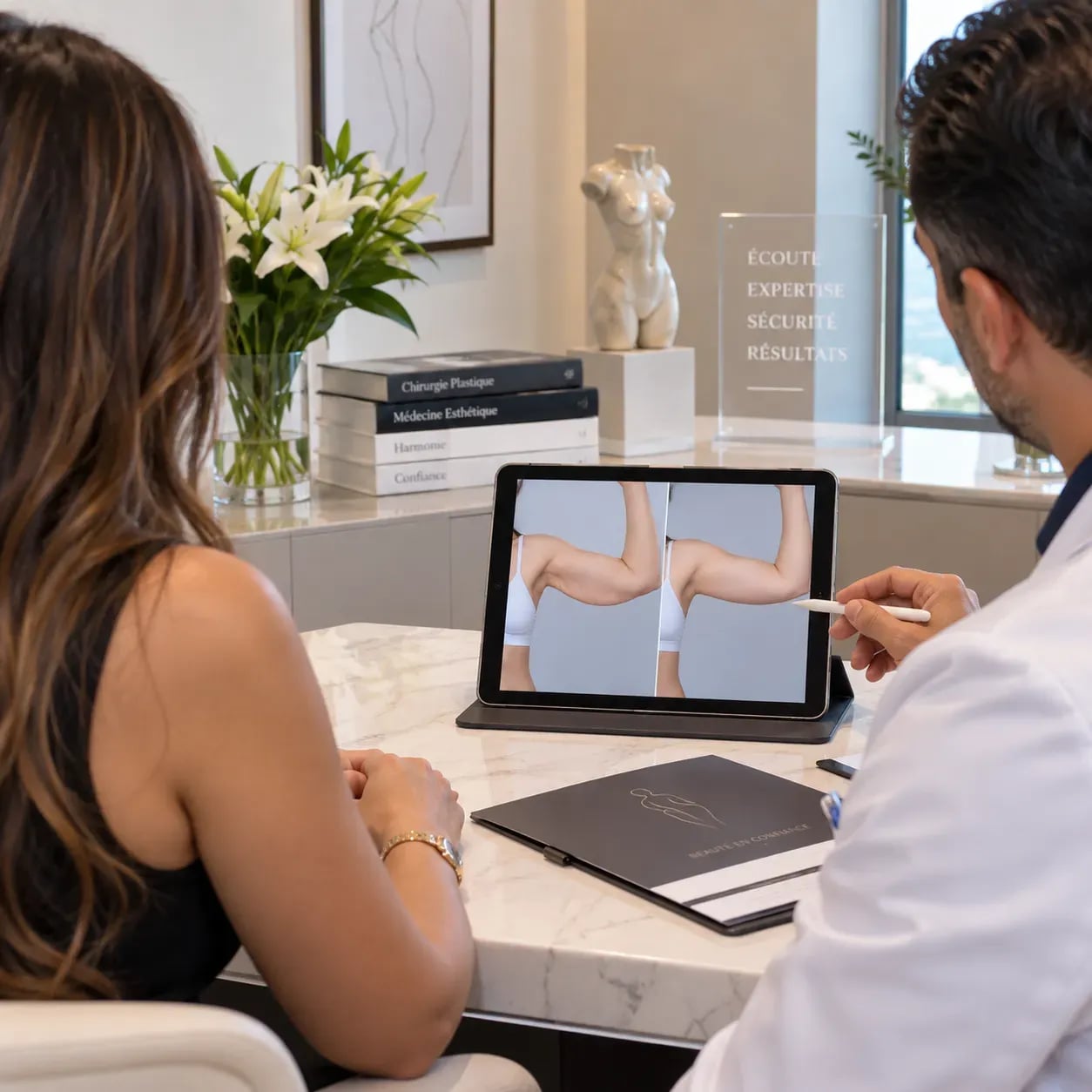
Which applies to you is decided in consultation after examination — not from photographs. If someone commits to a mini-lift before examining your arm, treat that as a sales position rather than a surgical one. The honest answer is often the one you did not want: after major weight loss, the short scar is usually not available.
Are you a candidate for an arm lift?
Generally suitable
- Loose skin on the inner arm that no longer retracts, most often after major weight loss or with age.
- A weight that has been stable for several months.
- Realistic expectations about the scar — which is the criterion surgeons actually weigh most heavily here.
The one to raise before anything else
If you have had lymph nodes removed from the armpit — most often as part of breast cancer treatment — say so at your very first message. Operating in that area can worsen an arm lymphoedema that already exists, or bring out one that was latent. It does not automatically rule you out, but it means a careful assessment together with the doctor who is treating you, and in some cases the honest recommendation will be not to operate.
This is the most important sentence on the page for a sizeable number of the women who read it, and it is routinely left out elsewhere.
Postponed, or contraindicated
- Unstable weight, or significant weight loss still under way.
- Smoking not stopped before the operation.
- Clotting disorders or current anticoagulant treatment.
- Cardiac, respiratory or other conditions precluding a general anaesthetic.
- Unrealistic expectations about the scar.
Arm lift after major weight loss
This is the main indication. Skin does not always retract after losing several stone, and no exercise brings it back.
Wait for the weight to settle
Several months at a stable weight before operating. Continuing to lose afterwards degrades the result.
If you have had a sleeve or a bypass
Nutritional status is part of the surgical plan. Protein and iron in particular affect whether a wound closes and holds, and additional blood tests may be requested before you are booked. Bring your most recent results — you will have them from your annual bariatric review. See gastric sleeve and gastric bypass.
Several areas at once, or spread out?
Loose skin after major weight loss rarely stops at the arms. Two compatible procedures can be combined in one operation — lower total cost, one anaesthetic, one recovery — or staged across separate trips. The combinations most often considered alongside an arm lift are thigh lift, tummy tuck and breast lift.
Whether two procedures can safely be done together depends on operating time and your general health, and that is a surgical judgement rather than a menu choice.
How much does an arm lift cost in Tunisia?
Two prices, both including the stay.
Included: the consultation with the surgeon and the anaesthetist, the operation, the anaesthetic, the night in the clinic, the compression sleeves, transfers and the follow-up after you go home. Not included: flights, accommodation and the pre-operative tests, which are done where you live.
The combined arm and thigh lift at €2,750 is the better arithmetic if both bother you: one anaesthetic, one trip, one recovery and one extra day in Tunisia, against two separate operations and two sets of flights. Whether it is safe in your case is decided at the consultation.
One cost to budget for that is not on this list
Lymphatic drainage massage, typically three times a week for a month after you get home. It is part of the recovery for this operation and it is arranged where you live, at your own cost. Find out what a session costs near you before you commit to the surgery — it is a real figure and nobody mentions it.
| Procedure | Price | Stay |
|---|---|---|
| Arm lift | €2,050 | 4 days |
| Thigh lift and arm lift | €2,750 | 5 days |
Your journey, step by step
- Remote consultation. Send photographs of your arms, front and side, with what bothers you, by WhatsApp or email. Opinion and personalised quote within 24 to 48 hours. Declare any armpit lymph node surgery now.
- Organising the trip. Flights, accommodation, and visa paperwork where it is needed.
- Arrival and assessment. You are met at the airport. In-person consultation and the full pre-operative work-up, which is where the technique — mini-lift or full — is finally decided.
- The operation. Under general anaesthetic, 1 hour 30 to 2 hours 30.
- One night in the clinic, with temporary drains in some cases.
- Recovery in Tunisia. Reviews, removal of any drains, and the compression sleeves fitted and worn.
- Home, and remote follow-up by photograph or video at set intervals. Send them even when everything looks fine.
Is an arm lift safe? Risks and precautions
Brachioplasty is a well-established operation. The risks worth understanding are specific to the arm rather than generic.
General surgical risks
Haematoma, infection, delayed healing, and a scar that widens. Temporary changes in sensation along the scar are common.
Lymphoedema — the one specific to this area
The lymphatic channels of the arm run close to where the incision is made. The risk is managed by how the incision is positioned, by respecting the superficial lymphatic pathways, by the compression sleeve, and by monitoring the volume of the arm afterwards. It is a far more serious consideration for anyone who has had axillary lymph nodes removed — see the candidacy section above.
Clots
Early mobilisation is encouraged from the day of surgery. Pain or swelling in a calf, or breathlessness, at any point after you get home means an emergency department the same day — say you had surgery under general anaesthetic on that date, and tell us at the same time.
Sensation
Tightness or numbness along the scar is frequent and fades over several weeks to several months. A narrow numb strip occasionally remains. It affects how the arm feels, not how it works.
How long is the recovery?
- First week. Swelling and discomfort are at their worst, then ease steadily. Prescribed painkillers are enough; this is tightness rather than sharp pain.
- Dressings every other day. Stitches are dissolvable, so there is normally nothing to remove.
- Showering is allowed, drying the area carefully afterwards.
- First days — do not raise your arms above shoulder height.
- 2 weeks — back to work that does not involve physical effort.
- 4 to 6 weeks — no lifting and no wide arm movements, on the surgeon’s advice.
- Several weeks — compression sleeves worn continuously at first, then eased. Your surgeon sets the period.
- Lymphatic drainage — usually three times a week for a month, arranged where you live.
- Sport — reintroduced gradually, once the surgeon agrees.
- Sun protection on the scar for several months.
- Up to 12 months for the overall result, and 12 to 18 months for the scar.
Think about the practical side of arms that cannot go above shoulder height for a while: washing and drying your hair, reaching into high cupboards, getting dressed, lifting a child. Arrange help for the first days, and move the things you use daily down to waist height before you travel.
Arm lift, J-Plasma or liposuction: which one?
Three options, one question: is there skin to remove, or only fat and slackness?
- Liposuction — classic or VASER — removes fat and leaves no significant scar, but relies on your skin retracting afterwards.
- J-Plasma tightens mild to moderate laxity without removing skin and without a long scar.
- An arm lift removes skin. It is the only effective option for significant laxity, and it is the only one with a visible scar.
The temptation is obvious: choose the option without the scar. It is worth resisting if your skin will not retract, because a liposuction on an arm with hanging skin removes the volume and leaves the skin hanging emptier. That outcome is worse than either starting point, and it then needs the lift anyway.
Ask the surgeon directly whether your skin can be treated without a scar. If it can, you will be told. If it cannot, better to hear it before you book.
The partner surgeons
Arm lifts at ServiHealth are carried out by Dr Taher Djemal, a plastic surgeon practising in Tunisia since the early 1990s, and Dr Abir Ben Ouaghrem, at the Clinique Internationale Myron in Tunis, where an anaesthetic team is present continuously.
The decision that matters is mini-lift versus full arm lift, and it is taken after examining your arm rather than from photographs. The surgeon will also position the incision with the lymphatic pathways in mind, which is the part of this operation where experience shows.
Consultations are held in English and French, including with the anaesthetist.
Why have an arm lift in Tunisia?
- Everything in one organised trip — consultations, operation, a night in the clinic, compression sleeves, transfers and follow-up, inside the quoted price.
- Four days, or five combined with a thigh lift.
- Travel. Direct flights of 1 hour 30 to 3 hours from Paris, Brussels, Geneva, Lyon and Marseille into Tunis-Carthage, with regular connections from Dakar, Abidjan, Douala, Libreville and Casablanca. EU and Swiss nationals need no visa; other passports should check their own requirements, and we help with supporting paperwork on request.
- English and French throughout.
What is worth comparing
Body contouring after weight loss is not funded by health systems or insurers, so it is self-funded wherever you have it. Compare the things that decide the result: are the compression sleeves included; will someone answer in month four when the scar goes through its worst phase; and will a surgeon tell you honestly, before you fly, whether you qualify for the short scar or not.
Before you travel: a checklist
Documents and photographs
- A valid passport, and a visa if your nationality requires one.
- Recent photographs of your arms, front and side, arms raised and lowered.
- Basic blood tests if you can get them, and your latest results if you have had bariatric surgery.
Declare at first contact
- Any surgery or treatment involving the lymph nodes of the armpit, including breast cancer treatment. This is the one that changes the plan.
- Any tendency to keloid or thickened scars.
- Your full medication list and allergies, including anticoagulants.
Before you fly
- Stop smoking, ideally several weeks ahead.
- Pack loose clothing with wide sleeves — nothing you have to pull over your head or squeeze an arm into.
Arrange at home
- At least two weeks off work, and no lifting or wide arm movements for several weeks after that.
- Lymphatic drainage sessions, roughly three a week for a month. Find a practitioner and a price before you travel.
- Help for the first days: hair washing, high cupboards, dressing, small children.
And the question to ask at the consultation, before you consent: after examining me, is my scar stopping at the armpit or going to the elbow? Everything else follows from that answer.








Frequently asked questions about Arm Lift in Tunisia
€2,050 with a four-day stay, or €2,750 combined with a thigh lift over five days. The price includes the consultation with the surgeon and the anaesthetist, the operation, the anaesthetic, the night in the clinic, the compression sleeves, transfers and the follow-up after you go home. It does not include flights, accommodation or the pre-operative tests. Budget separately for lymphatic drainage at home, usually three sessions a week for a month.
Yes, and it is priced as a package at €2,750 with a five-day stay instead of four. One anaesthetic, one trip and one recovery, rather than two of each, which is why most patients with both problems choose it. Whether it is safe in your case depends on operating time and your general health, and that is decided at the consultation.
A full arm lift leaves a scar running from the armpit to the elbow along the inner arm. A mini-lift leaves a short scar in or just below the armpit fold, but it is only an option when the excess skin is confined to the upper third of the arm — which, after major weight loss, it usually is not. The scar is invisible with your arms by your side and visible when you raise them. Which one applies is decided after examination, not from photographs.
For mild to moderate laxity, yes: liposuction, VASER or J-Plasma tighten or remove fat without a long scar. For significant laxity, no. Removing fat from an arm whose skin will not retract leaves the skin hanging emptier than before, which is a worse result than either starting point and usually leads to the lift anyway. Ask the surgeon directly whether your skin can be treated without a scar — the answer is honest either way.
It is a well-established operation carried out under general anaesthetic with an anaesthetic team present continuously. The recognised risks are haematoma, infection, delayed healing, a scar that widens, and temporary changes in sensation along the scar. The risk specific to this area is lymphoedema, because the lymphatic channels of the arm run close to the incision — which is why incision placement, the compression sleeve and monitoring the arm’s volume all matter, and why a history of lymph node removal changes the assessment.
Tell us at your very first message if lymph nodes were removed from your armpit. Operating in that area can worsen an existing arm lymphoedema or bring out one that was latent. It does not automatically rule you out, but it requires a careful assessment made together with the doctor treating you, and in some cases the honest recommendation will be not to operate. This is the single most important thing to declare on this page, and we would rather lose the booking than get it wrong.
Four days, or five if a thigh lift is combined. That covers the in-person consultation and pre-operative work-up, the operation, one night of monitoring in the clinic with drains in some cases, and the reviews and compression sleeve fitting before you travel. Follow-up then continues remotely by photograph or video at set intervals.
The difference is substantial, and it is why most people reading this are considering travelling. Rather than quoting another country’s price list, compare properly: the full price including the compression sleeves, your flights and accommodation, the lymphatic drainage sessions at home, and whether anyone will still be answering you in month four when the scar goes through its worst phase. This is self-funded wherever you have it — no health system or insurer covers it.
Yes. Loose skin after major weight loss rarely stops at the arms, and two compatible procedures in one operation means a lower total cost, one anaesthetic and one recovery. The combinations most often considered are a thigh lift, a tummy tuck or a breast lift. Whether two can safely be done together depends on operating time and your general health, so it is a surgical judgement rather than a menu choice.
What patients describe is tightness and discomfort rather than sharp pain, strongest in the first week and then easing steadily. Prescribed painkillers are enough. Tightness or numbness along the scar is common and fades over several weeks to several months. The bigger practical constraint is not pain but movement: no raising your arms above shoulder height in the first days.
Several weeks, worn continuously at first and then eased, with the exact period set by your surgeon. They are included in the price. They limit swelling, support the closure and help manage the lymphatic risk specific to this area — which makes wearing them one of the few things entirely within your control that changes the outcome.
They will be firmer and better shaped, and slimmer to the extent that skin, and any fat removed by liposuction in the same operation, accounted for the volume. What an arm lift does not do is build muscle, replace exercise or reduce fat beyond what liposuction can take. If what bothers you is tone rather than hanging skin, this is not the right operation and the surgeon will say so.
In a sleeveless top the scar is hidden with your arms down and visible when you raise them — reaching, waving, holding a rail. That is the honest description. It also needs sun protection for several months after surgery, because a fresh scar exposed to sun darkens and stays darker. Plan the operation so that the first summer falls well after it rather than during the first months.
Some scars stay wider or thicker than others and no surgeon can promise you which you will get. Raise it at your follow-up rather than waiting: treatments exist and work better early. Do not judge anything between months three and six, when the scar deepens in colour and looks worse than it did at six weeks — that phase is normal and it reverses. Tell the surgeon before the operation if you have ever had a keloid or a thickened scar.