

Dental implants in Tunisia: prices, the two trips and lifelong care
Dental implants in Tunisia: the essentials
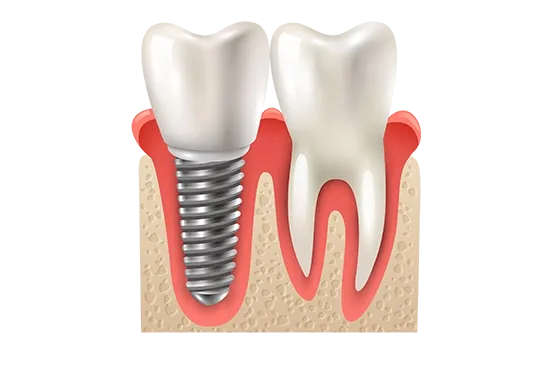
An implant is a small titanium screw placed in the jawbone to replace the root of a missing tooth. The bone grows onto it over three to six months — osseointegration — and then it carries an abutment and a custom crown. Done properly it lasts decades.
The thing to understand before anything else is that this is a two-trip treatment. Placement on the first visit, the permanent crown on the second, three to six months later. Almost every problem we see with dental work done abroad comes from someone planning the first trip carefully and the second one not at all. Plan both now.
Treatment is carried out by Dr Fedia Mtaallah at the Clinique Internationale Myron in Tunis, from the initial assessment through to the final crown.
| Procedure time | 30 to 90 minutes per implant |
| Anaesthetic | Local, sometimes with light sedation for larger cases |
| Trips to Tunisia | Normally two — placement, then the crown 3 to 6 months later |
| Osseointegration | 3 to 6 months |
| Back to work | 1 to 2 days |
| Lifespan | Several decades with proper maintenance |
How much do dental implants cost in Tunisia?
Prices are per situation, and the implant price includes the crown. A personalised quote is issued within 24 to 48 hours of receiving your x-rays or a photograph of your smile.
Included: the consultation, the radiographic assessment, placement of the implant, the abutment, the crown or prosthesis, transfers and follow-up. Not included: flights, accommodation and personal expenses.
Two worked examples, because the table alone rarely answers the real question. One tooth needing a bone graft comes to €1,880. Three teeth restored as a bridge on implants comes to €2,490. Both arches with All-on-4 comes to €8,980.
Whether you need a graft or a sinus lift is confirmed by the radiographic assessment, not guessed from a photograph — so treat any figure given before that as provisional, here or anywhere else.
| Situation | Price |
|---|---|
| Single implant with crown | €1,290 |
| Bone graft, if needed | €590 |
| Sinus lift, if needed | €790 |
| Bridge on 2 or 3 implants | €2,490 |
| All-on-4, one arch | €4,490 |
| All-on-6, one arch | €5,490 |
What a dental implant actually is
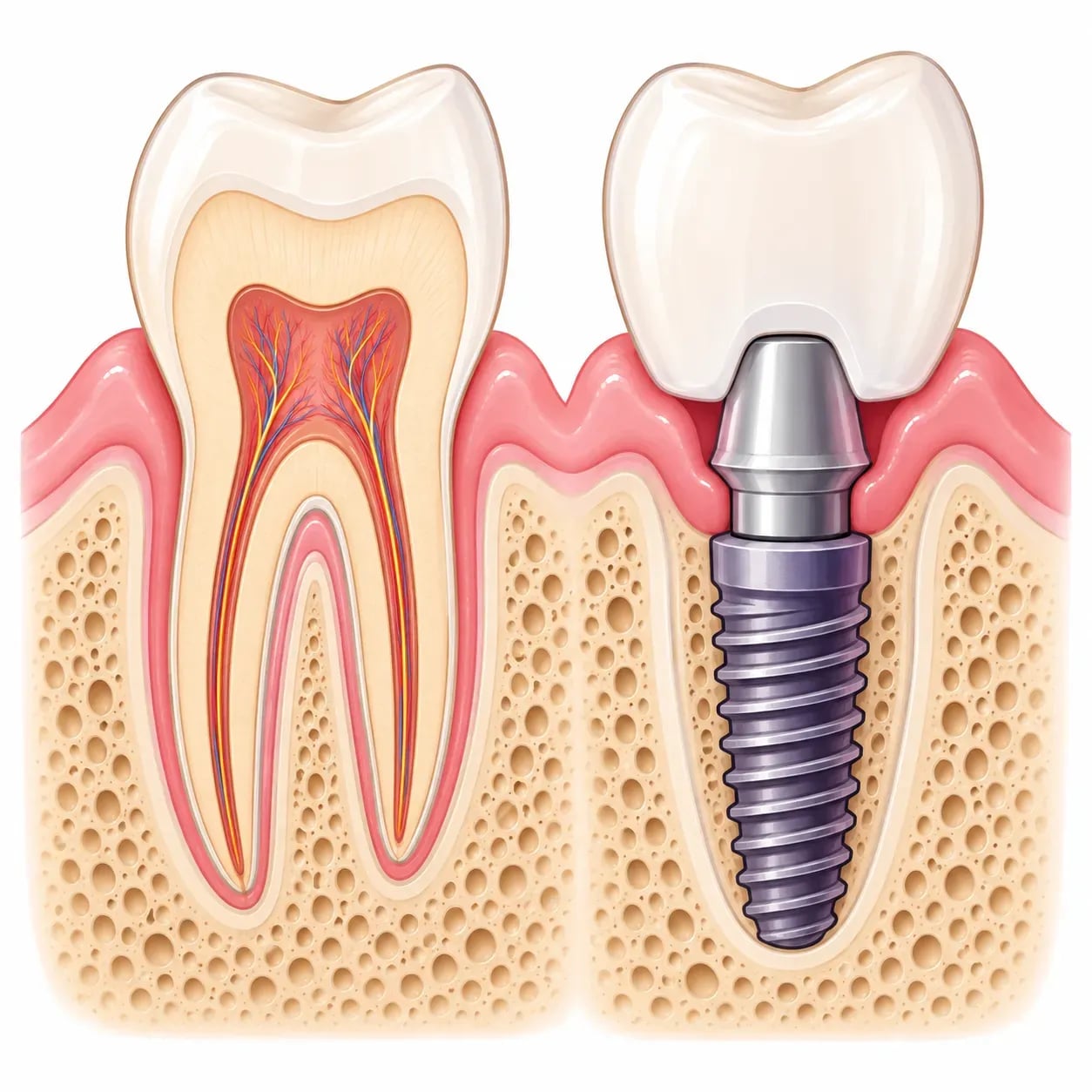
Three parts, and it helps to keep them separate, because they fail and get replaced separately.
- The implant — a titanium screw, sometimes zirconia, placed in the bone. This is the part that integrates and the part designed to stay for decades.
- The abutment — the connector that sits on the implant and emerges through the gum.
- The crown — the visible tooth, made to match your own.
Why that matters practically: if the crown chips or the abutment screw loosens in year eight, those parts are replaced without touching the implant itself. That is routine, and it is the main argument for keeping the paperwork described later on this page — a dentist can only order the right replacement part if they know which system was used.
Unlike a conventional bridge, an implant does not involve cutting down the healthy teeth on either side, and because it loads the bone it limits the resorption that follows losing a tooth.
One tooth, several teeth, or a full arch
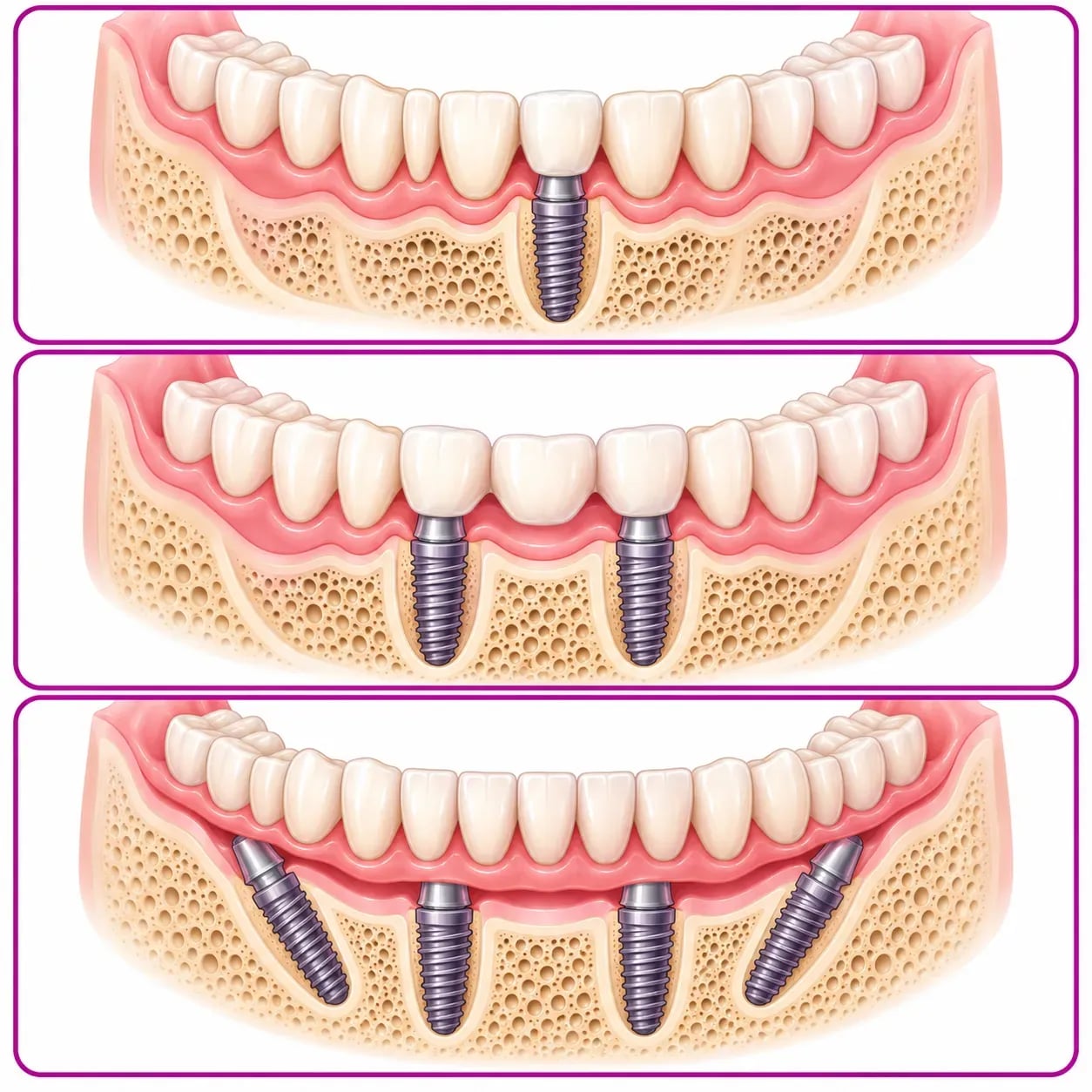
The number of implants is not the number of teeth. This is where most quotes are misread.
One tooth
One implant, one crown. €1,290.
Several teeth
Either separate implants, or a bridge carried on two or three implants — €2,490 for the bridge, whether it restores two teeth or three. Where teeth are adjacent, a bridge on fewer implants is usually both cheaper and kinder to the bone than one implant per tooth.
A full arch
All-on-4 carries a complete fixed arch on four implants — €4,490 per arch, €8,980 for both. All-on-6 uses six implants for €5,490 per arch, and is chosen where bone quality or the bite calls for more support. Which one applies is a clinical decision made on your scan.
A full arch replaces a removable denture with something fixed that you do not take out. If a removable solution is what you are weighing it against, see dentures, crowns and bridges.
Implant, bridge or denture: which one?
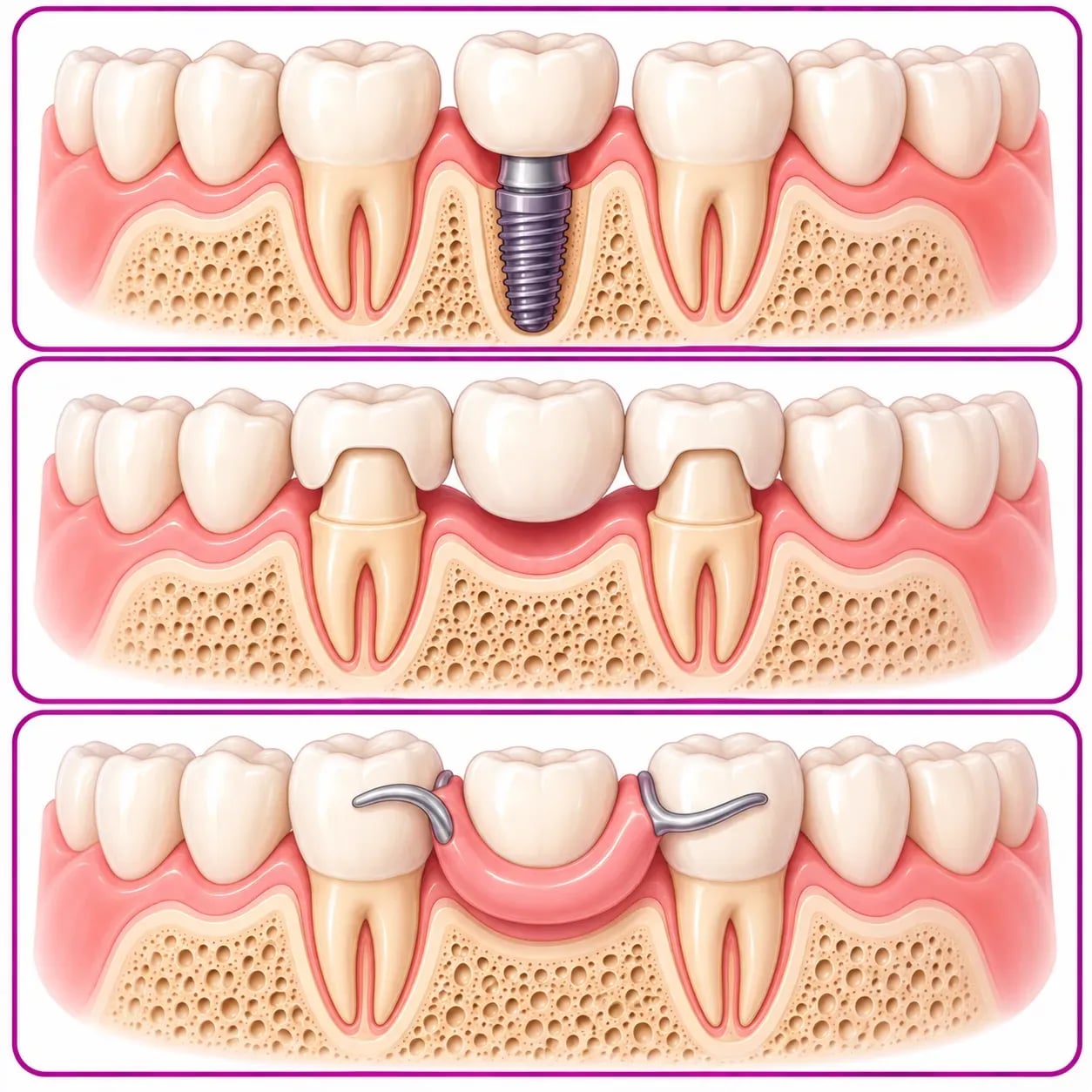
Three ways to replace a missing tooth, and they differ on more than price.
| Implant | Conventional bridge | Removable denture | |
| Neighbouring teeth | Left untouched | Cut down to carry the bridge | Left untouched |
| Bone underneath | Resorption limited | Resorption continues | Resorption continues |
| Fixed or removable | Fixed | Fixed | Removable |
| Lifespan | Several decades | 10 to 15 years | Replaced periodically |
| Time to complete | 3 to 6 months | Days to weeks | A few weeks |
| Main requirement | Enough bone, and preferably not smoking | Usable teeth either side | Few constraints |
The row that decides it for most people is the second one. A bridge or a denture restores the tooth you can see and leaves the bone underneath unloaded, so it keeps shrinking — which is why a denture that fitted well in year one needs relining in year four. An implant loads the bone and largely stops that.
The row that rules it out is the last one. If there is not enough bone and a graft is not an option, an implant is not the answer however much you want it to be.
The two stages
An implant is placed in two stages, months apart, and the gap between them is biology rather than scheduling.
Stage one: placement
Under local anaesthetic, sometimes with light sedation for a larger case. 30 to 90 minutes per implant. The implant is placed in the bone and the site is left to heal.
Three to six months: osseointegration
The bone grows onto the implant surface. This is what makes an implant different from everything else in dentistry, and it is also the reason nobody can shorten it to suit a flight. Loading an implant before it has integrated is how implants fail.
Stage two: the permanent crown
Once integration is confirmed, the abutment and the custom crown are fitted. This is the second trip.
In some cases — depending on bone quality, how stable the implant is at placement, and which tooth it is — a temporary crown can be fitted on the day. That is called immediate loading, it is decided in the chair, and it is never promised in advance. Anyone guaranteeing you teeth in a day before seeing your scan is guaranteeing something they cannot know.
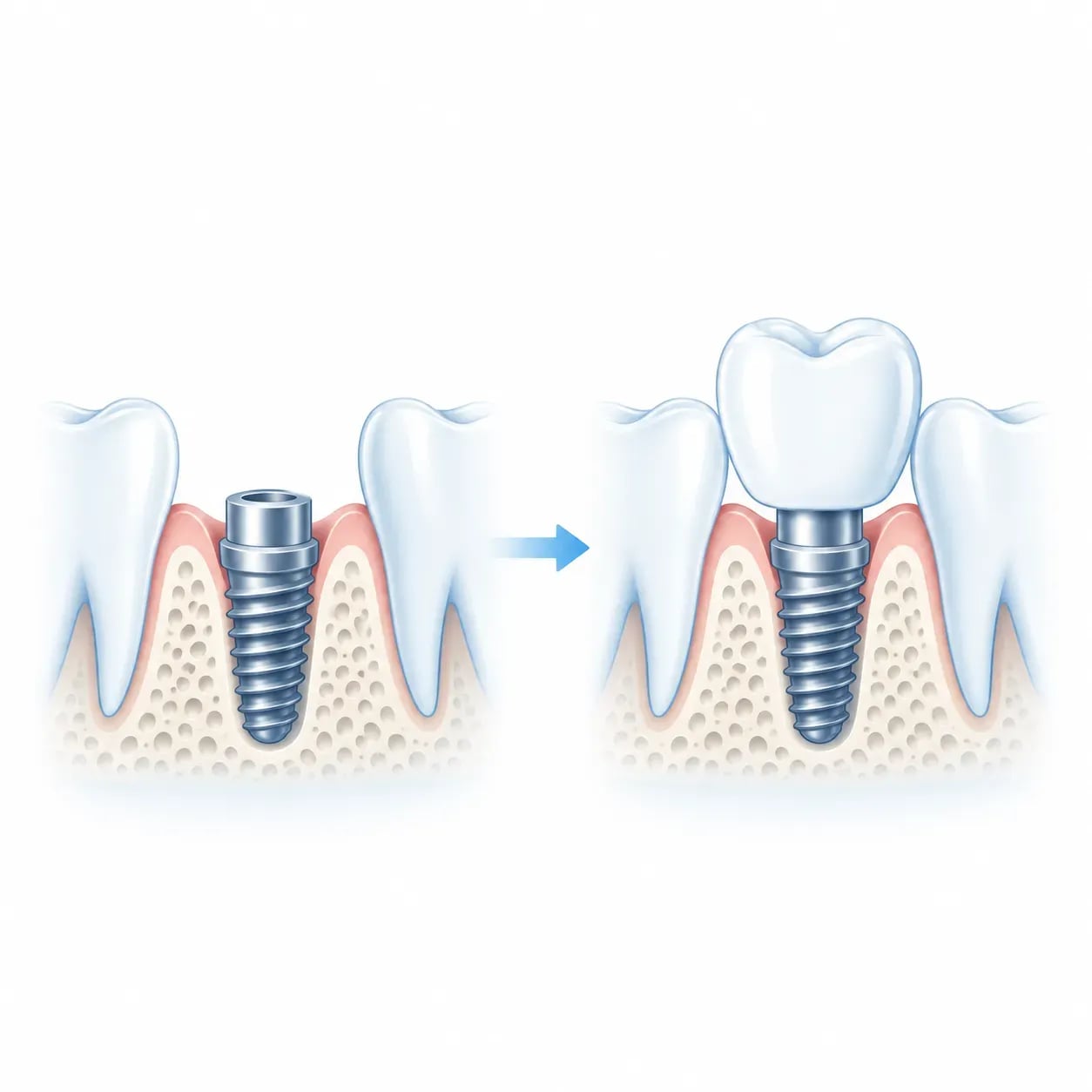
And during the months in between?
The honest answer depends on which tooth it is, and it is worth settling before you book rather than discovering at the airport.
A visible tooth
A temporary is arranged. Either a fixed temporary crown where immediate loading is possible, or a removable temporary prosthesis. Ask explicitly whether the temporary is included in your quote or costs extra, and get the answer in writing before you travel. It is the single most common surprise on a dental quote, here and everywhere else.
A back tooth
Much less of an issue cosmetically, and a temporary is often not needed at all.
Looking after the site during the wait
- Stop smoking, before placement and throughout integration. This is the single largest factor in whether an implant takes.
- Keep hygiene rigorous, and be gentle on the operated area.
- Contact the team if you have increasing pain, swelling, any discharge, or any sense of movement. A check by photograph is possible and costs nothing.
Three to six months is a long time to be out of contact with the people who did the work. Use the follow-up rather than waiting for the second trip to mention something.
Do I have enough bone?
An implant needs bone to sit in, and bone starts disappearing the moment a tooth comes out. The longer a gap has been there, the more likely this section applies to you.
Bone graft — €590
Where the ridge has thinned, bone is grafted to rebuild enough volume to hold an implant. It adds a step and healing time.
Sinus lift — €790
In the upper jaw, the sinus floor sits close above the back teeth and often leaves too little bone beneath it. A sinus lift raises that floor and adds bone underneath. Again, an extra step and extra healing.
How this is decided
By the radiographic assessment, not by discussion. Send a panoramic x-ray taken within the last six months, and a CBCT scan if you already have one — that is what turns a provisional quote into a real one. If you have neither, it is done at the clinic on arrival, but then any figure quoted beforehand remains an estimate.
And the practical consequence, which is worth saying plainly: bone is not waiting for you. If you are going to do this, the volume of bone available is an argument for sooner rather than later.
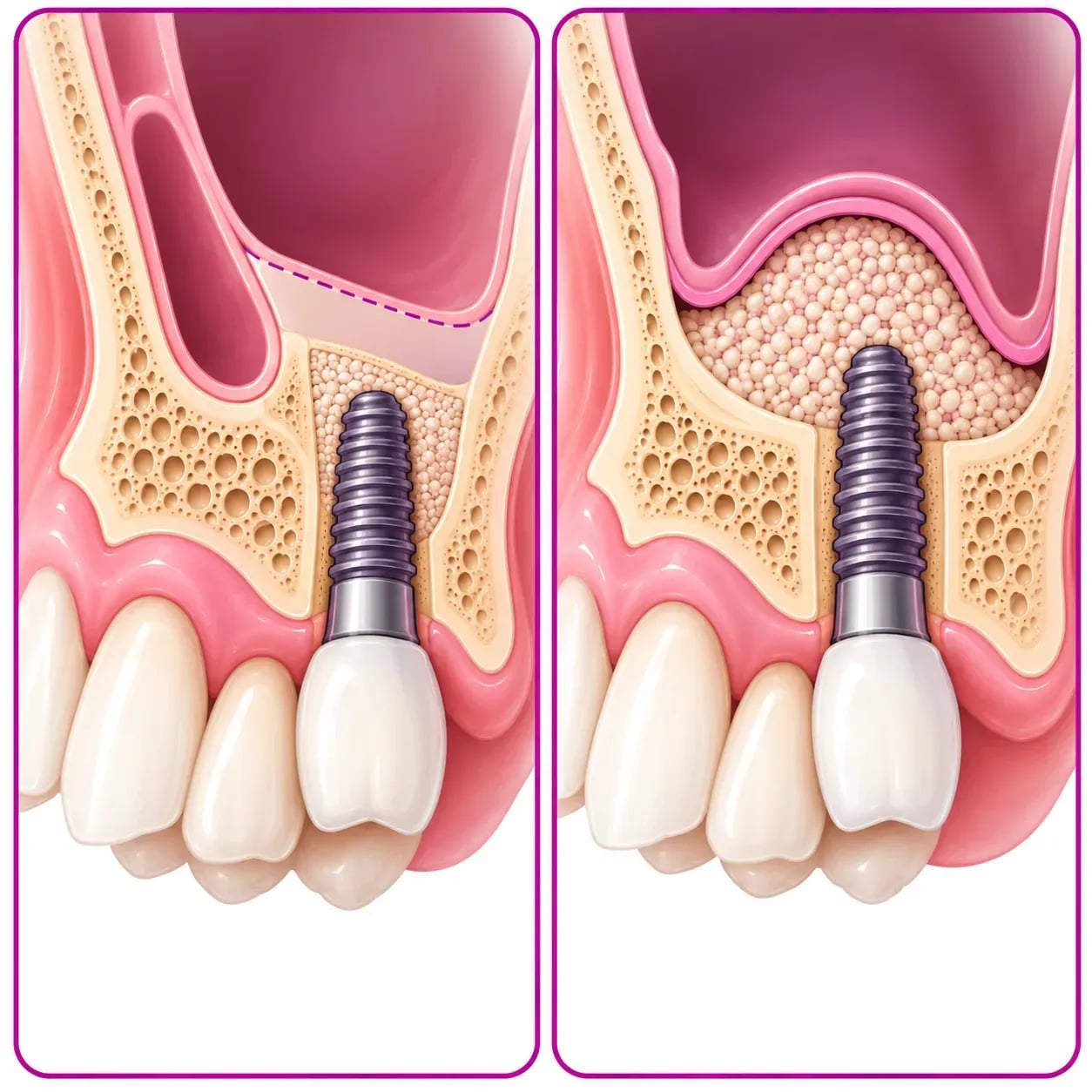
Are you a candidate for dental implants?
Generally suitable
- Good general health, healthy gums, and jaw growth complete.
- Enough bone, or bone that can be rebuilt with a graft or a sinus lift.
- Rigorous oral hygiene, and a willingness to keep it up. An implant is less forgiving than a natural tooth, not more.
Treated or assessed before placement
- Poorly controlled diabetes — it reduces the chance of success, and controlling it first changes the odds.
- Heavy smoking. The first cause of implant failure. Not a moral point, a biological one.
- Untreated decay or gum inflammation — dealt with at home before you travel.
- Insufficient bone — grafted first.
Contraindications
- Intravenous bisphosphonates, because of the risk of osteonecrosis of the jaw.
- Severe uncontrolled immunosuppression.
- Recent radiotherapy to the head and neck.
- Jaw growth not yet complete.
The medication nobody mentions
If you take, or have ever taken, a bisphosphonate — alendronic acid, risedronate, zoledronic acid — or denosumab, say so, even if it was years ago and even if it was only tablets. Denosumab in particular is given as an injection every six months, so people do not think of it as medication and leave it off the list. These drugs are prescribed very widely for osteoporosis and they matter here more than almost anything else on your form. Declaring it does not necessarily rule you out; not declaring it is genuinely dangerous.
Your journey, step by step
- Your enquiry and quote. Send a panoramic x-ray taken within the last six months, or photographs of your smile, with your dental history. A personalised quote follows within 24 to 48 hours.
- Preparation at home. Treat any decay and any gum inflammation before you travel, and stop smoking before placement and throughout integration.
- Arriving in Tunis. You are met at Tunis-Carthage with a board showing your name and taken to your accommodation.
- Clinical and radiographic assessment. This confirms the number of implants and whether a graft or a sinus lift is needed. Your quote is finalised here.
- Placement. Under local anaesthetic, sometimes with light sedation, 30 to 90 minutes per implant.
- Review before you fly. A post-operative check, your instructions and your prescriptions.
- Three to six months at home. Osseointegration, with remote follow-up and photo checks whenever you want one.
- Second trip: the crown. The shade is matched at this visit — which means any whitening has to be done before it, because a crown cannot be whitened afterwards and will stay the colour it was made. If that is part of your plan, see teeth whitening and do it first.
- Long term. You go home with an implant card to give to your own dentist, and an annual check-up near where you live.
Two trips, normally. Budget for two sets of flights from the start. A treatment plan that looks cheap on one trip and is unaffordable on the second is not cheap.
The days after placement
- Discomfort controlled by ordinary painkillers.
- Local swelling for 48 to 72 hours, sometimes with slight bruising.
- Soft food for the first few days.
- Back to work after 1 to 2 days.
Keep brushing — carefully around the site rather than avoiding the whole area, because plaque is the thing you are trying to keep away from a healing implant. Avoid smoking completely during this period, and avoid chewing on that side until you are told otherwise.
Contact the clinic for pain that increases rather than fades after the first days, swelling that worsens after 72 hours, any discharge or bad taste, or any sense that the implant or the temporary is moving. A photograph is often enough to sort it out from a distance.
Peri-implantitis: the risk to understand
Peri-implantitis is inflammation of the tissue around an implant — the equivalent of gum disease, around something that has no natural ligament to defend it. It is the main long-term reason implants are lost, and it is largely preventable.
What raises the risk
- Hygiene that slips over the years. Not one bad week — a pattern.
- Smoking, which is the first cause of implant failure overall.
- Poorly controlled diabetes.
Why it catches people out
It can progress silently. An implant has no nerve, so it does not ache the way a tooth does, and bone can be lost around it before anything hurts. By the time it is uncomfortable, it is advanced. This is the whole argument for an annual check-up even when everything feels fine.
Signs to act on
Bleeding around the implant, swelling, discomfort when chewing, a crown that moves, or gum receding to show metal. Any of these is a reason to see a dentist promptly rather than to wait and watch.
Prevention
Thorough brushing, daily cleaning between the teeth with interdental brushes sized for you, a water flosser if you prefer one, regular scaling, and not smoking. That is the entire list, and it is why the maintenance section below matters more than anything on the price table.
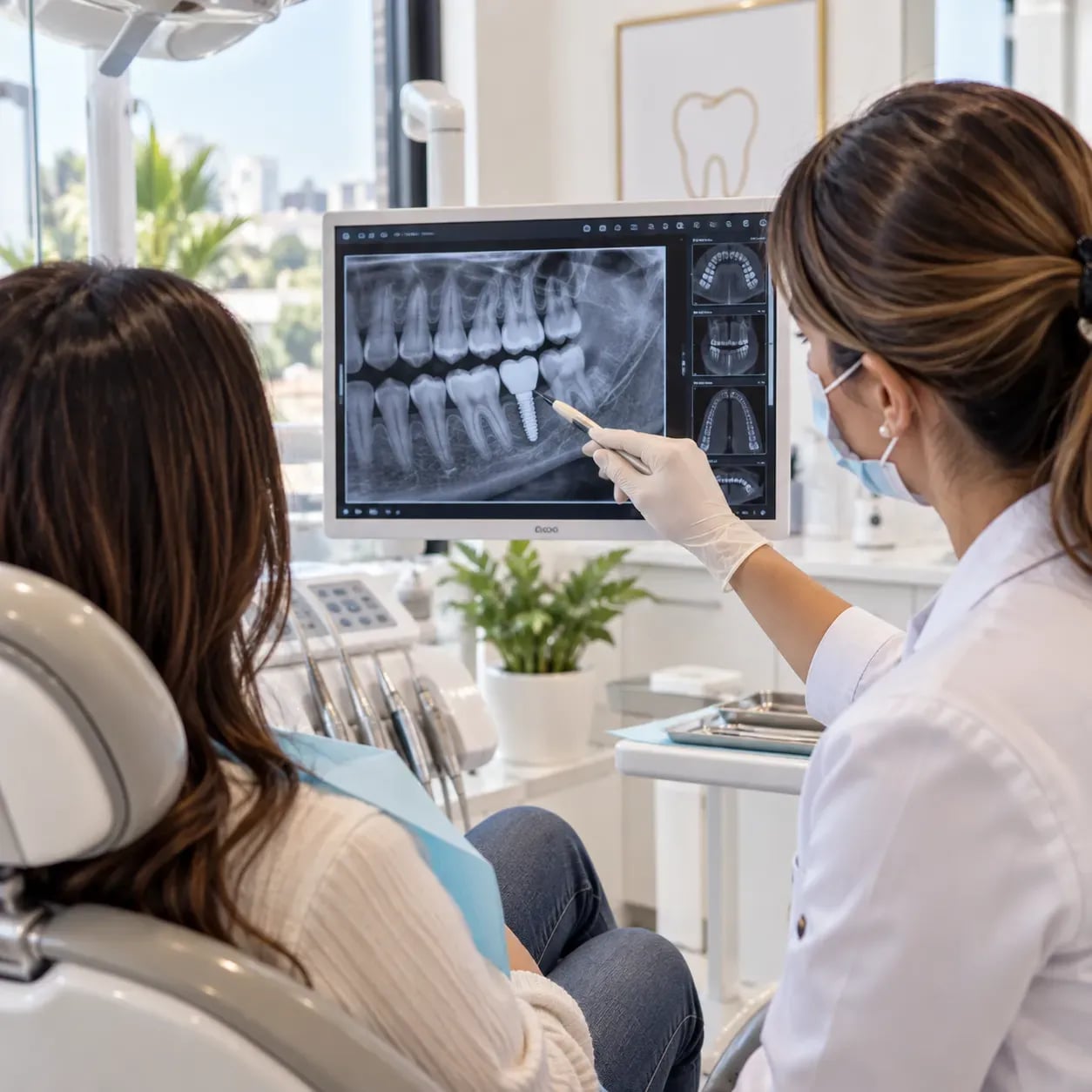
Looking after implants for thirty years
An implant placed well and maintained badly fails. An implant placed well and maintained properly outlasts most other dentistry you will ever have. The difference is entirely in this section.
The document to bring home — and the reason this page exists
You leave with an implant card. It records the implant system and brand, the reference, the diameter and length, and the date of placement. Give it to your own dentist and keep a photograph of it on your phone.
Here is why that one piece of card matters more than anything else you take home. Implant systems are not interchangeable. If in year nine a crown fractures or an abutment screw loosens, your dentist in Dublin, Manchester, Lagos or Dubai can order the matching component and fix it in a single appointment — if they know which system it is. Without that information, a dentist faces an unidentified screw in your jaw, and a twenty-minute repair becomes a decision about removing the implant. This is the most common avoidable disaster in dental tourism, and it is caused by a lost piece of paper.
If you ever lose it, contact us. We keep the record.
Daily
- Brush twice a day, concentrating on the junction where the crown meets the gum — that is where peri-implantitis starts.
- Clean between the teeth every day: interdental brushes sized for you, implant-specific floss, or a water flosser.
Every year
- A scale and polish, and a check-up with a dentist near where you live. Tell them you have implants before any treatment, every time.
- This is normal dentistry that any practice can do. You do not need to fly back for maintenance — only, in rare cases, for repairs.
Always
Do not smoke. And remember that the crown, the abutment and the screw are all replaceable without touching the implant itself — which is exactly why the card is worth more than it looks.
The practitioner
Implant treatment at ServiHealth is carried out by Dr Fedia Mtaallah, a practitioner in aesthetic dentistry, at the Clinique Internationale Myron in Tunis.
She follows each case from the initial assessment through to the final crown: a precise reading of the bone volume available, a clear recommendation when a graft or a sinus lift is needed, and the shade matching at the second visit. The point of one practitioner across both trips is continuity — the person who placed the implant is the person who restores it.
The assessment decides the plan. If your scan shows that an implant is not the right answer, or that it needs preparatory work first, you will be told that before you book anything.
Why Tunisia?
- Travel. Tunis is a direct flight of 1 hour 30 to 3 hours from most of western Europe, into Tunis-Carthage, with regular connections from West Africa and the Gulf. EU and Swiss nationals need no visa; every other passport has its own requirements, which change — check yours and tell us early if you need supporting documents.
- One practitioner across both trips, with the full price known before you fly.
- Everything included in the quoted figure — assessment, implant, abutment, crown, transfers and follow-up. Grafts and sinus lifts are priced separately and openly rather than appearing later.
- English and French throughout.
The comparison worth making
Price is the easy part and it is not where this goes wrong. Compare on three things instead: is the full treatment priced before you fly, including anything the scan might reveal; is the second trip planned and budgeted from the start; and do you leave with an implant card and a named contact. A clinic that gets those three right is worth more than one that is two hundred euros cheaper.
Other dental work often combined in the same trip: veneers, whitening — which must come before the crown shade is matched — and crowns, bridges and dentures.
Before you travel: a checklist
Documents
- A valid passport, and a visa if your nationality requires one.
- A panoramic x-ray taken within the last six months, and a CBCT scan if you have one.
- Your dental history: how long the teeth have been missing, extractions, previous treatment, any existing prosthesis.
Health
- A full list of your medication with doses, and your allergies.
- Flag specifically: bisphosphonates or denosumab (now or in the past), diabetes, immunosuppressants, anticoagulants, and any radiotherapy to the head or neck.
Before you fly
- Have any decay and any gum inflammation treated at home.
- Stop smoking — before placement, and through the months of integration.
- Do any whitening before the crown shade is matched, not after.
- Plan soft food for the first few days.
- Send your boarding pass and a photograph of what you will be wearing, for the airport welcome.
Plan now, not later
- The second trip, 3 to 6 months out. Dates, flights and budget. This is the step people skip.
- A dentist near you for the annual check-ups, and tell them an implant is coming.
Three questions worth asking before you pay a deposit
- If the scan shows I need a graft or a sinus lift, what is the final figure and when will I know it?
- Is a temporary tooth included while I wait, or is it extra?
- Which implant system are you using, and will I get the implant card before I leave?









Frequently asked questions about Dental Implants in Tunisia
Because the word covers very different amounts of work. At ServiHealth a single implant with its crown is €1,290; a bridge on two or three implants is €2,490; a full arch with All-on-4 is €4,490. On top of that, a bone graft (€590) or a sinus lift (€790) may be needed, and only a radiographic assessment shows that. Also check what a quoted price includes: ours covers the consultation, the x-rays, the implant, the abutment, the crown, transfers and follow-up.
Bone starts to resorb as soon as a tooth is lost, and an implant needs enough volume to sit in. A bone graft rebuilds that volume before the implant can be placed. It costs €590 and adds a step and some healing time. In the upper jaw, where the sinus floor sits close above the back teeth, a sinus lift (€790) is used instead. Whether you need either is confirmed by the radiographic assessment, not estimated from a photograph.
Three to six months, which is how long the bone takes to grow onto the implant — osseointegration. That interval is biology and cannot be shortened to fit a flight; loading an implant before it has integrated is how implants fail. You go home during it, with remote follow-up, and return for the second visit when integration is confirmed.
A technique that carries a complete fixed arch of teeth on four implants, rather than one implant per tooth. At ServiHealth it is €4,490 per arch, or €8,980 for both. All-on-6 uses six implants at €5,490 per arch and is chosen where bone quality or the bite calls for more support. It replaces a removable denture with something fixed that you do not take out, and which one suits you is decided on your scan.
Inflammation of the tissue around an implant — the equivalent of gum disease. It is the main long-term reason implants are lost. The risk factors are hygiene that slips over the years, smoking and poorly controlled diabetes. It can progress silently, because an implant has no nerve and does not ache the way a tooth does, which is why an annual check-up matters even when everything feels fine. Bleeding, swelling, discomfort on chewing, a crown that moves or gum receding to show metal are all reasons to see a dentist promptly.
It is a well-established procedure with a high success rate, done under local anaesthetic. The risks are failure to integrate, infection, and peri-implantitis later on. Smoking is the first cause of failure, and poorly controlled diabetes reduces the chances of success. There are real contraindications: intravenous bisphosphonates, severe uncontrolled immunosuppression, recent radiotherapy to the head and neck, and incomplete jaw growth. Declare all your medication, including bisphosphonates or denosumab taken years ago.
Normally two: one for placement, one for the permanent crown three to six months later. Budget for two sets of flights from the beginning. A plan that looks affordable on the first trip and impossible on the second is not affordable — and this is the most common mistake people make with dental treatment abroad.
Not during, because it is done under local anaesthetic, sometimes with light sedation for a larger case. Afterwards expect discomfort controlled by ordinary painkillers, local swelling for 48 to 72 hours and sometimes slight bruising, with soft food for the first few days. Most people are back at work after one or two days.
Several decades with proper maintenance — and maintenance is the operative word. Daily cleaning between the teeth, brushing at the crown-gum junction, an annual scale and check-up, and not smoking. The crown, the abutment and the screw are all replaceable without touching the implant itself, so wear and tear on the visible part does not mean starting again.
It depends which tooth it is. For a visible tooth a temporary is arranged — either a fixed temporary crown where immediate loading is possible, or a removable temporary prosthesis. For a back tooth it is often not needed. Ask explicitly whether the temporary is included in your quote or costs extra, and get the answer in writing before you travel; it is the most common surprise on a dental quote anywhere.
Fitting a temporary crown on the same day as the implant, instead of waiting. Whether it is possible depends on the quality of your bone, how stable the implant is once placed, and which tooth it is — so it is decided in the chair and never promised beforehand. The permanent crown still waits for osseointegration. Any clinic guaranteeing teeth in a day before seeing your scan is guaranteeing something it cannot know.
It is possible, and smoking is the first cause of implant failure, so the honest answer is that it significantly lowers your chances. Stopping before placement and staying stopped through the three to six months of integration makes a real difference — this is the period that decides whether the implant takes. Heavy active smoking is assessed before anything is scheduled, and the practitioner will tell you plainly where you stand.
Titanium, which is the standard and has decades of clinical use behind it, or zirconia in some cases. The crown on top is made separately and matched to your own teeth. Tell the practitioner about any known metal allergy at the assessment. Whichever system is used, make sure its details are on the implant card you take home — your own dentist will need them to order matching parts years later.
Brush twice a day, concentrating on the junction where the crown meets the gum, and clean between the teeth every day with interdental brushes sized for you, implant-specific floss or a water flosser. Have a scale and check-up once a year with a dentist near you, and tell them you have implants before any treatment. Do not smoke. That is the whole list, and it is what decides whether an implant lasts decades.
In the first days: pain that increases rather than fades, swelling that worsens after 72 hours, any discharge or bad taste, or a sense of movement. Later on: bleeding around the implant, swelling, discomfort when chewing, a crown that moves, or gum receding to show metal. Those later signs point to peri-implantitis, which progresses without pain, so act on them rather than waiting to see.
It is usually a straightforward repair, and you should not need to fly back. The crown, the abutment and the screw can all be replaced without touching the implant — but only if your dentist knows which implant system was used. Give them your implant card, which records the brand, reference, diameter, length and date. Without it they cannot order a matching part, and a twenty-minute repair becomes a much bigger decision. If you lose the card, contact us: we hold the record.
Rarely, and it varies by country. Most public systems exclude implants or cover only a fraction, and in the UK they are available on the NHS only in specific clinical circumstances. Private dental insurance commonly excludes them or caps the contribution well below the cost, and treatment paid for abroad is usually outside the policy entirely. Check your own scheme before you book rather than after.
The difference is substantial and it is why most people reading this are considering travelling. We are not going to quote you another country’s price list to make the point. Compare it properly instead: the full treatment price including any graft or sinus lift, both sets of flights and accommodation, what a temporary costs if you need one, and what happens — and who pays — if something needs repairing in year five.