

Hymenoplasty in Tunisia: timing, privacy and what can honestly be promised

Hymenoplasty in Tunisia: the essentials
Hymenoplasty — also called hymen repair or hymenorrhaphy — is a short procedure that reconstructs the hymenal membrane. It is done under deep local anaesthetic, takes under an hour, and you return to your accommodation the same day. The stay in Tunisia is two days.
Two things on this page matter more than the surgery, and both have a section of their own. The first is timing: schedule it 6 weeks to 3 months before the date you have in mind, and not closer. The second is what can honestly be promised, which is the technical quality of the reconstruction and the care around it — and not what happens afterwards, for reasons that are medical rather than commercial.
The procedure is carried out by Dr Sami Mahjoub and Dr Mehdi Lajmi at the Clinique Internationale Myron in Tunis. You will not be asked to explain or justify your reasons at any point, by anyone.
| Procedure time | 30 to 60 minutes, depending on the technique |
| Anaesthetic | Deep local — you stay awake and feel no pain |
| Hospital stay | None. Back to your accommodation 1 to 2 hours afterwards |
| Recommended stay in Tunisia | 2 days |
| Sutures | Dissolvable; gone on their own in 2 to 4 weeks |
| Back to work | Almost immediately, avoiding physical effort |
| Schedule it | 6 weeks to 3 months before the date concerned |
| Price | €1,200 |
Confidentiality: what it means in practice
Most clinics promise discretion in a sentence. Here is what it means in practice, item by item. Every one of these is your choice, and you can change any of them at any point.
How we contact you
- You choose the channel — WhatsApp, email or telephone — and you can rule any of them out. If you ask never to be called, you will never be called. You can also restrict us to certain hours.
- Messages can be written so that they mention neither the procedure, nor ServiHealth, nor Tunisia.
- Nothing is ever sent to any number other than the one you gave us. Not to a relative, not to a partner, not to anyone who contacts us claiming to act for you.
What we never ask for
- A reason. Not at first contact, not at the consultation, not afterwards. You do not owe anyone on this team an explanation.
- Photographs, for a first opinion. Anything you do send goes to the surgeon and no further.
Arrival and the clinic
- No name board at the airport. A different signal is agreed in advance, or you make your own way to your accommodation if you prefer.
- At the Clinique Internationale Myron you are received as any other patient. The reason for your visit is discussed only with the professionals involved, who are bound by medical confidentiality.
Paperwork
- The quote and the invoice are issued under a general heading, with no mention of the procedure.
- They can be handed to you in person, with nothing sent electronically at all.
- No certificate attesting to any physical state is issued, by anyone here, in any circumstance, to you or to a third party. That is a fixed position and it is not open to discussion.
- Your file is kept under the rules that apply to medical records, with access limited to the care team. You may ask at any time what is held.
And one thing that is not negotiable in your favour
No testimonial, review, photograph or case description relating to this procedure is ever published, anonymised or otherwise. You will never be asked for one.
The procedure is carried out only at the request of an adult woman, for herself. Not at the request of a family, a partner or an intermediary. If someone is pressuring you, or if you are worried about your safety, that is the thing to deal with first and specialist support services exist in most countries — a doctor or a women’s support organisation where you live can point you to them. You can still talk to us either way, and we will not report, record or relay anything you say.

What hymenoplasty actually is — and what it is not
The hymen is a thin membrane at the entrance of the vagina. It varies enormously between women in thickness, shape and how much of it is present at all, and it can be modified by sport, tampon use, examination or injury as well as by intercourse. Hymenoplasty reconstructs it.
That is the whole of what the operation does, and it is worth separating from what it is often assumed to do. There has never been a reliable relationship between the hymen and whether a woman has had sex. Many women do not bleed at first intercourse and never had a hymen that would have done so. Medical bodies internationally are clear on this point, and so is every surgeon worth consulting.
We say it here, at the top of the page, for a practical reason rather than a moral one: it is the single most common source of disappointment after this surgery. A reconstruction can be technically excellent and still not produce a particular outcome on a particular night, because that outcome was never something anatomy guaranteed. Going into this understanding that is the difference between a decision and a gamble.
What the surgery does reliably give you is a reconstructed membrane, healed, within a known timescale. Everything on this page is built around making that part as good as it can be.
The two techniques
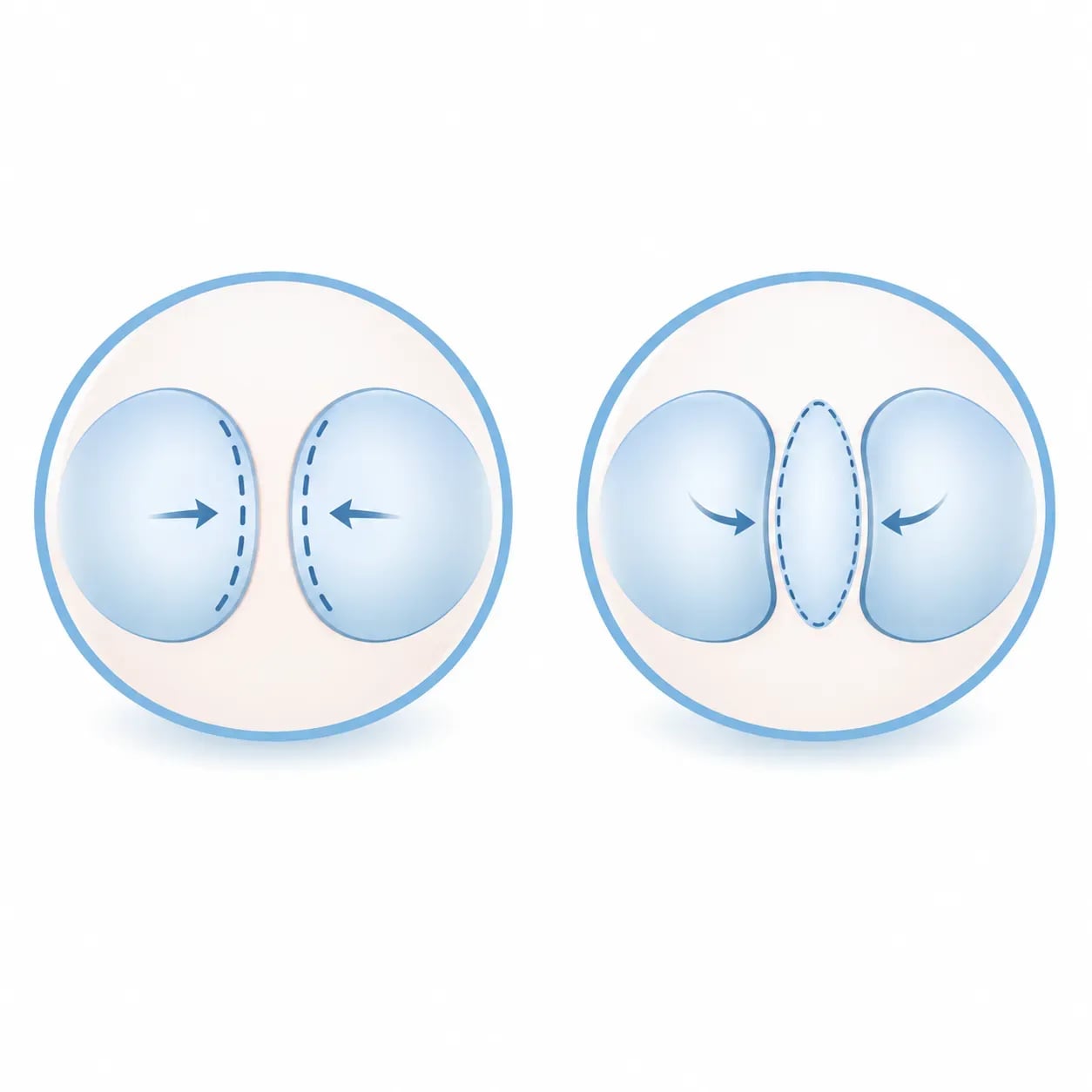
Two techniques are used, and which one applies to you depends on how much hymenal tissue remains. That is established by examination, not in advance.
Simple suture
Where enough residual tissue is present, the existing edges are brought together and sutured. It is the shorter of the two procedures and the more straightforward healing.
Mucosal flap reconstruction
Where there is not enough residual tissue to work with, a membrane is reconstructed using a small graft of vaginal mucosa taken from nearby. It takes longer, and the healing is a little more demanding.
Very limited residual tissue does not rule you out. It does point towards the flap technique, and it does mean the surgeon will tell you at the consultation that the result may be less satisfactory than with a simple suture. If you hear that, it is an accurate assessment rather than a negotiating position — and it is better heard before the operation than after it.
In both cases the sutures are dissolvable and disappear on their own over two to four weeks. There is nothing to remove, and nothing you need to go back for.
How much does hymenoplasty cost in Tunisia?
€1,200, for a two-day stay. The price covers the consultation, the procedure, the anaesthetic, transfers and the post-operative follow-up. It does not cover your flights.
There is one price because there is one procedure. Which technique the surgeon uses — simple suture or mucosal flap — is a clinical decision made at the examination and it does not change what you pay.
The quote and the invoice are issued under a general heading with no mention of the procedure, and they can be handed to you in person with nothing sent electronically. That is set out in full in the confidentiality section above.
| Procedure | Price | Stay |
|---|---|---|
| Hymenoplasty | €1,200 | 2 days |
When to schedule it — the decision that matters most
If you read one section on this page, read this one. More enquiries fail here than anywhere else, and the failure is always the same: not enough time.
The window
- Minimum 4 to 6 weeks between the procedure and the date concerned.
- Ideal window: 6 weeks to 3 months before. Healing is complete, the tissue has settled, and there is room for the unexpected.
- Less than 3 weeks before: advised against, and we will say so.
- More than a year ahead: the result becomes less predictable over that much time. Earlier is not automatically safer.
Your cycle
Tell us the dates of your period when you enquire. The procedure is scheduled outside it. If your cycles are irregular, say so — a margin is built into the planning rather than discovered later.
If the deadline is too close, we do not schedule it
That is a fixed position, and it is in your interest rather than ours. Operating too close to a date means going into it with tissue that has not finished healing, which raises the risk of partial separation of the suture line at precisely the moment that matters most to you. A clinic that agrees to a three-week deadline is taking your money and your risk at the same time.
Build in more room than you think you need. Flights move, visas take longer than expected, and periods arrive late. If you are reading this with a date already fixed, count the weeks backwards now and enquire today rather than next month.

Are you a candidate?
Generally suitable
Adult women in good general health, asking for themselves, with enough time before the date concerned.
Treated or checked before the procedure
- An active genital infection — treated first, without exception.
- A clotting disorder, or any contraindication to local anaesthetic — reviewed before anything is scheduled.
- Active smoking, which slows healing of a repair that depends entirely on healing well. Reducing or stopping in the weeks beforehand genuinely changes the outcome here.
Not scheduled
- Insufficient time before the date. See the section above.
- Anyone under 18. This is carried out on adults only.
- A request made by anyone other than the woman herself. Not a family, not a partner, not an intermediary.
Possible, with a frank conversation first
Very limited residual tissue does not rule you out, but it points towards the flap technique and the surgeon will tell you the result may be less satisfactory. That conversation happens before the procedure, not after.
If you live in the United Kingdom
Hymenoplasty and virginity testing were made criminal offences in the UK by the Health and Care Act 2022, and that legislation includes provisions reaching acts carried out outside the UK. We are not lawyers and nothing here is legal advice, but if you live in the UK you should take your own advice before making arrangements of any kind. We would rather set this out plainly and lose the enquiry than let someone find out afterwards.
Your journey, step by step
- Your enquiry. Tell us the date you have in mind, the dates of your period, and whether your cycles are regular. Say which channel to use and which never to use. No photographs are needed and no reason is asked for. You receive an opinion and a quote through the channel you chose.
- Planning. The date is set inside the 6-week-to-3-month window, outside your period, with a margin. If the deadline is too close, we say so at this point rather than later.
- Preparation. Stop aspirin, anti-inflammatories and blood-thinning supplements in the days beforehand, unless your own doctor says otherwise. Reduce or stop smoking in the preceding weeks. Flag any recent genital infection, current treatment, allergy or clotting problem.
- Arriving in Tunis. No name board. A discreet signal agreed in advance, or you make your own way if you prefer.
- Consultation. The surgeon examines you and establishes how much residual tissue there is, which decides the technique. This is the point at which you are told what is realistic in your case.
- The procedure. 30 to 60 minutes under deep local anaesthetic. You are awake and you do not feel pain.
- Straight back. You return to your accommodation one to two hours afterwards. There is no hospital stay.
- The next day. A check that there is no bleeding, and then you travel home.
- Afterwards. Follow-up through the channel you chose, for as long as you want it — and no contact at all if that is what you prefer.

Is it safe? Risks and what is guaranteed
This is a short procedure with a contained recovery. It is still surgery, and it depends entirely on healing well.
Normal, and not complications
Mild discomfort, a pulling sensation, and light bleeding for two or three days. Painkillers are prescribed. Avoid sitting for long stretches in the first two days.
Recognised risks
- Heavier bleeding, generally in the hours after the procedure, which is one reason you are checked before you travel.
- Infection — rare.
- Partial separation of the suture line — the most common problem, and almost always caused by physical effort, intercourse or tampon use earlier than instructed. It is the one risk that is largely in your hands.
- Discomfort or sensitivity lasting several weeks.
- A result judged insufficient, particularly where residual tissue was very limited to begin with.
What the clinic guarantees, and what it does not
What is guaranteed: the technical quality of the reconstruction, respect for the healing timescale rather than a convenient date, and a follow-up that answers. What cannot be guaranteed by any surgeon anywhere is how the reconstructed membrane behaves later — and as set out above, that has never been something anatomy reliably determined in the first place. Anyone promising you otherwise is selling a certainty that does not exist.
Contact us, or be seen locally, if you have
Heavy bleeding, or bleeding that restarts after stopping; pain that is increasing rather than easing; a fever; or unusual or foul-smelling discharge. If you need to be seen where you live, you need say no more than that you have had recent gynaecological surgery.
Recovery and aftercare
The instructions below are what protect the repair. Nearly every partial separation traces back to one of them.
Hygiene
- Wash with warm water two to three times a day and dry by patting.
- No perfumed soap, no douching, no antiseptic that has not been prescribed.
- Showers from the day after. No baths, swimming pool or hammam for 4 weeks.
Protection and clothing
- Cotton sanitary towels only. No tampon and no menstrual cup for at least 6 weeks, even if your period arrives in the meantime. This matters more than almost anything else on this list.
- Cotton underwear and loose clothing for 3 to 4 weeks. Avoid tight trousers.
The timetable
- The day after you get home — back to work, avoiding physical effort. No sick note is needed.
- 3 weeks — light exercise and cycling.
- 6 weeks — intense exercise, horse riding and lifting.
- 4 to 6 weeks minimum — intercourse, and never before healing is fully complete.
- 2 to 4 weeks — the sutures dissolve on their own.
One thing people overlook
Avoid constipation and straining. Drink enough, favour fibre, and deal with it early if it starts — straining pulls directly on a fresh repair, and it is a far more common cause of trouble than exercise is.
The journey home
You travel the day after the procedure, once you have been checked and there is no bleeding. It is a comfortable journey with a little planning and an uncomfortable one without.
Before you leave
- Take the painkiller about an hour before the journey, not when the discomfort starts.
- Use the toilet just before boarding.
- Wear something loose and soft with no seam at the crotch. Not jeans, nothing tight.
In your hand luggage
A spare cotton sanitary towel, unscented wipes, gauze, and your painkillers.
On the plane
- Ask for an aisle seat. Walk for a few minutes every hour.
- Shift your weight from side to side when seated; a folded jacket under one thigh takes the pressure off.
- Do not carry your own case. Use a light wheeled bag or check it in.
Once home
Back to your normal routine from the next day, avoiding physical effort. If you want a local doctor identified in advance, it is worth doing — and you need tell them no more than that you have had recent gynaecological surgery.

The surgeons
Intimate surgery at ServiHealth is carried out by Dr Sami Mahjoub, the lead surgeon for intimate surgery, and Dr Mehdi Lajmi.
The consultation is an examination and a technical conversation: how much residual tissue there is, which technique that points to, and what result is realistic in your case. It is not an interview. You will not be asked why, and you do not need an answer ready.
The decision on technique belongs to the surgeon. The decision on whether to go ahead is entirely yours, and you can change it at the consultation, after the consultation, or at the door.
Why Tunisia?
- Travel. Tunis is a direct flight of 1 hour 30 to 3 hours from most of western Europe, into Tunis-Carthage, with regular connections from North and West Africa. EU and Swiss nationals need no visa; every other passport has its own requirements, which change — check yours and tell us early if you need supporting documents.
- A short trip. Two days, with no hospital stay and no sick note required.
- Privacy that is organised rather than promised. The second section of this page sets out exactly what that means, line by line.
- English, French and Arabic.
Other procedures in the same area, if they are what you were actually looking for: labiaplasty and vaginal tightening. They are different operations addressing different things, and there is no reason one would be suggested to you here.
Before you travel: a checklist
Documents
- A valid passport, and a visa if your nationality requires one.
Dates to give us
- Your expected period dates, and whether your cycles are regular.
- The date you are working towards, if there is one. Count the weeks backwards before you enquire.
Health
- Any recent genital infection, any current treatment, any allergy, any clotting problem.
- Stop aspirin, anti-inflammatories and blood-thinning supplements in the days beforehand, unless your own doctor says otherwise.
- Reduce or stop smoking in the preceding weeks.
Privacy
- Make your requests when the trip is being organised, not on arrival — the airport arrangement in particular has to be agreed in advance.
What to pack
- Enough cotton underwear, loose clothing, and something soft with no crotch seam for the journey home.
- Cotton sanitary towels, unscented wipes, gauze.
At home
- No time off work is needed. Avoid physical effort after you get back.
- Identify a local doctor or clinic in advance, just in case. You need mention only recent gynaecological surgery.
And one last thing. If you are reading this because someone else wants you to, rather than because you do, that is worth a conversation with someone you trust before it is worth a flight. The procedure will still exist next month. You are allowed to take the time.










Frequently asked questions about Hymenoplasty in Tunisia
€1,200, with a two-day stay. The price covers the consultation, the procedure, the anaesthetic, transfers and the post-operative follow-up. It does not cover your flights. There is a single price whichever technique the surgeon uses, because that is a clinical decision rather than a tariff. The quote and the invoice are issued under a general heading with no mention of the procedure.
Yes, and in specific terms rather than as a promise. You choose the contact channel and can rule any out, including telephone entirely. Messages can mention neither the procedure, nor ServiHealth, nor Tunisia. Nothing is ever sent to any number other than yours. No reason is asked of you at any stage. There is no name board at the airport. The invoice carries a general heading. No testimonial, photograph or case description relating to this procedure is ever published.
Between 6 weeks and 3 months before the date concerned. The minimum is 4 to 6 weeks; under 3 weeks is advised against and will not be scheduled, because operating on tissue that has not finished healing raises the risk of the suture line separating at exactly the wrong moment. More than a year ahead makes the result less predictable, so earlier is not automatically safer. Tell us your period dates when you enquire — the procedure is planned outside them.
No, and no surgeon anywhere can guarantee it. What is guaranteed is the technical quality of the reconstruction, respect for the healing timescale and a follow-up that answers. What cannot be guaranteed is how the reconstructed membrane behaves later — and that was never something anatomy reliably determined, since many women do not bleed at first intercourse and never had a hymen that would have. Going in knowing this is the difference between a decision and a gamble.
No. It is carried out under deep local anaesthetic: you stay awake and you do not feel pain during it. Afterwards, expect mild discomfort, a pulling sensation and light bleeding for two or three days, managed with the painkillers you are prescribed. Avoid sitting for long periods in the first two days.
Two days. There is no hospital stay: you return to your accommodation one to two hours after the procedure. The following day you are checked for any bleeding and then you travel home. No time off work is needed, although you should avoid physical effort once you are back.
A short procedure, also called hymen repair or hymenorrhaphy, that reconstructs the hymenal membrane at the entrance of the vagina. It takes 30 to 60 minutes under deep local anaesthetic, uses dissolvable sutures and requires no hospital stay. It is a reconstruction of tissue — nothing more and nothing less. It is a different operation from labiaplasty and from vaginal tightening, which address different anatomy.
Two. Simple suture, where enough residual tissue remains and the existing edges are brought together and stitched — the shorter procedure with simpler healing. Or mucosal flap reconstruction, where there is not enough tissue and a membrane is rebuilt from a small graft of nearby vaginal mucosa — longer, with slightly more demanding healing. Which applies is established by examination at the consultation, not in advance, and the price is the same either way.
The sutures dissolve on their own over 2 to 4 weeks, and complete healing is counted at 4 to 6 weeks — which is why intercourse waits at least that long and tampons at least 6 weeks. Light exercise and cycling resume at 3 weeks, intense exercise, horse riding and lifting at 6 weeks. No baths, swimming pool or hammam for 4 weeks; showers are fine from the day after.
Heavier bleeding, generally in the hours after the procedure; infection, which is rare; partial separation of the suture line, which is the most common problem and almost always follows physical effort, intercourse or tampon use earlier than instructed; discomfort or sensitivity lasting several weeks; and a result judged insufficient, particularly where residual tissue was very limited. Contact the clinic or be seen locally for heavy or restarting bleeding, increasing pain, fever, or unusual or foul-smelling discharge.
No. The whole procedure is carried out internally, at the vaginal entrance, with nothing done to the external skin and nothing visible from outside. The sutures are dissolvable and disappear on their own within two to four weeks, so there is nothing to remove and no appointment to come back for.
No. You can return to work the day after you get home, provided the work does not involve physical effort. No sick note is issued or required, which is deliberate: it is one less document that exists. Avoid lifting and intense activity for the periods set out in the recovery section.
Yes, and it is worth identifying one in advance just in case. You need tell them no more than that you have had recent gynaecological surgery — that is enough for any doctor to examine and treat you appropriately. Contact us at the same time if something is wrong, but never delay being seen locally while waiting for a reply.
No. No document attesting to any physical state is issued, to you or to anyone else, in any circumstance. That is a fixed position and it is not open to discussion. The only paperwork you receive is a quote and an invoice, both under a general heading with no mention of the procedure.