

Gastric Balloon in Tunisia: 6 or 12 Months, No Surgery
Gastric balloon in Tunisia: the essentials
A gastric balloon is the only weight-loss option here that involves no surgery at all. A soft balloon is placed in the stomach through the mouth, filled with sterile saline, and taken out again after six or twelve months. There is no incision and no scar.
It is also temporary by design. It is a tool that buys you six or twelve months of easier eating, not a permanent change to your anatomy. What you do with that time decides whether it was worth it.
Looking for a lasting change rather than a temporary one? See the gastric sleeve, the gastric bypass and the gastric band.
The procedure is carried out by Dr Sofiene Ayadi at Myron International Clinic in Tunis, with English-speaking support throughout.
| Procedure | Endoscopic, about 30 minutes, no incision |
| Sedation | Light sedation, not general anaesthesia |
| Stay for placement | 4 days |
| In place for | 6 or 12 months |
| Expected loss | Around 10 to 15% of body weight, depending heavily on habits |
| Placement | From €2,500 |
| Total including removal | €4,500 or €4,800 |
Gastric balloon or weight-loss injections?
Both are non-surgical and both are reversible, so this is the comparison that matters most, and it deserves a straight answer.
The injections — semaglutide and tirzepatide, sold as Wegovy and Mounjaro — need no procedure at all. You take them for as long as you want the effect, you pay every month, a significant number of people get side effects, and weight is commonly regained when they stop.
The balloon is a fixed period with a fixed cost. Six or twelve months, one price, and then it is out. Nothing is taken daily or weekly, and nothing depends on continuing supply. But it requires two procedures, it is uncomfortable for the first days, and weight is commonly regained afterwards too if habits have not changed.
The honest summary: neither changes your eating on its own. The injections suppress appetite chemically while you take them; the balloon restricts volume mechanically while it is in. In both cases what decides the outcome is what you build during that window.
If you have not yet discussed medical treatment with a doctor, that is a reasonable place to start. Dr Ayadi will say so if that is what your situation calls for.
How a gastric balloon works
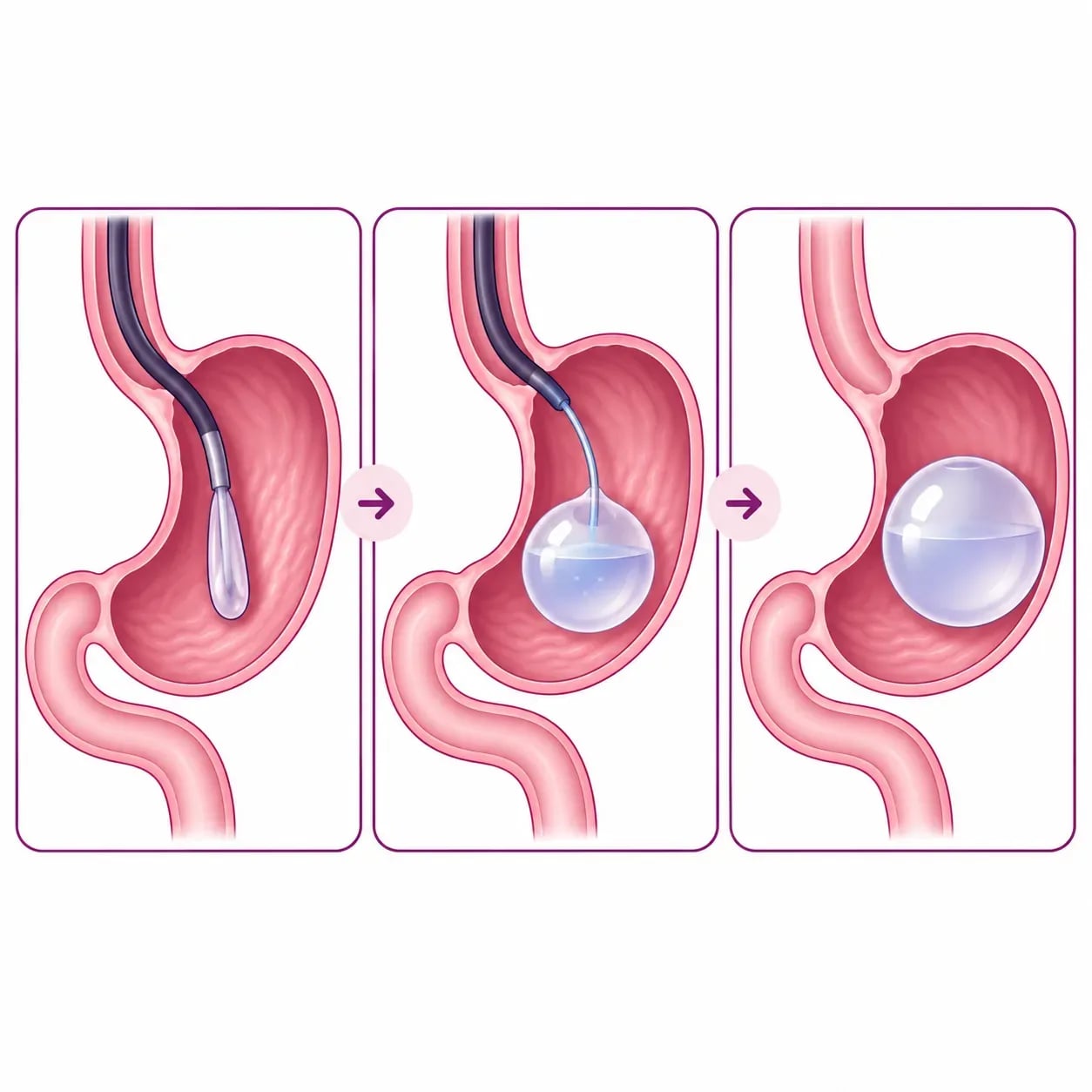
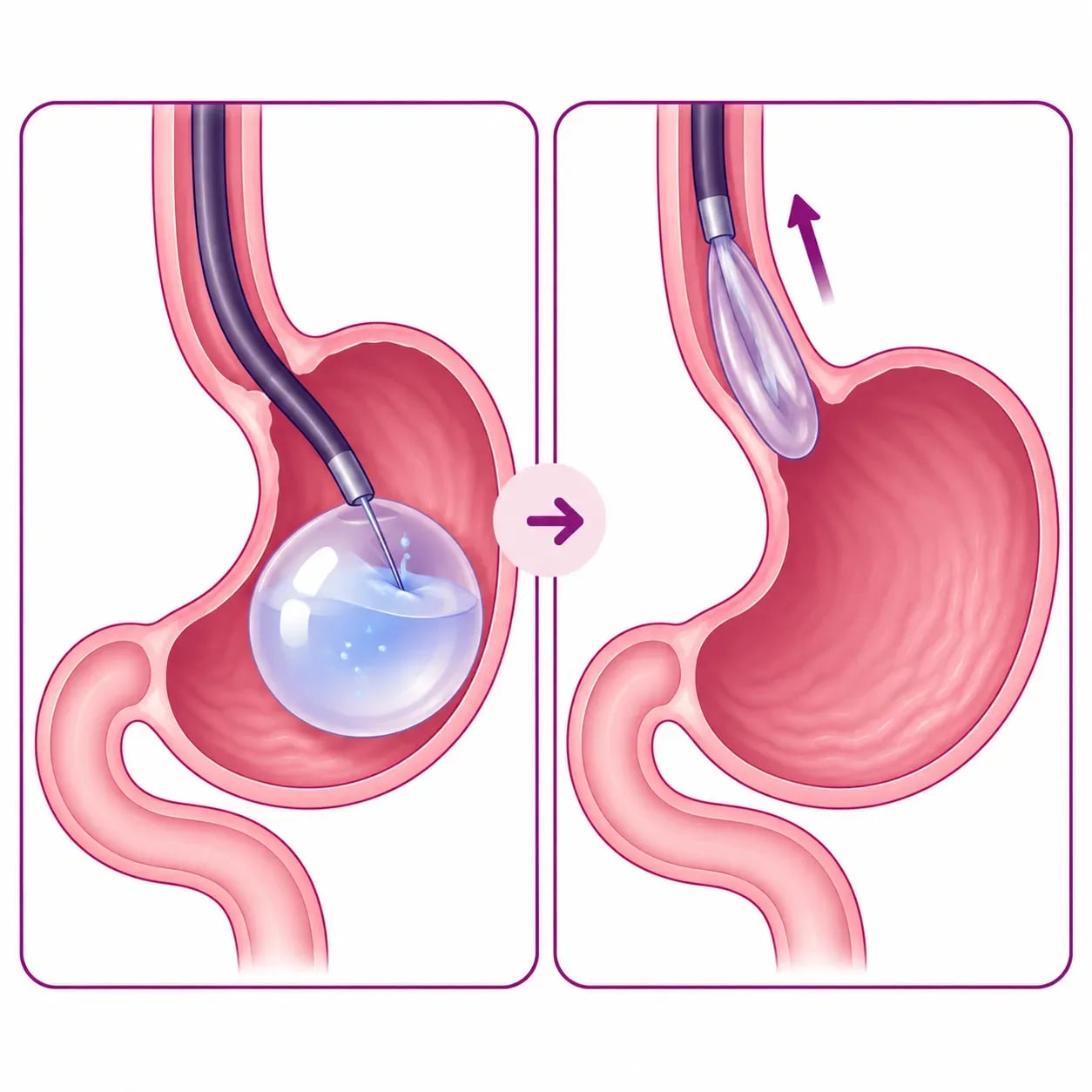
The deflated balloon is passed through the mouth into the stomach by endoscopy, then filled with sterile saline. The whole thing takes around 30 minutes under light sedation, and you are observed afterwards rather than admitted for a long stay.
Once in place, it takes up space. You feel full sooner and on less food. It does not alter hormones, it does not change absorption, and it does not remove or reroute anything — which is why it is fully reversible and why nothing is permanent about it.
Removal is also endoscopic, again about 30 minutes under light sedation. Both ends of the treatment need a camera, and that has practical consequences if you live abroad. There is a full section on removal below, and it is the part to read carefully before you book.
Six months or twelve?
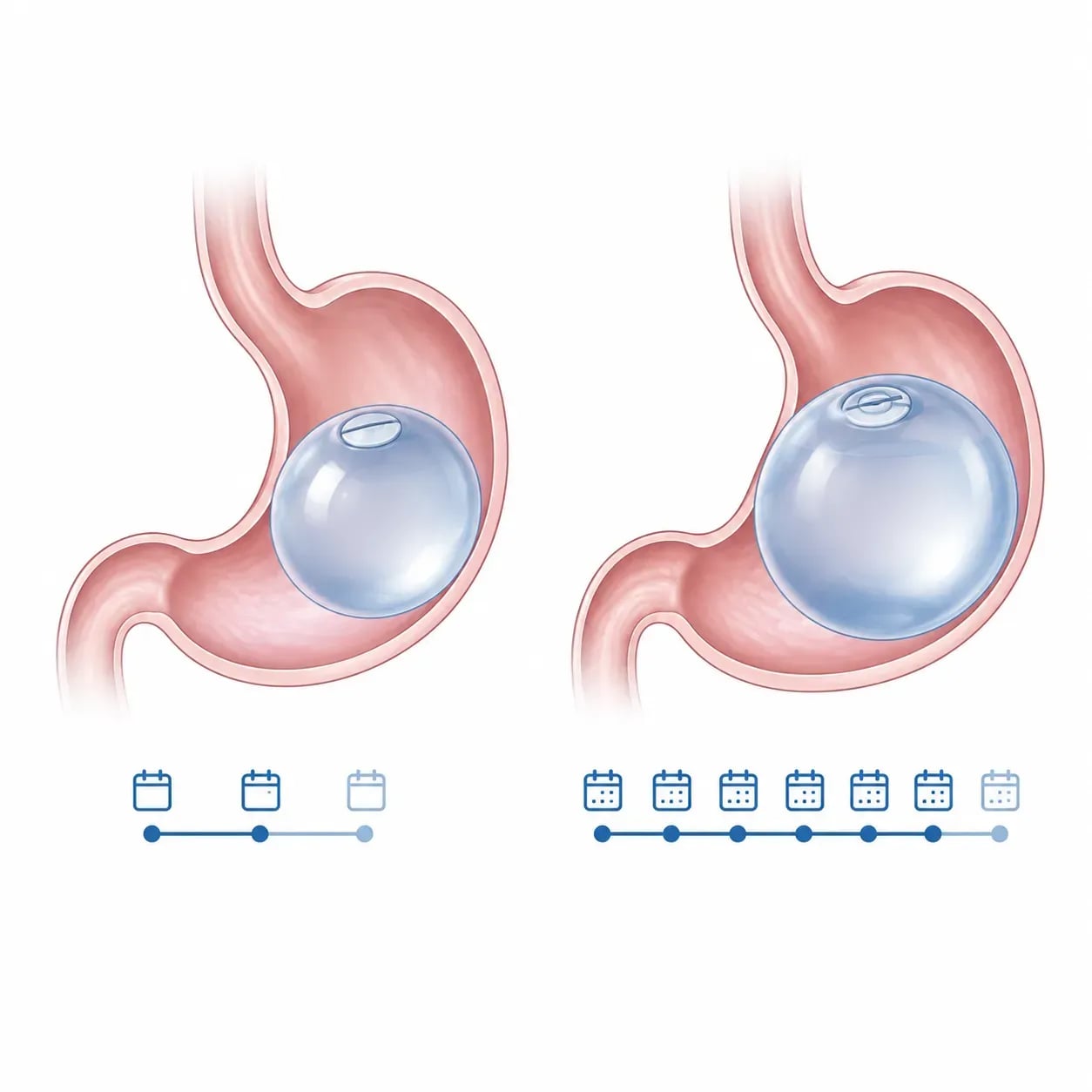
Six months is the option most people choose. It is long enough to establish a different way of eating and short enough to stay motivated throughout.
Twelve months gives a longer window, which suits someone with more weight to lose or who knows they need longer to change habits. It involves closer monitoring, because a device in place longer carries a slightly higher chance of degrading, and a volume adjustment may be discussed partway through.
The price difference is €300. The decision is not really about the money, it is about how long you realistically need — and that is a conversation for the consultation, not something to settle now.
What it actually costs, placement and removal
Read this before comparing prices anywhere. The balloon is the one procedure here with two separate costs, because it has to come out.
| Stage | Price | Stay |
| Placement, 6 months | €2,500 | 4 days |
| Placement, 12 months | €2,800 | 4 days |
| Removal | €2,000 | 2 days |
| Total, 6 months | €4,500 | Two trips |
| Total, 12 months | €4,800 | Two trips |
Included in the placement: the surgeon's and anaesthetist's fees, the Orbera365 balloon, the hospital stay, hotel accommodation, airport pickup and transfers, and assistance throughout.
Not included: flights — and you will need two sets of them, or one set plus a removal arranged where you live.
The removal can be done where you live instead, by a gastroenterologist, which saves the second trip. We provide the placement report and the device details. Arrange it before you travel, not afterwards: see the removal section below.
Every procedure is listed on the prices page, and a personalised quote reaches you within 24 to 48 hours.
| Procedure | Price | Stay |
|---|---|---|
| Gastric Balloon Placement (12 Months) | €2,800 | 4 days |
| Gastric Balloon Placement (6 Months) | €2,500 | 4 days |
| Gastric Balloon Removal | €2,000 | 2 days |
Who the balloon is not for
The balloon is refused more often than people expect, and almost always for digestive reasons. Tell us everything at the first contact rather than at the clinic.
- Significant reflux, or a sizeable hiatus hernia
- An active stomach ulcer
- Previous surgery on the stomach or oesophagus
- Long-term anti-inflammatories or anticoagulants
- Pregnancy, or a pregnancy planned during the placement period
- An untreated eating disorder
Reflux is the most common reason for a no. A balloon can make existing reflux considerably worse. If you get heartburn regularly, say so early — an endoscopy may be requested before anything is agreed, and that is a good sign rather than an obstacle.
Pregnancy is not considered possible while the balloon is in place. Discuss contraception with your own doctor before you travel, and tell us early if you are planning a pregnancy in the next year.
Balloon, sleeve, bypass or band
| Balloon | Sleeve | Bypass | Band | |
| Surgery | None — endoscopic | Keyhole | Keyhole | Keyhole |
| Anaesthetic | Light sedation | General | General | General |
| Permanent | No, 6 or 12 months | Yes | Yes | No, removable |
| Anatomy altered | None | Stomach reduced | Stomach and intestine | None |
| Absorption affected | No | No | Yes | No |
| Lifelong supplements | No | No | Yes | No |
| Price | €4,500 or €4,800 all in | €3,950 | €4,150 | €3,400 |
Worth noticing in that last row: once removal is counted, the balloon is the most expensive of the four and the only temporary one. That is not an argument against it — avoiding surgery altogether is worth something, and for some people it is worth a great deal. But it should be a decision you make with the real figure in front of you.
The balloon as a first step. It is also used deliberately before surgery, to reduce weight ahead of a sleeve or bypass where the starting weight makes the operation riskier. In that case it is not an alternative to surgery but a preparation for it.
Your pathway, step by step
- Get in touch from home. Your height, weight, medical history and in particular your digestive history. An opinion and a quote come back within 24 to 48 hours.
- Decide where removal will happen — a second trip here, or a gastroenterologist where you live. Settle this before you book anything.
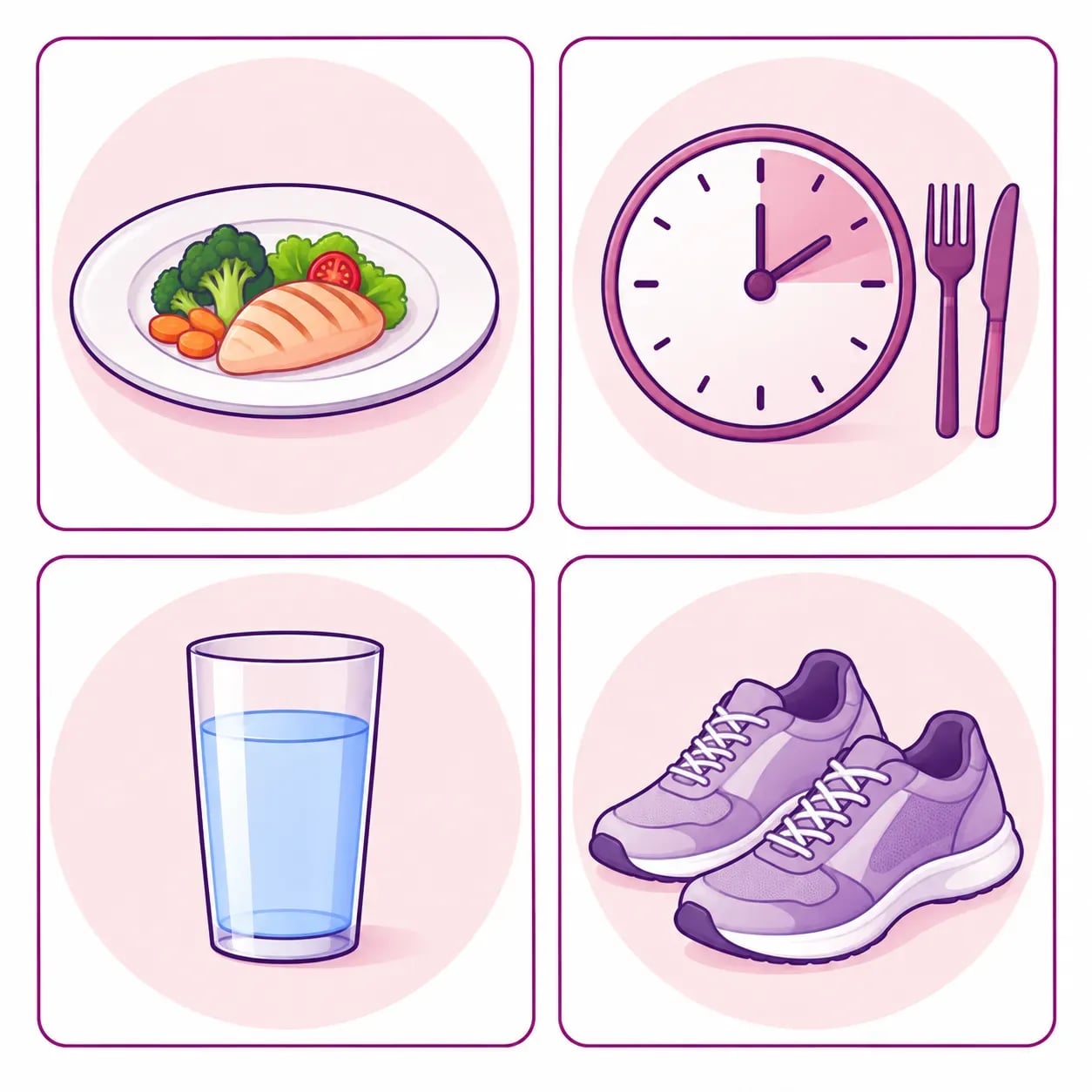
- Preparation. Pre-operative tests, fasting instructions, and our preparation guide for what applies to every procedure.
- Arrival. You are met at Tunis-Carthage and transferred.
- Consultation with Dr Sofiene Ayadi, who confirms the balloon is appropriate for you.
- Placement, around 30 minutes under light sedation, followed by observation.
- The adaptation days in Tunisia, with anti-nausea treatment and a dietary consultation.
- Home, with your placement document, your removal date, and remote follow-up.
The first few days, honestly
This is the part people are least prepared for, so here it is plainly: the first two to four days are unpleasant.
Nausea, vomiting and abdominal discomfort are expected, not a sign that something has gone wrong. Your stomach has a foreign object in it and is reacting accordingly. Anti-nausea medication is prescribed and it works, but it does not abolish the sensation entirely.
This is the reason the stay is four days rather than two. You are here, monitored and treated, through the worst of it rather than on a plane.
It settles. By the end of the first week most people are eating small meals normally and the discomfort has gone. Knowing the timetable in advance is what stops people panicking on day two.
Living with a balloon
Eating. Smaller portions, eaten slowly, chewed properly. No fizzy drinks. Go easy on very fatty and very sugary food, which sits badly. Do not drink while eating — liquid takes up the space you need for food.
Your daily medication. A stomach-protecting medicine is prescribed for the whole period the balloon is in. Take it. Do not stop it because you feel fine, and do not stop it without asking.
Exercise is encouraged once the adaptation period is over. It matters more than it sounds: losing weight quickly without activity costs you muscle, and muscle is what you want to keep for afterwards.
Flying is not a problem. Carry your medication and your placement document, which states the model and your removal date.
Contact us without waiting if: vomiting persists beyond the first days, pain comes on suddenly and severely, you cannot keep liquids down, or your urine changes colour. That last one matters — it can indicate the balloon has deflated, and it needs checking the same day.
The removal date is never exceeded
Of everything on this page, this is the sentence to remember.
A balloon left in beyond its intended period can degrade and deflate. A deflated balloon can move out of the stomach and into the intestine, where it can cause an obstruction. That is a surgical emergency. It is rare, and it is almost entirely preventable by removing the device on time.
What to do on the day it is placed: write the removal date down, put a reminder in your phone for one month beforehand, and book the removal then rather than later. Not the week before.
The date is not a guideline, and it is not negotiable because of a holiday or a busy month at work.
Removal: when, where and how much
How. Endoscopically, through the mouth, about 30 minutes under light sedation. No incision, same as placement.
When. At the end of the planned period. Earlier is possible and entirely legitimate if you cannot tolerate it or if there is a complication — the device is fully reversible and early removal is the same procedure.
Where — and decide this before you book the placement. Two options:
- In Tunisia, a second trip of two days, at €2,000.
- Where you live, by a gastroenterologist. We provide the placement report and the device details. This saves a trip, but it needs arranging in advance: a gastroenterologist has to agree to remove a device placed abroad, and that is not automatic. Confirm it before you travel for the placement, not six months later.
And afterwards, the fullness goes with the balloon. There is no gradual tapering. That is why the section below matters more than any other on this page.
After removal, being straight with you
Much of the weight often comes back.
That is not a reason to avoid the balloon, and it is not a failure of the device. It is what happens when a mechanical restriction is removed and nothing underneath it has changed. The balloon buys you six or twelve months in which eating less is easier than it has ever been. If you use that time to build habits that survive without it, the result holds. If you wait for the device to do the work, it will not.
Anyone who tells you otherwise is selling you something. The balloon is a springboard, not a solution.
The months immediately after removal are the most delicate period of the whole treatment, and they are the ones people plan for least.
The dietary follow-up is what decides the result
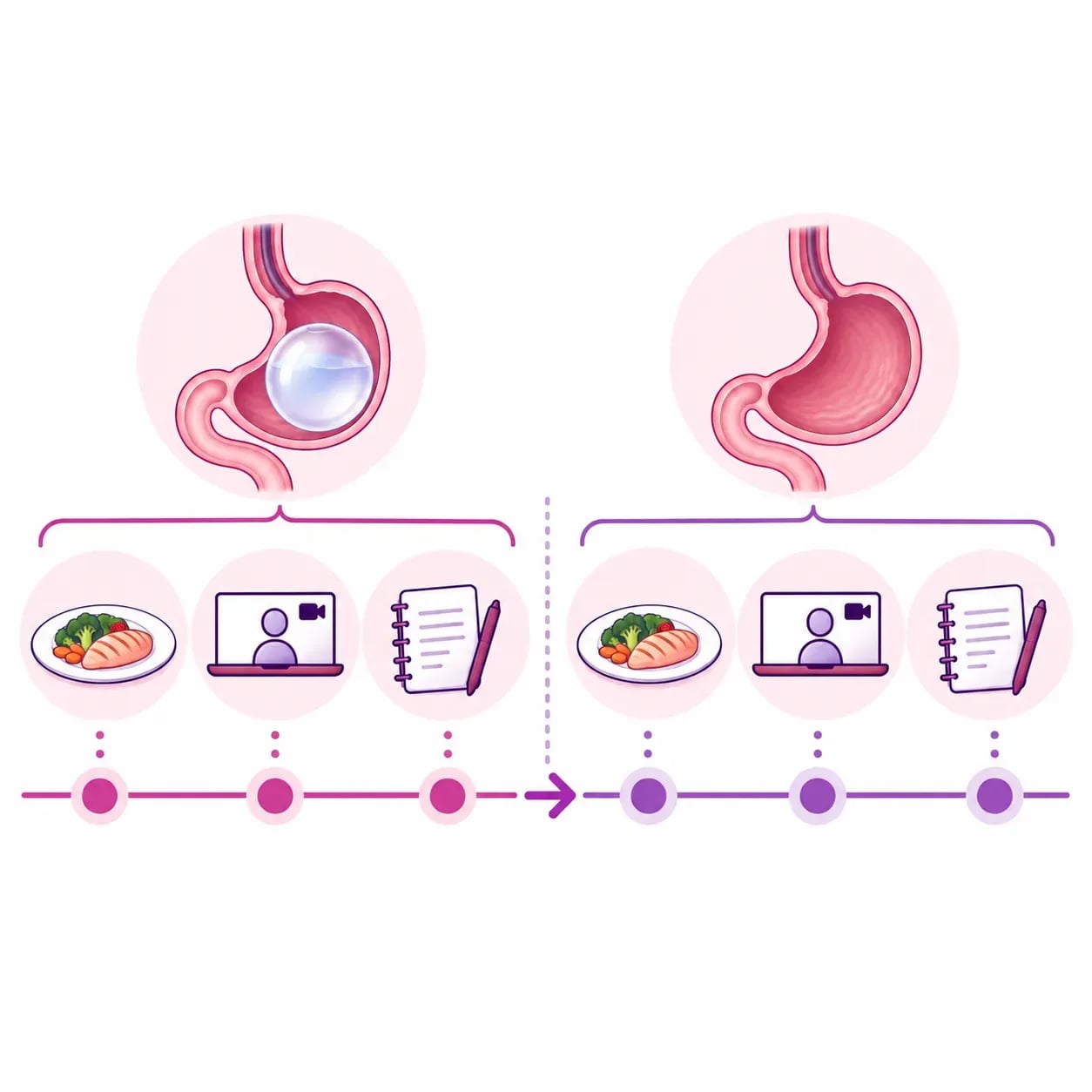
What we put in place: a dietary consultation during your stay, remote follow-up with defined check-in points, and a referral to a dietitian.
What you should arrange where you live: monthly dietitian appointments for the whole period the balloon is in, and continuing after it comes out. If eating is tied up with stress or emotion for you, psychological support alongside is worth considering, and there is nothing unusual about needing it.
And keep the follow-up going after removal. Most people stop at exactly the point it matters most. If you only commit to one thing on this page, make it the three months after the balloon comes out.
Your surgeon
Dr Sofiene Ayadi is the bariatric surgeon at Myron International Clinic. He handles balloon patients and surgical patients, which means he is in a position to tell you honestly when the balloon is the right tool and when it is not.
If what you need is a sleeve or a bypass, he will say so. If a balloon is being considered as a step before surgery, he will explain why.
Getting to Tunisia
From the UK and Ireland: around three hours from London, with connections from other UK and Irish airports. British and Irish passport holders do not currently need a visa for a short tourist stay — but see the note below.
From the Gulf: daily flights from Dubai with Emirates, around six and a half to seven hours, and from Doha with Qatar Airways, around six. Tunisia is two to three hours behind the Gulf, so follow-up calls fall inside the working day at both ends.
From continental Europe: direct flights of 1h30 to 3h from Paris, Brussels, Geneva, Lyon and Marseille, with no visa for EU and Swiss nationals.
From West and Central Africa: regular connections from Dakar, Abidjan, Douala, Libreville and Casablanca, with help on visa formalities where needed.
Entry requirements follow your nationality, not your country of residence. A resident of Dubai or London holding an Indian, Pakistani, Nigerian or Filipino passport does not have the same conditions as a British or Emirati national, and a residence permit changes nothing. Check with the Tunisian embassy for your country of citizenship before booking.
Remember you may be making this trip twice. Factor the removal flight into the budget from the start. How long each procedure needs is in our guide to lengths of stay.
Before you travel: a checklist
- Your removal plan, confirmed. A second trip here, or a named gastroenterologist at home who has agreed. The most important item on this list.
- Documents: a passport valid well beyond your return date, and a visa if your nationality requires one.
- Your digestive history in full: reflux, heartburn, hiatus hernia, ulcer, any previous stomach or oesophageal surgery. All of it.
- A written list of your medication, flagging any anti-inflammatory or anticoagulant, plus supplements and herbal products.
- Contraception, discussed with your own doctor before departure.
- The fasting instructions you are given. Follow them exactly — the procedure is postponed otherwise, and that is the correct decision.
- Tell your GP before you go, and find your dietitian before you travel rather than after.
- Stock your kitchen for the return: soups, yoghurts, soft food. You will not want to shop in the first days.
- Comfortable clothing, with nothing tight at the waist.
- Note your removal date the day the balloon is placed, and set a reminder one month before.
- Allow a few quiet days after you get home. Do not book anything demanding in the first week.
Request a quote and you will have an answer within 24 to 48 hours.









Frequently asked questions about Gastric Balloon in Tunisia
Placement is €2,500 for the 6-month balloon or €2,800 for the 12-month one, with a 4-day stay included. Removal is charged separately at €2,000 with a 2-day stay. The real total is therefore €4,500 or €4,800, excluding flights. Removal is part of the treatment, not an optional extra, so compare on the total rather than on the placement price.
Because the balloon has to come out, and that is a second endoscopic procedure requiring a second visit. You can have it done in Tunisia on a 2-day stay at €2,000, or by a gastroenterologist where you live, which saves the trip. Either way, decide which before you book the placement.
Both are non-surgical and reversible. The injections need no procedure but have to be taken continuously, cost money every month and are commonly followed by weight regain when stopped. The balloon is a fixed period at a fixed cost, with no ongoing treatment, but needs two procedures and is uncomfortable for the first days. Neither changes your eating on its own: what decides the outcome is what you build during the window.
The Orbera365, a saline-filled balloon placed and removed endoscopically and designed to stay in place for up to twelve months. You receive a placement document stating the model and your removal date.
A swallowable balloon is taken as a capsule, needs no sedation, and empties and passes naturally after around four months, which is convenient if you are travelling. It also stays in for a shorter period, does not allow the stomach to be examined at placement, and cannot readily be removed early if you do not tolerate it. We place the Orbera365 rather than a swallowable balloon. If a swallowable device is specifically what you want, say so before booking flights.
No. Placement and removal are both done by endoscopy through the mouth, under light sedation, with no incision and no scar. Each takes around 30 minutes.
The placement itself is not painful under light sedation. The following two to four days are genuinely uncomfortable, with nausea, vomiting and abdominal discomfort. Anti-nausea medication is prescribed and helps. This is the reason the stay is four days: you are here and monitored through the worst of it.
Four days for the placement, and two days for the removal if you have it done here. If a gastroenterologist where you live removes the balloon, you only make the one trip.
Around 10 to 15% of body weight is the usual expectation, but it depends heavily on how you eat during the period. The balloon creates fullness; it does not change behaviour. Nobody can give you a guaranteed figure, and you should be wary of anyone who does.
Six months is the more common choice and is long enough for most people to establish different habits. Twelve months suits someone with more weight to lose or who needs longer, and involves closer monitoring because a device in place longer carries a slightly higher chance of degrading. The price difference is €300. It is decided at the consultation.
Often, much of it, if habits have not changed. The fullness disappears with the balloon and there is no gradual tapering. The balloon buys you six or twelve months in which eating less is easier than usual, and the result depends entirely on what you build in that time. The months right after removal are the most delicate period of the whole treatment.
Do not. A balloon left in too long can degrade and deflate, and a deflated balloon can move into the intestine and cause an obstruction, which is a surgical emergency. It is rare and almost entirely preventable by removing the device on time. Note the date the day it is placed and set a reminder one month before.
Vomiting that persists beyond the first days, sudden severe pain, being unable to keep liquids down, or a change in the colour of your urine. The last one can indicate the balloon has deflated and needs checking the same day. Contact us without waiting, and go to an emergency department if you cannot reach us.
It depends on the severity. A balloon can make existing reflux considerably worse, and marked reflux or a sizeable hiatus hernia can be a contraindication. Report heartburn early rather than at the clinic: an endoscopy may be requested before anything is agreed.
Significant reflux or a sizeable hiatus hernia, an active stomach ulcer, previous surgery on the stomach or oesophagus, long-term anti-inflammatories or anticoagulants, pregnancy or a pregnancy planned during the period, and an untreated eating disorder. Reflux is the most common reason for a refusal.
Pregnancy is not considered possible while the balloon is in place. Discuss contraception with your own doctor before you travel, and tell us early if you are planning a pregnancy in the next year.
Yes, and it is entirely legitimate to do so for persistent intolerance or a complication. The device is fully reversible and early removal is the same procedure.
Possibly, after an interval and an assessment. Repeating a placement without having changed anything usually produces the same outcome as the first time. Dr Ayadi will want to look at what happened after the first removal before agreeing to a second.
Yes, and it is used that way deliberately. Reducing weight before surgery can lower the risk of the operation where the starting weight makes it higher. In that case the balloon is a preparation for surgery rather than an alternative to it.
Yes, and it is recommended once the adaptation period is over. Losing weight quickly without activity costs you muscle, and keeping muscle is what helps you afterwards.
Yes, flying is not a problem. Carry your medication and your placement document, which states the model and your removal date.
Yes. A stomach-protecting medicine is prescribed for the entire period the balloon is in place. Take it throughout, including on the days you feel completely fine, and do not stop it without asking.