

Gastric sleeve in Tunisia: eligibility, price and lifelong follow-up

Gastric sleeve in Tunisia: the essentials
A sleeve gastrectomy removes about two thirds of the stomach and leaves a narrow tube. It is the most commonly performed weight-loss operation in the world, it works, and it is permanent.
It is also the one procedure on this site where the operation is the small part. Two hours in theatre, five days in Tunisia — and then ten years of blood tests, vitamins and eating differently, almost all of it happening several thousand kilometres from the surgeon who operated. Whether a sleeve works for you is decided far more by how well that second part is organised than by the first. Everything on this page is arranged around that, and the section on who does what after you fly home is the one worth reading twice.
At ServiHealth the operation is carried out by Dr Sofiene Ayadi, a surgeon specialising in obesity surgery, at the Clinique Internationale Myron in Tunis.
| Operating time | 1 to 2 hours |
| Technique | Laparoscopic (keyhole) |
| Anaesthetic | General |
| Recommended stay in Tunisia | 5 days |
| Back to work | 2 to 3 weeks |
| Expected weight loss | 50 to 70% of excess weight over 1 to 2 years |
| Reversible | No |
Are you eligible for a gastric sleeve?
A sleeve is not offered on weight alone. The usual criteria are:
- A BMI above 40, or
- A BMI between 35 and 40 with at least one weight-related condition — type 2 diabetes, high blood pressure, obstructive sleep apnoea, or severe joint problems.
- Generally after a structured medical weight-management programme, followed for several months, has not worked.
A point that matters if your family background is South Asian, Middle Eastern, Chinese, Black African or African-Caribbean
The metabolic risk carried by a given BMI is not the same in every population. UK guidance recommends using lower BMI thresholds for people from these backgrounds, because type 2 diabetes and its complications appear at a lower body weight. If your BMI sits just under the figures above and you already have a weight-related condition, you are not automatically outside the conversation — say so when you enquire rather than assuming you do not qualify.
How the assessment actually runs
You get a first opinion within 24 to 48 hours of sending your details. That opinion is a starting point and not an approval. Eligibility is confirmed by the surgeon and the anaesthetist after your pre-operative work-up, and that work-up exists partly to find the people for whom this operation is the wrong one. A surgeon who approves a sleeve from a form and a photograph is not assessing you.
If you have significant reflux or a hiatus hernia, read the gastric bypass page before going further — for that particular group the sleeve is often the wrong operation, for reasons set out below.
How a gastric sleeve works
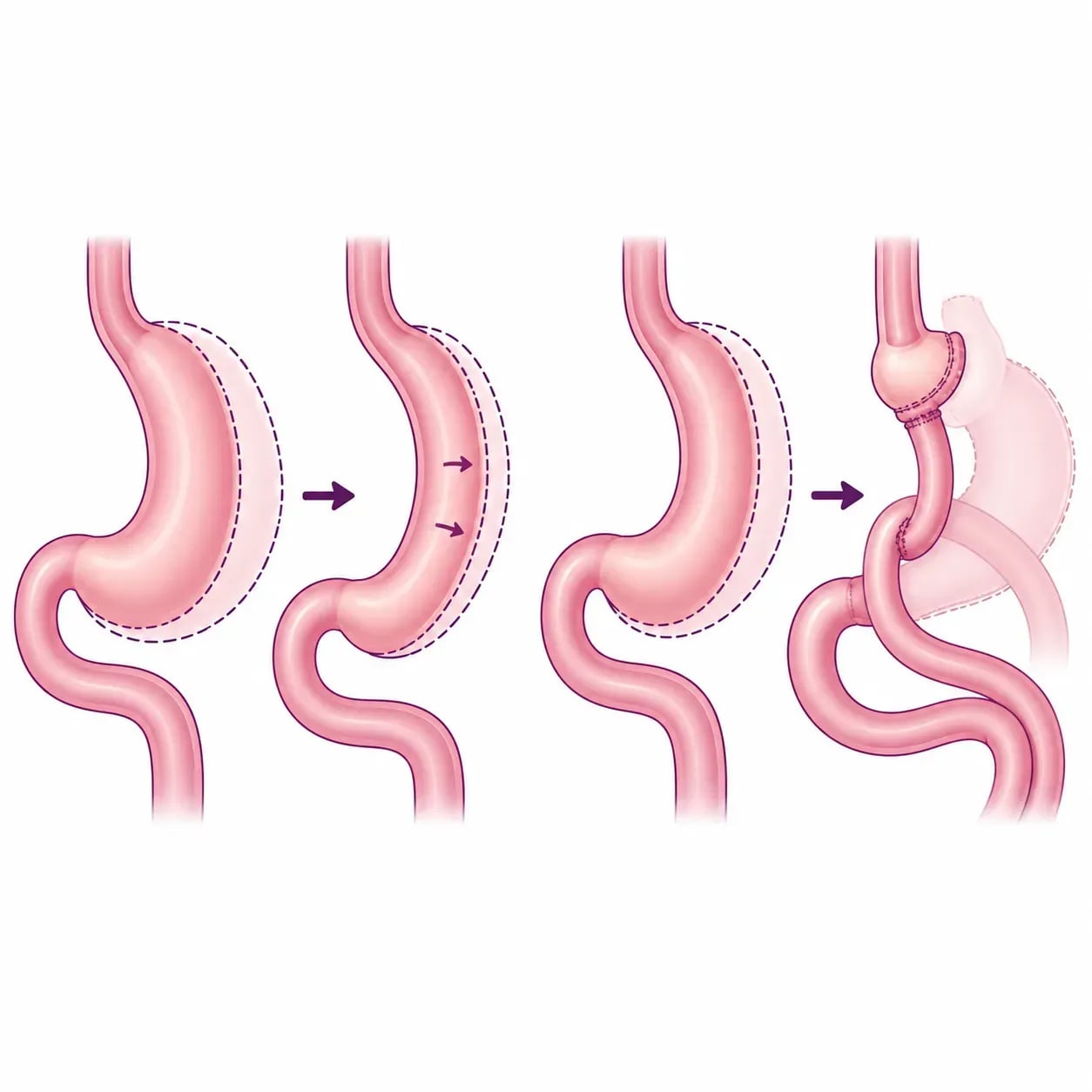
The surgeon removes roughly two thirds of the stomach, taking the outer curve and leaving a narrow vertical tube running from the oesophagus to the outlet. Nothing is rerouted and no implant is placed: what is removed is removed, and what remains works in the normal order.
It changes two things at once, and the second is the one people underestimate. Capacity falls sharply, so a small volume of food produces a feeling of fullness. Appetite also falls, because the part of the stomach that is removed produces much of the ghrelin that drives hunger. Most patients describe the first year as the first time in their adult life that they are not thinking about food between meals. That effect is real and it is also not permanent at the same intensity — which is why the habits you build in that first year matter so much.
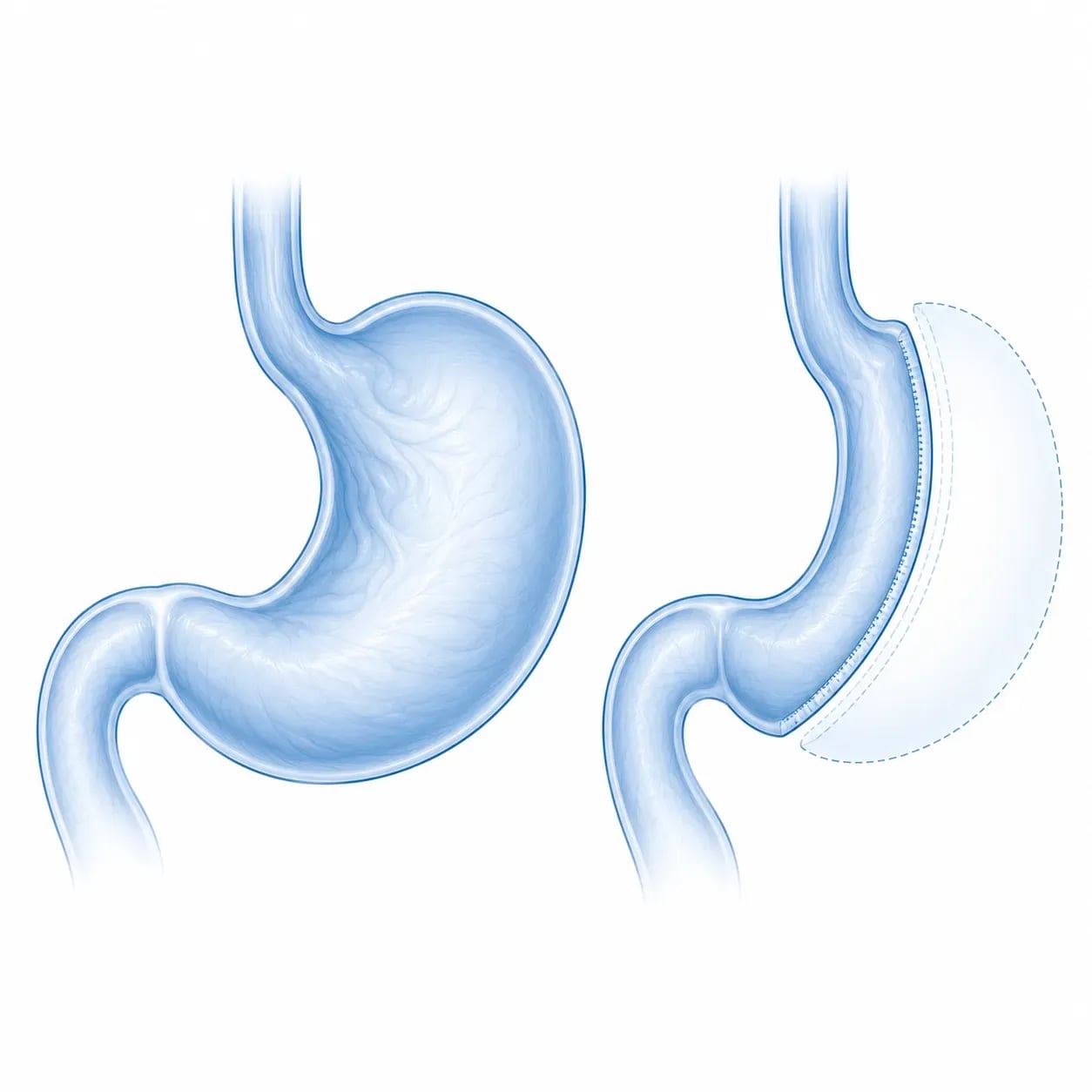
This operation is permanent
This needs saying plainly, because it is the question people ask last and should ask first. A sleeve gastrectomy cannot be undone. The part of the stomach that is removed is removed; there is nothing to put back and nothing to deflate or unclip.
What can be done later is a conversion — most often to a gastric bypass, where reflux or significant weight regain makes it the better option. That is a second operation with its own risks, not a reversal.
If the permanence of that is what is holding you back, there are reversible options, and they are genuinely different operations rather than weaker versions of this one: see the gastric band and the gastric balloon.
Sleeve, bypass, band or balloon — and where the injections fit
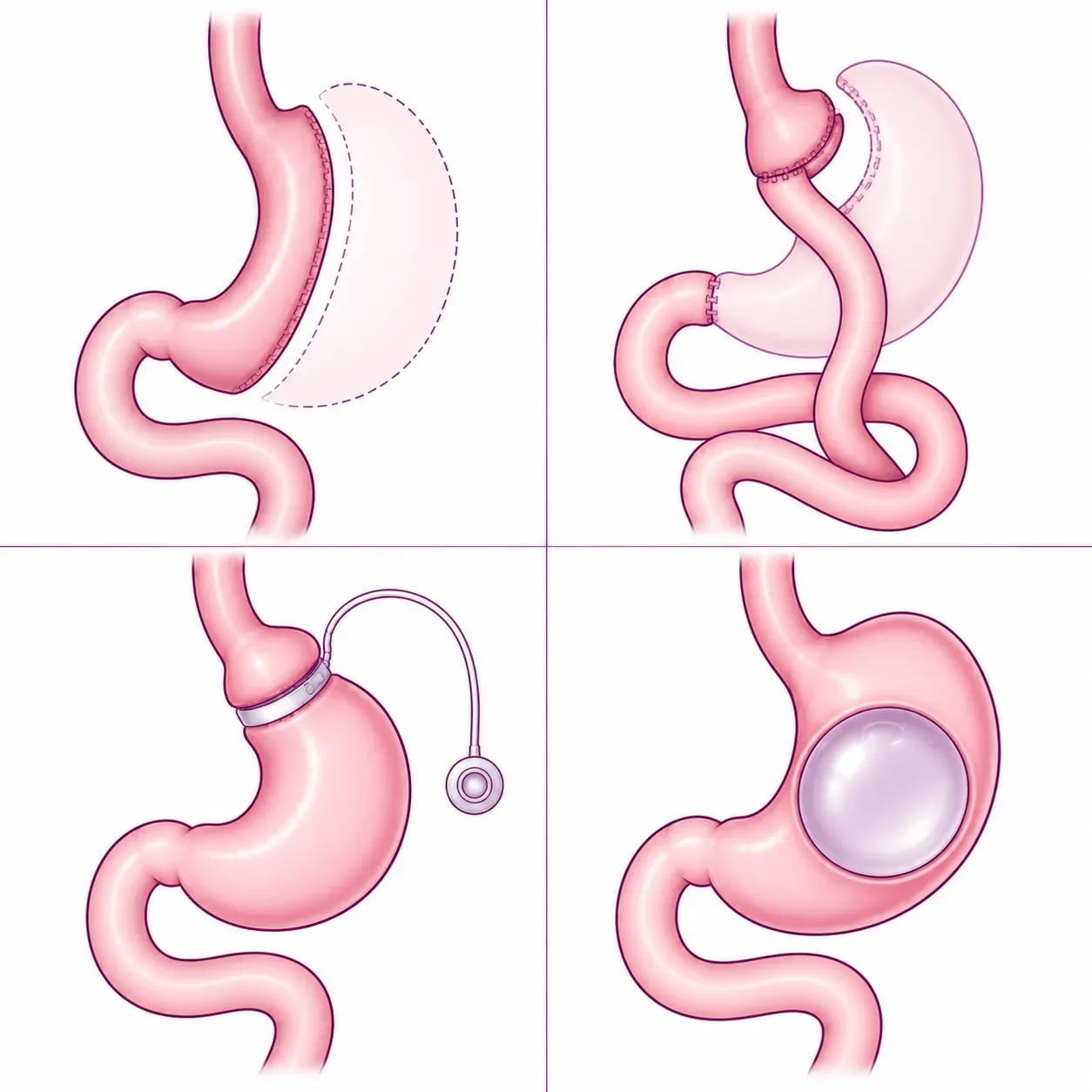
Four procedures are commonly discussed, and they are not four strengths of the same thing. They solve different problems and they fail in different ways.
| Procedure | What it does | Permanent | The drawback to weigh |
| Gastric sleeve | Removes about two thirds of the stomach; reduces capacity and hunger | Yes | Can cause or worsen acid reflux |
| Gastric bypass | Creates a small pouch and reroutes the small intestine; restriction plus reduced absorption | Yes | Greater risk of nutritional deficiency; stricter lifelong supplementation |
| Gastric band | An adjustable band placed around the upper stomach | No — removable | Depends heavily on adjustment and adherence; may need removal later |
| Gastric balloon | A balloon placed endoscopically in the stomach for a set period | No — temporary | A temporary measure; weight returns without a change in habits |
Sleeve or bypass, in one sentence each
If you have significant acid reflux or a hiatus hernia, a bypass is usually the better operation, because a sleeve can make reflux considerably worse. If you have poorly controlled type 2 diabetes, a bypass often has the stronger metabolic effect. If neither applies, a sleeve is the simpler operation, with less rerouting and a lighter lifelong supplementation burden. Your surgeon decides this after the work-up, not from a page.
And what about Mounjaro, Wegovy and the other weight-loss injections?
This is now the first question most people ask, and it deserves a straight answer rather than a sales one.
GLP-1 and dual-agonist medicines genuinely work. They are not a weaker version of surgery and surgery is not a stronger version of them — they are different commitments. The medicines require an indefinite prescription, an indefinite cost and an indefinite supply, and weight regain after stopping is well documented. Surgery is one irreversible event followed by lifelong vitamins and blood tests. Some people are better served by one, some by the other, and some use the medication first and never need the operation. A clinic that tells you injections do not work is selling you something.
One safety point that is not optional. If you are taking any GLP-1 or dual-agonist medicine — semaglutide, tirzepatide, liraglutide, under whatever brand name — you must tell the surgeon and the anaesthetist before you travel, even if you stopped recently. These medicines slow the emptying of the stomach, which matters for a general anaesthetic, and anaesthetic societies have issued guidance on pausing them beforehand. Your anaesthetist will tell you for how long. Do not leave this off your medication list because it feels like a diet drug rather than a medicine.
How much does a gastric sleeve cost in Tunisia?
Two prices, both for a five-day stay in Tunisia.
The price covers the consultation, the basic pre-operative work-up, the operation, the anaesthetic, the hospital stay, transfers, and the immediate post-operative follow-up. It does not cover your flights, the vitamins and supplements you will take from here on, or the blood tests and dietetic follow-up in your own country — and those are not an afterthought. Budget for them in the same conversation in which you budget for the operation, because they continue for the rest of your life.
Reimbursement where you live is a separate question. Several European systems fund bariatric surgery against their own criteria, but the waiting time runs from several months to more than a year, which is why most people looking at this page are looking abroad in the first place. Surgery paid for privately abroad is not usually reimbursed afterwards. Check with your own scheme before you book rather than after.
| Procedure | Price | Stay |
|---|---|---|
| Gastric sleeve | €3,950 | 5 days |
| Revision gastric sleeve | €4,200 | 5 days |
The pre-operative work-up
The work-up is not a formality and it is not there to sell you the operation. It exists to answer two questions: is this operation safe for you, and is it the right one.
- Nutritional assessment, which also establishes the baseline your later blood tests are measured against.
- Full blood work-up.
- Cardiac and respiratory assessment.
- A psychological opinion, in many cases. This is not a test you pass or fail; it is there because the operation changes your relationship with food abruptly and some people need support with that arranged in advance rather than discovered afterwards.
The pre-operative diet
You will be asked to follow a low-calorie diet for one to three weeks before surgery. The purpose is surgical rather than cosmetic: it shrinks the liver, which sits directly over the operating field, and a smaller liver makes a laparoscopic sleeve safer and easier. This is the part patients are most tempted to skip and the part the surgeon notices immediately. Follow it.
Nicotine in every form — cigarettes, vapes, heated tobacco, pouches — is stopped several weeks beforehand. It raises the risk of a leak at the staple line and of a clot, which are the two early complications that matter most.

Your journey, step by step
- Your enquiry and a first opinion. Send your height and weight, your BMI, the weight-related conditions you have, your medication list and a summary of what you have already tried. You receive a first opinion and a quote within 24 to 48 hours. It is an opinion, not an approval.
- The work-up. Blood tests, cardiac and respiratory assessment, nutritional assessment and, in many cases, a psychological opinion, carried out where you live. The surgeon reviews the results before you book anything.
- The pre-operative diet. One to three weeks of a low-calorie diet to shrink the liver, plus stopping nicotine several weeks ahead.
- Arriving in Tunis. A member of the team meets you in the arrivals hall at Tunis-Carthage with a board showing your name, and takes you to your accommodation. Tell us immediately about a delayed flight or a missed connection; surgery is scheduled around your arrival, not the other way round.
- Consultations. You meet Dr Ayadi and the anaesthetist. Bring your full medication list, including anything taken for diabetes, blood pressure or weight — the injections included.
- The operation. 1 to 2 hours, laparoscopically, under general anaesthetic. Several small incisions rather than one large one.
- In hospital. Several days of monitoring. You will be asked to walk within hours of the operation, which is not enthusiasm on the staff’s part — it is the single most effective thing you can do against a clot. Expect shoulder pain from the gas used during keyhole surgery; it goes within a few days and surprises everyone who was not warned.
- Discharge. You leave with your operative report, your discharge prescription and your dietary protocol.
- Going home. You fly once the surgeon confirms you are fit to travel, and the follow-up starts the moment you land.
Two things to ask for before you leave the clinic
Your operative report, in English, in writing. It should say what was done, when, by whom and with what. This is the document an emergency department abroad will ask for if anything goes wrong, and the document your GP will want before taking on your follow-up. Keep a paper copy in your bag and a photograph of it on your phone.
Your prescription written in generic drug names with doses. Brand names differ between countries and a pharmacist in Manchester or Abu Dhabi may not recognise a Tunisian one. Ask for the generic name and the strength of every item, supplements included.
Is a gastric sleeve safe? Risks and warning signs
A sleeve gastrectomy is a routine operation in experienced hands and it is major abdominal surgery. Both of those are true, and a page that only told you the first would be useless to you.
Early risks
- A leak at the staple line. Rare, and the complication that matters most, because it needs treating quickly.
- Bleeding.
- Infection.
- Venous thrombosis — a clot in the leg or the lung. The risk is higher in this group of patients and higher again around a flight, which is why walking early and following the clot-prevention plan are not optional.
Later risks
- Stricture — a narrowing of the sleeve.
- Acid reflux, new or worsened. Covered in its own section below, because it deserves one.
- Nutritional deficiency, which is preventable and is the reason for lifelong supplements and blood tests.
Go to an emergency department the same day if you have any of these
- Fever.
- Abdominal pain that persists or is getting worse.
- Repeated vomiting, or being unable to keep fluids down at all.
- A fast heart rate. This one is easy to dismiss and is often the earliest sign of a leak — take it seriously.
- Breathlessness.
- Pain or swelling in one calf.
The honest risk of having this operation abroad is that the first two weeks, when these things declare themselves, are partly spent at home. That is managed rather than ignored: you leave with a named contact who answers, written instructions on what is normal, and your operative report. If you need to be seen urgently, be seen where you are — do not wait for a reply from Tunis — and tell us at the same time. Walk into the emergency department saying I had a sleeve gastrectomy on this date and hand over the report. That sentence and that piece of paper change how quickly you are assessed.
The risk to understand properly: acid reflux
This is the drawback of the sleeve, and the reason it is not the right operation for everyone.
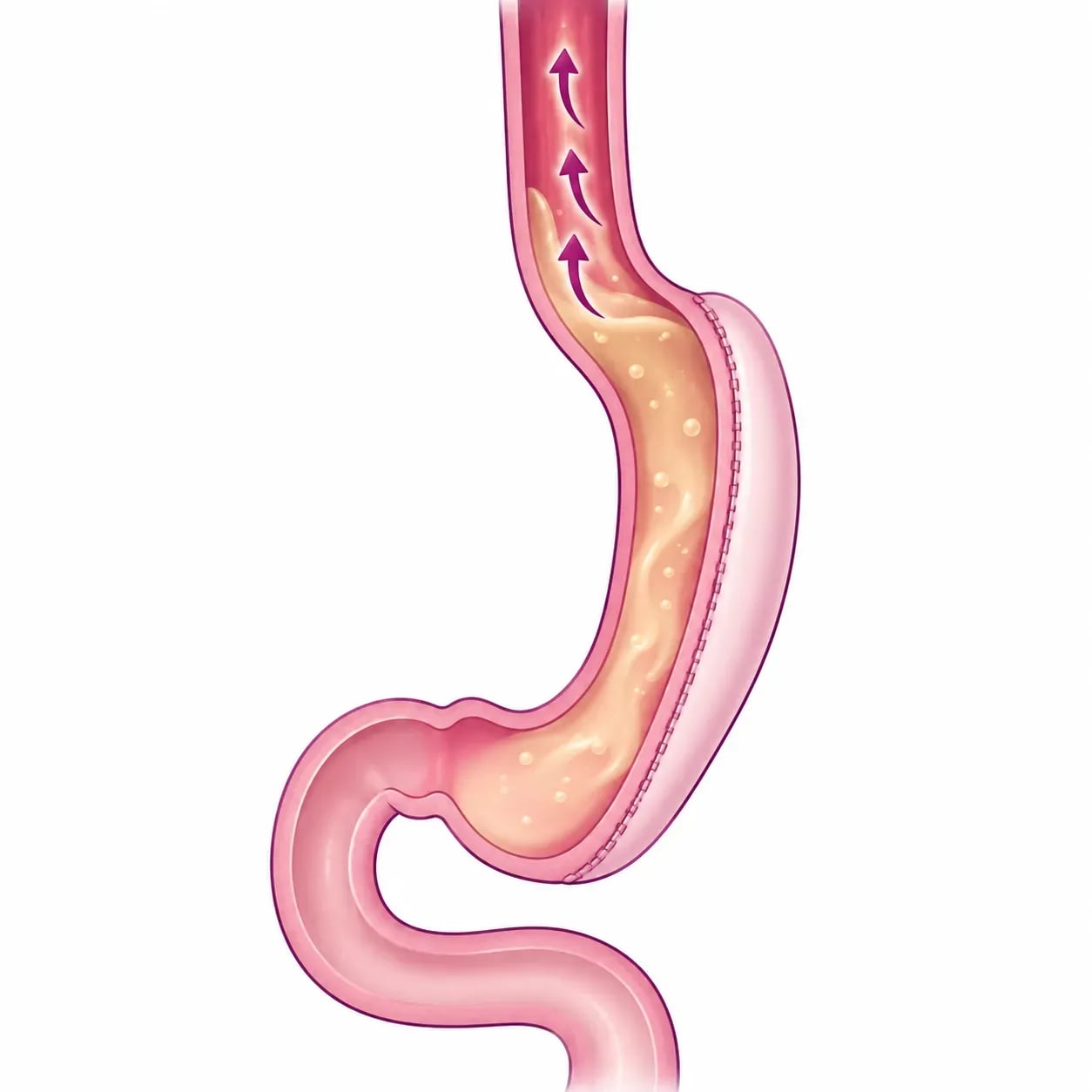
A sleeve can cause acid reflux that was not there before, and it can make existing reflux considerably worse. It is one of the commonest reasons for long-term dissatisfaction after this operation, and one of the commonest reasons for a revision. It is not a rare curiosity and it is not a sign that anything went wrong.
Where reflux is already significant, or where there is a hiatus hernia, a sleeve may be advised against in favour of a gastric bypass, which generally improves reflux rather than aggravating it.
The question to answer honestly at the consultation
Do you take omeprazole, lansoprazole, esomeprazole, pantoprazole or any antacid — regularly, occasionally, or just when you have eaten late? Many people do not think of this as medication and do not mention it. It is one of the most important pieces of information in your whole assessment, and leaving it out can mean having the wrong operation. Say it even if you buy it over the counter.
After the operation: a new rhythm
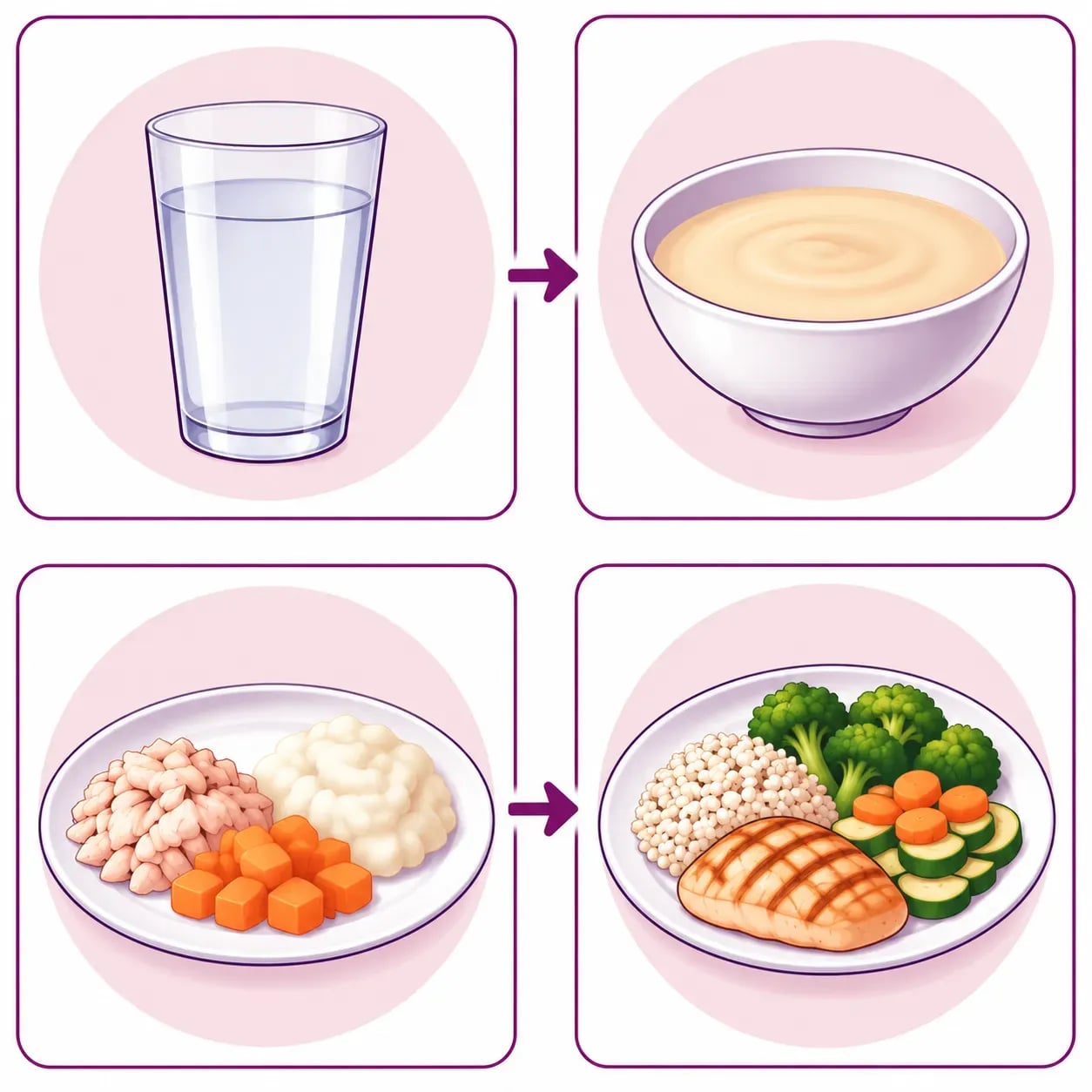
Eating returns in four stages, over several weeks, following the protocol you are given on discharge: liquids for the first days, then puréed, then soft, then normal food in small quantities. The stages are not arbitrary and moving through them faster than you are told is how people end up vomiting and back in hospital.
Three habits carry most of the long-term result: protein first at every meal, fluids between meals rather than with them, and eating slowly enough to notice fullness before you pass it. Your new stomach gives you very little warning.
Things nobody warns you about
- Hair loss between the third and sixth month. Common, distressing, and temporary. It reflects the speed of the weight loss, not a deficiency you have caused, and it regrows.
- Your usual medication may need changing. Treatments for type 2 diabetes and high blood pressure often need reducing, sometimes quickly, as your weight falls. That is done by a doctor, with monitoring — not by you, and not by stopping something because you feel better.
- Alcohol affects you differently. It is absorbed faster and reaches you harder at volumes that used to be nothing. Surgical societies also report a raised risk of problematic alcohol use after bariatric surgery. Either avoid it or treat it with considerably more caution than before, and talk to your doctor if it becomes a concern.
Fasting, including Ramadan
This comes up constantly and is rarely written down anywhere, so plainly: fasting after a sleeve is mainly a question of dehydration and protein, not of willpower. A small stomach makes it hard to take in enough fluid in a short eating window, and dehydration is the most common reason patients are readmitted in the first year. Most patients are advised not to fast during that first year, and to resume afterwards with a plan for fluids and protein across the hours when eating is permitted.
Islamic practice makes allowance for health, and whether that applies to you is a conversation between you, your doctor and your own religious adviser. It is not a decision for a clinic and we will not pretend otherwise — but do have the conversation before Ramadan rather than during it.
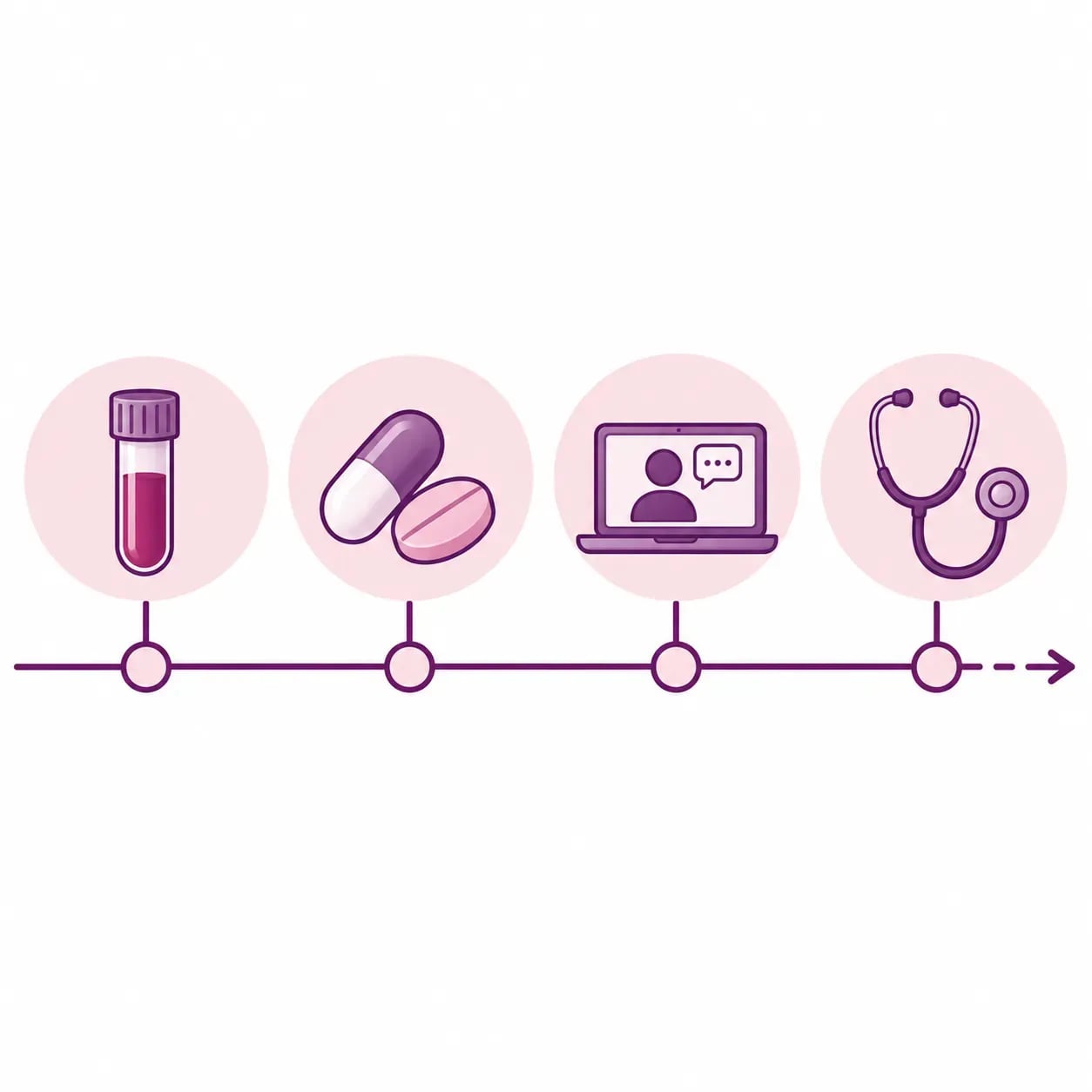
Follow-up after you go home: who does what
Read this section before you decide where to have the operation, not after. For a sleeve, the aftercare is not a service you receive — it is a structure you have to assemble, partly in a country where we are not.
ServiHealth and Dr Ayadi
Remote follow-up for the first six months — telephone, messaging and video — with a contact who answers in English or French. That covers the recovery, the diet stages, and the questions that come up as your weight starts to move.
Your GP or family doctor
They receive your operative report and they are the ones who, from here on, request and interpret your blood tests, adjust your diabetes and blood-pressure medication, and refer you if something is wrong. Speak to them before you book. Ask two specific questions: will you request and review my bariatric blood tests each year, and will you prescribe my supplements, or do I buy them myself?
In the UK this matters more than people expect. NHS bariatric services do not generally take on routine follow-up for operations carried out privately or abroad, arrangements vary between areas and between practices, and some GPs will want a shared-care agreement in place before prescribing lifelong supplements. None of that is a reason not to go abroad. It is a reason to find out the answer in week one rather than year two.
A dietitian or nutritionist where you live
Strongly recommended, and most valuable in the first year, when the habits that hold the weight off are either built or not built.
Blood tests and supplements, for life
Blood tests at 3, 6 and 12 months, then once a year for life, covering iron, vitamin B12, vitamin D, calcium and protein. Supplements — iron, B12, vitamin D and calcium — are taken for life, as prescribed on discharge. Deficiency after a sleeve is slow, silent and entirely preventable, and it is the thing that catches out patients who felt fine and stopped going.
If you live as an expatriate, read this twice
A sleeve commits you to a lifelong medical record in a life that may move countries every few years. Nobody else will carry that record across a border for you. Keep your own folder — operative report, discharge prescription and every blood result — on paper and in cloud storage, and hand it to each new doctor on the first visit. If your supplements are covered by an employer scheme, check what happens to that cover when you change job.
The honest test of whether you are ready for this operation is one question: can you name, today, the doctor who will sign your blood test request in year three? If you cannot, that is the thing to sort out first.
Is weight regain possible? Let us be straight
Yes, it is possible, and you should hear it from us rather than find out at year three.
A regain of around 10% of the weight you lost is expected in a proportion of patients, typically between two and five years after surgery. That is not failure and it is not a sign that the operation did not work — it is the known shape of the curve.
Three things drive it: the sleeve itself stretches somewhat over time, the strong early reduction in appetite fades, and grazing and liquid calories pass through a small stomach without ever triggering fullness. The first is anatomy. The other two are the reason the dietetic follow-up matters more in year two than in week two, when everyone is still paying attention.
What helps is acting early. A few kilos regained at eighteen months is a conversation about habits. The same pattern left until year five is a conversation about revision surgery. If the weight starts moving back up, say so at the next review rather than waiting until you feel you have something to confess.
Pregnancy after a gastric sleeve
A sleeve generally improves fertility and improves the outlook of a pregnancy, and it also sets a timetable.
Wait 12 to 18 months after surgery before conceiving. That is the period of rapid weight loss, and it is a poor environment for a pregnancy: nutritional intake is low, weight is falling fast, and the deficiencies that supplements are preventing are at their most likely. Once weight has stabilised, pregnancy after a sleeve is generally safer than pregnancy at the weight you started from.
Contraception, which catches people out
Fertility often returns quickly as weight falls — sometimes in women who had been told conceiving was unlikely, and sometimes within months. Effective contraception should be agreed before the operation, not after. Ask your doctor specifically whether your current method stays reliable after bariatric surgery; the answer differs between methods, and oral contraception is the one worth asking about.
If you do become pregnant
Tell the midwife or obstetric team at the first appointment that you have had a sleeve gastrectomy, and bring the operative report. Supplementation and monitoring are adjusted in pregnancy, and the team cannot do that if they do not know.
And the excess skin afterwards?
Significant weight loss leaves skin that does not retract, most often at the abdomen, the arms, the inner thighs and the breasts. How much depends on how much weight was lost, over how long, on your age and on your skin — and not on anything you did wrong.
Reconstructive surgery is considered once your weight has been stable, generally 12 to 18 months after the sleeve. Operating earlier means operating on a body that is still changing, and the result changes with it.
Two honest points before you plan for it. Body contouring after major weight loss is rarely a single operation — it is usually staged across more than one procedure and more than one trip. And it trades loose skin for permanent scars, which are long and which some people find a harder trade than they expected. Most health systems and insurers treat it as cosmetic and do not fund it.
The procedures most often discussed at that point: tummy tuck, arm lift, thigh lift and breast lift.
Revision gastric sleeve
A revision is a second bariatric operation after a sleeve. It is quoted at €4,200 with a five-day stay, and it is considered for three reasons.
- Significant weight regain with dilatation of the sleeve.
- Reflux that has appeared or worsened and is not responding to medication. This is the commonest reason.
- More rarely, a late complication such as a stricture.
Two different operations, not one
Re-sleeve — reshaping a dilated sleeve. Conversion to a gastric bypass — usually preferred where reflux is the problem, because a bypass tends to resolve it, and often preferred where the weight regain is substantial. Which one applies is a surgical decision taken after the work-up, and the two are not interchangeable.
The work-up before a revision
Upper gastrointestinal endoscopy, imaging where needed, and nutritional and psychological assessment according to the case. A revision is a bigger undertaking than the first operation, on tissue that has already been operated on, and the assessment reflects that.
Bring the report from your first operation. What was done, when, by whom, and whether anything went wrong. Revising a sleeve without knowing how it was made is possible and it is a great deal harder. If you no longer have the paperwork, say so early — an endoscopy will answer some of it, and the surgeon will plan for the uncertainty rather than assume.
Why Tunisia?
Most people arrive at this page because of a waiting list or a price, so here is what those two things actually look like.
- Time. Several European systems fund bariatric surgery against their own criteria, and the wait runs from several months to more than a year. That wait is the single most common reason patients look abroad.
- Travel. Tunis is a direct flight of 1 hour 30 to 3 hours from most of western Europe, into Tunis-Carthage. EU and Swiss nationals do not need a visa. Every other passport has its own requirements, which change — check yours against your own government’s guidance before booking, and tell us early if you need supporting documentation.
- One organised trip. Consultations, the operation, the hospital stay and transfers are arranged together, with a coordinator who knows your file.
- English and French throughout, including with the anaesthetist.
And the thing to weigh against all of it
Bariatric surgery abroad works well for people who have their aftercare arranged before they fly, and badly for people who have not. That is the honest comparison, and it is not about Tunisia — it would be the same sentence about any country. Read the follow-up section above, have the conversation with your GP, and then decide.
The surgeon
Bariatric surgery at ServiHealth is carried out by Dr Sofiene Ayadi, a surgeon specialising in obesity surgery, at the Clinique Internationale Myron in Tunis.
You meet him in person before the operation, alongside the anaesthetist. That consultation is where your work-up is reviewed, where the choice between a sleeve and a bypass is settled, and where you are told what this operation will and will not do for you. The decision on indication and technique belongs to the surgeon; the decision on whether to proceed belongs to you, and it is taken after that conversation.
Dr Ayadi and the ServiHealth team remain reachable for remote follow-up through the first six months after you go home.
Before you travel: a checklist
Send with your enquiry
- Your height, weight and BMI, and your weight history in outline.
- Weight-related conditions: type 2 diabetes, high blood pressure, sleep apnoea, joint problems.
- Your full medication list — including any GLP-1 or weight-loss injection, and any antacid or stomach-acid medication, even bought over the counter.
- Any previous abdominal surgery, including a caesarean section, a hernia repair or a previous bariatric operation.
- What you have already tried, and for how long.
Arrange before you book, not after
- Talk to your GP. Will they request and review your annual bariatric blood tests? Will they prescribe your supplements, or are you buying them? Get the answer now.
- Find a dietitian or nutritionist where you live, for the first year at least.
- Budget for the aftercare, not only the operation: supplements for life, and blood tests from here on.
- Arrange travel insurance that covers you abroad, and read what it says about planned surgery.
- Book 2 to 3 weeks away from work and a return flight you can move.
Before you fly
- Complete the work-up: bloods, cardiac and respiratory assessment, nutritional assessment, and a psychological opinion where asked for.
- Follow the pre-operative diet for the one to three weeks you are given. It shrinks the liver and it makes your operation safer.
- Stop nicotine in every form, several weeks ahead.
- Agree contraception in advance if that applies to you.
Before you leave the clinic
- Your operative report in English, on paper and photographed on your phone.
- Your prescription in generic drug names, with doses.
- Your dietary protocol, in writing.
- The name and the number of the person you call if something is wrong at two in the morning.
One last thing. Take a photograph of your operative report and keep it where you can find it in five years, in another country, on another phone. The number of patients who cannot say what operation they had is larger than you would believe, and it is the single most avoidable problem in this entire field.









Frequently asked questions about Gastric Sleeve in Tunisia
€3,950 with a five-day stay, and €4,200 for a revision sleeve. The price covers the consultation, the basic pre-operative work-up, the operation, the anaesthetic, the hospital stay, transfers and the immediate post-operative follow-up. It does not cover your flights, your lifelong supplements, or the blood tests and dietetic follow-up in your own country. Budget for those at the same time, because they continue for the rest of your life.
A BMI above 40, or a BMI between 35 and 40 with at least one weight-related condition such as type 2 diabetes, high blood pressure, obstructive sleep apnoea or severe joint problems — usually after a structured medical weight-management programme has not worked. UK guidance recommends lower thresholds for people of South Asian, Chinese, Middle Eastern, Black African or African-Caribbean family background, because metabolic risk appears at a lower body weight. If you are close to the threshold, ask rather than assume.
No. Around two thirds of the stomach is removed and cannot be put back. What is possible later is a conversion, most often to a gastric bypass, where reflux or significant weight regain makes that the better option — but that is a second operation with its own risks, not a reversal. If you want a reversible option, look at the gastric band or the gastric balloon instead; they are different procedures rather than milder versions of this one.
A sleeve removes part of the stomach and leaves the digestive route unchanged. A bypass leaves a small pouch and reroutes the small intestine, so it restricts intake and reduces absorption. A bypass is generally preferred where there is significant acid reflux or a hiatus hernia, because a sleeve can make reflux worse, and it often has the stronger effect on poorly controlled type 2 diabetes. A sleeve is the simpler operation with a lighter lifelong supplementation burden. The choice is made by the surgeon after your work-up.
Yes, and it is expected in a proportion of patients. A regain of around 10% of the weight lost is common between two and five years after surgery. The sleeve stretches somewhat over time, the strong early loss of appetite fades, and grazing and liquid calories pass through a small stomach without producing fullness. Acting early matters: a few kilos at eighteen months is a conversation about habits, while the same pattern left until year five is a conversation about revision surgery.
It can, and that is why supplementation is lifelong rather than temporary. Iron, vitamin B12, vitamin D and calcium are taken for life as prescribed on discharge, and blood tests are done at 3, 6 and 12 months and then once a year for life, covering iron, B12, vitamin D, calcium and protein. Deficiency after a sleeve is slow and silent — you feel perfectly well while it develops — which is exactly why the annual test matters more than how you feel.
It is a routine operation in experienced hands and it is still major abdominal surgery. The early risks are a leak at the staple line (rare, and the one that matters most), bleeding, infection and venous thrombosis. Later risks are stricture, acid reflux and nutritional deficiency. Go to an emergency department the same day if you develop a fever, abdominal pain that persists or worsens, repeated vomiting, a fast heart rate, breathlessness, or pain or swelling in one calf — and take your operative report with you.
Several European systems fund bariatric surgery against their own criteria, but the wait runs from several months to more than a year, and surgery paid for privately abroad is not usually reimbursed afterwards. Check your own scheme before booking. The reason most people come to Tunisia is the combination of a short wait, one organised trip and the price. The reason some should not is aftercare: this operation works well for people who arrange their follow-up at home before they fly, and badly for those who do not.
Yes, for one to three weeks beforehand, and the reason is surgical rather than cosmetic: a low-calorie diet shrinks the liver, which sits directly over the operating field, and a smaller liver makes keyhole surgery safer and easier. It is the instruction patients are most tempted to skip and the one the surgeon notices immediately in theatre. Nicotine in every form is also stopped several weeks ahead, because it raises the risk of a staple-line leak and of a clot.
Five days. That covers the consultations with the surgeon and the anaesthetist, the operation, several days of monitoring in hospital and the first review. You fly home once the surgeon confirms you are fit to travel. Book a return flight you can move: if you are kept one more day, you want that to cost nothing.
Commonly, between the third and sixth month, and it regrows. It reflects the speed of the weight loss rather than something you have done wrong. Taking your protein and your prescribed supplements consistently is what helps most. It is distressing at the time and it is temporary — and it is worth knowing in advance rather than discovering in the shower at month four.
50 to 70% of excess weight over one to two years, with the fastest loss in the first six months. Excess weight means the difference between your current weight and a healthy weight for your height, not your total weight — the two are often confused and the confusion leads to disappointment. The figure is an expectation across patients, not a promise to any individual, and what you do in the first year moves it considerably.
Less than most people expect, because it is done through several small incisions rather than one large one, and pain relief is given throughout. The symptom that surprises people is shoulder pain, caused by the gas used during keyhole surgery; it is referred pain, it has nothing to do with your shoulder, and it goes within a few days. Walking helps it, which is convenient, because you will be asked to walk within hours anyway.
Bariatric surgery is generally for adults, with particular caution at both ends of the age range. There is no single cut-off: beyond a certain age the balance between the expected benefit and the operative risk is weighed case by case during the work-up, taking account of your general health rather than your date of birth.
It should be avoided, or treated with considerably more caution than before. Alcohol is absorbed faster after a sleeve and affects you at volumes that used to be nothing, and surgical societies also report a raised risk of problematic alcohol use after bariatric surgery. If you notice yourself drinking more than you did, or drinking differently, raise it with your doctor early rather than waiting.
Often, yes. Treatments for type 2 diabetes and high blood pressure frequently need reducing as your weight falls, sometimes within weeks. That is done by a doctor with monitoring — never by stopping something yourself because you feel better. This is one of the main reasons your GP needs your operative report and needs to know what you have had done.
Walking starts within hours of the operation, to prevent clots. Gentle activity resumes over the following weeks, and intense exertion or anything that loads the abdominal wall later, on your surgeon’s advice. Regular physical activity is one of the strongest protections against weight regain in the years afterwards, so the point of starting gently is to keep going, not to catch up.
Usually yes, but say so at the very first contact and send the operative reports. Previous abdominal surgery — including a caesarean section, a hernia repair or an earlier bariatric operation — can leave adhesions that make keyhole surgery more complex and sometimes change the surgical plan. It is far better for the surgeon to know this when planning than to discover it in theatre.