
Breast Fat Transfer in Tunisia: Natural Volume, Price and Results

Breast fat transfer in Tunisia: the essentials
Breast fat transfer takes fat from somewhere you have too much of it, purifies it, and reinjects it into the breast in thousands of small deposits. There is no implant, no silicone and no foreign body. The material is yours.
The realistic gain is one to two cup sizes. That sentence is the whole decision. If it is what you want, this operation does it better than anything else, because the result feels and moves like breast tissue rather than like something placed underneath it. If you want a large or precisely chosen increase, fat transfer will disappoint you and breast implants will not.
Part of the transferred fat is reabsorbed. Around 60 to 70% typically survives, varying from one patient to another, and the volume stabilises at three to six months. Your surgeon allows for this, which is why you will look fuller in the first weeks than the final result.
At ServiHealth the procedure is carried out at the Clinique Internationale Myron in Tunis, from €2,700, with a 5-day stay including one night in hospital. It takes two to three hours under general anaesthesia.
Two things this page will tell you that a brochure will not. A second session is a normal possibility, not a failure, and if you are aiming high you should price two trips before you book one. And you will be telling radiologists about this operation for the rest of your life — that section is further down, and it is the one worth reading twice.
What is breast fat transfer?
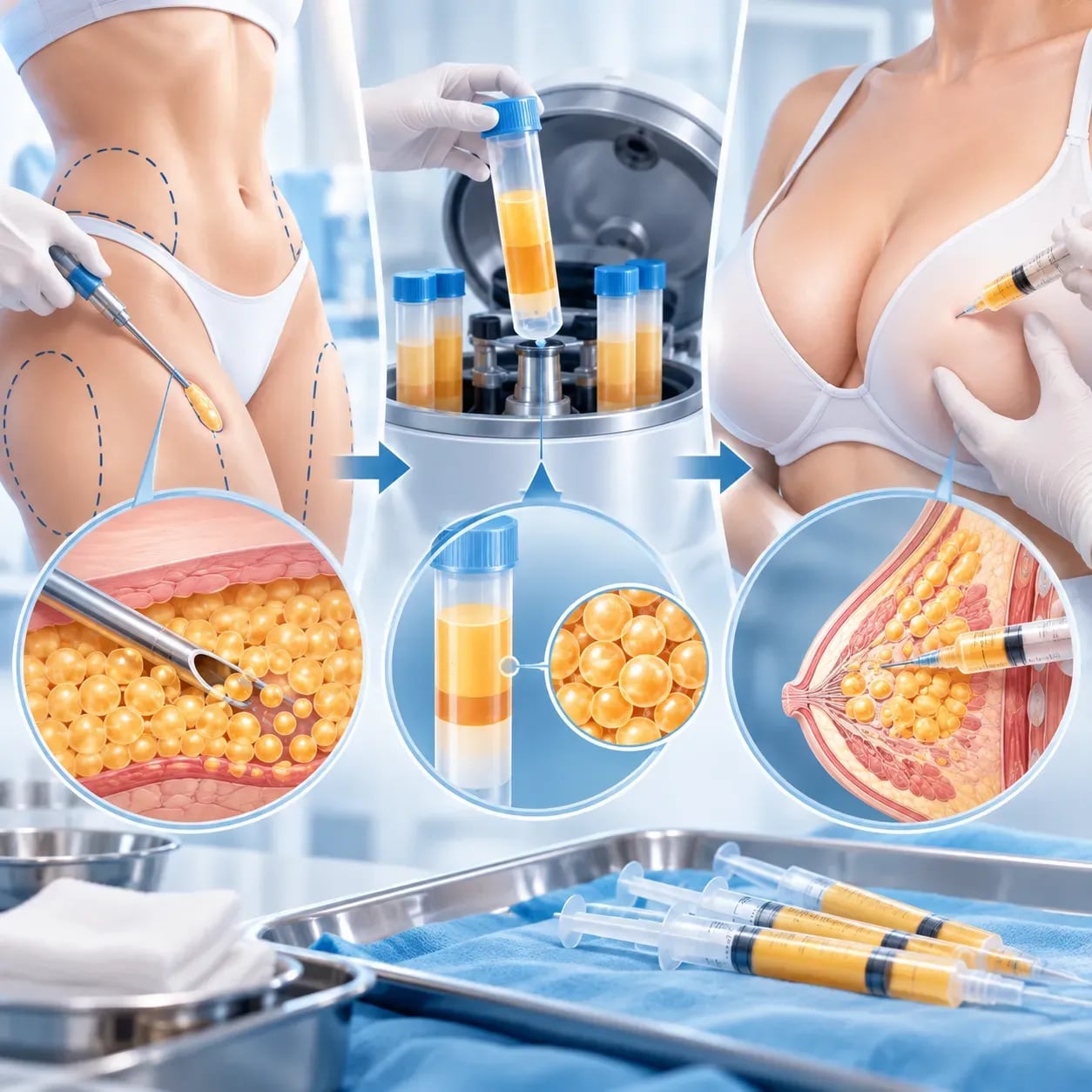
Breast fat transfer — also called lipofilling, fat grafting, lipomodelling or natural breast augmentation — rebuilds breast volume using your own fat. It has three stages, performed in one operation under general anaesthesia, lasting two to three hours.
| Stage | What happens |
| 1. Harvest | Fat is removed by liposuction from an area where there is a surplus — abdomen, hips, flanks or thighs. The entry points are a few millimetres long. |
| 2. Purification | The harvested fat is processed to separate the living fat cells from blood, fluid and oil. Only the usable fraction is kept, which is why the volume injected is smaller than the volume removed. |
| 3. Reinjection | The fat is placed in the breast in many small deposits, spread across several planes, so that each one sits close to a blood supply and can survive. |
That third stage is where the operation is won or lost. Fat injected in large pockets does not get a blood supply fast enough: the centre dies and forms a firm nodule or an oil cyst. Fat injected in fine droplets across different depths survives better and feels normal. This is the whole reason the operation takes two to three hours rather than forty minutes, and the reason it costs more than an implant.
You stay one night in hospital for monitoring after the general anaesthetic, and a total of five days in Tunisia.
How much volume will I actually gain?
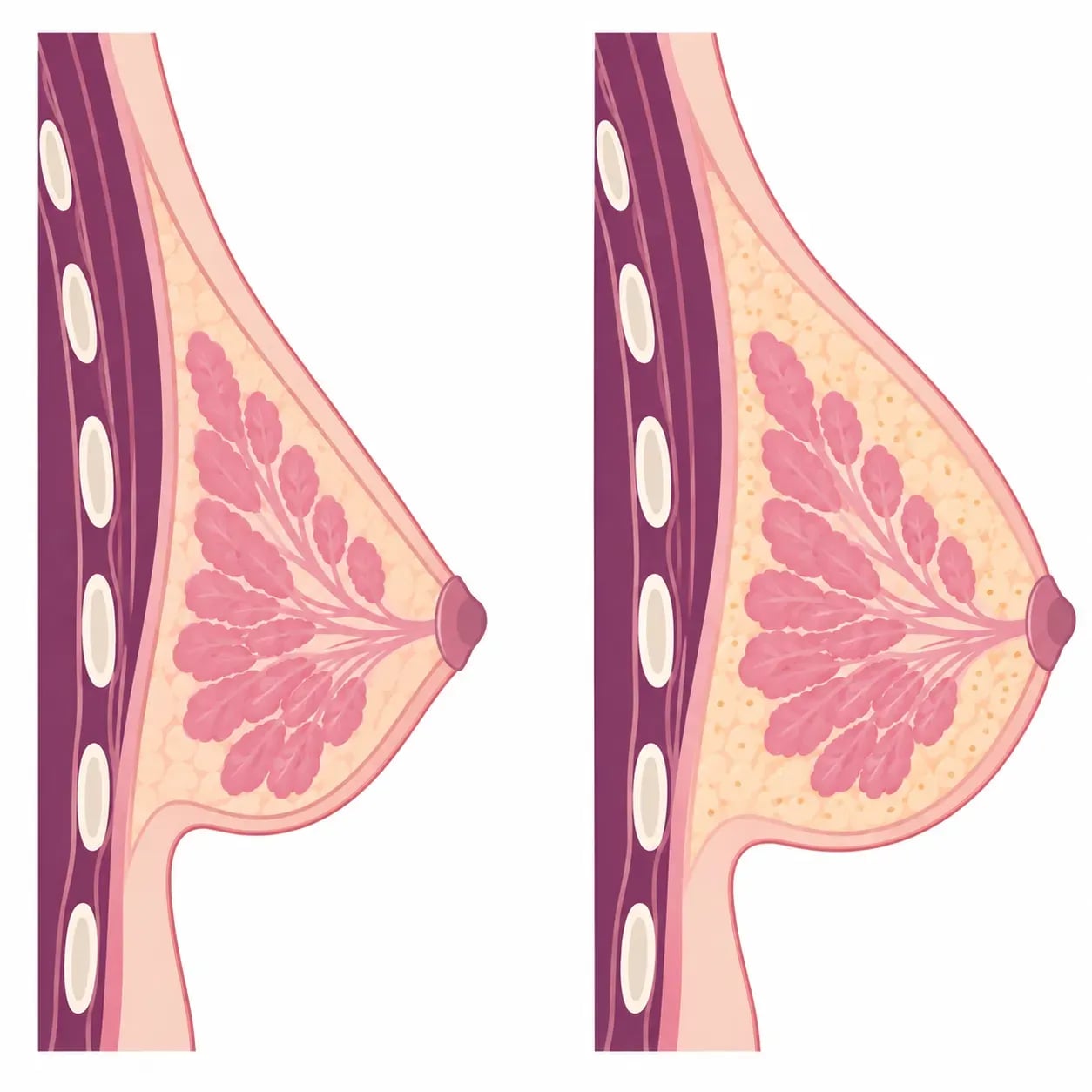
One to two cup sizes. That is the honest range, and it is the single most important number on this page.
Two things limit it. The first is how much fat can be injected into a breast in one operation while still giving every droplet a blood supply — push past that and you get necrosis, not volume. The second is resorption: around 60 to 70% of the transferred fat typically survives, and that figure varies from one woman to another. Nobody can tell you in advance where you will fall.
So the sequence looks like this. You wake up noticeably fuller than you expected, because of swelling and because your surgeon deliberately over-corrected. Over the following weeks the swelling goes and some of the fat is reabsorbed. At three to six months, what is left is what you have.
Which leads to the two mistakes patients make. Judging the result at two weeks — you are looking at swelling. And assuming one session will reach the target — for a modest increase it usually does, for an ambitious one it often does not.
What fat transfer gives you that an implant cannot is the way it behaves: it is your tissue, so it feels like breast, moves like breast, and has no edge to find. What an implant gives you that fat cannot is a volume you choose precisely and obtain in one operation. Neither is better. They answer different questions.
One consequence worth planning for: because transferred fat is body fat, significant weight loss afterwards will reduce it. Reach a weight you can hold before the operation, not after.
Where does the fat come from?
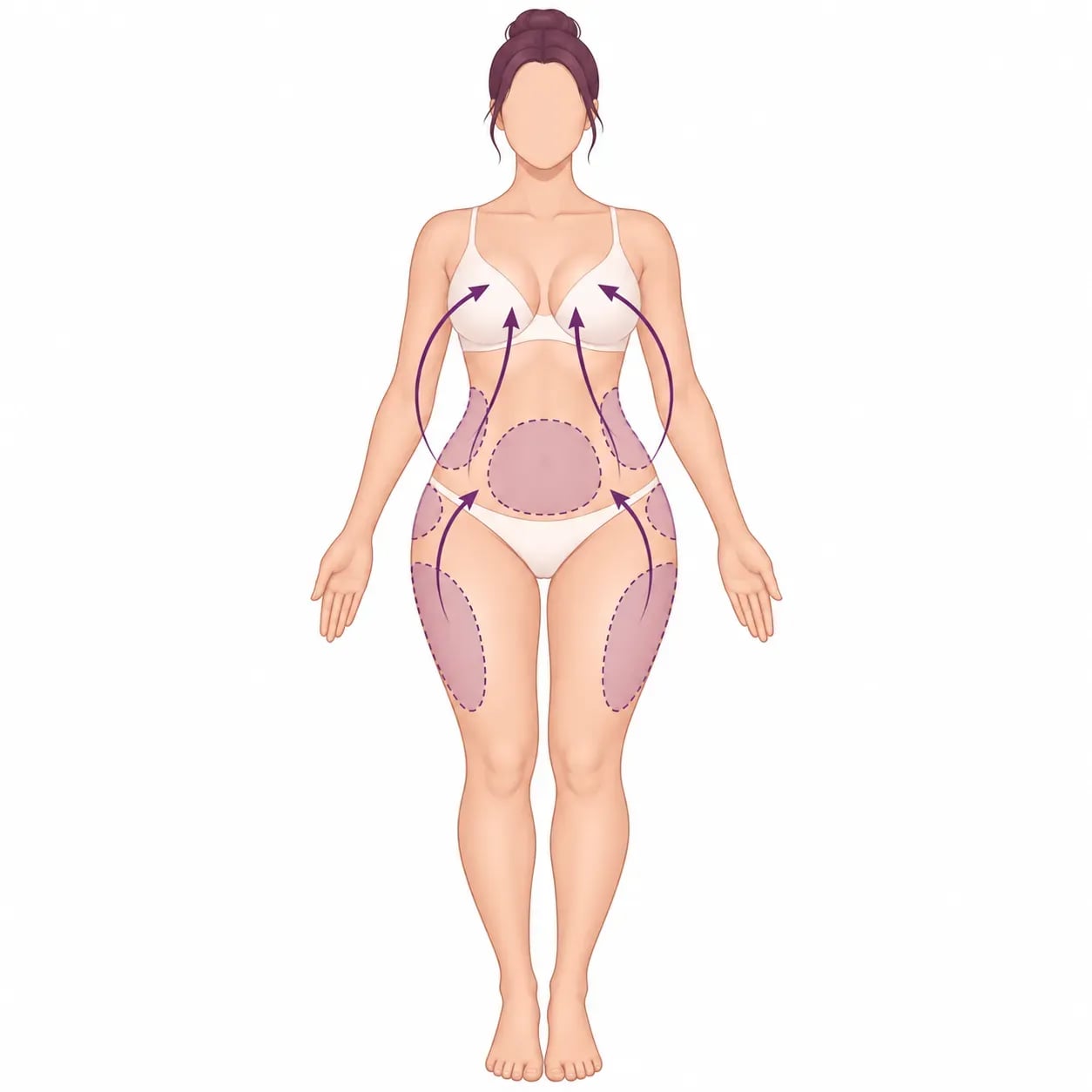
From wherever you have a surplus: most often the abdomen, hips, flanks or thighs. Your surgeon chooses at the consultation, based on where the fat is and how it behaves, not on where you would most like it gone.
This is the part of the operation patients underestimate, in both directions. It is a real liposuction, with real bruising and several days of heavy, aching discomfort — and for most women the donor area is more uncomfortable afterwards than the breasts. But it is also a genuine second benefit: the waist, hips or thighs are slimmer, and the overall change in silhouette is often what people notice first.
Two practical consequences for planning.
- You need enough fat to harvest. Not a great deal, but enough. A very slim woman may not have it, and no amount of good technique compensates for an empty donor area. This is assessed in person, not from a photograph.
- Do not gain weight to create a donor area. The fat transferred comes from a body that is about to change, and when you return to your usual weight the breast volume goes with it. Arrive at a weight you can hold.
Tell your surgeon about any previous liposuction and where, because it changes which areas are usable.
If reshaping the body is as much the point as the breasts, read our pages on tummy tuck and thigh lift in Tunisia — what can be combined in one session is decided by your surgeon.
Are you a candidate for breast fat transfer?
The procedure suits a woman in good health, at a stable weight, who wants a moderate and natural increase without an implant, and who has enough fat to harvest. If that describes you, it is likely to be the right operation. If it does not, it is better to know now than after a flight.
| If this is you | What usually fits better |
| You want a large increase, or a precisely chosen size and shape | Breast implants, which deliver a chosen volume in one operation |
| Your breasts have dropped rather than emptied | A breast lift, which repositions tissue; fat adds volume but lifts nothing |
| You are very slim with little fat to harvest | Implants, or a reassessment later if your weight changes |
| You have both: emptied and dropped | A lift with fat transfer in the same operation — see the section below |
The procedure is postponed or ruled out in the following situations, each assessed individually by the surgeon and the anaesthetist:
- Unstable weight, or weight loss still in progress
- Pregnancy or breastfeeding
- Active smoking, which constricts the small vessels the grafted fat depends on to survive
- Any breast finding that has not been investigated
- A clotting disorder, or treatment with anticoagulants
- Any condition that contraindicates general anaesthesia
A personal or family history of breast cancer must always be declared, along with any ongoing surveillance and any previous breast surgery. This is not automatically a refusal, and you should not assume it is. It means your file is assessed with that history in front of the surgeon, it may change what imaging is required before the operation, and it may change the answer. Bring the reports rather than a summary from memory.
How much does breast fat transfer cost in Tunisia?
€2,700 at ServiHealth, with a 5-day stay including one night in hospital. Combined with a breast lift, €2,850.
What the price covers: the consultations with the surgeon and the anaesthetist, the harvest, purification and reinjection of the fat, the anaesthesia, the hospital stay, the compression garment, the support bra, the transfers, and the follow-up after you return home.
What it does not cover: flights, accommodation for the nights outside hospital, and the pre-operative tests, which you have done in your own country around fifteen days before.
Two things to factor in that are not on any price list. A possible second session, which means another trip — not needed by everyone, but if you are aiming for the upper end of what fat transfer can give, price two before you commit to one. And a second support bra, so you can alternate while one is washed.
On the comparison with implants: fat transfer costs slightly more, and the reason is operating time rather than materials. Harvesting, purifying and reinjecting fat in thousands of small deposits takes two to three hours; placing an implant does not. You are paying for the technique that makes the fat survive.
| Procedure | Price | Stay |
|---|---|---|
| Breast fat transfer | 2700 € | 5 days |
| Breast lift with fat transfer | 2850 € | 5 days |
Fat transfer or implants?
Neither is better. They answer different questions, and the right one depends on how much volume you want and how you feel about having a device in your body.
The honest summary is this. Implants give you a volume you choose, in one operation, reliably. The cost is a manufactured device that carries its own risks, including capsular contracture, and that is generally replaced at around ten to fifteen years. Fat transfer gives you one to two cup sizes of your own tissue, with no foreign body, no replacement schedule and a slimmer donor area. The cost is a smaller gain, a result you cannot specify precisely in advance, and the possibility of a second session.
Three things that tip the decision in practice:
- How much you want. Above two cup sizes, fat transfer is the wrong tool and no technique changes that.
- Whether you want to be done. Implants are one operation with a known endpoint; fat transfer may be one trip or two, and the answer only arrives at six months.
- What happens in twenty years. Implants will need attention at some point — see breast implant replacement and removal in Tunisia. Fat that has survived does not need replacing, but it does respond to weight change, pregnancy and the menopause.
There is also a third option: implants and fat together, where the fat softens the upper edge of the implant. Whether that applies to you is a surgical judgement made at the consultation.
Read our page on breast augmentation with implants in Tunisia for what the implant route involves.
| Breast fat transfer | Breast implants | |
|---|---|---|
| Volume gained | Moderate: one to two cup sizes | Large, and precisely chosen |
| Material | Your own fat | A silicone implant |
| Scars | Only the liposuction entry points | Depends on the incision used |
| Implant-specific risks | None: no foreign body | Capsular contracture, replacement at 10–15 years |
| Secondary benefit | The donor area is slimmed | None |
| Result known | At three to six months | Immediately, once swelling settles |
| Second session | Sometimes needed | Not applicable |
Can it be combined with a breast lift?
Yes, and it is one of the most useful combinations in breast surgery, because it treats the two problems that usually arrive together.
A breast that has changed after pregnancy, breastfeeding or weight loss has often both emptied and dropped. Volume alone fills a breast that is still sitting too low. A lift alone raises a breast that is still empty at the top. Together, the lift repositions the breast and the fat restores the fullness, in one theatre session, under one anaesthetic.
At ServiHealth the combined procedure is €2,850 with the same 5-day stay — €150 more than fat transfer alone, which is considerably less than two separate trips.
The trade-off is scars. Fat transfer alone leaves only the small liposuction entry points. A lift leaves a scar whose pattern depends on how much skin has to be removed, and that is a real decision rather than a detail. Your surgeon will show you where it goes before you agree to anything.
Read our page on breast lift in Tunisia. Whether a lift, fat transfer, or both is right for you is decided at the consultation, after an examination.
Your pathway, step by step
ServiHealth organises and coordinates the stay. The medical decisions belong to the surgeon and the anaesthetist; everything around them is our work.
| Stage | What happens |
| First contact | You send photographs, your medical history and any breast imaging you already have. A first review is carried out remotely and we tell you whether the procedure appears appropriate before you spend anything. |
| Quote | A written quote setting out what is planned, what the price covers and what it does not. |
| Preparation | Pre-operative tests around 15 days before surgery, in your own country, following the protocol you are given. Breast imaging according to your age and history, so there is a baseline on file. Dates and flights fixed. |
| Arrival | You are met at Tunis-Carthage airport and taken to your accommodation. Send us your boarding pass and a photograph of what you are travelling in, so we can find you quickly. |
| Consultation | Examination by the surgeon, assessment of your donor areas and of the realistic volume, and the anaesthetic consultation. The plan is confirmed, adjusted or reconsidered here. |
| Procedure | Two to three hours under general anaesthesia at the Clinique Internationale Myron. |
| One night in hospital | Monitoring after the general anaesthetic. The compression garment and support bra are fitted. |
| Rest of the stay | Post-operative checks before you fly home. Five days in total. |
| After you return | Remote follow-up, with a contact you can reach. The result is reviewed at three to six months, which is when a second session is discussed if it is needed at all. |
Tell us straight away about anything affecting the journey — a delayed flight, a changed booking, a missed connection, lost luggage. Nearly all of it is easy to absorb if we know in time.
And expect the consultation to be able to change the plan. A surgeon who examines you may recommend a different volume, a lift as well, or in some cases a different operation. That is the consultation working. The remote review is a first opinion from photographs, not a diagnosis.
Is breast fat transfer safe? Risks and precautions
It is a well-established operation, performed under general anaesthesia, and it carries real risks. They belong on the page, not in a conversation you have after you have paid.
Risks common to any surgery: haematoma, infection, and complications of general anaesthesia.
Risks from the liposuction side: contour irregularities at the donor area, bruising, temporary loss of sensation, and fluid collection.
Risks from the transferred fat:
- Resorption greater than expected. The commonest disappointment, and the reason a second session exists as an option.
- Asymmetry. Fat does not always survive equally on both sides.
- Fat necrosis and oil cysts. This is the complication specific to the operation. Fat that does not establish a blood supply can die and form a firm nodule or a fluid-filled oil cyst. These are usually benign. Injecting in fine droplets rather than large pockets is what reduces the risk, and it is most of the reason the operation takes two to three hours.
Treat any new lump as something to have examined, not as something to explain away. A nodule after fat transfer is usually fat necrosis. Usually is not always, and the only way to know is to have it looked at by someone who knows you have had this operation. That is not a reason to worry; it is a reason to keep your surgeon's report and show it.
Smoking deserves its own line. Nicotine narrows the small vessels that grafted fat depends on to stay alive. It raises the complication rate and lowers the proportion of fat that survives. Stopping for the period your surgeon specifies is the single most effective thing you can do for your own result.
Declare, in full: any personal or family history of breast cancer, any ongoing breast surveillance, any previous breast surgery, all medication including anticoagulants, and all allergies.
Calcifications and mammograms: what you need to know
This is the section to read twice, because it concerns the rest of your life rather than the next six months.
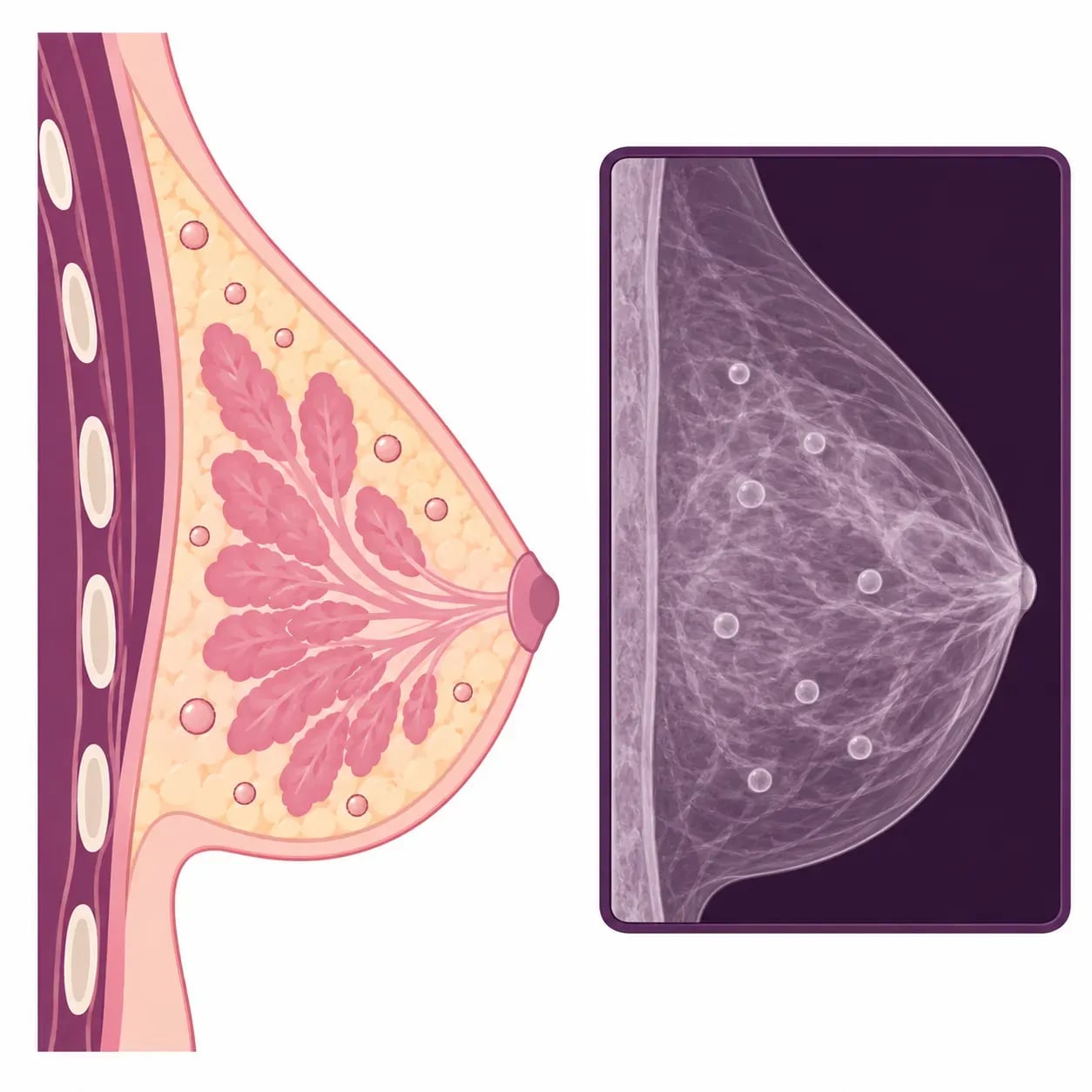
In a minority of cases, fat that does not survive leaves behind small oil cysts or micro-calcifications. They are generally benign. They can appear on a mammogram months or years after the operation, long after you have stopped thinking about it.
A radiologist who knows you have had breast fat transfer can usually recognise these for what they are. A radiologist who does not know is looking at calcifications in a breast with no explanation for them — which means further imaging, possibly a biopsy, and a frightening few weeks that were avoidable.
So three things, and none of them is optional:
- Have breast imaging before the operation, according to your age and history. It gives you a baseline, and a baseline is what makes every future comparison easy.
- Keep your operative report and your pre-operative imaging, somewhere you will still find them in ten years. Not in an inbox.
- Tell every radiologist, every time. At every mammogram, ultrasound or MRI, for the rest of your life, say that you have had fat transfer to the breast and when. It takes one sentence.
This matters more, not less, when you have surgery abroad: your records are not automatically in the system your screening programme uses. Carry them with you.
None of this means fat transfer interferes with breast cancer screening in a way that should put you off. It means the imaging has to be interpreted with the information, and you are the person who supplies it.
Pregnancy and breastfeeding afterwards
Breastfeeding generally remains possible. The fat is placed around the gland rather than within it, and the milk ducts are not cut or moved. This is one of the clearer advantages of fat transfer over operations that go through the gland.
A pregnancy will, however, change the result. The breasts enlarge and then change again after breastfeeding, and the transferred fat behaves like the rest of your body fat throughout. The volume you end up with afterwards may not be the volume you had before. That is not a complication; it is what breasts do.
So if you are planning a pregnancy in the near future, it is reasonable to wait. Not because the operation would harm anything, but because you would be paying for a result that is about to be rewritten.
The operation itself is postponed during pregnancy and breastfeeding, with an interval after you stop before the breasts are stable enough to assess and operate on. Your surgeon sets that interval.
And the point from the previous section applies here too: mention the fat transfer at any breast imaging during or after pregnancy, when the breast is changing and images are harder to read than usual.
How long is recovery?
About a week before you are back to work without physical effort, and four to six weeks before sport. The result keeps evolving for three to six months.
The thing nobody warns you about: you are recovering from two operations in two places. The breasts feel tight and tender. The donor area — abdomen, hips, flanks or thighs — feels like severe muscle ache, and for most women it is the more uncomfortable of the two for the first several days. Prescribed painkillers are generally enough for both.
| When | What to expect |
| Night of surgery | One night in hospital for monitoring. Compression garment on the donor area and support bra fitted. |
| Days 2–5, in Tunisia | Swelling and bruising in both areas. Walking from the first day. Post-operative checks before you fly home. |
| Around 1 week | Back to work, provided it involves no physical effort. The donor area is still the sorer of the two. |
| Several weeks | Compression garment and support bra worn as instructed. No pressure, impact or bouncing on the chest. |
| 4–6 weeks | Sport resumes, on your surgeon's advice. |
| 3–6 months | Volume stabilises. This is the result, and the point at which a second session is discussed if needed. |
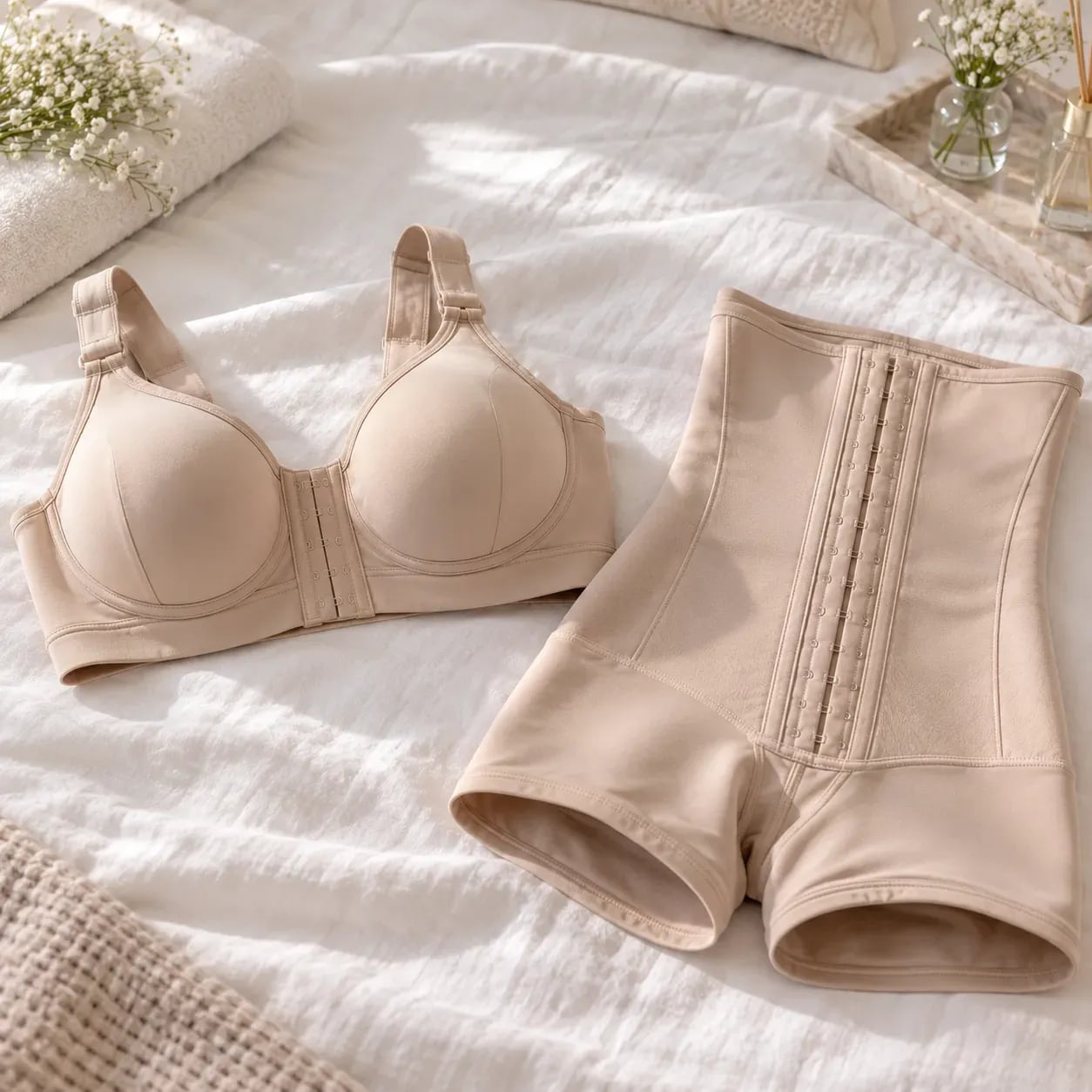
Wear the compression garment and the support bra for as long as you are told. This is not comfort advice. In the early weeks the transferred fat is establishing a blood supply, and pressure, impact and movement are exactly what prevents that. The bra is part of the operation, not an accessory to it.
Pack a second support bra so you can alternate, and clothes that open at the front, with something loose over the donor area.
Will I need a second session?
Not everyone does, and it is better understood as a normal part of the method than as a failure.
There are two reasons it exists. Only so much fat can be transferred safely in one operation before the deposits are too crowded to survive. And part of what is transferred is reabsorbed, in a proportion that varies between patients and cannot be predicted in advance.
So the rule is simple: a second session is discussed only once the result has fully stabilised, at three to six months, and only if the result is below what you wanted. Never before. Adding fat to a breast that is still resorbing means operating on a moving target.
What a second session needs: another trip, another general anaesthetic, and enough remaining donor fat — which is worth checking at the first consultation if you already suspect you will want one.
And the arithmetic worth doing before you book the first operation, not after. If your target is at the upper end of what fat transfer can give, add up two sessions, two sets of flights and two sets of time off, and compare that with implants in one operation. Sometimes fat transfer is still the answer, because you want your own tissue and no device. Sometimes the honest answer is that implants fit the goal better. Make that comparison with real numbers.
Your surgeons
Breast fat transfer at ServiHealth is performed by qualified plastic surgeons at the Clinique Internationale Myron in Tunis.
- Dr Taher Djemal — plastic and aesthetic surgery, practising in Tunisia since the early 1990s, with a particular interest in structural fat grafting.
- Dr Abir Ben Ouaghrem — plastic and aesthetic surgery, with particular attention to assessing the donor reserve and the volume that is realistically achievable.
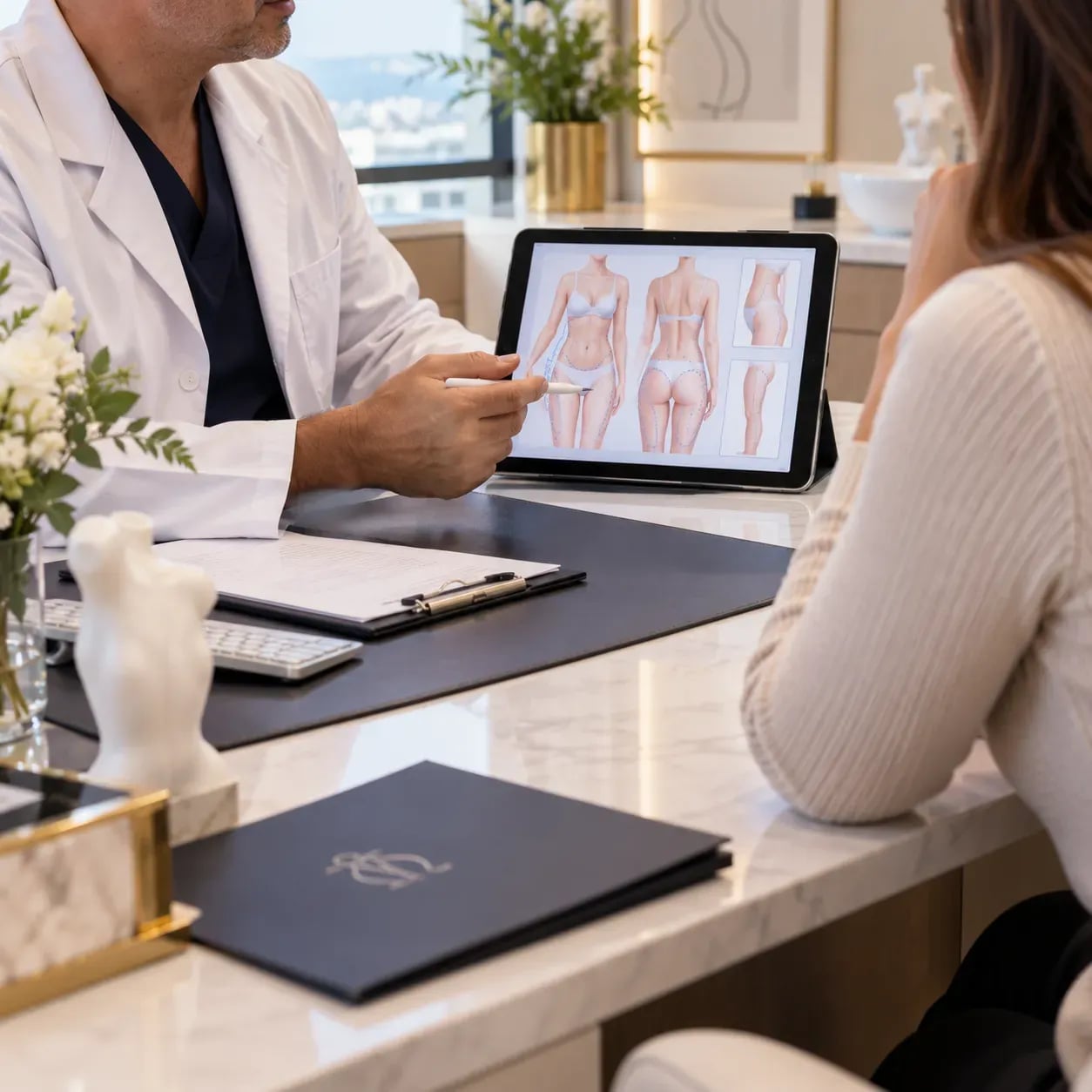
The surgeon assigned to your case is named in your quote before you travel, and you meet them in person before anything is decided.
Questions worth asking at that consultation, because the answers tell you more than any gallery:
- Looking at my donor areas, what volume do you expect to achieve in one session?
- What proportion of it do you expect to remain?
- Would you recommend a lift as well, and if so why?
- What would make you advise against operating on me?
- If I want a second session at six months, how is that arranged from abroad, and what does it cost?
A surgeon who answers the fourth question readily is usually the one you want. What to do, how much, and whether to operate at all is a medical decision and belongs to them, not to ServiHealth.
Why have breast fat transfer in Tunisia?
Tunisia has run an organised medical travel sector for decades: private clinics built around international patients, surgeons trained to European standards, and costs that reflect Tunisian overheads rather than shortcuts in the operation.
What matters specifically for a patient flying in for this procedure:
- Distance. Two to three hours from most of Western Europe, with direct connections from several Gulf hubs. Short enough that the flight home, five days after a general anaesthetic, is manageable.
- One night in hospital, then supervision. You are not discharged into a hotel on the day of a general anaesthetic, and the post-operative checks happen before you fly rather than by message afterwards.
- English throughout. ServiHealth coordinates in English from the first exchange to the follow-up after you are home.
- Cost. The difference is where the clinic operates, not what is left out.
Three things to weigh honestly before deciding, because they are specific to this operation rather than to Tunisia:
- The result is judged at six months, from home. Ask before you travel what happens at that point if the volume is below target, who you speak to, and what a second session costs. Get it in writing.
- A lump at month four is dealt with where you live. Know who you would call, and keep your operative report accessible.
- Your records need to travel with you. Your national screening programme will not automatically hold a Tunisian operative note. Bring it home and keep it.
Many patients combine procedures in one stay. That is sensible when the combination is surgically coherent and poor when it is driven by the travel budget. Your surgeon decides what can reasonably be done in one session.
Before you travel: a checklist
Work through this before you book, not the week before you fly.
| Category | What to do |
| Documents | A valid passport, and a visa if your nationality requires one for Tunisia. Check the expiry date. |
| Photographs | Recent photographs, front and profile, plus the areas you expect the fat to be taken from. |
| Breast imaging | A recent mammogram or ultrasound, according to your age and history. Bring the images and the report, and keep them afterwards — they are your baseline for every future scan. |
| Breast history | Any personal or family history of breast cancer, any ongoing surveillance, and any previous breast surgery. Bring the reports, not a summary from memory. |
| Medication and allergies | A full list, anticoagulants included. Follow your surgeon's instructions on what to stop and when. |
| Pre-operative tests | Completed around 15 days before surgery, in your own country, following the protocol you are given. |
| Weight | Stable for several months, with no strict diet in the preceding weeks. Do not gain weight to create a donor area. |
| Smoking | Stop for the period your surgeon specifies. It directly affects how much fat survives. |
| Donor areas | Think about which areas you would like slimmed, and mention any previous liposuction. The surgeon confirms what is usable. |
| To pack | The compression garment and support bra are provided — bring a second support bra so you can alternate. Front-opening tops, and loose clothing over the donor area. |
| Your calendar | Around a week after you return with no demanding activity, and nothing that presses on the chest. Sport waits four to six weeks. |
Considering more than one procedure in the same stay? Read the relevant pages first: breast lift, breast augmentation with implants, implant replacement and removal or tummy tuck in Tunisia. What can reasonably be combined in one session is decided by your surgeon.








Frequently asked questions about Breast Fat Transfer in Tunisia
Yes, but modestly. The realistic gain is one to two cup sizes, and part of the transferred fat is reabsorbed over the first months. If you want a large, precisely chosen increase, implants do that and fat transfer does not. If you want a natural, moderate increase with no foreign body, this is the operation designed for it.
€2,700 at ServiHealth, with a recommended 5-day stay including one night in hospital. Combined with a breast lift it is €2,850. The price covers the consultations with the surgeon and the anaesthetist, the harvest, purification and reinjection of the fat, the anaesthesia, the hospital stay, the compression garment, the support bra, transfers and remote follow-up. Flights, accommodation and the pre-operative tests are not included.
Because it is two operations in one. The fat has to be harvested by liposuction, processed, and then reinjected in thousands of small deposits — which takes considerably longer in theatre than placing an implant. You are paying for operating time and technique, not for a more expensive material: the material is your own.
It can make them harder to read if nobody tells the radiologist. Fat that does not survive can leave small oil cysts or micro-calcifications that show up on imaging months or years later. They are usually benign, and an experienced radiologist can distinguish them from something that needs investigating — but only if they know you have had fat transfer. Tell them every single time, for the rest of your life, and have breast imaging before surgery so there is a baseline to compare against.
Women who are very slim and have too little fat to harvest; women who want a large or precisely sculpted increase; and women whose main problem is sagging rather than volume, for whom a lift is the relevant operation. The procedure is also postponed or ruled out with unstable weight or ongoing weight loss, pregnancy or breastfeeding, active smoking, an unexplained breast finding, a clotting disorder or anticoagulant treatment, and any condition that contraindicates general anaesthesia. Your surgeon decides.
Implants give a large, precisely chosen volume and need replacing at around ten to fifteen years; they carry implant-specific risks such as capsular contracture. Fat transfer gives one to two cup sizes using your own tissue, leaves only the small liposuction entry points, introduces no foreign body, and slims the donor area as a secondary benefit. It costs slightly more and may need a second session.
Five days, including one night in hospital for monitoring after the general anaesthetic. That covers the consultation with the surgeon and the anaesthetist, the procedure, and the first post-operative checks before you fly home.
Generally yes. The fat is placed around the gland rather than in it, and the milk ducts are not touched, so breastfeeding usually remains possible. A pregnancy can change the volume you obtained, as it changes fat everywhere else in the body. The procedure itself is postponed during pregnancy and breastfeeding, with an interval after you stop. Mention the fat transfer at any breast imaging during or after pregnancy.
Less than most patients expect in the breasts, and more than they expect at the donor area. The chest feels tight and tender; the abdomen, hips or thighs where the fat was taken feel like heavy muscle ache for several days. Prescribed painkillers are generally sufficient for both.
Possibly, and it is worth planning for from the start rather than discovering later. There is a limit to how much fat can be transferred safely in one operation, and part of it is reabsorbed. A second session is discussed only once the result has fully stabilised, at three to six months, and it requires another trip and enough remaining donor fat. If you are aiming for a large increase, compare the total cost of two sessions against implants before you decide.
Sometimes. Fat that does not establish a blood supply can form a firm nodule or an oil cyst. These are usually benign, but any new lump in a breast should be examined rather than assumed — and your doctor needs to know you have had fat transfer so it can be assessed in that context. Do not self-diagnose a lump as a fat cyst.
Work without physical effort is usually possible after about a week. Sport comes back at four to six weeks, on your surgeon's advice. Avoid anything that compresses or bounces the chest in the early weeks, because the transferred fat needs to establish a blood supply undisturbed.
The fat that survives the first three to six months becomes living tissue and stays. It is not frozen in time: it behaves like the rest of your body fat and responds to weight gain, weight loss, pregnancy and the menopause. A stable weight is what keeps the result stable.
It is sometimes possible — fat can be used around existing implants to soften an edge or improve the upper pole, and it is also used when implants are removed and you want some volume back. Whether it applies to you depends on your implants, your tissue and what you are trying to achieve, and it is a decision for the surgeon at the consultation. If your plan is to remove or change your implants, read our page on breast implant replacement and removal in Tunisia.