

Breast lift in Tunisia: your ptosis grade, your scar, your price

Breast lift in Tunisia: the essentials
A breast lift — mastopexy — repositions a breast that has descended. The surgeon removes the excess skin, reshapes the gland and moves the nipple and areola back up, keeping them attached to the breast on their own pedicle throughout.
One sentence prevents most of the disappointment in this operation: a lift moves the breast, it does not fill it. If what you miss is fullness at the top, lifting alone will give you a higher breast that is still empty where you were looking. That is why implants and fat transfer exist as options on this page, and why section two is worth reading before the price.
Surgery is carried out by Dr Taher Djemal and Dr Abir Ben Ouaghrem at the Clinique Internationale Myron in Tunis.
| Operating time | 1 hour 30 to 3 hours |
| Anaesthetic | General |
| In hospital | One to two nights |
| Recommended stay in Tunisia | 5 days |
| Surgical bra | Worn continuously for several weeks |
| Back to non-physical work | 1 to 2 weeks |
| Sport | 4 to 6 weeks, on the surgeon’s advice |
| Scars fade | Around 12 months |
| Price | From €2,400 |
Lift or augmentation: what is the difference?
These two operations are confused more often than any other pair in cosmetic surgery, and choosing wrongly is expensive.
- A lift changes shape and position. It removes excess skin and raises the breast and the nipple. It does not change volume.
- An augmentation adds volume, with an implant or with your own fat. It does not raise a breast that has descended.
Where there is both descent and a loss of volume — which is the commonest situation after pregnancy or weight loss — the two are combined in a single operation, a mastopexy-augmentation. That is what the €2,750 and €2,850 options on this page are.
How to tell which you need
Stand in front of a mirror. If the breast is in the right place and simply smaller or flatter than you want, see breast augmentation. If the volume is there but sitting low, you need a lift. If you are looking at an empty upper pole on a breast that has also dropped, you need both — and being told that honestly is better than paying for half of it.
What grade of ptosis do you have?
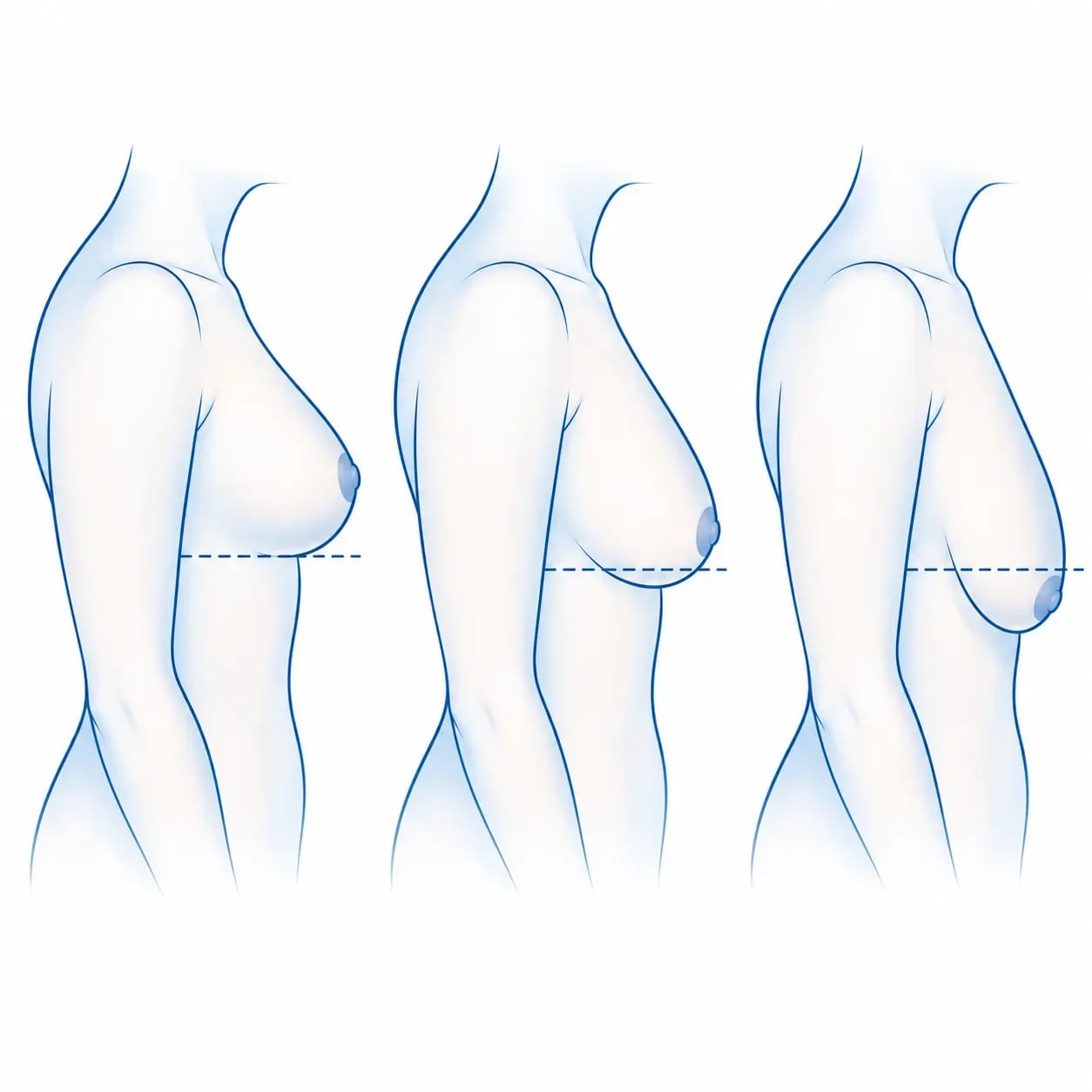
Surgeons grade ptosis by where the nipple sits relative to the inframammary fold — the crease under the breast. It is the single measurement that determines your technique, your scar and the quote you receive, and you can work it out in a mirror before you even enquire.
Stand upright, relaxed. Find the crease under the breast. Then see where the nipple is in relation to it.
Grade I usually means a short-scar technique is possible — and sometimes that surgery is not justified at all. Grade III means a longer scar, and the surgeon will not pretend otherwise. Between the two, the rule is simple: the surgeon uses the least invasive technique compatible with the grade found at examination, not the one requested from a photograph.
| Grade | Where the nipple sits | What it looks like |
|---|---|---|
| Grade I (mild) | Level with the inframammary fold | Slight descent |
| Grade II (moderate) | Below the fold, but breast tissue still sits above the nipple | Clear descent |
| Grade III (severe) | Well below the fold, nipple pointing downwards | Marked descent |
Can breasts be lifted without surgery?
Short answer: no. A descended breast cannot be raised without surgery, and it is worth understanding why rather than taking it on trust.
The pectoral muscles sit beneath the breast gland. Training them builds what is underneath; it does not shorten the skin or move the gland. No cream reaches the structures that have stretched, and no non-invasive device has been shown to reverse ptosis. Thread lifts do not give a durable result here and are not an indication for this problem.
There is one honest exception, and it is not a lift. If your breast sits where it should and what bothers you is flatness at the top, that is a volume problem rather than a position problem — and augmentation or fat transfer can address it without any lift scar at all. Work out which of the two you actually have before paying for either.
Which scar, and where
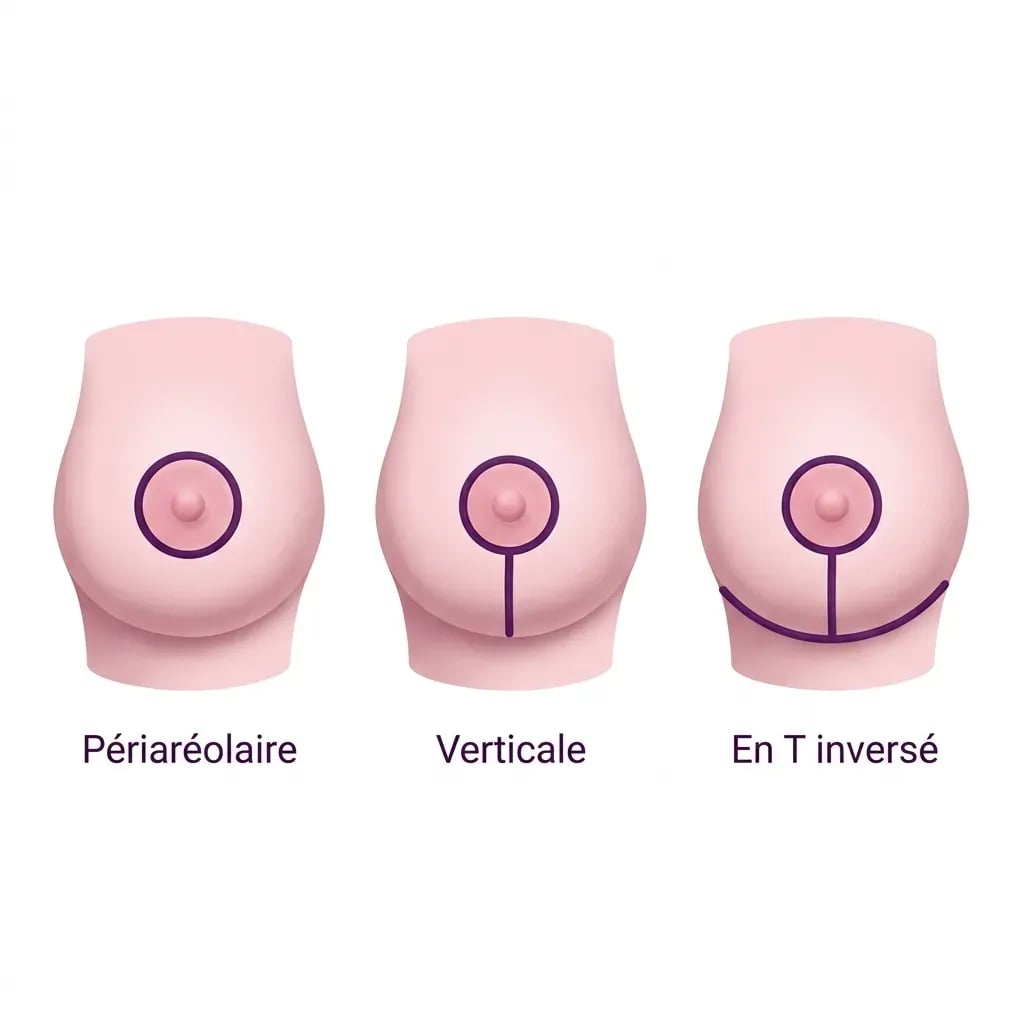
The scar scales with the grade. There is no technique that removes a lot of skin through a small incision, and this is the part of the decision that deserves the most time.
Periareolar — the round-block technique
A scar around the edge of the areola only. For mild ptosis.
Vertical — the lollipop
Around the areola, plus a vertical line down to the fold. For moderate ptosis. This is the most commonly used technique.
Inverted T — the anchor
Adds a horizontal line hidden in the inframammary fold. For marked ptosis, and the usual choice after significant weight loss.
How they behave
All of them are pink at first, then thin and fade over roughly 12 months. The scar around the areola generally becomes the least visible, because it hides at a colour boundary. The vertical limb is the one most likely to widen, because it is under tension.
The scars are permanent. They become discreet; they do not disappear. Tell the surgeon at the consultation if you have ever had a keloid or thickened scar — it changes the recommendation, and occasionally the advice will be against surgery.
Are you a candidate for a breast lift?
Generally suitable
- Good general health, stable weight, and a breast that has descended — most often after pregnancy, breastfeeding, major weight loss, or simply with age.
- A clear understanding that the scars are permanent.
Postponed
- A pregnancy planned, under way, or breastfeeding. Wait until the family is complete and breastfeeding has finished, with a delay afterwards. A later pregnancy can undo the shape.
- Unstable weight, or weight loss still in progress.
- Active smoking — the single most important risk factor here, because of the blood supply to the areola.
Investigated first
- Any breast lump or change that has not been looked at. Imaging will be requested.
- A personal or family history of breast cancer, ongoing surveillance, previous breast surgery or existing implants. Declare all of it at first contact. If you are on a national screening programme, say so — and bring your most recent mammogram or ultrasound if you have one.
- Clotting disorders or anticoagulants; any condition ruling out a general anaesthetic.
A mammogram or ultrasound may be requested before surgery depending on your age and history. That is not an obstacle put in your way; it is the step that makes sure an operation is not carried out over something that needed investigating.
How much does a breast lift cost in Tunisia?
Three options, one five-day stay for all of them.
Included: consultations with the surgeon and the anaesthetist, the operation, the anaesthetic, the hospital stay, the surgical bra, transfers and the follow-up after you go home. Not included: flights, accommodation and the pre-operative tests, which are done where you live about fifteen days beforehand.
The difference between the three is what is added to the lift: nothing, an implant, or your own fat. The lift itself is the same operation in all three cases, which is why the gap between them is smaller than people expect.
One cost that is not on the list and belongs in your thinking: if you choose implants, you are taking on a device that needs long-term monitoring and will eventually need replacing. That monitoring happens where you live, for decades. Budget for it the way you would budget for the operation — and read the implant section below before choosing the €2,750 option because it is only €350 more.
| Procedure | Price | Stay |
|---|---|---|
| Breast lift without implants | €2,400 | 5 days |
| Breast lift with implants | €2,750 | 5 days |
| Breast lift with fat transfer | €2,850 | 5 days |
Choosing your implant
If you add an implant to your lift, four things are decided at the consultation and none of them should be decided by message beforehand.
- Type. Cohesive silicone gel is what is used in almost all cases. Saline implants exist but are rarely offered now.
- Shape. Round gives more fullness at the upper pole; anatomical — teardrop — gives a more gradual slope.
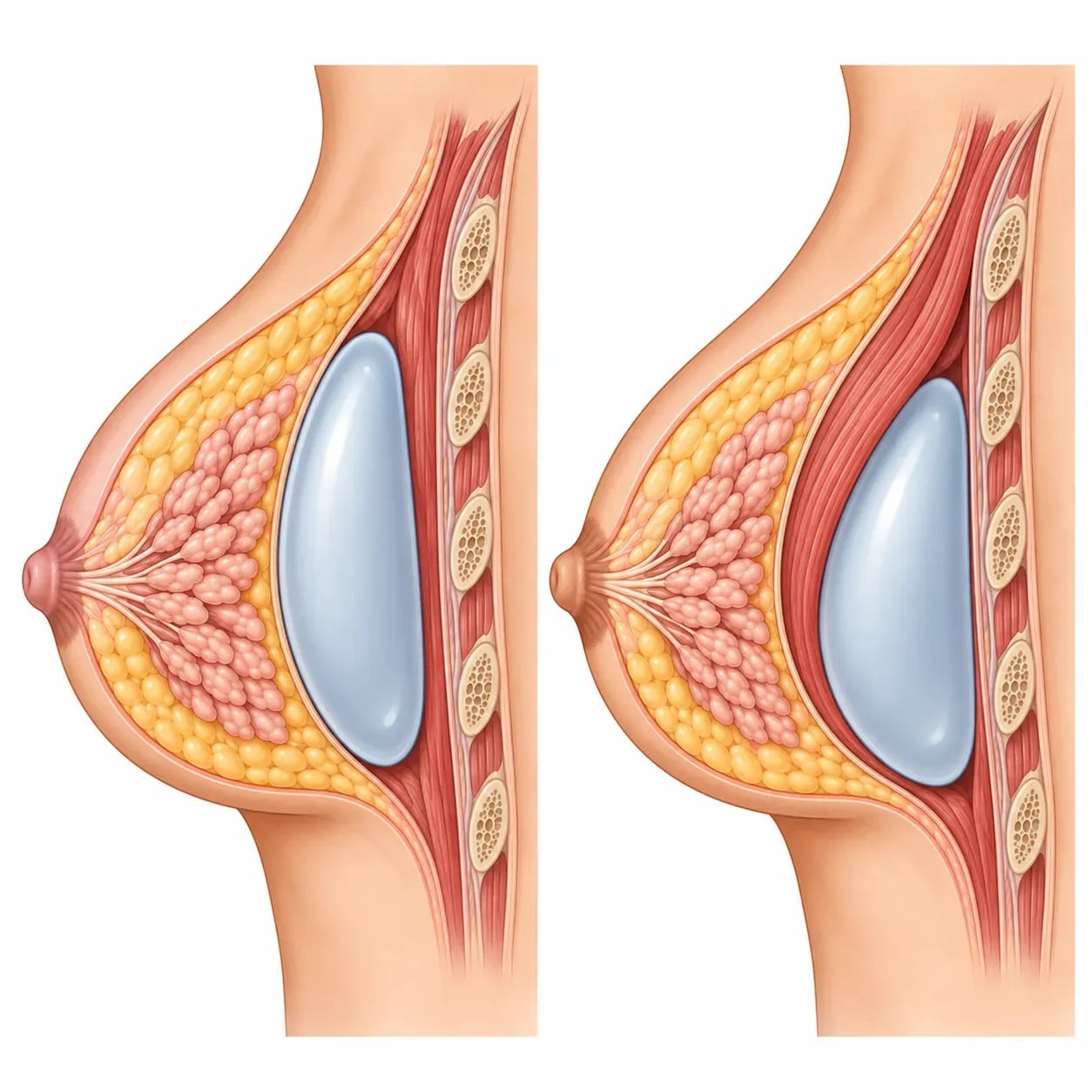
- Position. Retroglandular, under the gland and over the muscle, where you have enough tissue to cover it; or retromuscular or dual plane, under the pectoral, for better coverage when your tissue is thinner. This is decided by pinching your tissue, not by preference.
- Access. The implant goes in through the lift incision you were having anyway. No additional scar is created for the implant.
The part to think hardest about
An implant is a device, and it comes with lifelong consequences: periodic monitoring, imaging that has to account for it, and eventual replacement. You will be managing that where you live, not in Tunis. Ask yourself the same question we ask on every page where something is implanted — who is checking this in year twelve? — and make sure you have an answer before choosing the implant option.
Implants also carry risks of their own, which the surgeon goes through in detail at the consultation. Keep whatever implant documentation you are given; it identifies exactly what was placed, and a doctor anywhere will need it.
Lift with fat transfer: the option without a device
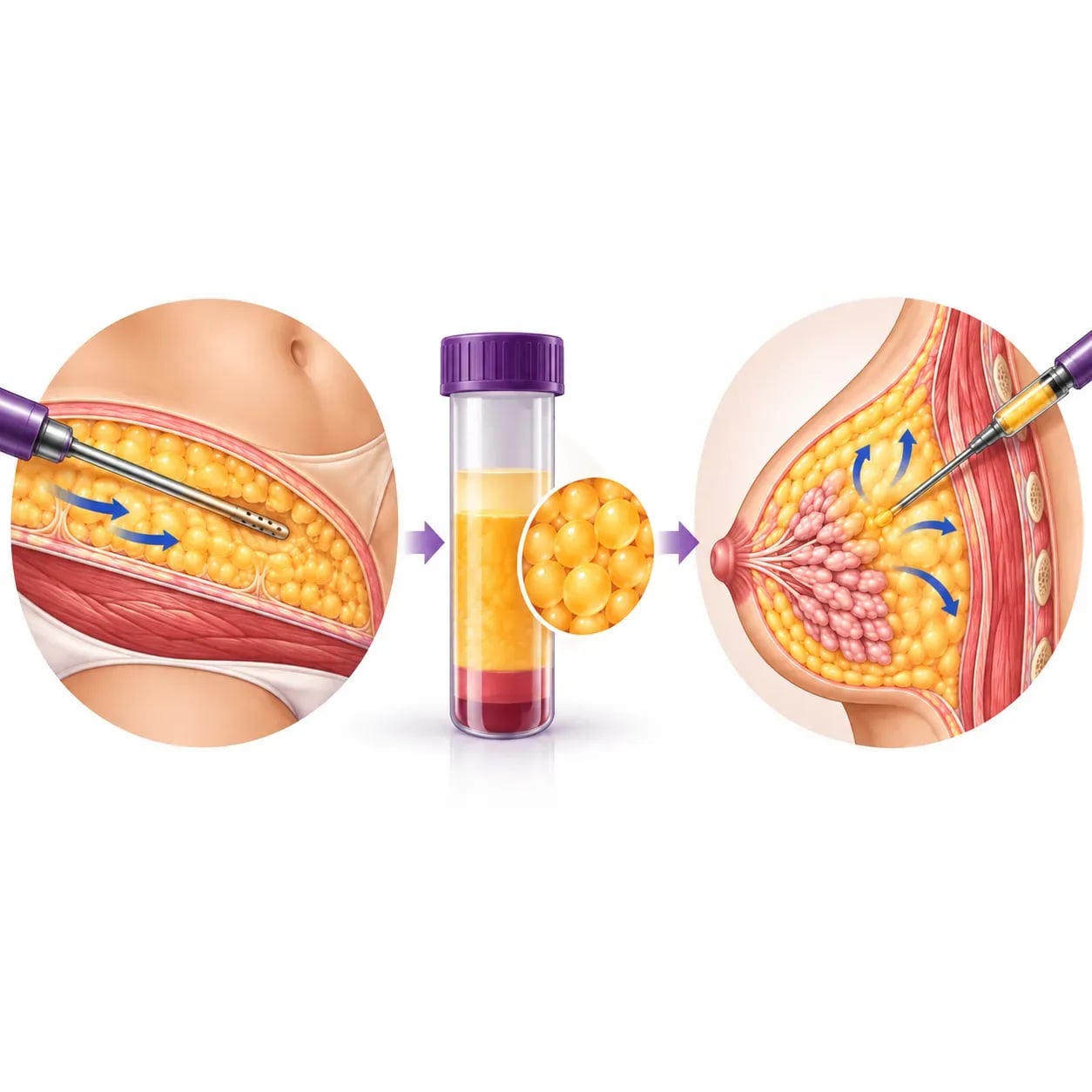
The alternative to an implant: fat taken by liposuction from the abdomen, flanks or thighs and reinjected after the breast has been repositioned. Nothing foreign is placed.
What it gives you
A soft, natural feel, no device to monitor and no replacement scheduled, a slimmer donor area, and harvest incisions of a few millimetres.
What it will not give you
- A part of the fat is reabsorbed in the first months. The final volume is less than the volume injected, and the amount varies between patients — which is why the result is judged at six months, not at six weeks.
- A moderate gain, not several cup sizes. If you want a defined, predictable volume, that is what an implant is for.
- A very slim patient may not have enough fat to harvest.
- The volume moves with your weight. It is your own fat and it behaves like it.
One thing to remember for the rest of your life
Fat transferred to the breast can produce findings on a mammogram. They are recognisable to a radiologist who knows they are there, and confusing to one who does not. Tell every radiologist, every time, that you have had fat transferred to the breast. Put it with your medical records rather than trusting your memory in fifteen years.
See also breast fat transfer on its own.
Your journey, step by step
- Your enquiry. Photographs from the front and the side, by WhatsApp or email, with your history. A first opinion and a personalised quote within 24 to 48 hours. A remote opinion is a starting point, not a diagnosis.
- Preparation. We help with flights and accommodation. Pre-operative tests about fifteen days before; a mammogram or ultrasound depending on your age and history; stop smoking several weeks ahead.
- Arriving in Tunis. A member of the team meets you at Tunis-Carthage with a board showing your name.
- Consultations. Measurements, symmetry, skin quality and your grade. The marking is done standing. The technique — and the implant, if you are having one — is settled here.
- The operation. General anaesthetic, 1 hour 30 to 3 hours. Excess skin removed, the gland reshaped, and the areola repositioned on its pedicle.
- One to two nights in the clinic. The surgical bra goes on at the end of the operation.
- Recovery in Tunisia. Reviews, with the scars and the colour of the areola watched closely — that observation is the reason the stay is five days.
- Home, and follow-up. Healing checked before you fly, then remote follow-up by photograph and video, on the scars in particular, across the first 12 months.

Is a breast lift safe? Risks and precautions
Mastopexy is a well-established operation carried out in an accredited clinic with a dedicated anaesthetic team. The risks worth understanding are specific rather than generic.
Recognised risks
- Haematoma, infection, delayed healing.
- Scars that widen or thicken.
- Residual asymmetry — no two breasts are identical to start with, and they are not identical afterwards.
- Changes in nipple sensation, covered in its own section below.
The rare but serious one
Compromise of the blood supply to the areola. It is uncommon, and smoking makes it markedly more likely. That is the entire reason the surgeon insists on stopping weeks beforehand and watches the colour of the areola during your stay. If you are not going to stop smoking, say so honestly rather than risk this one.
If you choose implants
Implants add their own risks, which are gone through in detail at the consultation. They are the reason the implant option deserves more thought than its €350 difference suggests.
How long is the recovery?
- First days. Swelling and bruising are normal. The discomfort is tightness rather than sharp pain, and it comes as much from not being able to raise your arms as from the breast itself. Prescribed painkillers are enough, and it improves after a few days.
- Several weeks — the surgical bra, without underwiring, worn continuously. Bring a second one so you can alternate while one is washed.
- Several weeks — no lifting and no raising your arms above shoulder height.
- 1 to 2 weeks — back to work that does not involve physical effort.
- 4 to 6 weeks — sport, on the surgeon’s advice.
- Around 12 months — the scars finish fading.
The shape is visible straight away, which makes this one of the more immediately rewarding operations on the site. It settles over several months as the swelling resolves, so the breast you see at day five is not quite the breast you keep.
How long the result lasts
The repositioning is durable, but a breast goes on changing with time, weight and pregnancy. Nobody can stop that. What helps is a stable weight and proper support, and the honest framing is that a lift resets the clock rather than stopping it.
Practical point for the first weeks: tops that button or zip at the front. Anything you have to pull over your head is a problem when you cannot raise your arms.
Is nipple sensation preserved?
This is the question women ask most often and the one that is answered badly most often, so here is how it actually works.
The nipple and areola are never detached. They stay connected to the breast on their own pedicle throughout the operation — they are moved, with their blood supply and their nerves, not removed and put back somewhere else. That is the structural reason sensation is usually preserved.
A temporary reduction in sensitivity is common and usually recovers within 6 to 18 months. That is a long window and it is normal to be worried somewhere in the middle of it. Permanent change is rare but possible, and no surgeon can promise you otherwise.
If sensation matters a great deal to you, say so at the consultation. It is a legitimate thing to raise and it belongs in the conversation about which technique is used.
Pregnancy and breastfeeding after a lift
Breastfeeding
A lift generally preserves the ability to breastfeed, because most techniques do not cut across the milk ducts and the nipple stays attached on its pedicle. It is not a guarantee — no surgeon can give you one — but the anatomy is on your side here, and this is a real difference from breast reduction, where a nipple graft in a very large reduction does end breastfeeding.
Pregnancy afterwards
Entirely possible, and it may change the shape of your breasts again — which is why surgeons generally advise waiting until your family is complete. Not because pregnancy is dangerous after a lift, but because you may find yourself wanting the same operation twice.
There is no upper age limit. What matters is a breast that has stabilised and a decision about pregnancy that has already been made.
The partner surgeons
Breast lifts at ServiHealth are carried out by Dr Taher Djemal, a plastic surgeon practising in Tunisia since the early 1990s with experience in breast surgery, and Dr Abir Ben Ouaghrem, at the Clinique Internationale Myron in Tunis — an accredited facility with a full technical platform and a dedicated anaesthetic team.
Both are trained in all three techniques, which matters more than it sounds: a surgeon who only does one of them will find a reason to use it. The approach here is the least invasive technique compatible with the grade found at examination, and you will be told plainly which that is after you are measured and marked standing up.
Consultations are held in English and French, including with the anaesthetist.
Why have a breast lift in Tunisia?
- Everything in one trip — consultations, operation, one to two nights in the clinic, the surgical bra, transfers and follow-up, inside the quoted price.
- Five days, which is set by how long the areola needs watching rather than by convenience.
- Breast imaging requested where your age or history justifies it, rather than skipped.
- Travel. Direct flights of 1 hour 30 to 3 hours from most of western Europe into Tunis-Carthage. EU and Swiss nationals need no visa; other passports should check their own requirements, which change.
- English and French throughout, before, during and after the stay.
What is worth comparing
Breast surgery for appearance is self-funded wherever you have it. Compare on the things that decide the outcome: whether imaging is requested when it should be, whether follow-up on the scars continues across the full 12 months, and whether a surgeon will tell you before you fly that your grade needs an anchor scar rather than the short one you were hoping for.
Before you travel: a checklist
Documents and images
- A valid passport, and a visa if your nationality requires one.
- Recent photographs, front and side.
- Any recent mammogram or ultrasound results.
Declare at first contact
- Any breast lump or change, any personal or family history of breast cancer, any ongoing surveillance or screening programme, any previous breast surgery including existing implants.
- Your full medication list and allergies, including contraception and any hormone treatment.
- Any tendency to keloid or thickened scars.
Before you fly
- Pre-operative tests about fifteen days before, from the list we send.
- Stop smoking several weeks ahead — on this operation it protects the areola, not just the healing.
- Pack tops that button or zip at the front. The surgical bra is provided; bring a second to alternate.
- Send your boarding pass and a photograph of your travel outfit for the airport welcome.
Arrange at home
- One to two weeks off work, and no lifting or arms above shoulder height for several weeks after.
And the question to ask once you have been marked standing up: which of the three scars am I having, and why that one? The answer is the operation.









Frequently asked questions about Breast Lift in Tunisia
A lift changes shape and position: it removes excess skin and raises the breast and nipple, without changing volume. An augmentation adds volume with an implant or your own fat, but does not raise a breast that has descended. Where there is both descent and loss of volume — the usual situation after pregnancy or weight loss — the two are combined in one operation. Choosing the wrong one is the commonest and most expensive mistake in breast surgery.
Stand in front of a mirror and find the crease under your breast. If the nipple sits level with it, that is grade I ptosis; below it with breast tissue still above the nipple, grade II; well below it with the nipple pointing down, grade III. If the breast is in the right place and simply smaller than you want, you need volume rather than a lift. If the volume is there but sitting low, you need a lift. The grade also determines which scar you will have.
Generally yes. Most techniques do not cut across the milk ducts, and the nipple stays attached to the breast on its own pedicle rather than being removed and replaced. It is not a guarantee and no surgeon can give you one, but the anatomy is on your side. Surgeons still usually advise waiting until your family is complete, because a later pregnancy can change the shape again.
A temporary reduction is common and usually recovers within 6 to 18 months. The nipple and areola are never detached during the operation — they are moved with their blood supply and nerves on their own pedicle — which is why sensation is usually preserved. Permanent change is rare but possible. If sensation matters a great deal to you, say so at the consultation; it belongs in the discussion about technique.
€2,400 without implants, €2,750 with implants and €2,850 with fat transfer, each with a five-day stay. The price includes the consultations with the surgeon and the anaesthetist, the operation, the anaesthetic, the hospital stay, the surgical bra, transfers and the follow-up after you get home. It does not include flights, accommodation or the pre-operative tests. If you choose implants, budget separately for the lifelong monitoring and eventual replacement where you live.
By what is missing. If the breast has descended but the volume is enough for you, a lift alone is the operation. If there is also a loss of fullness, particularly at the top, a lift alone will give you a higher breast that is still empty where you were looking. Then it is a question of implant versus fat transfer: an implant gives a larger, predictable volume but is a device to monitor and eventually replace; fat is softer and natural but gives a moderate gain that moves with your weight.
No. The implant goes in through the same incision as the lift — generally the periareolar one — so no additional scar is created for it. What the implant does add is a device requiring long-term monitoring and eventual replacement, which is the real consideration rather than the scar.
It is a well-established operation carried out in an accredited clinic with a dedicated anaesthetic team. The recognised risks are haematoma, infection, delayed healing, scars that widen or thicken, residual asymmetry and changes in nipple sensation. The rare but serious one is compromise of the blood supply to the areola, which smoking makes markedly more likely — which is why stopping weeks beforehand is insisted on and why the colour of the areola is watched throughout your stay.
Five days. That covers the consultations with the surgeon and the anaesthetist, the marking, the operation, one to two nights in the clinic and the reviews before you travel. The length of stay is set by how long the scars and the colour of the areola need watching, not by convenience. Healing is checked before you fly, and follow-up then continues remotely across the first 12 months.
No. The pectoral muscles sit beneath the breast gland, so training them builds what is underneath without shortening skin or moving the gland. No cream reaches the structures that have stretched, and thread lifts do not give a durable result here. The one honest exception is not a lift: if the breast sits where it should and only looks flat at the top, augmentation or fat transfer can address that without any lift scar.
What patients describe is tightness rather than sharp pain, and as much discomfort from not being able to raise their arms as from the breast itself. Prescribed painkillers are enough and it improves noticeably after a few days. Swelling and bruising in the first days are normal. The practical constraint lasts longer than the discomfort: no lifting and no arms above shoulder height for several weeks.
There is no upper limit. What matters is that the breast has stabilised, that your weight is stable, and that any plans for pregnancy are behind you — a later pregnancy can undo the shape, which is why surgeons generally advise waiting until your family is complete rather than operating twice.
Several weeks, worn continuously, with the exact period set by your surgeon. It has no underwiring and it is included in the price. Bring a second one so you can alternate while one is being washed — a small thing that makes those weeks considerably easier.
The repositioning is durable, but a breast continues to change with time, weight and pregnancy, and no operation stops that. A lift resets the clock rather than stopping it. A stable weight and proper support are what preserve the result. The scars are permanent in a different sense: they become discreet over roughly 12 months, but they do not disappear.
Yes, and it is one of the main indications — but wait until your weight has been stable for some time, because continuing to lose will undo the result. After major weight loss the descent is usually marked, which means the inverted T or anchor scar rather than a short one. If you have had bariatric surgery, say so: protein and iron levels affect wound healing and additional blood tests may be requested.