

Breast Reduction in Tunisia: Symptoms, Scars, Price and Recovery

Breast reduction in Tunisia: the essentials
This is the one operation on this site that is usually about pain rather than appearance. Women come to it because of their neck, their shoulders and their back, because of the grooves their bra straps cut, because they cannot exercise comfortably, and because they have spent years adapting their posture and their clothes around a volume they did not choose.
The operation removes breast tissue and skin, lifts the breast into position, and reshapes what remains. It takes two to three hours under general anaesthesia, with one or two nights in hospital, drains, and a total stay of 5 days. €2,600, or €2,850 if implants are placed at the same time.
The relief often starts early. Many women notice the back and neck pain easing within the first days, which is unusual — most operations take months to show their benefit.
And the trade is scars. Permanent ones, around the areola and down the front of the breast, usually with a line hidden in the fold underneath. They are pink at first, darker around months three to six, and fade over twelve to eighteen months. Some stay wider or thicker whatever the surgeon does. That is the honest exchange this operation offers, and nobody should sell it to you any other way.
Two things on this page you will not find on most: what the removed tissue is checked for, and what to document before you travel if you may want to claim this on insurance or need to show your own health service that you tried.
Is my breast size actually causing the problem?
The question is not what size you are. It is what your daily life looks like. There is no measurement at which breasts become "too big" — there is a point at which they cost you something, and that point is different for every body.
Work through this list honestly:
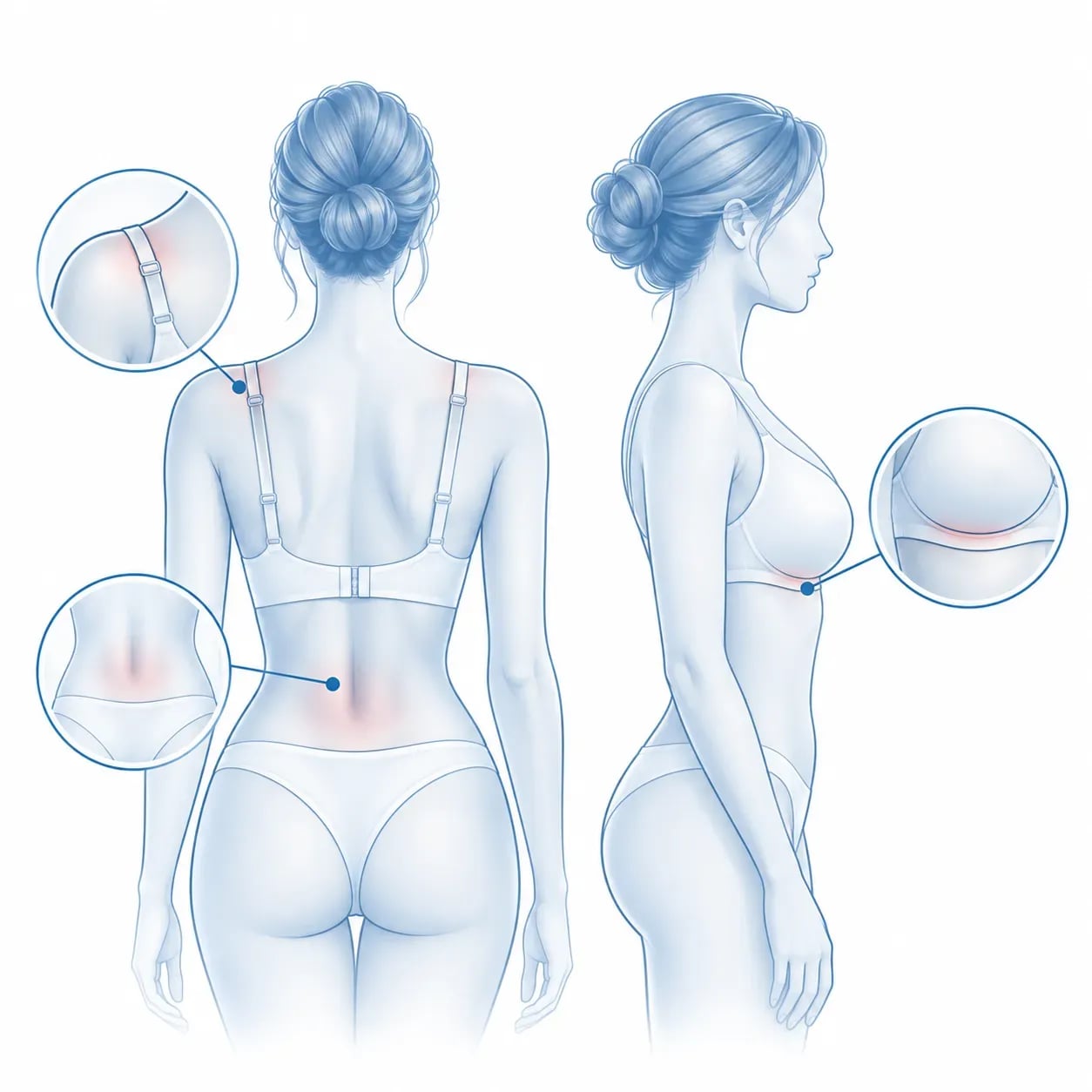
- Persistent pain in the neck, the shoulders or the upper back, that you have stopped mentioning because it is simply how you are.
- Grooves in your shoulders where the bra straps sit — visible marks that are still there an hour after you take the bra off.
- Irritation beneath the breast: redness, soreness, or fungal infections that keep coming back in the fold.
- Exercise is uncomfortable or impossible, even in a proper sports bra, so you have quietly stopped.
- Clothes never fit. You buy for your chest and everything else is too big.
- Your posture has adapted — rounded shoulders, a habit of stooping, developed over years to make the volume less visible.
If several of those are true, the operation is being considered for the right reason. If none of them is, and the concern is purely how the breasts look, that is a different conversation and worth saying plainly at the consultation so the plan matches what you actually want.
One thing worth knowing: many women have carried these symptoms for a decade or more and have stopped registering them as a problem. If you are unsure whether your pain "counts", try describing a normal day to someone who does not share your body. The answer usually becomes obvious.
An examination confirms whether your symptoms fit what reduction relieves. Pain with a different cause will not disappear because the breasts are lighter, and a good surgeon will tell you that.
How the operation is done
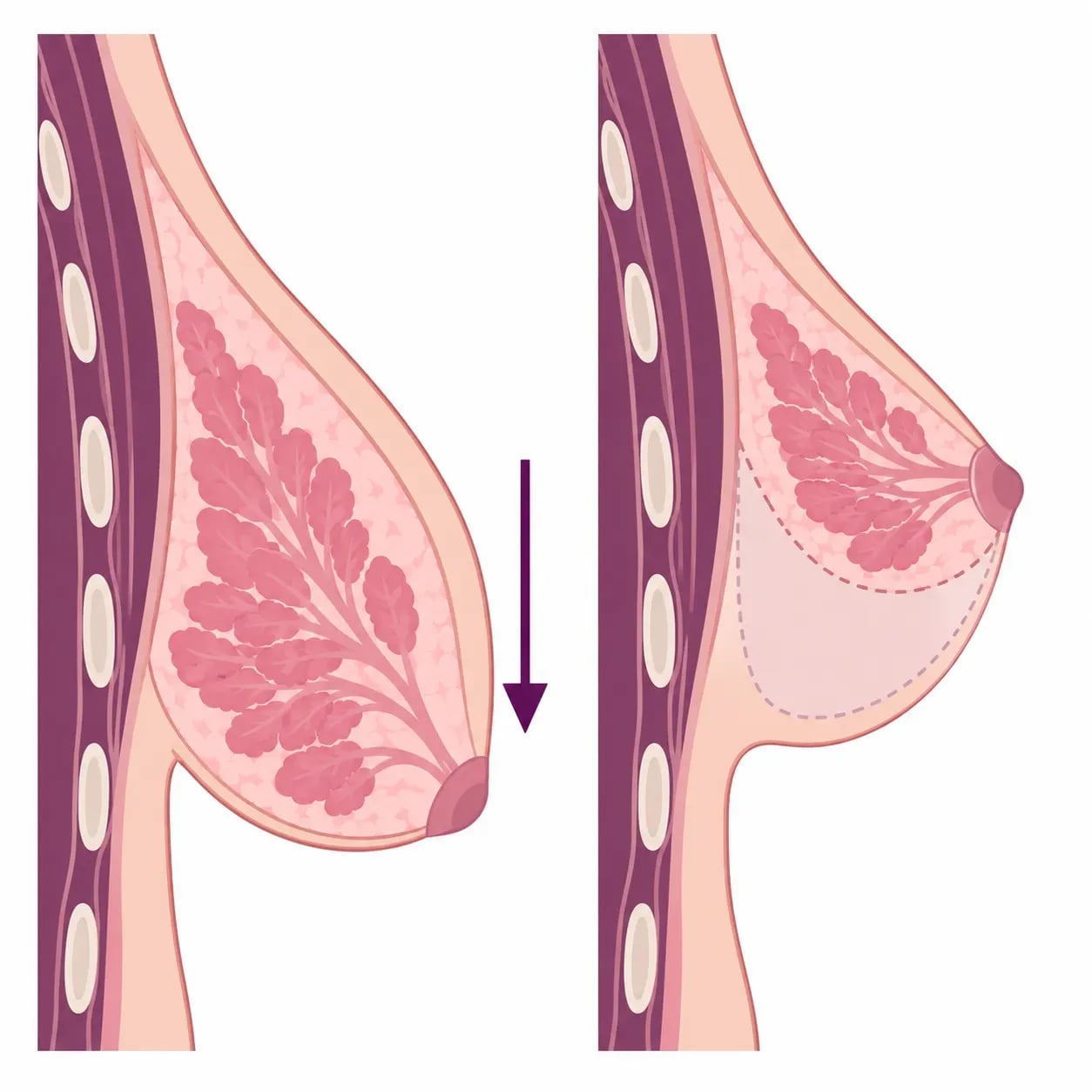
Three things happen in one operation, and understanding them explains everything else on this page — including the scars.
- Tissue is removed. Breast tissue and the skin that covered it, mainly from the lower part of the breast. The amount varies enormously and can reach several hundred grams per side in large reductions.
- The nipple is moved up. In a heavy breast it sits low, often below the fold. It is repositioned while remaining attached to its own blood and nerve supply — the pedicle — which is what preserves sensation and the possibility of breastfeeding.
- What remains is reshaped into a breast that is lifted and in proportion, and the skin is closed around it.
Two to three hours, under general anaesthesia, depending on the volume. Drains are placed at the end and removed before you fly home. You stay one or two nights in hospital, and this is not a formality: the colour and blood supply of the nipple are monitored closely during that period, because that is when a problem would show.
The nipple moving is the reason this operation is not a liposuction and not a simple lift. It is also the reason smoking matters so much, and the reason the technique is chosen in person rather than from a photograph.
If your breasts have dropped but the volume does not trouble you, the operation you are looking for is a breast lift rather than a reduction.
The scars: what they are and where they go
Breast reduction leaves permanent scars. That is the price of the operation, and it should be decided on before you book rather than discovered afterwards.
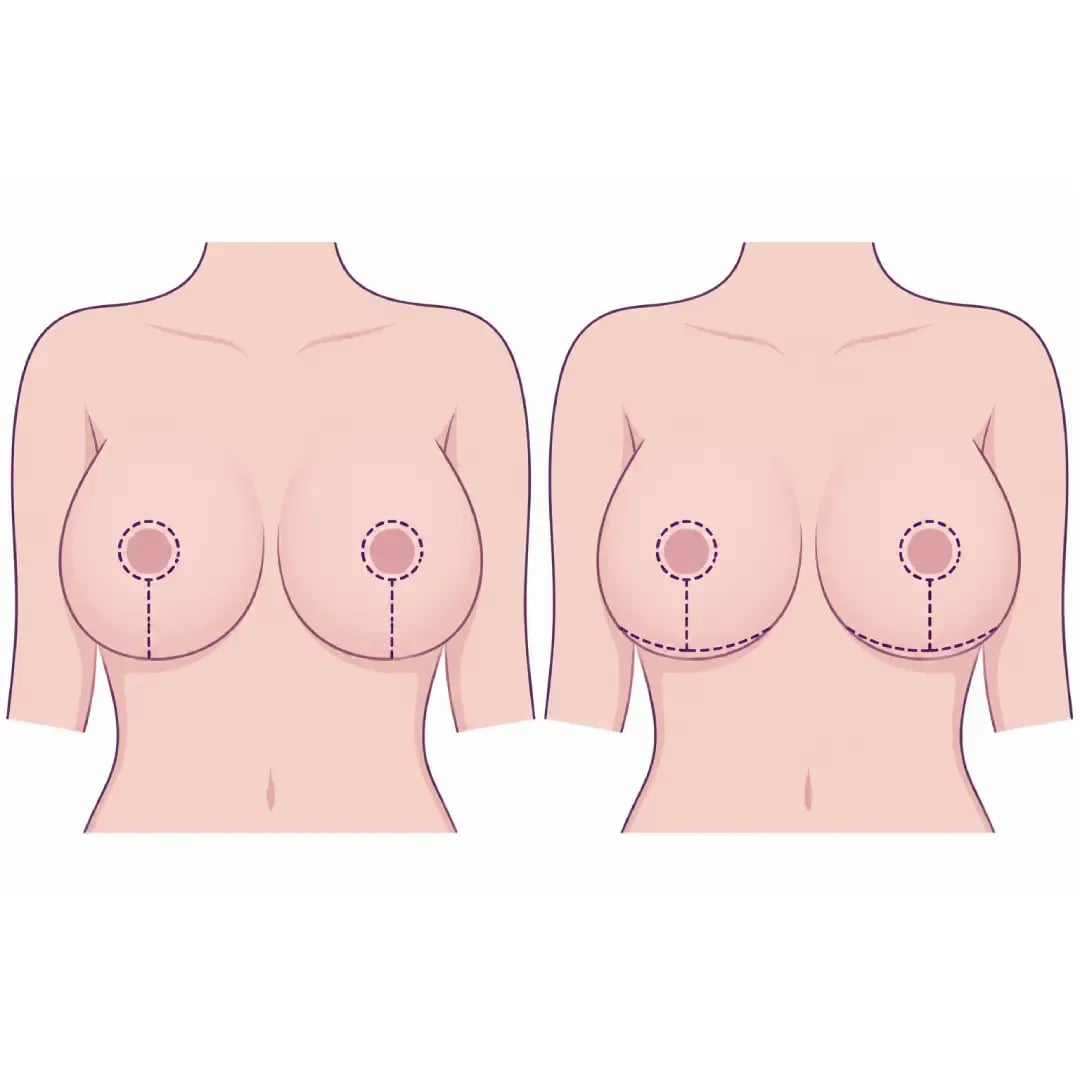
There are two usual patterns, and the choice is made by the surgeon on examination — not from photographs, and not by you from a menu.
| Pattern | Where the scars are | Used for |
| Vertical, or "lollipop" | Around the areola, and a vertical line down to the fold beneath the breast | Moderate reductions |
| Inverted T, or "anchor" | The same, plus a horizontal line hidden in the fold beneath the breast | Larger volumes — the most common choice |
What decides it: how much has to come out, the quality of your skin, and how far the nipple has to travel. A large reduction with a long way to move the nipple cannot be closed with a vertical scar alone, whatever anyone prefers aesthetically.
How they change over time
- Early: pink or red, raised, obvious.
- Months 3 to 6: often darker and at their most visible. This is the stage patients find hardest, and it is normal.
- 12 to 18 months: faded, flatter, considerably less noticeable.
In some women they stay wider or thicker despite good technique. That depends on skin and individual healing, not on the surgeon, and it cannot be predicted in advance. Follow the scar care you are given and keep them out of the sun — both genuinely help.
The useful way to think about this: the scars are on the breast, and they are visible to you and to anyone you undress in front of. The relief is in your back and your shoulders, every day. Most women who have this operation say the exchange was worth it; you are the one who decides that, and you should decide it knowing exactly what the scars look like at month four.
Very large reductions and the nipple graft
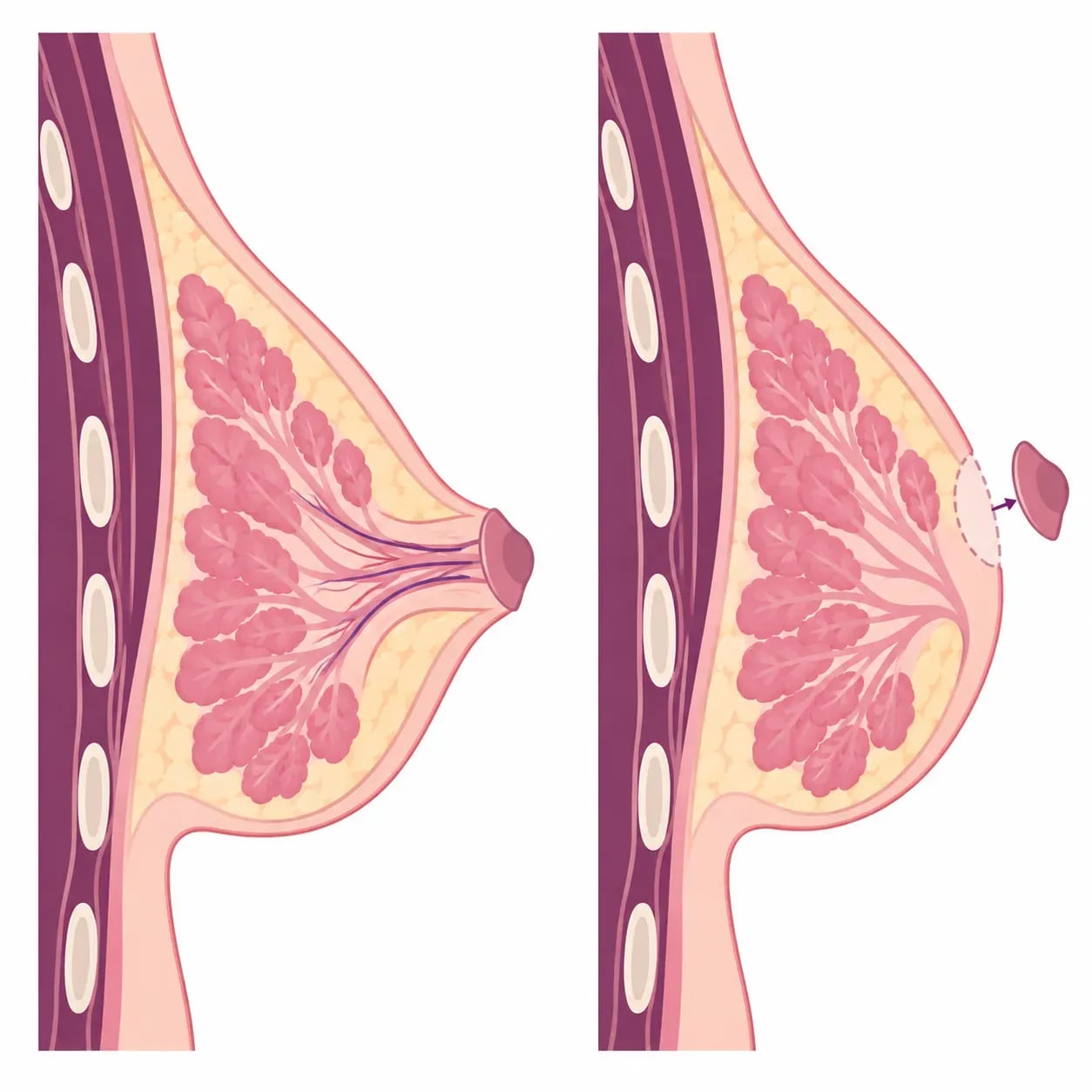
In most reductions the nipple is moved up while staying attached to its own blood and nerve supply. There is a limit to how far it can travel that way.
When the distance is too great, the nipple is detached and replaced as a graft. It is removed, the breast is reduced and reshaped, and the nipple is then placed back onto its new position as a piece of tissue that has to re-establish its own blood supply.
This is a legitimate and sometimes necessary technique, and it has two consequences you must know before consenting:
- Breastfeeding afterwards is not possible. The connection to the milk ducts is deliberately divided. This is permanent.
- Sensation is affected more than with the standard technique, and the loss is more often lasting.
The colour and texture of the grafted nipple can also differ from before.
If you are planning a pregnancy, or are not sure, say so at the consultation. It may change the technique chosen, or the timing of the operation, and that is a conversation to have before the day of surgery rather than on it.
Whether a graft is necessary in your case is a surgical judgement made on examination, and it depends on how far the nipple has to move. It is not a choice you make, but it is absolutely one you should be told about in advance.
Are you a candidate?
The procedure suits a woman in good health whose breast volume is causing a functional problem in daily life. There is no upper age limit. Breast development must be complete.
The operation is postponed or reconsidered in these situations, each assessed individually by the surgeon and the anaesthetist:
- Unstable weight, or significant weight loss still in progress. The breasts will change with it, and so will the result.
- Active smoking. This is the one to take most seriously here — see below.
- A bleeding or clotting disorder, or anticoagulant treatment
- Any condition that contraindicates general anaesthesia
- A breast finding that has not been investigated. Anything unexplained is assessed before, not after.
- Plans to breastfeed in the near future, if the reduction required would involve a nipple graft
Smoking, specifically
Smoking is the main contributing factor in the most serious complication of this operation — compromise of the blood supply to the nipple, which can progress to partial or total necrosis. Nicotine narrows exactly the small vessels the repositioned nipple depends on to survive.
This is not a general health recommendation attached to a surgical page. Stopping for the period your surgeon specifies is a condition of being operated on safely, and a surgeon who insists on it is protecting you rather than being difficult.
Declare in full: any personal or family history of breast cancer, any previous breast surgery, all medication and allergies, and any hormonal contraception or treatment.
How much does breast reduction cost in Tunisia?
€2,600, with a 5-day stay. €2,850 if implants are placed at the same time.
What the price covers — and this list is longer than on most of our pages, because the operation needs more:
- The consultations with the surgeon and the anaesthetist
- The operation and the anaesthesia
- The hospital stay, one or two nights
- The drains
- The laboratory analysis of the removed tissue — see the section on that below
- A support bra
- The transfers, and the follow-up after you return home
What it does not cover: flights, accommodation, and the pre-operative tests, which you have done in your own country around fifteen days before.
Two practical notes. Bring a second support bra so you can alternate while one is washed, over several weeks of continuous wear. And budget about two weeks off work after you return — this is a longer recovery than most of the procedures on this site, and treating it as a long weekend is how people end up pulling on healing scars.
On comparison: the difference with a quote at home comes from where the clinic operates, not from what is left out of the operation. Compare inclusions rather than totals — here the hospital stay, the drains, the pathology and the bra are inside the price, and those are not always included elsewhere.
| Procedure | Price | Stay |
|---|---|---|
| Breast reduction | 2600 € | 5 days |
| Breast reduction with implants | 2850 € | 5 days |
Funding, insurance and what to document
Breast reduction is one of the few operations in this field performed mainly for functional reasons, which means it is sometimes funded or reimbursed — and the rules depend entirely on where you live.
In the United Kingdom, breast reduction is available on the NHS only in limited circumstances. The criteria are set locally and vary between areas, and a great many women who have genuine symptoms are declined. That is one of the main reasons people look privately or abroad, and it is not a reflection on how real the problem is.
Elsewhere, some private insurers will contribute towards a reduction carried out for documented functional reasons. Policies differ, and so does whether treatment abroad is eligible at all.
What to do before you travel, whatever your situation
Gather the evidence of your symptoms now. It is far harder to assemble after the operation, and it is what every funding decision and every reimbursement claim turns on:
- Letters or notes from your GP recording the back, neck or shoulder pain, and for how long
- Physiotherapy records, or any treatment you have tried for the pain
- Photographs of the grooving your bra straps leave, taken an hour after removing the bra
- Records of skin problems under the breast — prescriptions for fungal infections, dermatology notes
- Your own written timeline: when it started, what you have stopped doing because of it
Check with your insurer before you book whether treatment abroad is covered at all, and what documentation they require. Some will not consider a claim unless the paperwork existed beforehand.
We cannot tell you whether your case will be funded — that is between you and your own health service or insurer. What we can tell you is that patients who arrive with their symptoms documented have options that patients who do not simply never have.
Your pathway, step by step
ServiHealth organises and coordinates the stay. The medical decisions belong to the surgeon and the anaesthetist; everything around them is our work.
| Stage | What happens |
| First contact | You send photographs front and in profile, your medical history, and any breast imaging you already have. Describe the symptoms, not only the size. |
| Quote | A written quote setting out what is planned, what the price covers and what it does not. |
| Preparation | Pre-operative tests around 15 days before, in your own country. Breast imaging according to your age and history. Stop smoking for the period your surgeon specifies. |
| Arrival | You are met at Tunis-Carthage and taken to your accommodation. Send your boarding pass and a photograph of what you are travelling in. |
| Consultation | Examination by the surgeon: how much to remove, which scar pattern, how far the nipple must move, and whether a graft is necessary. The anaesthetic consultation follows. |
| Operation | Two to three hours under general anaesthesia at the Clinique Internationale Myron. Drains placed. |
| One or two nights in hospital | Monitoring, with the colour and blood supply of the nipple checked closely. The support bra is fitted. |
| Before you fly | Drains removed, post-operative checks, documents handed to you. Five days in total. |
| After you return | Remote follow-up with a contact you can reach. The laboratory result on the removed tissue is communicated to you. |
The consultation can change the plan — most often the scar pattern, sometimes the technique for the nipple. That is the examination doing its job, and it is why these decisions are not made from photographs.
Tell us straight away about anything affecting the journey: a delayed flight, a changed booking, a missed connection, lost luggage.
Is breast reduction safe? Risks and precautions
This is a substantial operation and it carries substantial risks. They belong here, before you book.
General surgical risks: bleeding, infection, poor wound healing, and complications of general anaesthesia.
Specific to this operation:
- Compromise of the blood supply to the nipple. The most serious risk. The nipple has been moved, and it depends on its remaining blood supply to survive. If that is compromised it can lead to partial or total necrosis. Smoking is the main contributing factor. This is why you spend one or two nights in hospital being monitored, and why stopping smoking is a condition rather than a suggestion.
- Changes in nipple sensation, reduced or absent. Often temporary, sometimes permanent, and more marked after a nipple graft.
- Wound separation, most often at the junction of the inverted-T scar, where three lines meet and the tension is highest. Usually managed with dressings, and it heals.
- Scars that stay wider or thicker than hoped, despite good technique.
- Residual asymmetry. Breasts are rarely identical to begin with, and perfect symmetry is not the objective.
- Fluid collecting under the skin, which is what the drains are there to reduce.
Declare in full: any personal or family history of breast cancer, any previous breast surgery, any breast finding not yet investigated, all medication including anticoagulants, all allergies, and any hormonal contraception or treatment.
Contact your surgeon the same day if you have a fever, increasing pain, redness spreading around a wound, discharge, or any change in the colour of a nipple. The last one in particular does not wait.
Results vary from one patient to another, and your surgeon will tell you at the consultation what is realistic in your case.
The removed tissue is examined in the laboratory
Something happens in this operation that does not happen in any other procedure on this site, and it is worth a section of its own.
The breast tissue removed during the reduction is sent for laboratory analysis. A pathologist examines it, as a matter of routine, on every patient. It is included in the price.
Occasionally that examination finds something nobody was looking for. The volume of tissue removed in a reduction is substantial, and it is tissue that would otherwise never have been examined under a microscope. In a small number of cases, a finding of clinical importance is identified this way — early, incidentally, and in a woman who had no symptoms and no reason to suspect anything.
This is a genuine benefit of the operation and it is rarely mentioned anywhere. We mention it because you are entitled to know that it happens, and because the result belongs to you: it is communicated to you after your return, and you should keep it with your records.
What it is not is a substitute for breast screening. The pathologist examines the tissue that was removed. It says nothing about the tissue that remains, and nothing about the other breast beyond what was taken from it. You continue with whatever mammography or screening programme applies at your age, exactly as before.
And one practical point that matters for years afterwards: a reduced breast looks different on a mammogram, because tissue has been moved and scar tissue has formed. Tell every radiologist that you have had a breast reduction and when — it takes one sentence, and it is the difference between a straightforward report and an unnecessary recall.
How long is recovery?
Around two weeks before desk work, four to six weeks before sport, and twelve to eighteen months before the scars have settled. The pain relief, unusually, often arrives in the first days.
| When | What to expect |
| First days | One or two nights in hospital with monitoring and drains. Surgical soreness — and, for many women, the back and neck pain already easing. |
| First weeks | Swelling and bruising. A non-underwired support bra worn continuously. No lifting, and no raising the arms above shoulder height. |
| Around 2 weeks | Back to desk work. |
| 4 to 6 weeks | Sport resumes, on your surgeon's advice. |
| Months 3 to 6 | The scars are often at their most visible. This is normal and it is temporary. |
| 12 to 18 months | Scars faded and flattened. This is the result. |
Wear the support bra. Non-underwired, continuously, for the weeks you are told. It supports the reshaped breast while everything heals and takes tension off the scars. Bring a second one so you can alternate.
No lifting, and nothing above shoulder height, for several weeks. This is the instruction patients break most often and the one most likely to pull on a healing scar. Plan for it: if you have small children or a physical job, that is something to arrange before you travel, not after.
And be ready for months three to six. The scars darken before they fade, and women who were not warned conclude at month four that something has gone wrong. It has not.

Pregnancy and breastfeeding
Two separate questions, and they have different answers.
Breastfeeding afterwards
With the standard technique, generally possible from around twelve months after the operation. The nipple stays attached to its pedicle, which carries both its blood supply and its connection to the milk ducts, and that is what preserves the possibility.
With a nipple graft — used in very large reductions — it is not possible. The connection is deliberately divided and the change is permanent. If you may want to breastfeed, say so at the consultation: it is one of the few things that can change which technique is used, and it is a conversation to have before the day of surgery.
Even with the standard technique, nobody can promise you will be able to breastfeed. Many women cannot for reasons unrelated to surgery, and the operation adds its own uncertainty.
Pregnancy afterwards
Pregnancy changes breasts, with or without previous surgery: they enlarge, and they change again after breastfeeding. A reduction done before a pregnancy may look different afterwards, and in some cases that means the result is partly undone.
That is not a reason to postpone indefinitely. If a pregnancy is years away or uncertain, and the symptoms are affecting your life now, the sensible calculation is usually to treat the problem you have rather than the one you might have. If you are actively planning a pregnancy in the near term, discuss the timing.
And the practical point that applies either way: mention the reduction at any breast imaging during or after pregnancy, when the breast is changing and images are harder to read.
Your surgeons
Breast reduction at ServiHealth is performed by qualified plastic surgeons at the Clinique Internationale Myron in Tunis.
- Dr Taher Djemal — plastic and aesthetic surgery, practising in Tunisia since the early 1990s.
- Dr Abir Ben Ouaghrem — plastic and aesthetic surgery.
The surgeon assigned to your case is named in your quote before you travel, and you meet them in person before anything is decided.
Questions worth asking at that consultation:
- Which scar pattern will I have, and why that one for me?
- How far does the nipple have to move, and will it stay on its pedicle or need a graft?
- What can I expect for sensation afterwards?
- Roughly how much do you plan to remove, and what does that mean for proportion?
- What would make you advise against operating on me?
The second question is the important one, and it is rarely asked. The answer determines whether you will be able to breastfeed, and how much sensation you are likely to keep. You are entitled to know it before the morning of surgery, not on it.
How much to remove, which technique, which scar pattern and whether to operate at all is a medical decision and belongs to the surgeon, not to ServiHealth.

Why have breast reduction in Tunisia?
Tunisia has run an organised medical travel sector for decades: private clinics built around international patients, surgeons trained to European standards, and costs that reflect Tunisian overheads rather than shortcuts in the operation.
What matters specifically for this operation:
- Many women arrive here having been declined at home. Where a health service will not fund a reduction and private surgery is out of reach, this is often the only route to an operation they genuinely need.
- The package includes what this operation actually requires: one or two nights in hospital, the drains, the pathology on the removed tissue, and a support bra. Those are not always inside a quote elsewhere.
- Distance. Two to three hours from most of Western Europe, with direct connections from several Gulf hubs — a manageable flight five days after a general anaesthetic.
- English throughout, from the first exchange to the follow-up after you are home.
Three things to weigh honestly:
- This is a two-week recovery, not a long weekend. Arrange help at home before you travel, particularly if you have young children or a physical job. No lifting, nothing above shoulder height.
- Wound problems show up in week two or three, usually at the T junction, and that is after you are home. Know who you would contact and keep your operative documents accessible.
- Your records need to travel with you. Your operative note, your pathology result, and the date — every radiologist who scans your breasts for the rest of your life will want to know about this operation.
If what you want is a lift rather than a reduction, see breast lift in Tunisia.
Before you travel: a checklist
Work through this before you book, not the week before you fly.
| Category | What to do |
| Documents | A valid passport, and a visa if your nationality requires one for Tunisia. Check the expiry date. |
| Photographs | Recent photographs, front and in profile. Also photograph the grooving your bra straps leave — useful clinically, and useful if you ever claim. |
| Breast imaging | A mammogram or ultrasound according to your age and history. Bring the images and the report, and keep them afterwards as your baseline. |
| Breast history | Any personal or family history of breast cancer, any previous breast surgery, and anything unexplained that has not been investigated. |
| Your symptom record | GP letters, physiotherapy notes, prescriptions for skin problems under the breast, and your own timeline. Assemble this before surgery — it cannot be reconstructed afterwards. |
| Medication and allergies | A full list, anticoagulants included, plus any hormonal contraception or treatment and any clotting disorder. |
| Pre-operative tests | Completed around 15 days before, in your own country, following the protocol you are given. |
| Smoking | Stop for the period your surgeon specifies. On this operation it is a safety condition, not advice. |
| Weight | Stable for several months. If you are in the middle of significant weight loss, finish it first. |
| Pregnancy plans | Say so at the consultation if you may want to breastfeed. It can change the technique chosen. |
| To pack | Front-opening tops — you will not be raising your arms. A second non-underwired support bra so you can alternate. |
| Help at home | No lifting and nothing above shoulder height for several weeks. Arrange this before you go, especially with young children or a physical job. |
| Your calendar | About two weeks off work, four to six weeks before sport, and no dated event where you want your scars invisible inside a year. |
Considering another procedure during the same stay? Read our pages on breast lift, breast augmentation or tummy tuck in Tunisia first. What can reasonably be combined in one session is decided by your surgeon.









Frequently asked questions about Breast Reduction in Tunisia
The question is not about size, it is about symptoms. Persistent neck, shoulder or upper back pain; deep grooves where your bra straps sit; irritation, redness or recurring fungal infections in the fold beneath the breast; difficulty exercising; clothes that never fit properly; and a posture adapted to hide the volume. If several of those describe your daily life, the operation is being considered for the right reason. An examination confirms it.
For many women the relief begins within the first days, which is unusual among the operations on this site — most take months to show a benefit. It is not a treatment for every back problem: pain with another cause will not disappear because the breasts are lighter. Your surgeon assesses whether your symptoms fit the pattern that reduction relieves.
€2,600, or €2,850 if implants are placed at the same time, both with a 5-day stay. The price covers the consultations with the surgeon and the anaesthetist, the operation, the anaesthesia, the hospital stay, the drains, the laboratory analysis of the removed tissue, a support bra, the transfers and the follow-up after you return home. Flights, accommodation and the pre-operative tests are not included.
It sounds contradictory and it is not. Reduction removes volume mainly from the lower part of the breast, and in some women that leaves the upper pole flat or empty once the breast is lifted into position. A small implant restores shape at the top while the overall volume comes down. It is proposed after examination where that applies — it is not a routine addition, and you should ask why it is being suggested in your case.
With the standard technique, in which the nipple stays attached to its blood and milk supply, breastfeeding is generally possible from around twelve months after the operation. With a very large reduction requiring a nipple graft, it is not — the connection to the ducts is deliberately divided. If you are planning a pregnancy, say so at the consultation: it may change which technique is appropriate, or the timing of the surgery.
It varies enormously, and in large reductions it can reach several hundred grams per breast. Your surgeon thinks in terms of volume removed and proportion to your frame rather than in cup sizes. The weight is not the point — the symptoms are — although the removed tissue does show on the scales and some patients are surprised by that.
It is a substantial operation under general anaesthesia, lasting two to three hours, with one or two nights in hospital and drains. It carries the general risks of surgery and some specific to the procedure — the most serious being compromise of the blood supply to the nipple, which can progress to partial or total necrosis. Smoking is the main contributing factor, which is why stopping is not negotiable. The full list is in the safety section of this page.
Five days, including one or two nights in hospital where the colour and blood supply of the nipple are monitored closely. The drains are removed before you fly home. Plan around two weeks off work after your return.
Sometimes, and the rules depend entirely on where you live. In the United Kingdom it is funded on the NHS only in limited circumstances, the criteria are set locally and vary between areas, and a great many women are declined — which is one of the main reasons they look privately or abroad. Elsewhere, some private insurers cover a reduction performed for documented functional reasons. The practical advice is the same everywhere: before you travel, gather evidence of your symptoms — GP letters, physiotherapy notes, photographs of the grooving from your bra straps — because that is what any funding decision or reimbursement claim turns on, and it is far harder to assemble afterwards.
Manageable with prescribed painkillers, and with an unusual feature: many women report that the back and neck pain they came in with improves within the first few days, while the surgical soreness is still present. Swelling and bruising are expected for the first weeks. Avoid lifting and raising your arms above shoulder height for several weeks.
No surgeon can promise a cup size, and one who does is guessing. Cup sizing is not standardised between manufacturers, and the surgeon works with tissue volume and proportion to your frame rather than with letters. Describe the outcome you want in words instead — lighter, in proportion, no longer in pain, able to exercise — and that is something a surgeon can actually aim at.
Four to six weeks, on your surgeon's advice. Desk work usually resumes after about two weeks. For several weeks you avoid lifting and raising your arms above shoulder height, which matters more than it sounds — it is the movement most likely to pull on the healing scars.
Yes, permanently — this operation trades scars for relief and that is the honest way to put it. What changes is how they look: pink at first, often darker around months three to six, then fading over twelve to eighteen months. In some women they stay wider or thicker despite good technique, and that depends on skin and healing rather than on the surgeon. Sun protection and following the scar care you are given both help.
The removed tissue weighs something and that shows on the scales, but breast reduction is not a weight-loss operation and should not be chosen as one. What often changes indirectly is activity: women who could not exercise comfortably before frequently can afterwards, and that has its own effect over time.