

Buccal Fat Removal in Tunisia: Price, Risks and What It Will Not Do

Buccal fat removal in Tunisia: the essentials
Buccal fat removal — a bichectomy — takes out part of the buccal fat pad, the pocket of fat that sits in the hollow of each cheek. It slims the middle and lower face. It is done from inside the mouth, so there is no scar on the skin.
Is it your jawline rather than your cheeks that bothers you? Read the next section before anything else — this may not be the right operation for you.
It is carried out by Dr Taher Djemal and Dr Abir Ben Ouaghrem at Myron International Clinic in Tunis, with English-speaking support throughout.
| Operating time | About 1 hour |
| Anaesthetic | General |
| Stay in Tunisia | 3 days |
| Scar | None on the skin — the incision is inside the cheek |
| Result | Visible in weeks, settles over 2 to 3 months |
| Back to work | Next day |
| Reversible | No |
| Price | €1,800 |
Will this give you a sharper jawline? Probably not
This is the most common misunderstanding about this operation, and it is worth being blunt about it.
The buccal fat pad sits in the middle of your cheek, not along your jaw. Removing it hollows the area under the cheekbone. It does not sharpen the jawline, it does not reduce a double chin, and it does not change the angle of the jaw.
Jawline definition comes from somewhere else entirely: the shape of the bone, the fat under the chin, the tone of the skin, and the size of the masseter muscles. If what you want is a sharper jaw, the answer is one of those — liposuction under the chin, genioplasty, or Botox to the masseters — not this.
A great many people arrive asking for buccal fat removal because they have seen the before-and-after photographs that circulate online. A fair proportion of them need something different, or nothing at all. The surgeon will tell you which, and being told no on this operation is a good outcome, because it cannot be undone.
Is your buccal fat actually the cause?
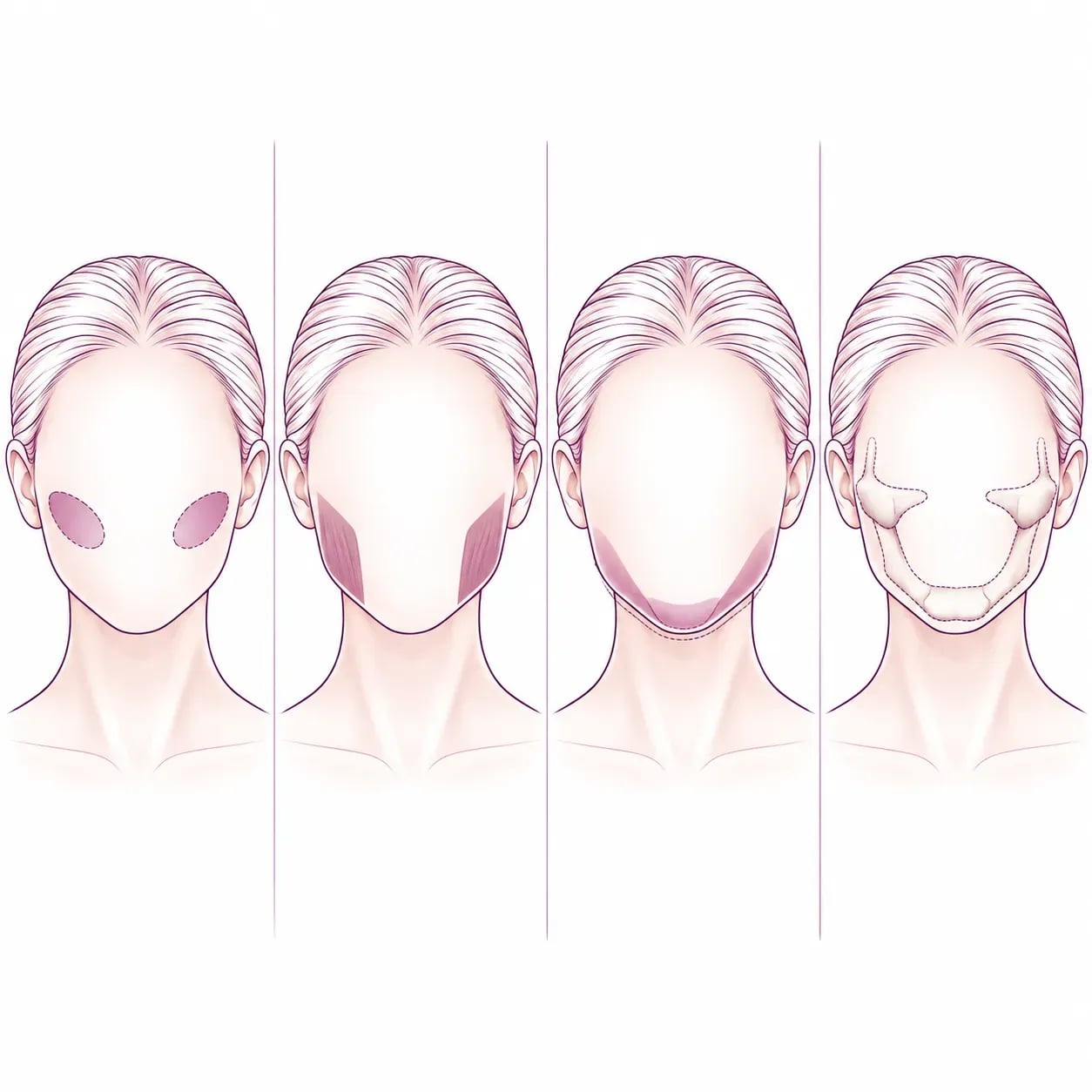
A full-looking lower face has four possible causes, and only one of them is treated by this operation.
- A large buccal fat pad — the one this surgery addresses.
- Developed masseter muscles, the chewing muscles at the angle of the jaw. Often linked to clenching or grinding, and treated with Botox rather than surgery.
- Superficial fat under the chin and along the jaw, which is a liposuction question.
- Bone structure. A wide facial skeleton is not changed by removing fat, and nothing short of jaw surgery alters it.
More than one is usually involved at once, in different proportions. That is why this cannot be judged from a photograph, and why the assessment is a physical examination rather than a formality.
If the fullness turns out to be muscle or bone, removing buccal fat achieves nothing and takes away volume you will want later.
What the buccal fat pad actually is
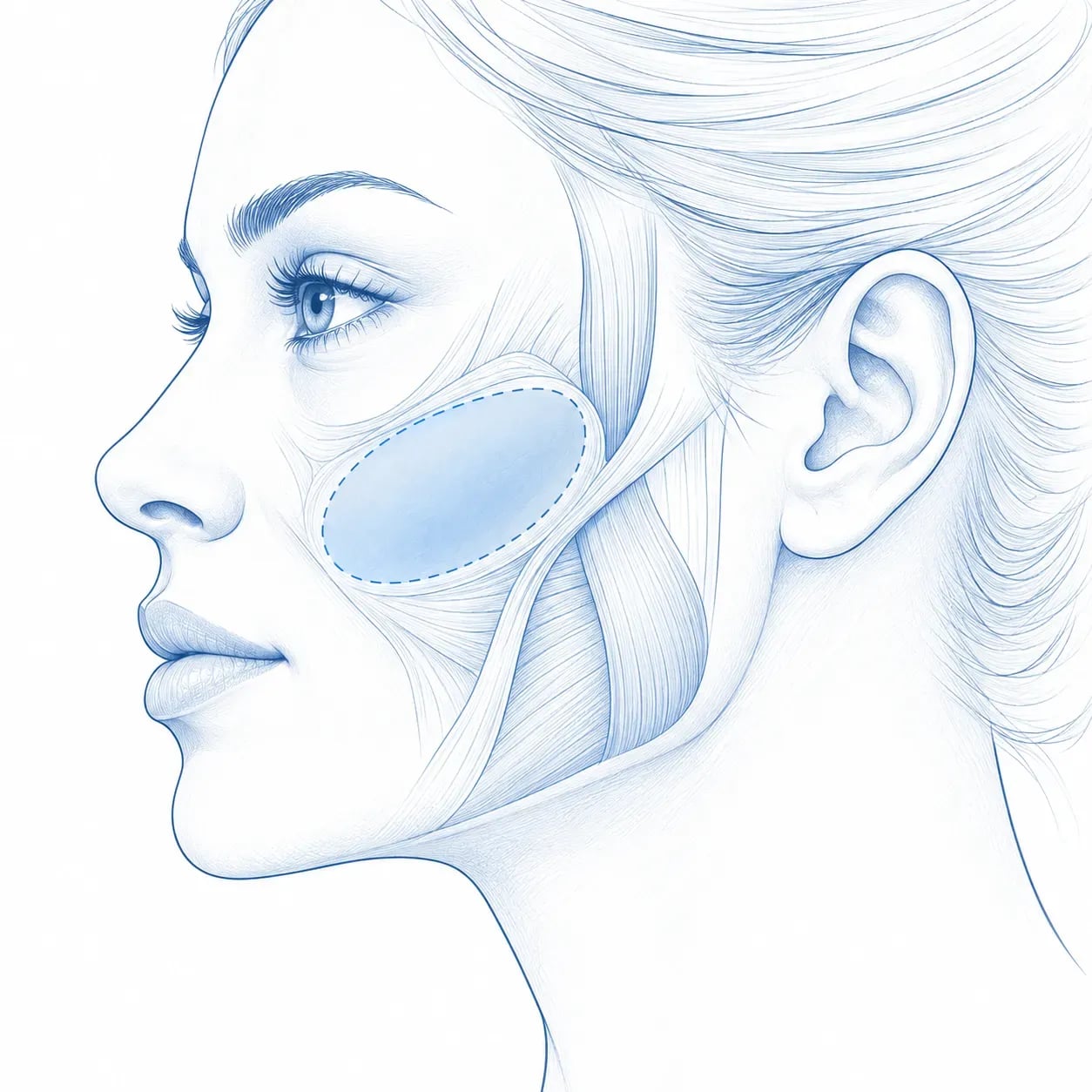
Everyone has one in each cheek. It is a discrete pocket of fat, distinct from the fat just under the skin, and it sits deeper, between the facial muscles.
It is largely independent of your weight. Losing weight does not reliably reduce it, which is why people with slim bodies can still have full cheeks and why dieting for it does not work.
It also shrinks naturally with age, as part of the general loss of facial volume that happens to everyone. That fact is the reason for the two sections that follow.
The trap: taking out too much
This is the part of the operation that goes wrong, and it almost never goes wrong on the operating table. It goes wrong five or ten years later.
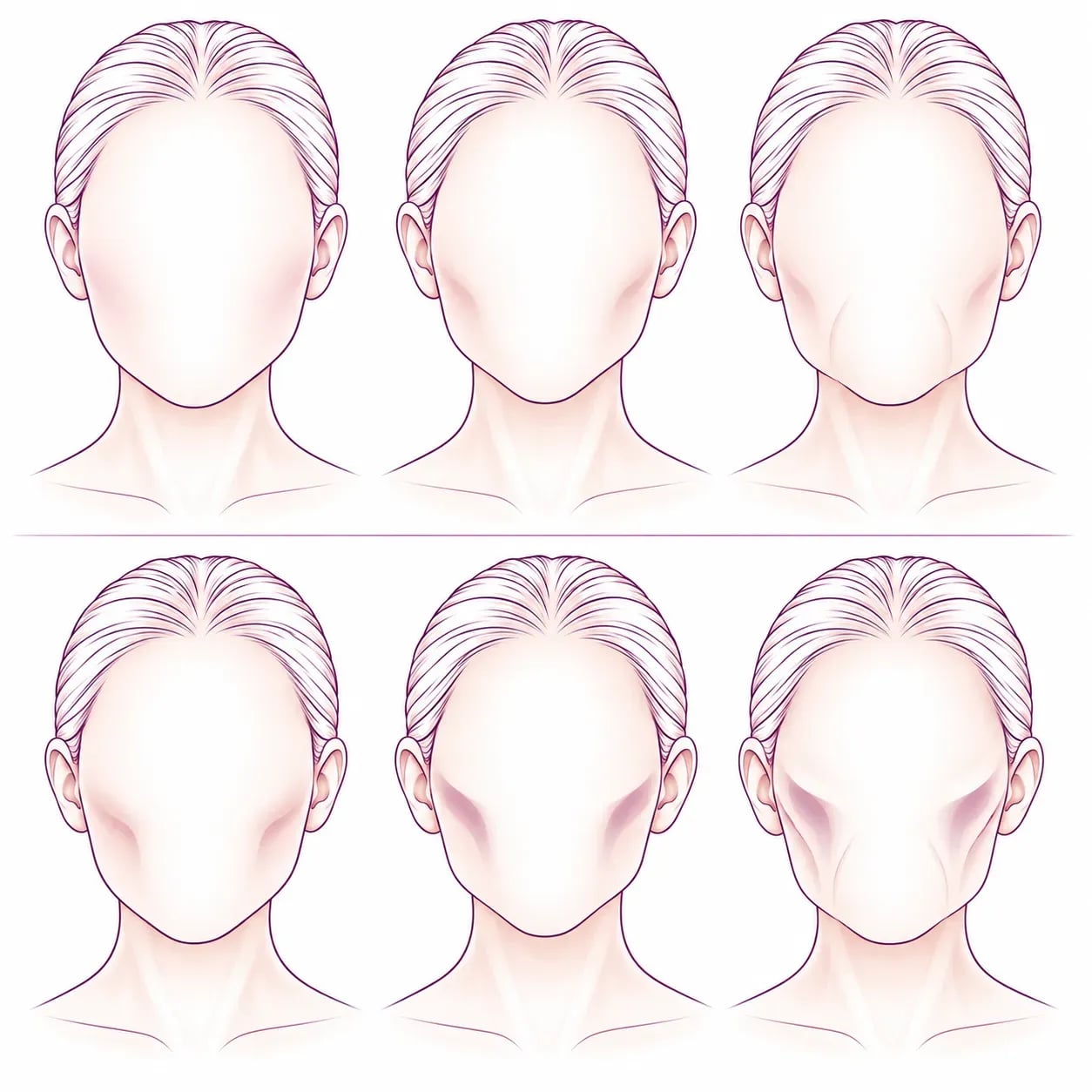
Faces lose volume with age. Cheeks hollow, the midface flattens, and the face reads as older partly because of that loss. It happens to everyone, and the buccal fat pad shrinks along with everything else.
Removing too much brings that forward and amplifies it. A result that looks sculpted at 25 can look gaunt at 35, and the gauntness is permanent because the fat is gone.
The fat removed cannot be put back. A hollowed face can be partly corrected later with facial fat transfer or hyaluronic acid filler, but that is a correction, not an undo, and it means paying for a second procedure to reverse the first.
What this means in practice: a measured removal, adjusted to your facial analysis, rather than the maximum possible. If you ask a surgeon to take out as much as they can, and they agree, find another surgeon.
Age: the question that matters most here
There is no fixed minimum age, but age is the single strongest predictor of whether someone regrets this operation.
The younger you are, the more volume you still have to lose naturally. A twenty-year-old face has decades of hollowing ahead of it. Removing fat from it now is a decision made on behalf of a face that does not exist yet.
And at the other end: from a certain age the face is already hollowing on its own. At that point the operation is generally advised against, because it adds to a process already under way. What suits that face is usually volume added rather than taken away.
There is a window where this operation makes sense, and it is narrower than the demand for it suggests. The surgeon's job is to tell you whether you are in it. A no here is worth more than a yes.
Are you a candidate?
This suits someone with genuinely full cheeks caused by the buccal fat pad, at a stable weight, in good general health, with realistic expectations and an understanding that the change is permanent.
You may be directed elsewhere if:
- The fullness is muscle — Botox to the masseters
- It is superficial fat under the chin — liposuction
- It is the chin projection that is the real issue — genioplasty
- Your face already lacks volume — fat transfer, the opposite operation
- Your weight is not yet stable — wait
Contraindications: any infection in the mouth, smoking if you have not stopped, a clotting disorder, or anticoagulant treatment.
A dental check before you travel is worth doing. The incision is inside your mouth, and an untreated dental problem is a reason to postpone.
What buccal fat removal costs
€1,800, for a 3-day stay.
Included: the consultation, the procedure, the anaesthetic, airport transfers and post-operative follow-up.
Not included: flights and the pre-operative tests you have done at home.
| Procedure | Price |
| Buccal fat removal | €1,800 |
| Genioplasty, setback | €1,800 |
| Genioplasty, advancement | €2,000 |
| Facial fat transfer | €2,100 |
| Face and neck lift | €2,400 |
It can be combined with another facial procedure in the same trip — genioplasty or liposuction under the chin are the usual ones — which often makes more sense than buccal fat removal alone. All prices are on the prices page, and a personalised quote reaches you within 24 to 48 hours.
| Procedure | Price | Stay |
|---|---|---|
| Buccal Fat Removal (Bichectomy) | €1,800 | 3 days |
How it is done
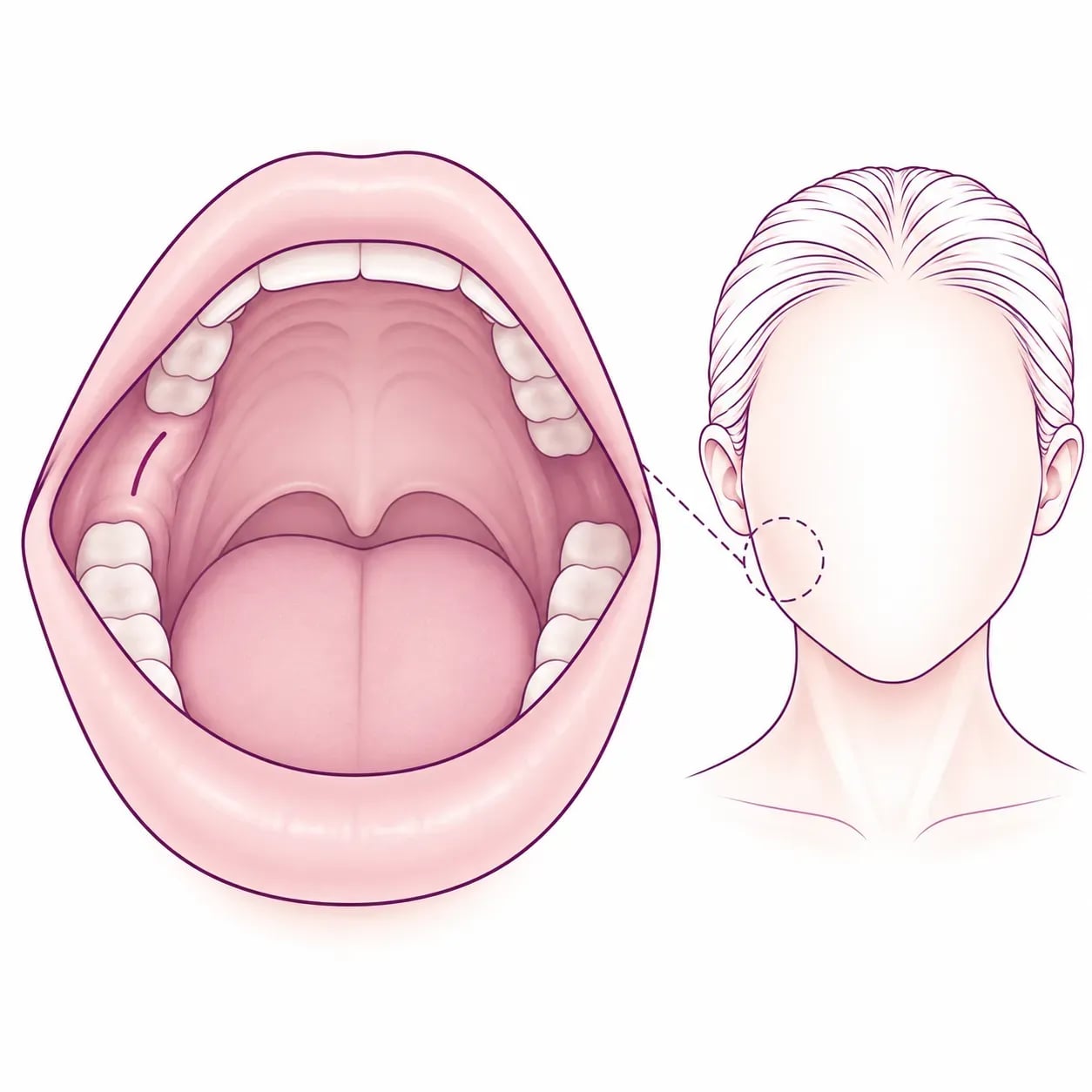
A small incision is made inside the cheek, so nothing is cut on the outside of the face and there is no visible scar.
The buccal fat pad is reached through that incision and the planned portion is removed. The incision is closed with dissolving stitches. The whole thing takes around an hour.
It is a small operation in a crowded area. A branch of the facial nerve, which controls part of your smile and lip movement, runs close by. So does the parotid duct, which carries saliva from the parotid gland into the mouth. Neither is difficult to avoid with careful dissection, but both are the reason this is done by a plastic surgeon and not treated as a minor procedure.
Risks, including the one that appears years later
Common to any surgery: haematoma, infection, swelling, asymmetry, and temporarily limited mouth opening.
Specific to this area:
The facial nerve. A branch controlling part of the smile and lip movement passes close to the operating field. Injury is rare and usually temporary, but it is the reason the dissection is done the way it is.
The parotid duct. Rare, but injury can cause saliva to collect in the cheek.
And the long-term one: a face that is too hollow. This is the risk specific to this operation, it does not show for years, and it is permanent. It is reduced by removing a measured amount rather than the maximum, by a proper facial analysis beforehand, and by not operating on someone too young.
Contact us without waiting if you have a fever, increasing pain, spreading swelling, discharge in the mouth, or any change in your smile.
When it is functional rather than cosmetic
A genuinely large buccal fat pad can push the inside of the cheek against the teeth, so it gets bitten during chewing. That causes repeated irritation and sore patches inside the mouth.
Where that is happening, the operation has a functional purpose as well as an aesthetic one, and the assessment is different: the question becomes how much needs to come out to stop the biting, rather than how much can come out for the look.
If you bite the inside of your cheek regularly, say so at the consultation. It changes the conversation.
Your pathway, step by step
- Get in touch from home. Photographs from the front and both sides, your medical history and what bothers you. An opinion and a quote come back within 24 to 48 hours.
- Preparation. A dental check, pre-operative tests around fifteen days before, and stop smoking. Our preparation guide covers what applies to every procedure.
- Arrival. You are met at Tunis-Carthage and transferred.
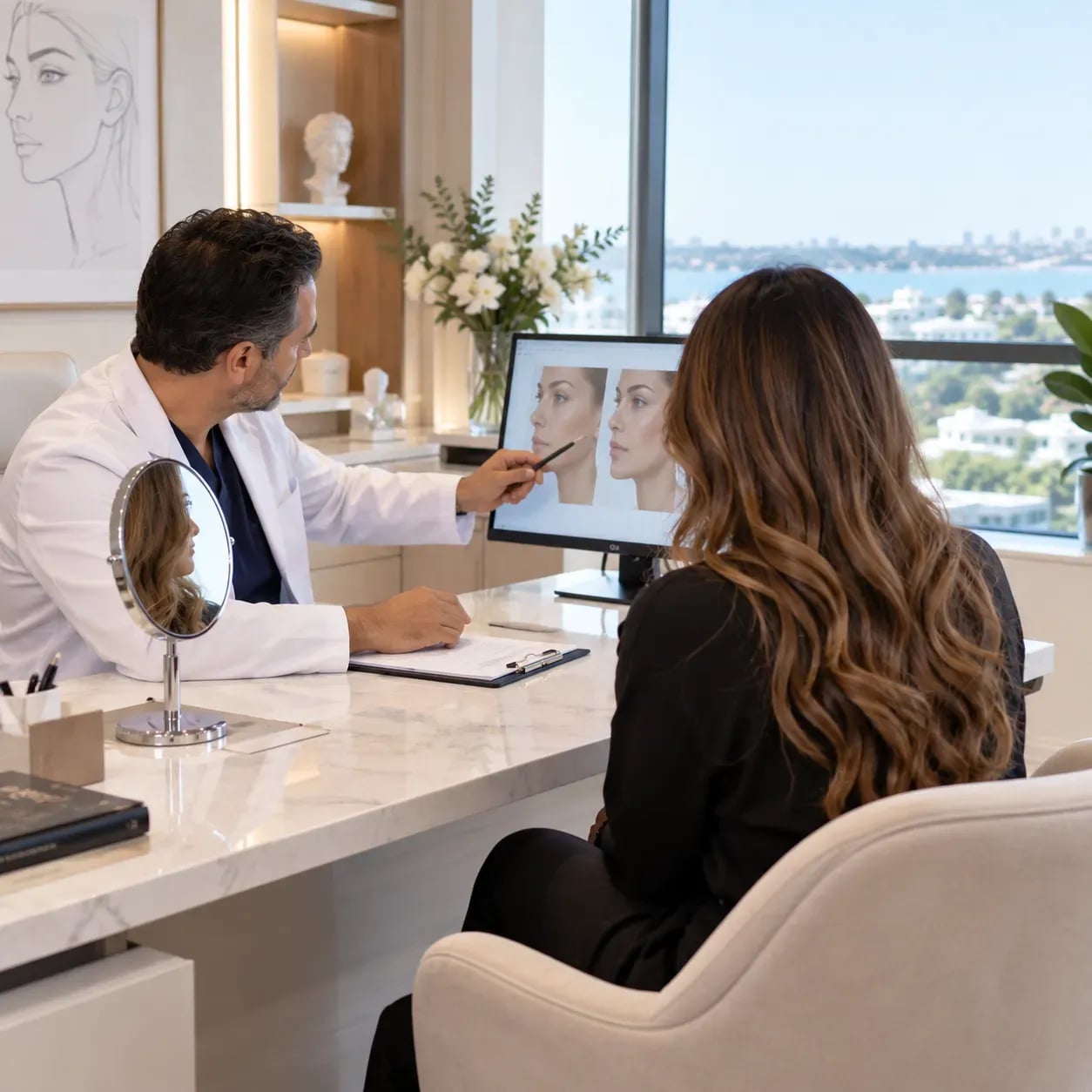
- Consultation, with a facial analysis to confirm the buccal fat pad is actually the cause and to decide how much to remove.
- The procedure, about an hour.
- Back to your room the same day.
- Convalescence in Tunisia, with a check before you fly.
- Home, with remote follow-up.
Recovery and eating
Swelling in the first days is expected, and it is the thing that makes people think the operation has not worked. Your cheeks will look fuller before they look slimmer.
Soft food at first, then back to normal on your surgeon's advice. Nothing hot, nothing sharp, nothing that needs serious chewing.
Mouth hygiene matters more than usual, because the incision is inside your mouth. You will be given specific instructions and they are worth following exactly.
Cold applied as instructed helps the swelling.
Discomfort is mild — more a feeling of tension than pain. Prescribed painkillers cover it.
Back to work the next day for most people, with visible swelling for a few days after that.
The result settles over 2 to 3 months. What you see at two weeks is not the result. This is a slow-reveal operation and judging it early is pointless.

Your surgeons
Dr Taher Djemal has practised as a plastic surgeon in Tunisia since the early 1990s. He trained in Tunis, Paris and Nancy, with further experience at Foch Hospital in Paris and in Baltimore.
Dr Abir Ben Ouaghrem assesses the facial proportions to confirm the indication before agreeing to operate.
Consultations are possible by video call before you travel. On this procedure, ask one question above all others: « What will my face look like in fifteen years if you do this? » A surgeon who has thought about that answer is the one you want.
Getting to Tunisia
From the UK and Ireland: around three hours from London, with connections from other UK and Irish airports. British and Irish passport holders do not currently need a visa for a short tourist stay — but see the note below.
From the Gulf: daily flights from Dubai with Emirates, around six and a half to seven hours, and from Doha with Qatar Airways, around six.
From continental Europe: direct flights of 1h30 to 3h from Paris, Brussels, Geneva, Lyon and Marseille, with no visa for EU and Swiss nationals.
From West and Central Africa: regular connections from Dakar, Abidjan, Douala, Libreville and Casablanca, with help on visa formalities where needed.
Entry requirements follow your nationality, not your country of residence. A resident of Dubai or London holding an Indian, Pakistani, Nigerian or Filipino passport does not have the same conditions as a British or Emirati national, and a residence permit changes nothing. Check with the Tunisian embassy for your country of citizenship before booking.
At three days, this is one of the shortest stays we organise. How long each procedure needs is in our guide to lengths of stay.
Before you travel: a checklist
- Documents: a passport valid well beyond your return date, and a visa if your nationality requires one.
- Photographs from the front and both sides, in natural light, without filters.
- A dental check. The incision is inside your mouth, and an untreated dental problem is a reason to postpone.
- Pre-operative tests done at home around fifteen days before.
- Tell us about any filler or injectable you have had in the face, and when. This matters and people routinely forget to mention it.
- A written list of your medication, supplements and allergies. Aspirin and anti-inflammatories are usually stopped beforehand unless you are told otherwise.
- Stop smoking. It affects healing inside the mouth particularly.
- Soft food at home for the first days back — buy it before you travel.
- Mouth hygiene: bring a soft toothbrush.
- Expect to look swollen for a few days, and plan anything you care about being photographed at accordingly.
Request a quote and you will have an answer within 24 to 48 hours.







Frequently asked questions about Buccal Fat Removal in Tunisia
No. The buccal fat pad sits in the middle of the cheek, not along the jaw. Removing it hollows the area under the cheekbone; it does not sharpen the jawline, reduce a double chin or change the jaw angle. Jawline definition comes from bone shape, fat under the chin, skin tone and the masseter muscles, so if that is what you want the answer is liposuction under the chin, genioplasty or Botox to the masseters, not this.
€1,800 with ServiHealth for a 3-day stay, covering the consultation, the procedure, the anaesthetic, airport transfers and post-operative follow-up. Flights and the pre-operative tests you have at home are not included.
A discrete pocket of fat in each cheek, deeper than the fat just under the skin and sitting between the facial muscles. It is largely independent of your weight, which is why slim people can still have full cheeks and why dieting does not reduce it. It also shrinks naturally with age.
No. The fat removed cannot be put back. A face that ends up too hollow can be partly corrected later with facial fat transfer or hyaluronic acid filler, but that is a correction rather than an undo, and it means a second procedure to compensate for the first.
It can, if too much is taken. Faces lose volume with age, and the buccal fat pad shrinks along with everything else. Removing too much brings that forward and amplifies it, so a result that looks sculpted at 25 can look gaunt at 35 — permanently. A measured removal based on a proper facial analysis is what prevents it.
There is no fixed minimum, but age is the strongest predictor of regret with this operation. The younger you are, the more natural volume loss you still have ahead of you. At the other end, from a certain age the face is already hollowing on its own and the procedure is generally advised against. The window is narrower than the demand for it suggests, and the surgeon's job is to tell you whether you are in it.
No scar on the skin. The incision is made inside the cheek and closed with dissolving stitches.
The common risks are haematoma, infection, swelling, asymmetry and temporarily limited mouth opening. Specific to this area, a branch of the facial nerve controlling part of the smile runs close by, and so does the parotid duct carrying saliva into the mouth; injury to either is rare. The risk particular to this operation is a face that ends up too hollow, which does not show for years and is permanent.
Three days. That covers the consultation and facial analysis, the procedure, and a check before you fly. It is one of the shortest stays we organise.
Not very. It is more a feeling of tension than pain, and prescribed painkillers cover it. Swelling is the main inconvenience of the first days.
Soft food at first, then back to normal on your surgeon's advice. Nothing hot, nothing sharp and nothing requiring serious chewing in the early days. Mouth hygiene matters more than usual because the incision is inside your mouth.
Anyone whose face is already thin or angular with little volume to spare, anyone whose fullness is muscle or bone rather than buccal fat, anyone whose weight is not yet stable, anyone with an infection in the mouth, and anyone on anticoagulants or with a clotting disorder. Smoking has to stop beforehand.
A full lower face has four possible causes: a large buccal fat pad, developed masseter muscles, superficial fat under the chin, or the shape of the facial bones. Usually more than one is involved. Only the first is treated by this operation, which is why the assessment is a physical examination and not something that can be judged from a photograph.
Yes, and it often makes more sense than buccal fat removal alone. Genioplasty and liposuction under the chin are the usual combinations, since between them they address the jawline that most people are actually asking about.
Slight asymmetry is possible, as it is with any facial surgery, and most faces are slightly asymmetrical to begin with. The amount removed is adjusted on each side during the operation to account for that.
The swelling in the first days makes the cheeks look fuller before they look slimmer. The change becomes visible over a few weeks and settles over 2 to 3 months. Judging it at two weeks tells you nothing.
The removal is. The face continues to age normally afterwards, which is exactly why how much is taken out matters so much.
Yes. A stable weight gives a more predictable result, and the buccal fat pad is in any case largely independent of body weight, so losing weight will not remove the need for the procedure if it is genuinely indicated.
Occasionally. A genuinely large buccal fat pad can push the inside of the cheek against the teeth so it gets bitten during chewing, causing repeated irritation. Where that is happening the assessment changes: the question becomes how much needs to come out to stop the biting rather than how much can come out for the look. Mention it at the consultation if it applies to you.
Partly. Facial fat transfer or hyaluronic acid filler can restore some volume, but neither puts back what was removed and both mean a further procedure. It is far better not to over-resect in the first place.
It is worth doing. The incision is made inside your mouth, so an untreated dental problem or an infection is a reason to postpone.
Ask what is actually causing the fullness in your face, how much they intend to remove and why that amount, and what your face is likely to look like in fifteen years if they do it. A surgeon who has a considered answer to the last one is the surgeon you want.