

Facial Fat Transfer in Tunisia: Price, Fat Survival and Results

Facial fat transfer in Tunisia: the essentials
Facial fat transfer takes a small amount of fat from your own body, prepares it, and places it back into the parts of the face that have lost volume: hollow temples, flat cheekbones, hollows under the eyes, thin cheeks, the area around the folds that run from nose to mouth.
There is no implant and no manufactured product. The material is yours, which is why the result, once it settles, behaves like the rest of your face rather than like something sitting inside it.
The one thing worth understanding before anything else: not all of the fat stays. Part of it is reabsorbed in the first weeks and months. The published figures vary widely, and no surgeon can tell you in advance which figure will apply to you. This is normal, it is expected, and your surgeon compensates for it — but it means the face you see in the mirror on the flight home is not the result, and it means a second session is a possibility rather than a failure.
At ServiHealth, facial fat transfer is carried out at the Clinique Internationale Myron in Tunis, from €2,100, with a recommended stay of 3 days. The procedure takes around one to two hours under local anaesthesia with sedation, or under general anaesthesia, depending on how much is being treated.
This page is written for patients travelling from abroad. It sets out what the operation does, what it does not do, how much fat realistically survives, when you can judge the result, and what you should have settled before you book a flight.
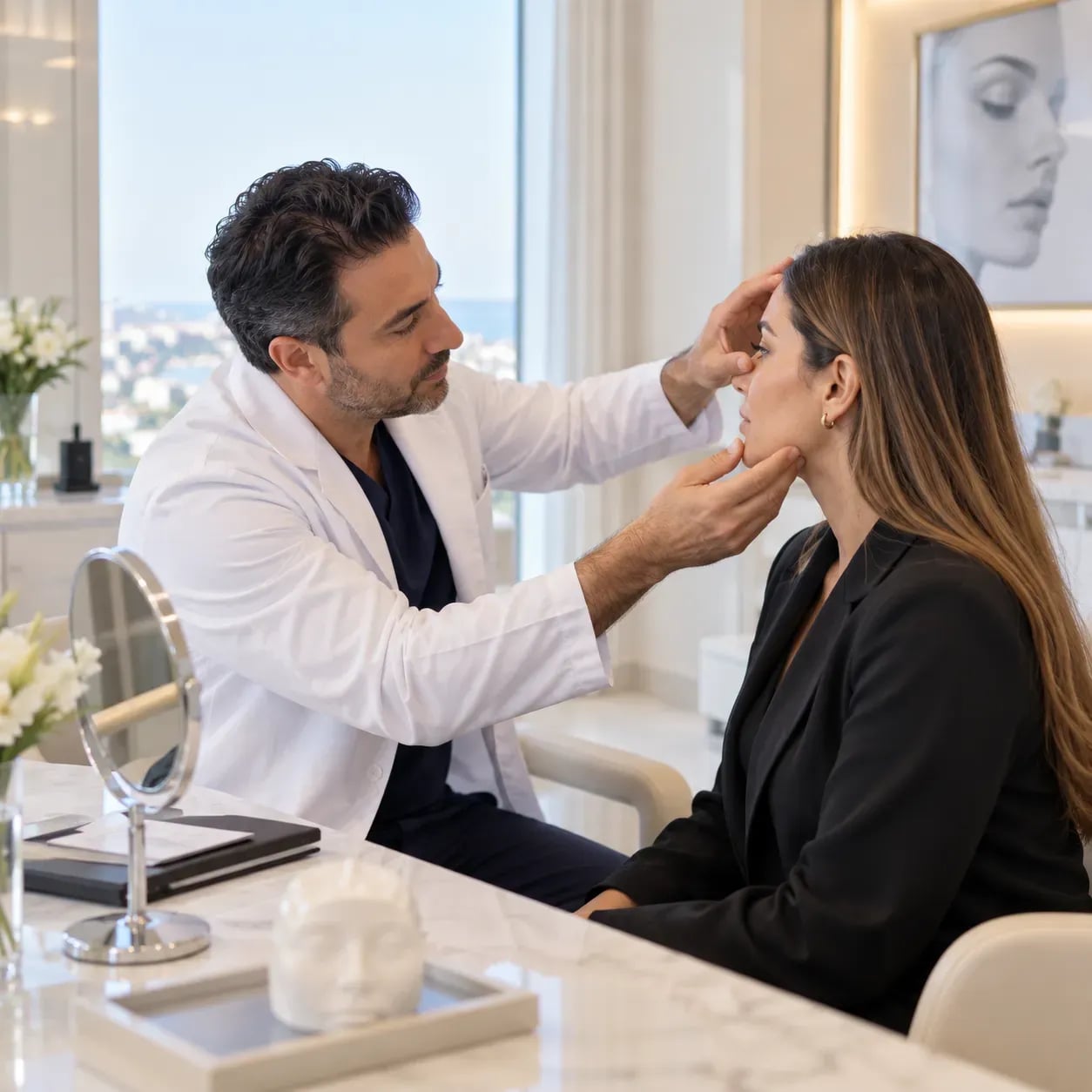
How much does facial fat transfer cost in Tunisia?
Facial fat transfer at ServiHealth starts at €2,100, with a recommended 3-day stay in Tunisia. The final figure depends on how many areas are treated, how much fat is needed, and whether the procedure is combined with anything else.
Three things move the price. The number of areas: temples alone is not the same operation as temples, cheekbones and under-eye hollows together. The harvest: a small, straightforward donor area costs less in theatre time than one that needs more work. What it is combined with: fat transfer is often added to another facial procedure, and the combined quote is lower than the two priced separately because one anaesthetic and one theatre session cover both.
Ask for the inclusions in writing before you commit, and read them against what you will actually need: nights of accommodation, airport transfers, the anaesthetist, the pre-operative tests, and the post-operative follow-up. A price is only comparable to another price once you know what each one contains. Your ServiHealth quote itemises this for your own case.
One cost that patients forget: a possible second session. It is not needed for everyone and it is never decided early, but if you are budgeting for a result rather than for an operation, allow for the possibility of a second trip at around six months.
Beware of comparing this with injectable prices. A syringe of filler looks cheaper on the day. Over five years, the comparison usually goes the other way, and the section further down sets out why.
| Procedure | Price | Stay |
|---|---|---|
| Facial fat transfer | 2100 € | 3 days |
What is facial fat transfer?
A face does not age only by creasing. It ages by emptying. Fat sits in the face in distinct compartments, and those compartments shrink and shift over time. Bone resorbs quietly underneath them. The result is a face with the same skin and the same features that nonetheless looks tired, flatter and older — the temples sink, the cheekbone loses its curve, a shadow appears under the eye, the jawline loses its edge.
That is a volume problem, and tightening skin does not fix it. Fat transfer — also called lipofilling, fat grafting, lipostructure or lipomodelling — addresses it directly by putting volume back where it was lost.
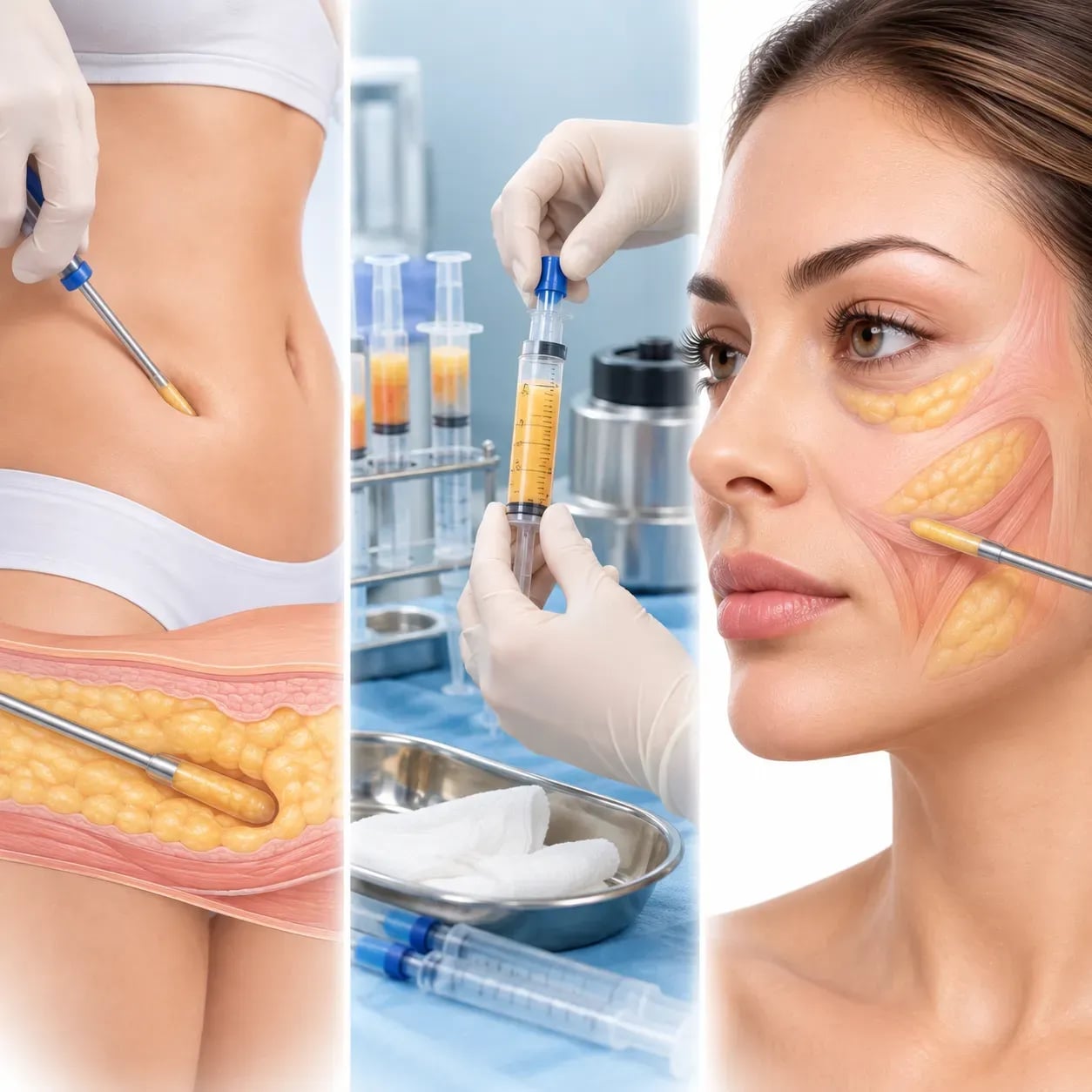
The operation has three stages. Fat is harvested from somewhere that has enough of it, most often the abdomen, hips or thighs. It is processed to separate the part that is worth reinjecting. It is then placed in the face in very small amounts, at several depths, through tiny entry points.
The quantities are small. This is not liposuction with a cosmetic side effect: the face needs a few tens of millilitres, not litres, which is why the donor area is rarely changed in any visible way. If you want fat removed from the body as the main goal, that is a different operation with different planning — see tummy tuck in Tunisia or BBL in Tunisia, where the fat harvested is the point rather than the raw material.
The aim is restoration, not enlargement. A well-judged fat transfer does not make a face bigger or change its proportions; it returns a face to a shape it used to have. Patients who bring photographs of themselves from five or ten years earlier give the surgeon the most useful information in the whole consultation.
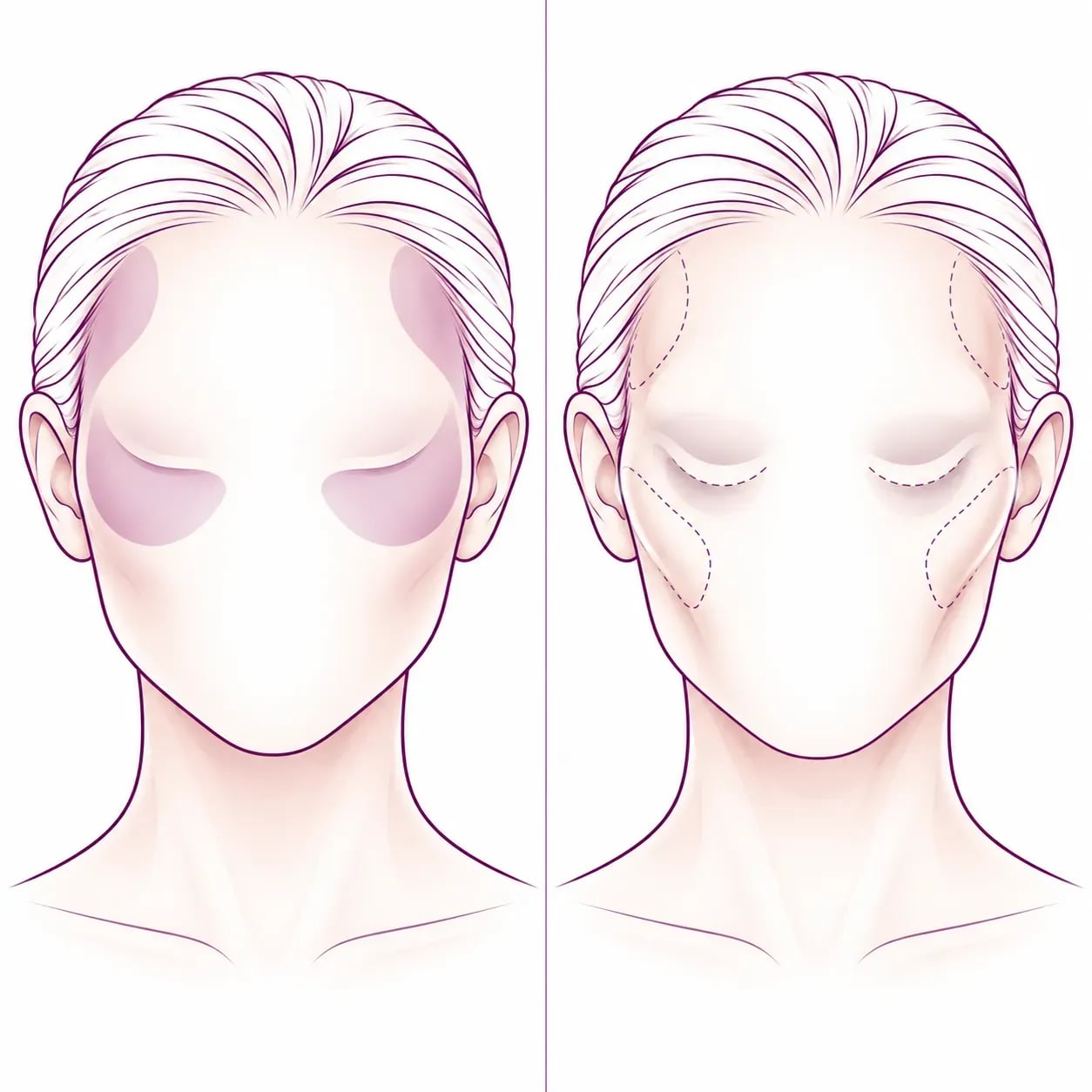
Which areas of the face can be treated?
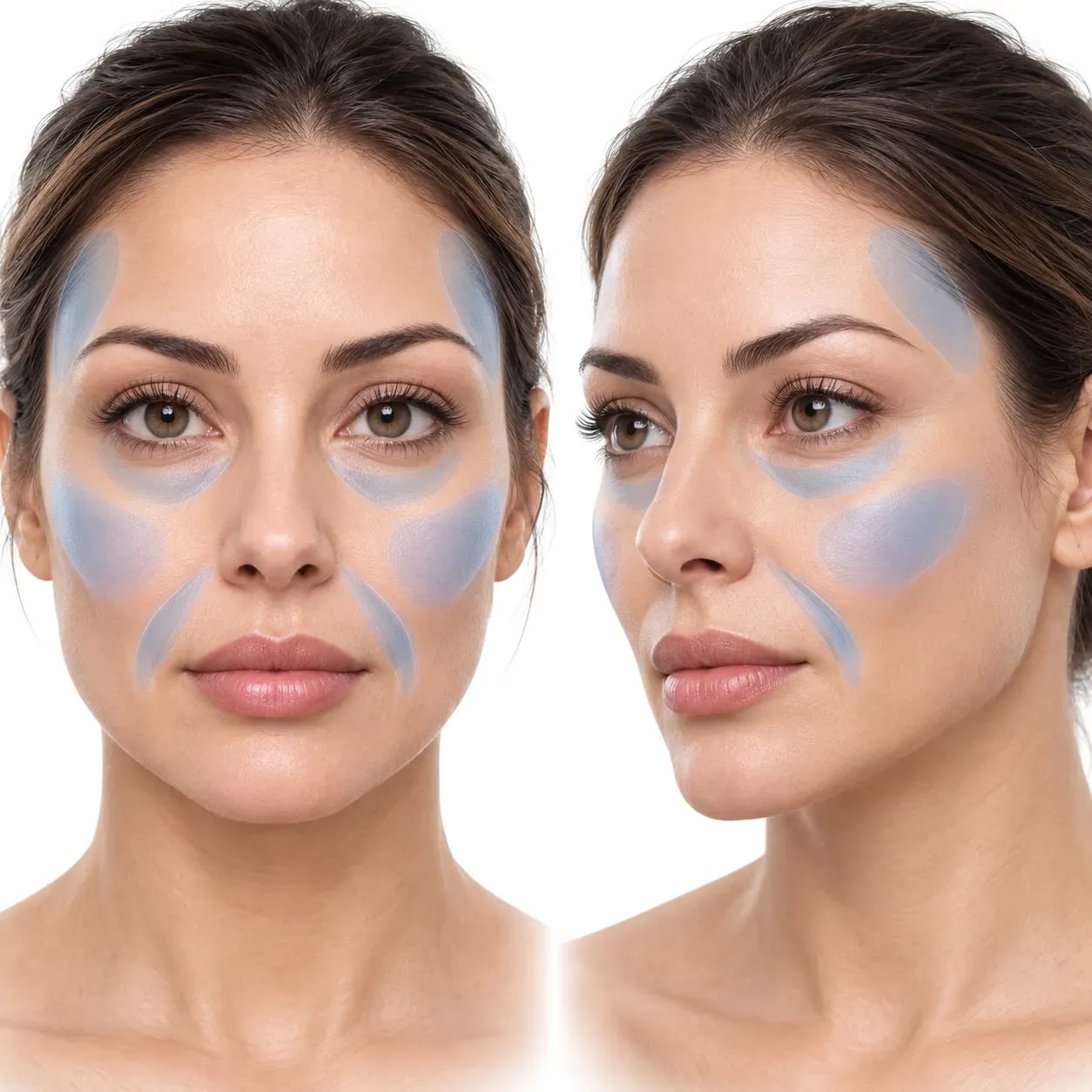
The areas most often treated are the temples, the cheekbones, hollow cheeks, the hollows under the eyes, the chin, and small contour irregularities. The folds running from the nose to the corners of the mouth are usually improved indirectly, by rebuilding the cheek above them, rather than by filling the crease itself.
| Area | What fat transfer does |
| Temples | Restores the flat or hollow area beside the eyes, which widens the upper face and softens a skeletal look. Technically demanding because of the blood vessels there. |
| Cheekbones | Rebuilds the curve that catches light. One of the areas where a small volume changes the most. |
| Cheeks | Fills hollowing, including after significant weight loss or with age. |
| Under-eye hollows | Smooths the step between the lower lid and the cheek. Suitable for a hollow, not for a bulge — see the next section. |
| Nasolabial folds | Usually softened by restoring the cheek above, not by injecting the fold. Filling the crease directly is not always the right move. |
| Chin and contour | Corrects small irregularities and adds definition. A structural chin problem is a different operation. |
Three areas call for particular caution: the temples, the forehead and the region around the eyes. Their blood supply is anatomically complex, and these are the areas where an injection placed in the wrong plane carries the most serious consequences. This is not a reason to avoid them. It is a reason they should be treated by a surgeon who does this routinely, with the technique that goes with it.
Equally important is what is not treated. Deciding to leave an area alone, or to put less in than the patient asked for, is part of a good indication rather than a shortfall. Overfilling a face is easy to do, obvious to everyone who sees it, and far harder to undo than it was to create.
If your concern is a chin that is set too far back rather than a chin that lacks contour, the structural correction is different — see chin surgery in Tunisia. If your concern is a lower face that feels too full rather than too empty, see buccal fat removal in Tunisia.
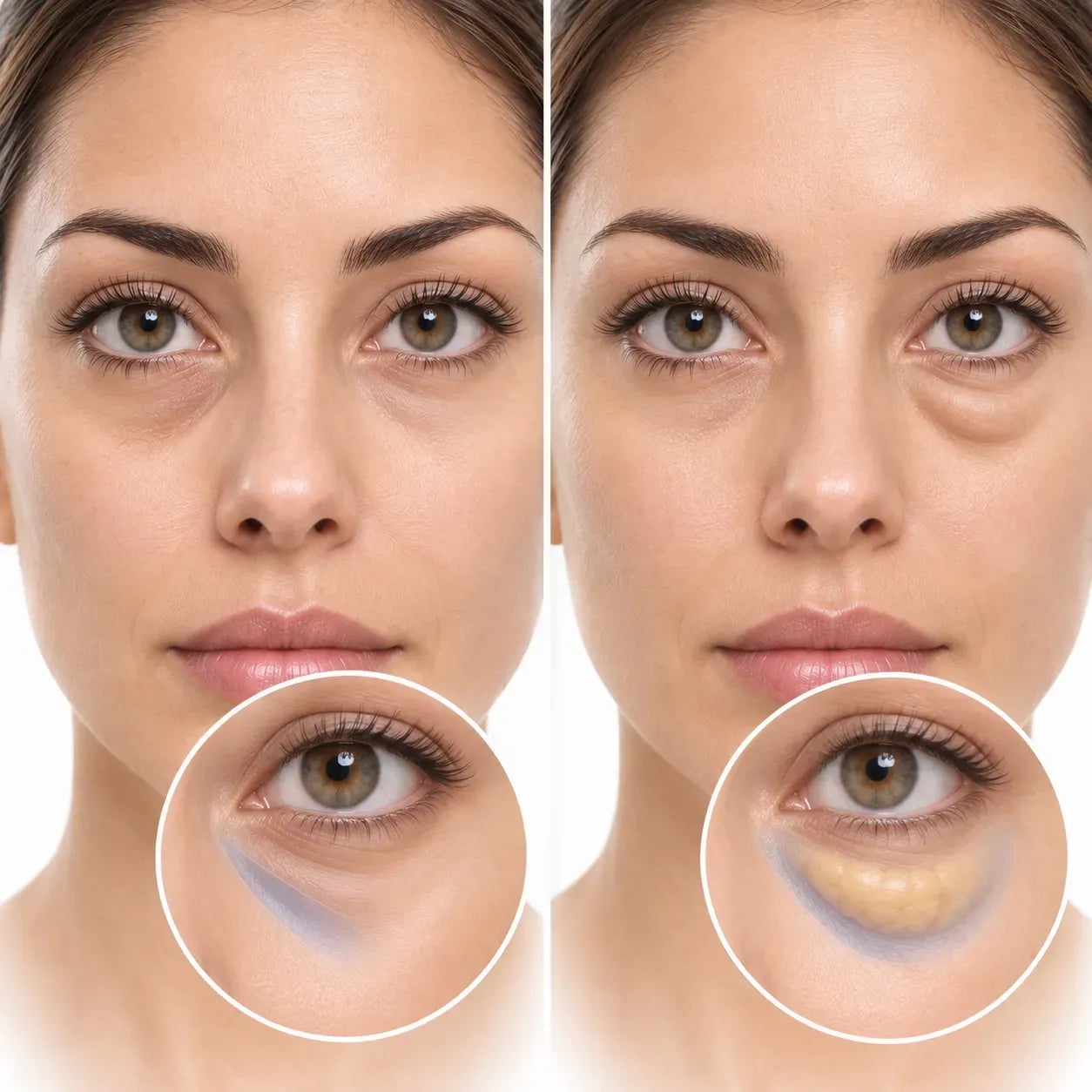
Under-eye hollows: is fat transfer the right treatment?
It depends entirely on what is causing the shadow, and there are three different causes that look similar in a mirror. Getting this wrong is the single most common reason a patient is disappointed by an otherwise well-performed procedure.
| What you have | What it looks like | What actually treats it |
| A hollow | A depression between the lower lid and the cheek, with a visible step. The shadow deepens in overhead light. | Fat transfer is designed for exactly this. |
| A bag | A bulge that protrudes rather than a dip. It is fat pushing forward, not fat that is missing. | Lower eyelid surgery, depending on size. Adding more volume to a bulge makes it worse. |
| Pigmentation | A genuinely darker colour of the skin itself, often present since adolescence and often familial. | Not a volume problem. Fat sits underneath pigmented skin without changing its colour. |
Many people have more than one of the three at once, which is why a photograph sent in advance and a face-to-face examination are not interchangeable. Skin here is the thinnest on the body and it forgives very little, so the assessment matters more than the technique.
Be wary of any assessment that promises to remove dark circles. Fat transfer can lift a hollow and soften the shadow it casts. It cannot change the colour of your skin, and anyone implying otherwise is describing a result they cannot deliver.
If the examination shows a bulge rather than a hollow, read our page on eyelid surgery in Tunisia.
How is facial fat transfer performed?
The procedure takes about one to two hours and is carried out under local anaesthesia with sedation, or under general anaesthesia, depending on how much is being treated. It has three stages.
| Stage | What happens |
| 1. Harvest | A small volume of fat is taken from a donor area with enough reserve — usually the abdomen, hips or thighs — through incisions a few millimetres long, placed in a fold or somewhere inconspicuous. |
| 2. Preparation | The harvested fat is processed to separate the portion worth reinjecting, by decanting, filtration or centrifugation depending on the surgeon's technique. |
| 3. Placement | The prepared fat is deposited in very small amounts, at several anatomical depths, through tiny entry points in the face. |
The third stage is where the result is decided. Where the fat is placed matters at least as much as how much of it goes in: the same volume put in the wrong plane produces a heavy, flat or lumpy face, while the right volume placed correctly reads as the patient simply looking well. Small deposits spread across several layers also give each parcel of fat contact with a blood supply, which is what allows it to survive.
Your surgeon will deliberately put in slightly more than the final target, because part of it will be reabsorbed. That overcorrection is intentional. It is also why you look fuller in the first weeks than you expect to look, and why judging the outcome early tells you nothing useful.
Scarring is minimal. The facial entry points are tiny, sometimes closed with a single stitch, and become difficult to find. The donor incisions are a few millimetres and are positioned where clothing or a natural fold covers them.
How much of the fat survives?
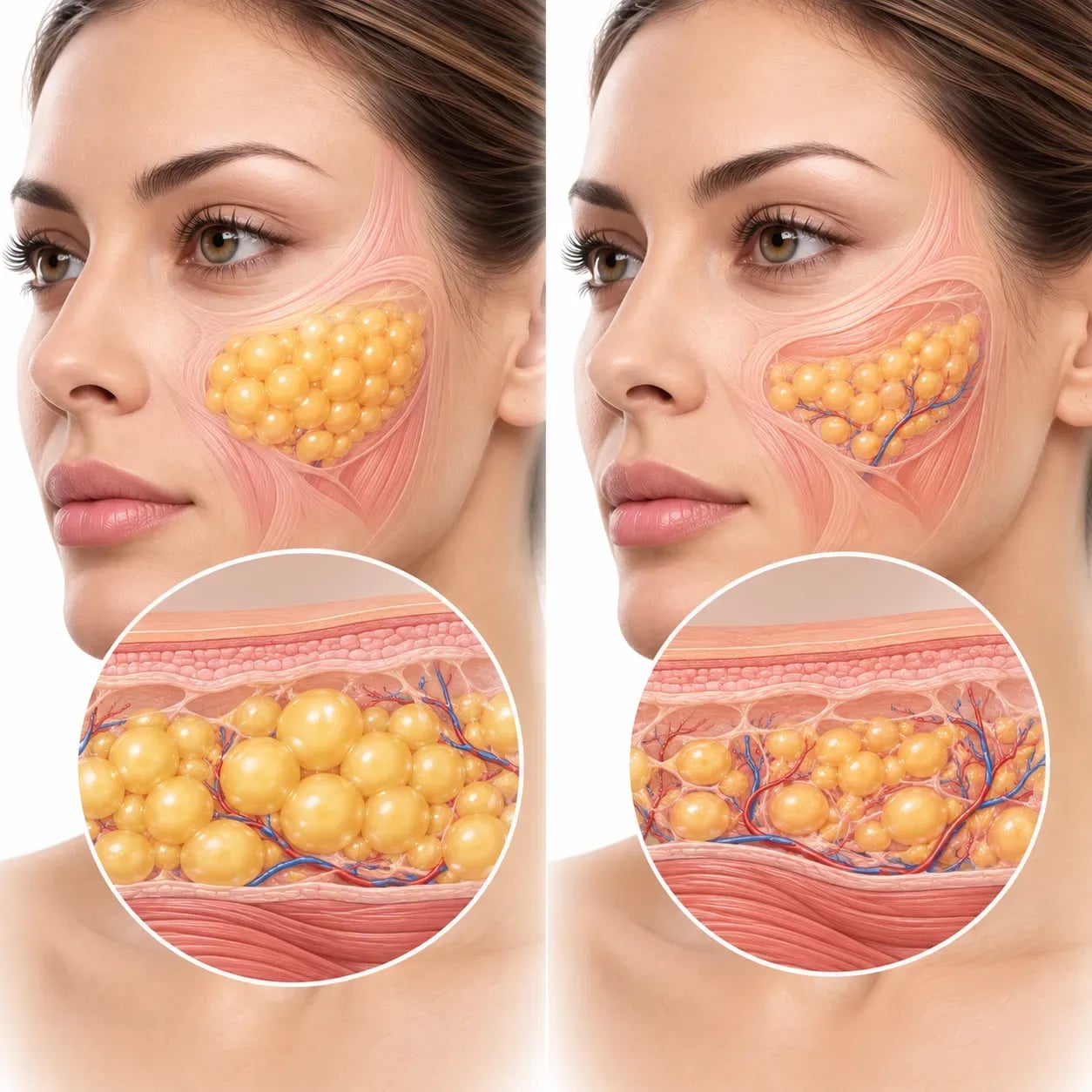
Not all of it. A meta-analysis of 27 studies covering more than 1,000 patients reported facial fat retention ranging from 26% to 83%, with a pooled average of roughly 47%. That is the honest answer, and the width of that range is the important part of it.
Roughly half is a reasonable planning assumption. It is not a promise, and no one can tell you in advance where in that range you will fall. A surgeon who quotes you a precise survival percentage for your own face is quoting a number that does not exist.
Several things influence it, some within your control and some not:
- Technique. How the fat is harvested, processed and placed — small deposits across several layers survive better than a single large bolus.
- The recipient area. Well-vascularised, stable areas hold fat better than mobile ones. Grafts around the mouth, which never stops moving, are typically less reliable than grafts on the cheekbone.
- Smoking. Nicotine constricts small blood vessels, and small blood vessels are precisely what a fat graft depends on to stay alive. This is the biggest single factor a patient controls.
- Weight stability. Transferred fat cells behave like the fat they came from. Significant weight change after the procedure changes the result in both directions.
- Biology. Some of it is simply individual and cannot be predicted.
The practical consequence for someone travelling: plan the operation around the biology, not around your calendar. Resorption happens over months, not days, so the trip you book is for the procedure, and the assessment of whether it achieved what you wanted happens much later, from where you live.
Is facial fat transfer permanent?
The fat that survives the first months is generally durable, but "durable" is not the same word as "permanent", and the distinction matters.
Fat cells that establish a blood supply become living tissue in their new location. They are not a product that wears off on a schedule the way an injectable does. In that sense the result is lasting.
But they remain your own fat, and they behave accordingly. They respond to weight gain and weight loss. And the face around them continues to age: the bone keeps resorbing, the skin keeps changing, the remaining native fat keeps shifting. A graft placed at forty-five is still there at fifty-five; the face it sits in is not the same face.
So the realistic framing is this. Fat transfer resets volume at a point in time and that reset holds. It does not stop the process that created the problem. Many patients are satisfied for many years without doing anything further. Some choose a top-up later, for the same reason they had the first one.
What it does not do is tighten anything. If the issue is loose skin rather than lost volume, adding volume underneath it will not lift it — see facelift in Tunisia.
When will I see the final result?
Volume can begin to be assessed at around three months, and stabilises by around six. Anything you see before that is a mixture of swelling, deliberate overcorrection and fat that has not yet decided whether it is staying.
| When | What you are looking at |
| Days 1–7 | Swelling, at its most noticeable. The face looks considerably fuller than the intended result. Bruising possible, on the face and at the donor site. |
| Week 2 | Swelling usually no longer obvious to others. Still not the result. |
| Weeks 3–8 | Swelling settles, some of the graft is reabsorbed, contours become more natural week by week. |
| Around 3 months | The volume can reasonably be judged for the first time. |
| Around 6 months | Stabilised. This is the point at which a top-up is discussed, if it is discussed at all. |
This timeline is the reason to be careful about booking a facial procedure close to a wedding, a reunion or any dated event. Three weeks is enough to look normal. It is not enough to look like the result.
It is also the reason to take proper photographs before you travel: same light, same angles, no makeup. In six months you will not reliably remember what your temples looked like, and neither will anyone else. Patients who skip this step routinely underestimate their own result.
Do not request a top-up before six months. Adding fat to a graft that is still resorbing risks overcorrecting a face that was going to be fine.
Fat transfer or dermal fillers: what is the difference?
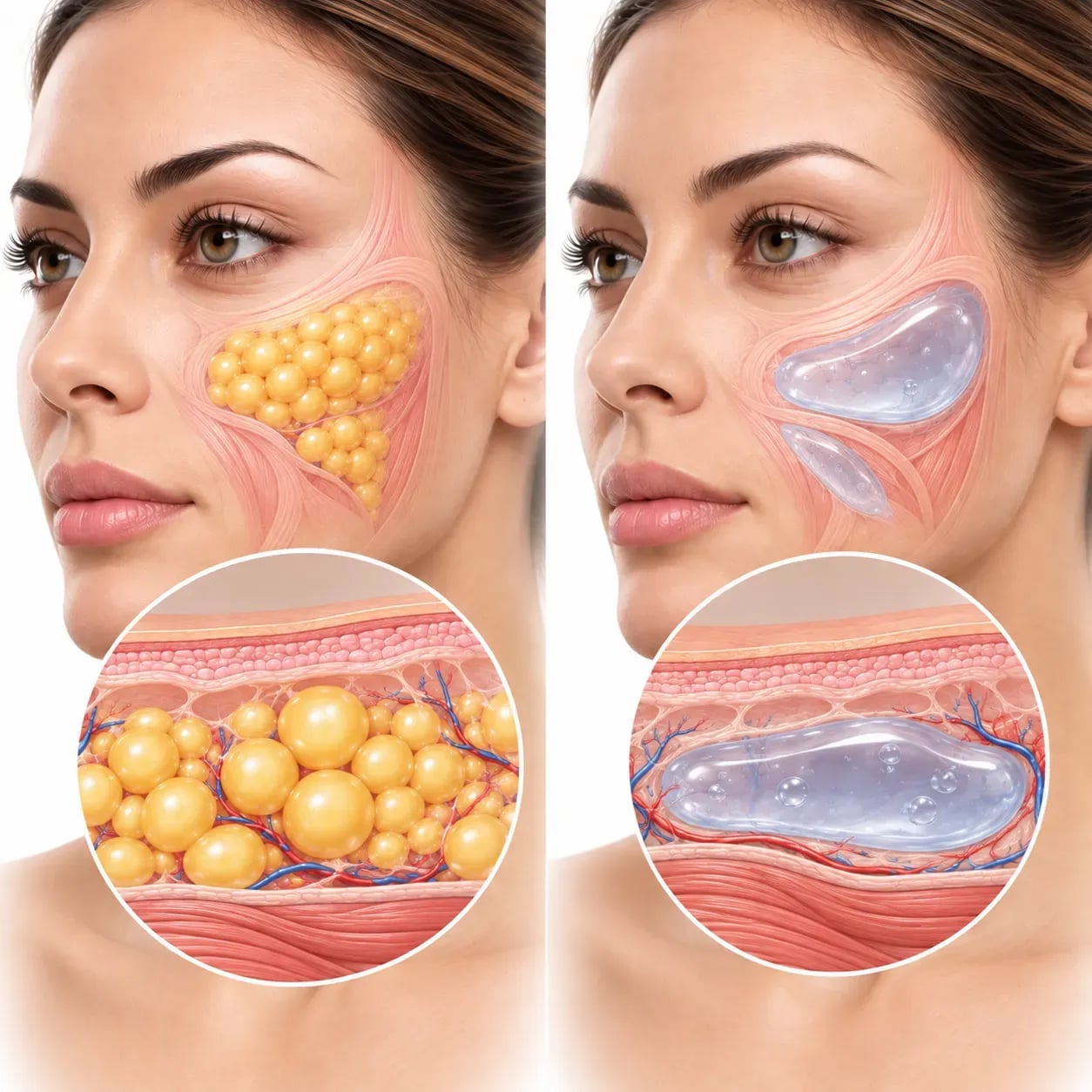
Fillers are a product injected into the face; fat transfer is an operation that moves your own tissue. They can achieve similar shapes, by routes that have almost nothing in common.
The honest trade-off is reversibility against durability. Hyaluronic acid can be undone, which is genuinely reassuring if you have never had anything done before and are not certain you will like it. Fat cannot be undone, which is the price of it lasting.
That argues for a sensible order for someone new to this: try the reversible option first, in modest quantity, see whether you actually enjoy having volume back in your face, and convert to the durable option once you know the answer. Many patients do exactly this. Nobody is obliged to, but nobody regrets it either.
It also argues the other way for anyone who has been maintaining fillers for several years and is tired of the schedule and the cumulative cost. Read our page on dermal fillers in Tunisia for what the injectable route involves.
One point that matters for safety rather than cost: if you have had fillers, tell your surgeon — which product, which areas, which dates, as precisely as you can. Old product does not always disappear on the schedule the brochure suggested, and operating into an area that still contains an unidentified gel is a different proposition from operating into untouched tissue.
| Facial fat transfer | Hyaluronic acid fillers |
|---|---|
| Uses your own fat | Uses a manufactured injectable product |
| Requires a fat harvest | Requires no harvest |
| A surgical procedure, under anaesthesia | Generally performed without surgery |
| About one to two weeks of visible swelling | Hours to a few days of downtime |
| Part of the fat is reabsorbed over the first months | The product is reabsorbed progressively |
| The fat that integrates can last for years | A temporary result, lasting months |
| Not reversible: correcting an excess means surgery | Can be dissolved with an enzyme injection |
| Result judged at three to six months | Result visible immediately |
| Suited to several areas lacking volume | Well suited to a localised correction |
Fat transfer or a facelift: which one do I need?
They solve two different problems, and the question is not which is better but which problem you have.
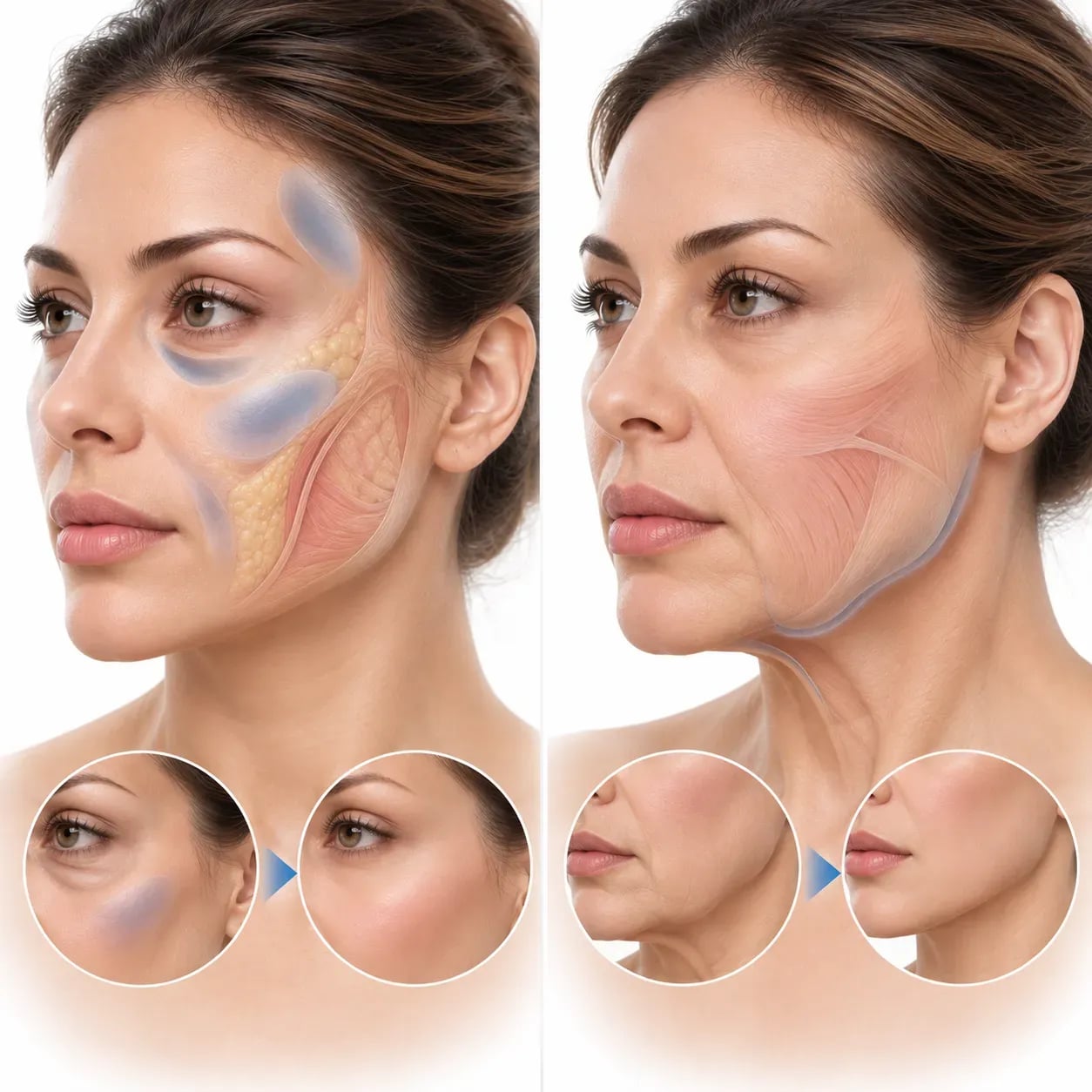
A facelift repositions tissue that has descended and removes the skin left over. It addresses sagging: a jawline that has blurred, jowls, a neck that has lost its angle. It does not add volume, and a facelift performed on a face that is hollow rather than loose can leave it looking tighter and no younger.
Fat transfer adds volume where it has been lost. It addresses emptiness: flat cheekbones, sunken temples, hollow cheeks. It does not lift anything, and adding volume to a face whose problem is loose skin tends to make the skin look heavier rather than younger.
A simple test in front of a mirror. Look straight ahead and then lie back, or tilt your head back and look up. If your face looks markedly better lying down, gravity is the problem and lifting is the answer. If it looks much the same but still flat and tired, volume is the problem.
In practice the two are frequently combined, and that combination is one of the most common pairings in facial surgery: the lift restores the position, the fat restores the fullness. Done in one theatre session, under one anaesthetic, it costs less than two separate trips and gives a more coherent result than either alone.
Your surgeon decides which applies in your case, and that decision belongs to the consultation rather than to a web page. Read our page on facelift in Tunisia. For a non-surgical approach to mild laxity, see thread lift in Tunisia.
Can I have fat transfer if I am very slim?
Usually yes. The volumes needed for a face are small, and most people who consider themselves thin still have a harvestable deposit somewhere — the lower abdomen, the inner thigh, the flank, the area above the knee. Your surgeon will look for it at the consultation rather than assume it from a photograph.
There is nonetheless a genuine lower limit. If there is not enough fat to harvest safely, the operation cannot be done well, and a surgeon who tells you so is protecting your result rather than turning away your business. In that situation the alternatives are injectable volume or, depending on the problem, a different procedure altogether.
Three points specific to very slim patients:
- Do not gain weight for the operation. Putting on several kilos to create a donor area means the transferred fat is drawn from a body that is about to change, and the result changes with it when you return to your usual weight.
- Do not lose weight either. A strict diet in the weeks before surgery is the other version of the same mistake. Arrive at a weight you can hold.
- Be realistic about the number of areas. A limited harvest may mean treating two areas properly rather than four partially. Treating four partially is the worse outcome.
Patients who have already had liposuction in their usual donor areas should say so, with the areas and the dates, since it changes where the surgeon will look.
Facial fat transfer before and after: what result should I expect?
The honest description of a good result is that people notice you look well and cannot say why. They comment on your sleep, your holiday, your haircut. The face is read as rested rather than as treated.
What you can reasonably expect: temples that no longer read as hollow, a cheekbone that catches light again, a softer transition between lower lid and cheek, cheeks with more substance, and an overall impression that the face is less drawn.
What you should not expect:
- A lift. Volume does not raise what has descended.
- A different face. This restores proportions, it does not redesign them.
- Removal of fine lines. Surface texture and wrinkles are a skin question, not a volume one.
- Pigmented dark circles to lighten. Fat sits beneath the skin and does not alter its colour.
- Symmetry that did not exist before. Every face is asymmetric. A good result respects your asymmetry rather than erasing it, and erasing it is what makes a face look operated on.
A warning about before-and-after photographs, including good ones. Lighting controls almost everything in facial volume photography: a light placed slightly higher creates hollows, slightly lower fills them. Two photographs of the same untreated face can show a dramatic difference. When you assess any clinic's gallery, including ours, look for identical lighting, identical angle and a neutral expression in both frames. If the lighting changed, the photograph is telling you nothing.
Results vary from one patient to another, and your surgeon will tell you at the consultation what is realistic for your own face.
What is recovery like?
Expect about one to two weeks before you look unremarkable in public, depending on how much was treated. Pain is generally mild; the inconvenience is swelling and bruising, not discomfort.
| When | What to expect |
| First days | A visibly swollen face. Possible bruising on the face and at the donor area. Tension, sensitivity or temporary numbness. Sleep with the head raised. Prescribed painkillers are generally sufficient. |
| Around 1 week | Most patients are presentable without having to explain themselves. Makeup is usually possible once the entry points have closed — your surgeon gives the exact timing. |
| Around 2 weeks | Swelling no longer obvious. Normal social and working life. |
| Several weeks | No intense exercise. Walking is fine from the first days. |
The donor site is often the part patients did not anticipate. The face is tender; the abdomen, hip or thigh where the fat was taken is usually more so, and stays sensitive or bruised a little longer. It is a minor matter, but it is easier if you were expecting it.
Two things to arrange before you leave home: a travel pillow so you can sleep with your head elevated on the flight and afterwards, and sunglasses and a scarf or cap, which make the journey home considerably more comfortable while your face is still swollen.
And plan the calendar honestly. Allow roughly one to two weeks after your return without obligations that require you to look your best. Most people manage with less. Nobody regrets having allowed more.

What are the risks?
Facial fat transfer is a surgical procedure and carries real risks. They should be read before booking, not after.
- Asymmetry and irregularities. Fat does not always resorb evenly on the two sides. Small irregularities or palpable lumps can appear and may need correction.
- Under- or overcorrection. Too little is straightforward to address later. Too much is considerably harder, and is the reason a careful surgeon errs on the conservative side.
- Fat cysts and fat necrosis. Grafted fat that does not establish a blood supply can form a cyst or a firm nodule. These are sometimes felt rather than seen, and sometimes need treatment.
- Infection. Uncommon, treatable, but possible at both the facial and the donor sites.
- Bruising, swelling and temporary altered sensation, expected in every case and resolving with time.
- Serious vascular complications. If fat is accidentally injected into a blood vessel it can block it. This is rare, and it is the most serious risk of the procedure. The anatomy around the temples, forehead and eyes is the reason those areas demand the most technically careful work and the most experienced hands.
Circumstances that may make you unsuitable, temporarily or permanently: an unstabilised medical condition, an active infection, a clotting disorder, certain medications, a contraindication to anaesthesia, insufficient donor fat, and smoking. Each of these is assessed individually by the surgeon and the anaesthetist.
Smoking deserves its own line. It is not an administrative box. Nicotine narrows the small vessels that a fat graft needs in order to survive, so it both raises the complication rate and reduces the amount of fat that stays. Stopping for the period your surgeon specifies is the most useful thing you can do for your own result.
Say what you have had done before, in full: every facial injection, including products whose name you were never told, with areas and approximate dates; every previous facial operation; and any procedure on the areas being considered as donor sites, liposuction included. Patients sometimes leave this out through embarrassment. It is clinical information, not a confession.
Why have facial fat transfer in Tunisia?
Tunisia has run an organised medical travel sector for decades, with private clinics built around international patients, surgeons trained to European standards, and costs that reflect Tunisian overheads rather than Tunisian shortcuts.
Practical considerations that matter specifically for patients flying in:
- Distance. Around two to three hours from most of Western Europe, and direct connections from several Gulf hubs. Short enough to avoid a long-haul flight on a swollen face.
- Language. ServiHealth coordinates in English throughout, from the first exchange to the follow-up after you are home.
- One setting. Consultation, anaesthetic assessment, theatre and first post-operative checks all happen in one place over a short stay, rather than across several separate appointments weeks apart.
- Cost. The difference comes from where the clinic operates, not from what is left out of the operation.
Two things to weigh honestly before you decide. Follow-up is at a distance: if a nodule appears at month four, you will be dealing with it from where you live, so ask before you travel exactly how that is handled and by whom. And fat transfer is a procedure judged at six months, which means the relationship with your provider has to outlast the trip. Ask what happens at six months if the result needs revisiting, and get the answer in writing.
Many patients combine procedures in a single stay. That is sensible when the combination is surgically coherent; it is a poor idea when it is driven by the travel budget rather than by the plan. Your surgeon decides what can reasonably be done in one session.
Your surgeons
Facial fat transfer at ServiHealth is performed by qualified plastic surgeons at the Clinique Internationale Myron in Tunis.
- Dr Taher Djemal — plastic and aesthetic surgery
- Dr Abir Ben Ouaghrem — plastic and aesthetic surgery
The surgeon assigned to your case is confirmed in your quote before you travel, and you meet them in person for the consultation before anything is decided.
Some questions worth asking at that consultation, because the answers tell you more than any brochure:
- Which areas are you recommending, and which are you deliberately leaving alone?
- How much do you expect to put in, and how much of that do you expect to remain?
- What is your approach around the temples and the eye area?
- What would make you advise against operating on me?
- If I want a top-up at six months, how is that handled from abroad?
A surgeon who answers the fourth question readily is usually the one you want. The indication — what to treat, how much, and whether to treat at all — is a medical decision and belongs to them, not to ServiHealth.
How your stay with ServiHealth works
ServiHealth organises and coordinates the stay. The medical decisions are made by the surgeon and the anaesthetist; our role is everything around them.
| Stage | What happens |
| First contact | You send photographs and your medical background. A first review is carried out remotely, and we tell you whether the procedure appears appropriate before you spend anything. |
| Quote | A written quote setting out what is planned, what the price covers and what it does not. |
| Preparation | Pre-operative tests, to be completed around 15 days before surgery according to the protocol you are given. Dates, flights and the programme for the stay are fixed. |
| Arrival | You are met at Tunis-Carthage airport and taken to your accommodation. Send us your boarding pass and a photograph of what you are travelling in, so we can find you quickly. |
| Consultation | Face-to-face examination with the surgeon and the anaesthetic assessment. The plan is confirmed, adjusted or reconsidered at this point. |
| Procedure | One to two hours at the Clinique Internationale Myron. |
| During the stay | First post-operative checks before you fly home. |
| After you return | Follow-up continues remotely, with a contact you can reach. |
Tell us immediately about anything that affects the journey — a delayed flight, a changed booking, a missed connection, lost luggage. Most of it is straightforward to absorb if we know in time, and difficult if we find out at the airport.
A short note on the consultation. It can change the plan. A surgeon who examines you in person may recommend fewer areas than discussed, a different approach, or in some cases a different procedure. That is the consultation doing its job. The remote review is a first opinion from photographs, not a diagnosis.
Before you travel: a checklist
Work through this before you book, not the week before you fly.
| Category | What to do |
| Documents | A valid passport, and a visa if your nationality requires one for Tunisia. Check the expiry date. |
| Photographs | Recent photographs: front, both profiles and three-quarter, without makeup, in natural light. One photograph of the areas you expect fat to be taken from. If you have photographs of yourself from five to ten years ago, bring them — they show the surgeon what you have actually lost. |
| Pre-operative tests | Completed around 15 days before surgery, following the protocol you are given. |
| Previous injections | Every facial injection you have had: hyaluronic acid, muscle-relaxing injections, threads, and anything whose name you were not told. Areas and dates where possible. |
| Previous surgery | Any previous facial surgery, and any procedure on the potential donor areas, including liposuction. |
| Medication and allergies | A full list. Stop aspirin, anti-inflammatories and certain supplements in the days before, unless your own doctor instructs otherwise. |
| Weight | Stable for several months. No strict diet in the preceding weeks. |
| Smoking | Stop for the period your surgeon specifies. This affects how much fat survives. |
| Skin treatments | No peels, lasers or aggressive facial treatments in the weeks before. Declare anything recent so the surgeon can set the interval. |
| To pack | Front-opening tops for the day of surgery, loose clothing for the donor area, a travel pillow, sunglasses and a scarf or cap for the journey home. |
| Your calendar | Around one to two weeks after you return without obligations that require you to look your best. Do not book this close to a dated event. |
Considering more than one procedure during the same stay? Read the relevant pages first: facelift, eyelid surgery, chin surgery, buccal fat removal or hair transplant in Tunisia. What can reasonably be combined in one session is decided by your surgeon.








Frequently asked questions about Facial Fat Transfer in Tunisia
Facial fat transfer at ServiHealth starts at €2,100, with a recommended stay of 3 days. The final price depends on how many areas are treated, how much fat is needed, and whether the procedure is combined with anything else. Your written quote sets out what is covered.
Your own. Fat is harvested from an area of your body with enough reserve, most often the abdomen, hips or thighs, then prepared and reinjected into the face. No donor tissue and no manufactured product are involved, which is why there is no risk of rejection.
No. Part of it is reabsorbed over the first weeks and months. A meta-analysis of 27 studies covering more than 1,000 patients reported retention between 26% and 83%, averaging around 47%. Your surgeon deliberately places slightly more than the target volume to allow for this.
The fat that survives the first months is durable, because it becomes living tissue with its own blood supply. It is not permanent in the sense of being unaffected by time: it responds to weight change, and the face around it continues to age. Many patients are satisfied for years; some choose a top-up later.
If what you have is a hollow, yes — fat transfer is designed for it. If what you have is a bulge, adding volume makes it worse and lower eyelid surgery is the relevant option. If the darkness is pigmentation of the skin itself, fat sits underneath it and does not change its colour. An in-person examination establishes which of the three applies.
Yes, and the temples are one of the areas where a small volume makes the most difference to how rested a face looks. They are also anatomically demanding because of the blood vessels there, which is why they call for a surgeon who treats this area routinely.
Usually. The volumes needed for a face are small, and most slim patients have a harvestable deposit somewhere. There is a genuine lower limit, and if there is not enough fat to harvest safely your surgeon will say so. Do not gain weight to create a donor area — the result changes when you return to your usual weight.
Fillers are a manufactured gel injected in a consulting room, with almost no downtime, lasting months, and reversible with an enzyme injection. Fat transfer is an operation using your own tissue, with one to two weeks of visible swelling, durable once stabilised, and not reversible. The real trade-off is reversibility against durability.
A facelift repositions tissue that has descended and removes excess skin; it treats sagging. Fat transfer restores lost volume; it treats emptiness. They address different problems and are frequently combined in one session. Your surgeon determines which applies to your face.
Swelling is at its most visible in the first days, usually no longer obvious to others at around two weeks, and continues to settle over the following weeks. The face looks considerably fuller at first than the intended result, partly from swelling and partly from deliberate overcorrection.
Volume can begin to be judged at around three months and stabilises by around six. Judging the result before three months is not meaningful, because swelling and resorption are both still in progress.
Yes. A second session is sometimes discussed once the result has stabilised at around six months, particularly if resorption was greater than expected. It is not systematic and it should never be decided earlier, because adding fat to a graft that is still resorbing risks overcorrection.
A stay of 3 days is recommended, which covers the consultation, the anaesthetic assessment, the procedure and the first post-operative checks. Allow around one to two weeks after you return before you have obligations that require you to look your best.
Pain is generally mild and prescribed painkillers are usually sufficient. Most patients find the donor site more uncomfortable than the face. The main inconvenience is swelling and bruising rather than pain.
The entry points on the face are tiny, sometimes closed with a single stitch, and become difficult to find. The donor incisions are a few millimetres long and are placed in a fold or somewhere inconspicuous.
Frequently, and the combination with a facelift is one of the most common in facial surgery: one restores position, the other restores volume. Combining procedures in a single theatre session also costs less than two separate trips. What can reasonably be combined in your case is decided by your surgeon.
Usually after a few days, once the injection points have closed. Your surgeon gives you the exact timing, which depends on how many areas were treated.
Walking is fine from the first days. Intense exercise should be avoided for several weeks, and your surgeon will specify how many for your case.
It can affect it. Transferred fat cells behave like the fat they came from and respond to weight change in both directions. This is why your surgeon asks for a stable weight for several months before the procedure, and why significant weight loss afterwards may alter the volume.
Not for everyone. It is one possible outcome of a procedure whose retention varies widely between patients, and it is discussed from around six months, once the result has stabilised. If you are budgeting for a result rather than for an operation, it is sensible to allow for the possibility.
Accidental injection of fat into a blood vessel, which can block it. It is rare, and it is the reason the temples, forehead and the area around the eyes demand the most technically careful work. This is also why previous injections matter: tell your surgeon which product, which areas and which dates, including any injection whose product name you were never told. Filler does not always disappear on the schedule you were quoted, and operating into tissue that still contains an unidentified gel is a different proposition from operating into untreated tissue.