

Chin Surgery in Tunisia: Genioplasty, Chin Implant and Price

Chin surgery in Tunisia: the essentials
Genioplasty repositions the chin. The bone is cut, moved to where it should be and fixed with small plates, through an incision inside the mouth. It can bring a receding chin forward, set a prominent one back, or correct an asymmetry.
That is a different operation from a chin implant, which sits on top of the bone and can only push the chin forward. Both are available here, and section 4 explains which does what.
Is it a double chin rather than the chin itself? That is submental liposuction. A small amount of extra projection, without surgery? That is filler.
It is performed by Dr Taher Djemal and Dr Abir Ben Ouaghrem at Myron International Clinic in Tunis, with English-speaking support throughout.
| Operating time | 45 minutes to 1h30 |
| Anaesthetic | General |
| Stay in Tunisia | 3 days |
| Scar | None on the skin — the incision is inside the mouth |
| Numbness | Expected afterwards; weeks to months |
| Final result | 6 months |
| Price | €1,800 setback, €2,000 advancement |
Is it your chin, or is it your jaw?
A weak chin in profile has four possible causes, and moving the chin bone only fixes one of them.
A genuinely set-back chin, with a normal bite and a normal jaw. This is what genioplasty corrects, and the result is excellent.
A short lower jaw — retrognathia. The whole mandible sits too far back, which usually shows in the bite: the upper incisors visibly overhang the lower ones. A genioplasty does not correct this. It moves the chin point forward and leaves the jaw and the bite where they were. The treatment is orthognathic surgery, usually with orthodontics, and it is a considerably bigger undertaking.
Fat under the chin. A double chin erases the jaw outline and makes the chin look weaker than it is. Submental liposuction alone sometimes redraws the angle completely.
A slight lack of projection, where surgery is more than the problem requires. Hyaluronic acid filler handles it, temporarily.
More than one is usually involved. The surgeon assesses it, sometimes with an X-ray, and an orthodontic opinion is requested where the bite is in question. If your bite is part of the problem, you will be told that a genioplasty alone is not the answer — which is worth hearing before you book, not after.
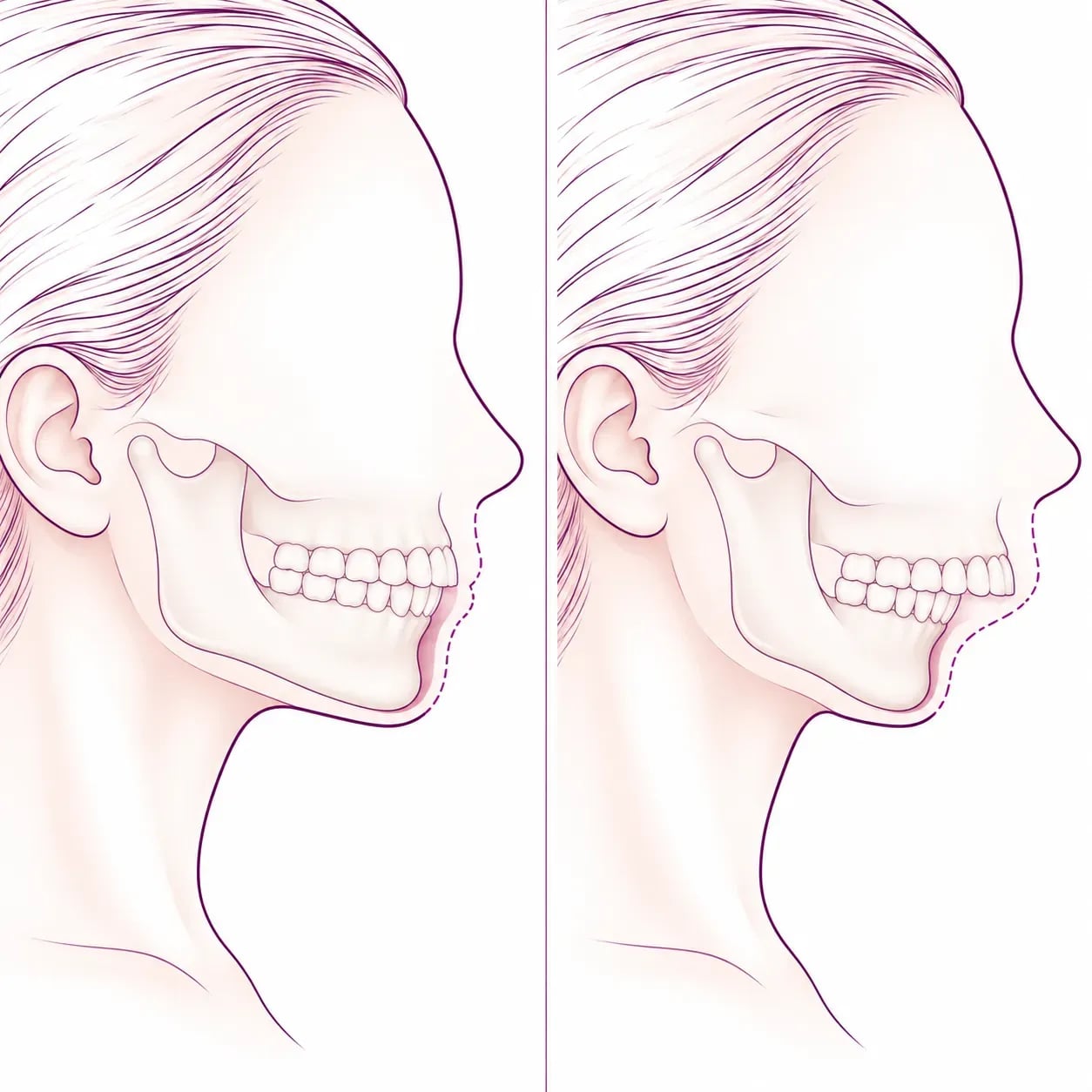
Advancement or setback?
Advancement brings a receding chin forward. This is the more frequent request, at €2,000.
Setback moves a prominent chin backward, at €1,800.
In both cases the technique is the same: the chin bone is cut below the tooth roots and below the nerve, moved to the planned position, and fixed there with small titanium plates. The bone heals in its new position.
The same approach also corrects a chin that is off-centre, and can lengthen or shorten the chin vertically. That range is what distinguishes a bone procedure from an implant.
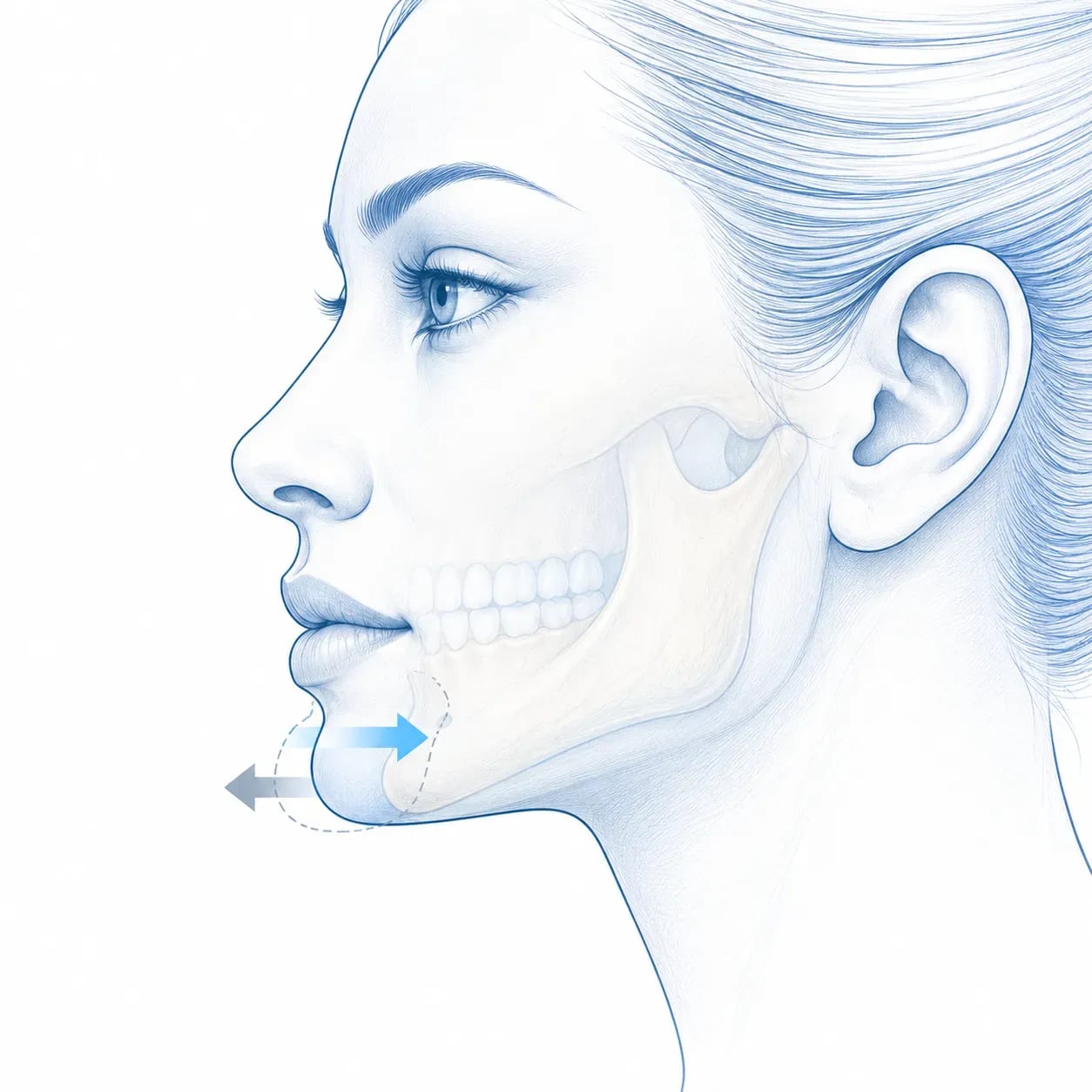
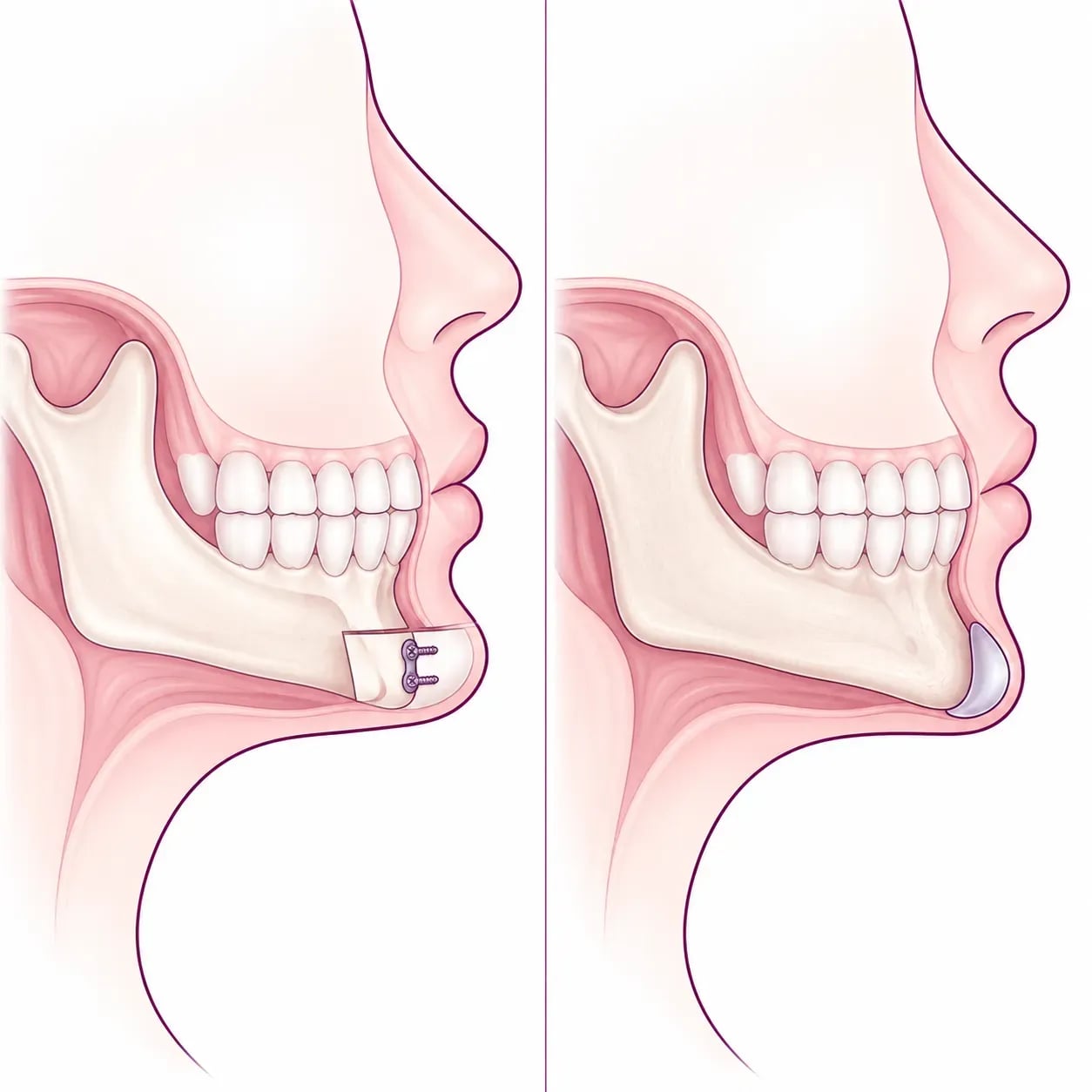
Sliding genioplasty or a chin implant?
If you have been researching this in English you will mostly have found chin implants, because they are simpler to perform and more widely offered. The distinction matters.
| Sliding genioplasty (bone) | Chin implant | |
| What happens | The bone is cut, moved and fixed with plates | A silicone implant is placed on the bone |
| Can advance | Yes, including substantially | Yes, modestly |
| Can set back | Yes | No |
| Can correct asymmetry | Yes | Poorly |
| Can change height | Yes | No |
| Foreign material | Plates only | An implant, permanently |
| Price | €1,800 to €2,000 | On quotation |
What the bone procedure does that an implant cannot: set a chin back, correct an asymmetry, change the vertical height, and move the chin more than a little.
And a point rarely made. A chin implant sits against the bone and can, over many years, cause slow erosion of the bone beneath it. The wear is generally modest and slow, but it is real, and it is one reason a bone procedure is preferred where a meaningful change is wanted. An implant can also migrate or become infected, which plates essentially do not.
Where an implant makes sense: a small advancement, in someone who wants a shorter operation. It is a legitimate choice for the right case, and it is offered here on quotation.
Which suits you is decided at the consultation. Ask specifically which you are being proposed and why — if a provider only ever offers one of the two, that tells you what they are equipped to do rather than what you need.
Numbness of the lip and chin: expect it
This is the part to understand properly before you consent, and it is not a rare complication.
The mental nerve supplies sensation to the lower lip and the chin, and it runs right through the operating field. It is almost always disturbed during the procedure.
So numbness of the lower lip and chin afterwards is expected, not a sign that something went wrong. It typically fades over several weeks to several months.
Movement is not affected. The nerve carries sensation, not muscle control: your smile and your speech work normally even while the area feels numb. People find that reassuring once they know it.
In a minority of cases some numbness persists, and that possibility is part of the decision. It is not painful and most people who have it describe it as something they stop noticing, but you should go in knowing it can be permanent rather than discovering it at month eight.
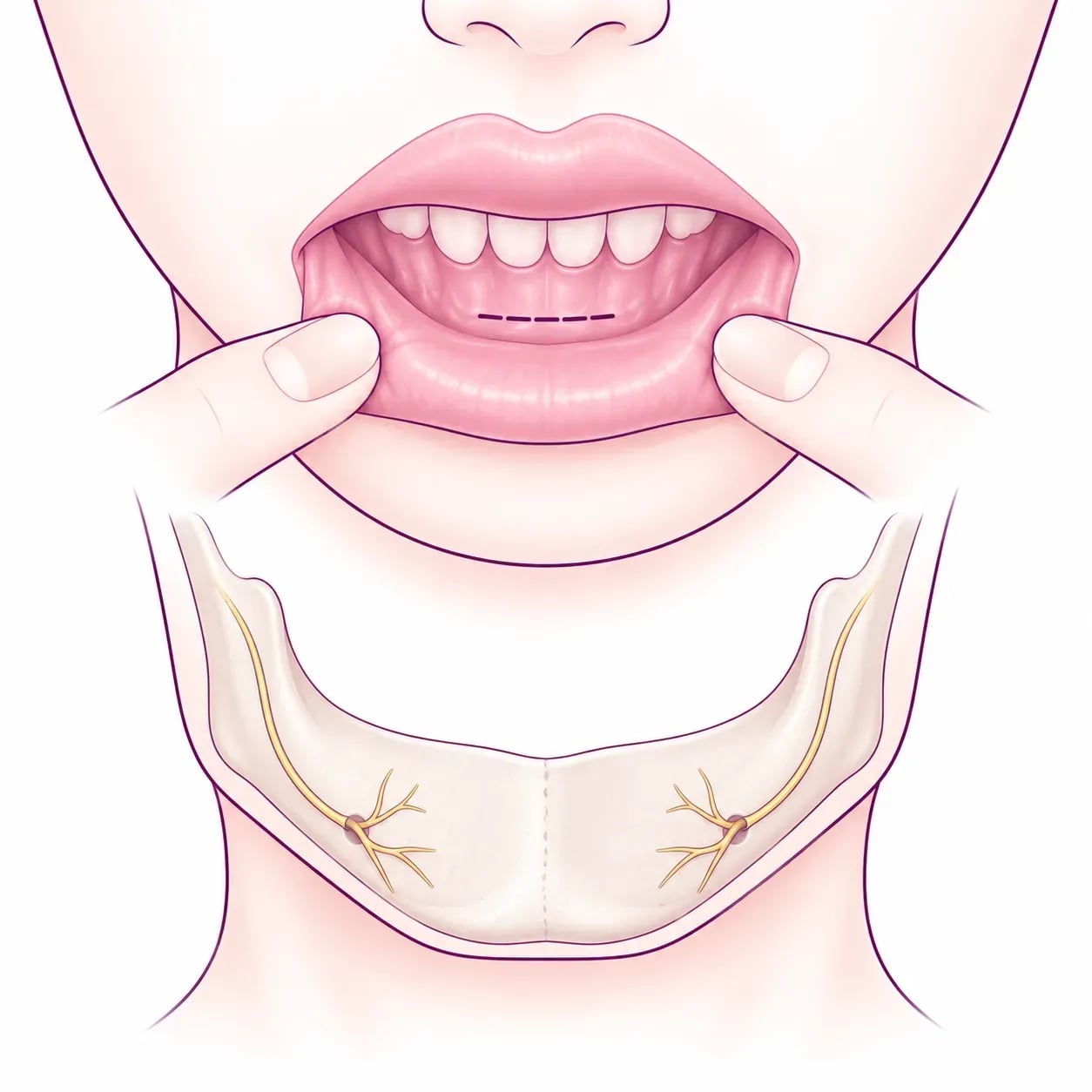
No scar: the operation is inside the mouth
The incision is made inside the lower lip, against the gum. Nothing is cut on the outside and no scar is visible on the skin.
It also means mouth hygiene matters more than usual in the first weeks, and that an untreated dental problem or gum infection is a reason to postpone. A dental check-up before you travel is worth doing.
Nose and chin: the profile is one thing
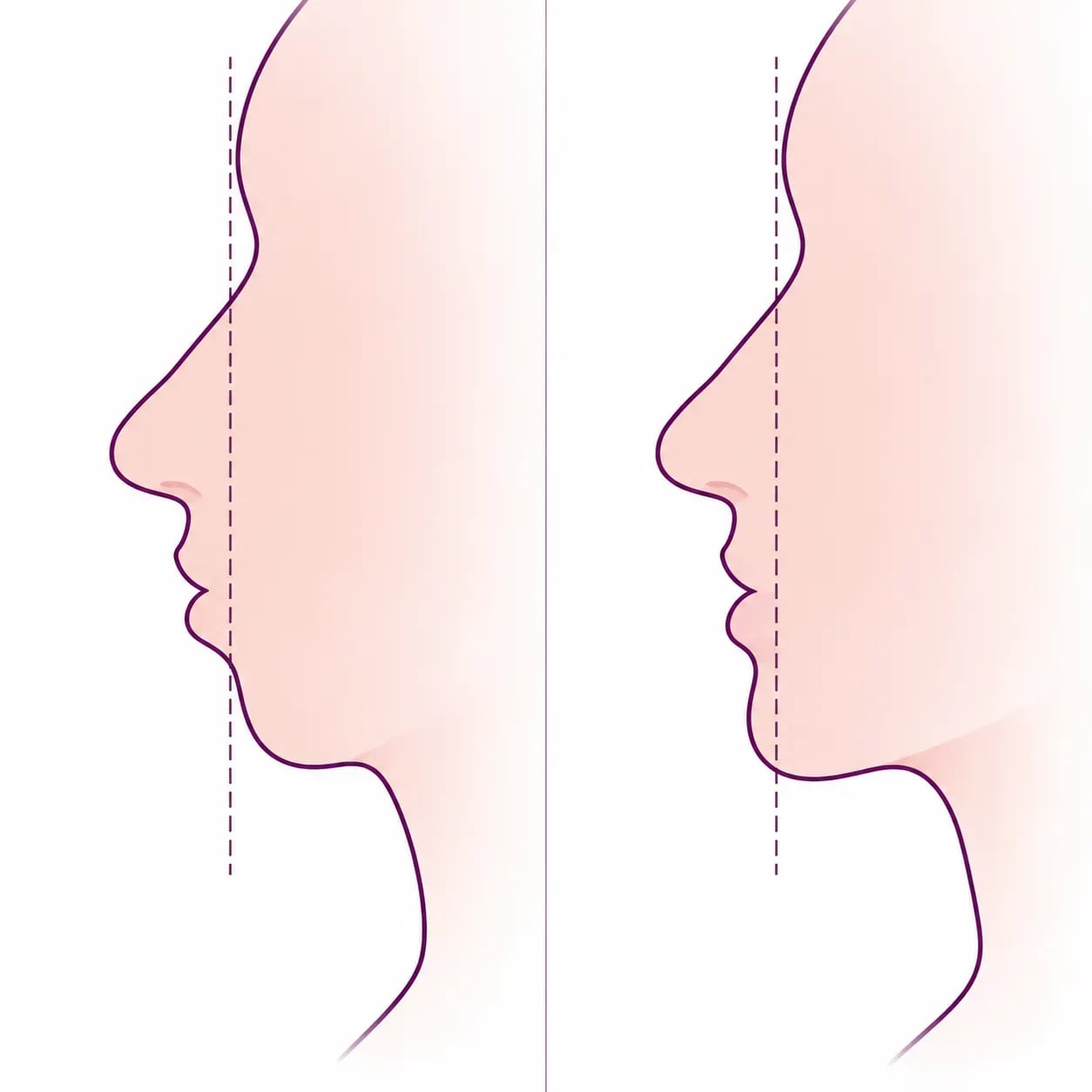
The nose and the chin are judged against each other, not separately. A chin that sits back makes a nose look larger; bringing the chin forward can make the same nose look proportionate without touching it.
This is why the two are frequently planned together, an approach sometimes called profiloplasty: a rhinoplasty and a genioplasty in the same operation, balancing the profile as a whole.
It is also why, if you came here about your nose, you may be told that your chin is the more effective place to intervene. People are routinely surprised by that, and the photographs at the consultation usually settle the argument.
Combining the two is quoted individually.
Are you a candidate?
Genioplasty suits an adult whose facial growth is complete and whose general health allows a general anaesthetic.
You may be directed elsewhere if:
- The problem is your jaw rather than your chin — orthognathic surgery, with orthodontics
- It is fat under the chin — submental liposuction
- The change wanted is small — filler, temporarily
- The lower face is full rather than ill-defined — a different assessment altogether, and our page on buccal fat removal covers what does and does not sharpen a jawline
- The whole lower face has descended with age — a face and neck lift may be the better conversation
Reasons to postpone: any infection in the mouth, orthodontic treatment in progress, current smoking, a clotting disorder, or anything contraindicating general anaesthesia.
Tell us if you are wearing braces or aligners, now or soon. Orthodontic treatment can change both the decision and the timing, because moving teeth changes the profile too.
Your pathway, step by step
- Get in touch from home. Photographs in profile and from the front, your medical and dental history, and any orthodontic treatment past or planned. An opinion and a quote come back within 24 to 48 hours.
- Preparation. A dental check-up, pre-operative tests around fifteen days before, and stop smoking. Our preparation guide covers what applies to every procedure.
- Arrival. You are met at Tunis-Carthage and transferred.
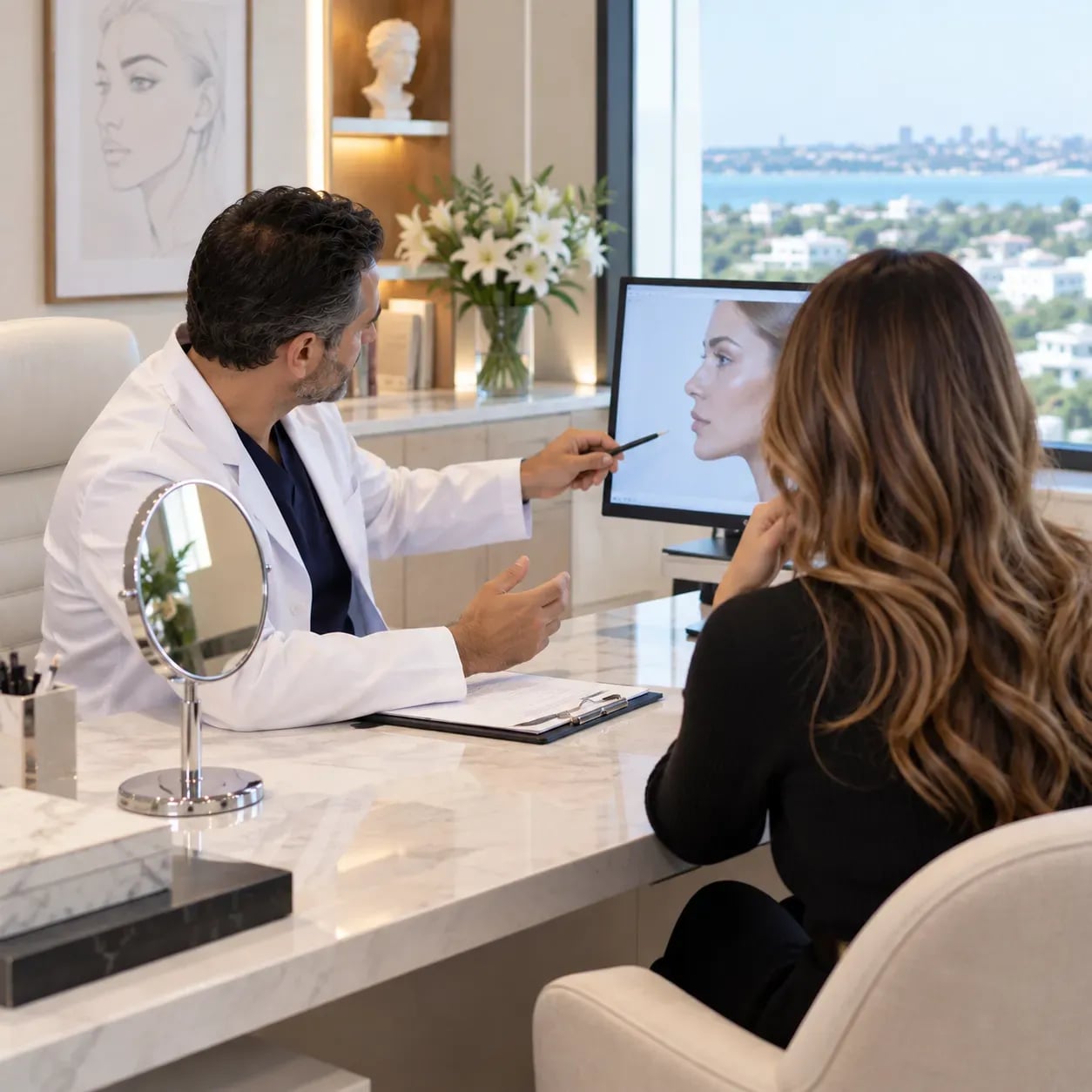
- Consultation with the surgeon and the anaesthetist, with the technique and the exact movement confirmed, sometimes using an X-ray.
- The operation, 45 minutes to 1h30 under general anaesthetic.
- One night of monitoring, or same-day discharge depending on the technique.
- Convalescence in Tunisia, on soft food, with a check before you fly.
- Home, with remote follow-up.
Risks
The most frequent is numbness of the lower lip and chin, covered above: expected, usually temporary, occasionally lasting.
Common to any surgery: haematoma, infection, swelling, and the risks of general anaesthesia. Infection matters more than usual here because the incision is inside the mouth.
Specific to the bone procedure: displacement of the bone fragment, a plate that becomes palpable, and delayed or incomplete bone healing. All are uncommon and all are manageable.
Specific to an implant: migration, infection, and slow erosion of the bone beneath it over the years.
And the aesthetic risk: a result that is not the proportion you wanted. This is reduced by planning the exact movement before the operation rather than deciding it during, and by assessing the chin against the nose and the whole profile instead of in isolation.
Contact us without waiting if you have a fever, increasing pain, spreading swelling, discharge in the mouth, or numbness that is getting worse rather than better.
Recovery and eating
Swelling and bruising around the chin and lower lip in the first days. The chin is a conspicuous place to be swollen and it looks worse than it is.
Numbness from the start, which is expected.
A feeling of tightness when you talk or smile in the first days.
Soft, lukewarm food at first, then back to normal on your surgeon's instructions. Nothing hot, nothing hard, nothing that needs serious chewing.
Mouth hygiene matters more than usual, and you will be given specific instructions. Follow them exactly — the incision is in your mouth.
Back to work after about a week, with some swelling still visible.
The final result at six months, once the bone has consolidated and the swelling has fully gone. The chin changes shape slowly as the last of the swelling resolves, so the profile at one month is not the profile you will keep.
The plates: do they stay in?
Generally yes, permanently, and without causing any problem. They are small titanium plates holding the bone in its new position while it heals.
Occasionally one becomes palpable under the skin or inside the lip, and can be removed in a straightforward second procedure. That is uncommon and it is not urgent when it happens.
On airport security: small titanium plates do not normally set off walk-through detectors. That said, scanners vary and so do airports. Keep your operative report accessible when you travel, particularly in the first year, and mention the plates if you are asked. It is a thirty-second conversation rather than a problem.
Your surgeons
Dr Taher Djemal has practised as a plastic surgeon in Tunisia since the early 1990s and performs both the bone procedure and the implant. He trained in Tunis, Paris and Nancy, with further experience at Foch Hospital in Paris and in Baltimore.
Dr Abir Ben Ouaghrem determines the technique at the consultation.
That both techniques are performed here matters. A surgeon who offers only implants will propose an implant; one who offers both can tell you which your face actually needs.
Consultations are possible by video call before you travel. Three questions worth asking: is this my chin or my jaw, bone or implant and why, and how many millimetres are you planning to move it.
Getting to Tunisia
From the UK and Ireland: around three hours from London, with connections from other UK and Irish airports. British and Irish passport holders do not currently need a visa for a short tourist stay — but see the note below.
From the Gulf: daily flights from Dubai with Emirates, around six and a half to seven hours, and from Doha with Qatar Airways, around six.
From continental Europe: direct flights of 1h30 to 3h from Paris, Brussels, Geneva, Lyon and Marseille, with no visa for EU and Swiss nationals.
From West and Central Africa: regular connections from Dakar, Abidjan, Douala, Libreville and Casablanca, with help on visa formalities where needed.
Entry requirements follow your nationality, not your country of residence. A resident of Dubai or London holding an Indian, Pakistani, Nigerian or Filipino passport does not have the same conditions as a British or Emirati national, and a residence permit changes nothing. Check with the Tunisian embassy for your country of citizenship before booking.
At three days this is one of the shorter stays we organise. How long each procedure needs is in our guide to lengths of stay.
Before you travel: a checklist
- Documents: a passport valid well beyond your return date, and a visa if your nationality requires one.
- Photographs in profile, both sides, and from the front, in natural light without a filter. The profile shots are the ones that matter here.
- A dental check-up, and a recent panoramic X-ray if you have one. The incision is inside your mouth.
- Tell us about any orthodontic treatment — past, current or planned. It can change the decision and the timing.
- Tell us if your bite feels wrong, or if a dentist has ever mentioned it. This is the single most useful thing you can tell us, and the one people leave out.
- Pre-operative tests done at home around fifteen days before.
- A written list of your medication, supplements and allergies.
- Stop smoking. It affects healing inside the mouth particularly.
- Soft food at home for your return — buy it before you go.
- A soft toothbrush.
- Expect visible swelling for a week or so, and plan anything you care about being photographed at accordingly.
Request a quote and you will have an answer within 24 to 48 hours.








Frequently asked questions about Chin Surgery in Tunisia
€1,800 for a setback genioplasty and €2,000 for an advancement, over a 3-day stay. That covers the surgeon's and anaesthetist's fees, the consultation, the operation, the anaesthetic, the hospital stay, hotel accommodation, transfers and follow-up. A chin implant alone, or a genioplasty combined with a rhinoplasty, is quoted individually. Flights and pre-operative tests are not included.
A sliding genioplasty cuts the chin bone, moves it to the planned position and fixes it with small plates. A chin implant places a silicone implant on top of the bone without cutting it. The bone procedure can advance substantially, set the chin back, correct asymmetry and change vertical height; an implant can only advance, and only modestly. An implant also adds permanent foreign material that can migrate, become infected or slowly erode the bone beneath it.
No. An implant adds volume to the front of the chin, so it can only push it forward. Setting a prominent chin back requires moving the bone.
Not always, and this is the key question. A weak profile can come from a genuinely set-back chin, from a short lower jaw, from fat under the chin, or from a slight lack of projection. Only the first is corrected by genioplasty. If the whole jaw is short — which usually shows in the bite, with the upper incisors overhanging the lower ones — a genioplasty moves the chin point and leaves the jaw and bite where they were. That needs orthognathic surgery with orthodontics.
Almost certainly, for a while. The mental nerve supplies sensation to the lower lip and chin and runs right through the operating field, so it is almost always disturbed. Numbness afterwards is expected rather than a complication, and it typically fades over several weeks to several months. Movement is not affected — the nerve carries sensation, not muscle control — so your smile and speech work normally throughout.
In a minority of cases some numbness persists. It is not painful and most people who have it describe it as something they stop noticing, but you should decide knowing it can last rather than finding out at month eight.
No scar on the skin. The incision is made inside the lower lip, against the gum. It does mean mouth hygiene matters more than usual in the first weeks, and that an untreated dental problem is a reason to postpone.
Three days, with either one night of monitoring at the clinic or same-day discharge depending on the technique. It is one of the shorter stays we organise.
Moderately, and well controlled by the prescribed painkillers. The tightness, the swelling and the numbness bother people more than the pain does.
Generally yes, permanently and without causing any problem. Occasionally one becomes palpable under the skin or inside the lip and can be removed in a straightforward second procedure, which is uncommon and never urgent.
Small titanium plates do not normally set off walk-through detectors. Scanners and airports vary, so keep your operative report accessible when you travel, particularly in the first year, and mention the plates if you are asked.
A rhinoplasty and a genioplasty planned together, balancing the profile as a whole. The nose and chin are judged against each other: a chin that sits back makes a nose look larger, and bringing the chin forward can make the same nose look proportionate without touching it. If you came about your nose, you may be told the chin is the more effective place to intervene.
Slight erosion of the bone beneath a chin implant remains possible over many years. It is generally slow and modest, but it is real, and it is one of the reasons a bone procedure is preferred where a meaningful change is wanted.
With a bone procedure, yes, once the bone has consolidated in its new position. With an implant the result is stable but the implant may, rarely, need repositioning or removal.
Once facial growth is complete. There is no fixed minimum age and the surgeon confirms it at the assessment.
Tell us, because it changes things. Orthodontic treatment moves teeth and changes the profile, so it can alter both the decision and the timing. In some cases the orthodontics should be finished first.
Hyaluronic acid filler can add a small amount of projection, at €350 per ml, with 1 to 2 ml usually needed. It is temporary, lasting 6 to 18 months, and it is limited to small corrections. It cannot set a chin back and it cannot change the bone.
Fat under the chin erases the jaw outline and makes the chin look weaker than it is. Submental liposuction alone sometimes redraws the angle completely, without touching the chin bone. The two are also combined where both are contributing.
Soft, lukewarm food at first, then back to normal on your surgeon's instructions. Nothing hot, hard or requiring serious chewing in the early days, and careful mouth hygiene throughout.
At around six months, once the bone has consolidated and the swelling has fully resolved. The chin changes shape slowly as the last swelling goes, so the profile at one month is not the profile you keep.
Not for appearance alone. Orthognathic surgery can be funded where there is a documented functional problem with the bite, which is a different pathway through your dentist and orthodontist. If your bite is genuinely affected, explore that before paying for anything privately.
Whether the problem is your chin or your jaw, whether bone or implant is being proposed and why, and how many millimetres they plan to move it. If a provider only ever offers one of the two techniques, that tells you what they are equipped to do rather than what you need.