

Facelift in Tunisia: SMAS Technique, Neck, Scars and Price

Facelift in Tunisia: the essentials
A facelift repositions the deep tissue of the lower face and neck, then removes the skin that is left over. It treats jowls, a lost jawline, deep nasolabial folds and a slack neck.
It does not treat the forehead, the brow or the eyelids, and no facelift ever has. Those are separate operations, and section 4 says which.
Mild laxity only, and not ready for surgery? See thread lifts — with the honest comparison in section 11.
It is performed by Dr Taher Djemal and Dr Abir Ben Ouaghrem at Myron International Clinic in Tunis, with English-speaking support throughout.
| Operating time | 2 to 4 hours |
| Anaesthetic | General |
| Stay in Tunisia | 5 days, with 1 to 2 nights monitored |
| Back to work | 2 to 3 weeks |
| Final result | 6 to 12 months |
| Lasts | 8 to 10 years |
| Price | €2,400 — accommodation not included |
What a facelift actually repositions
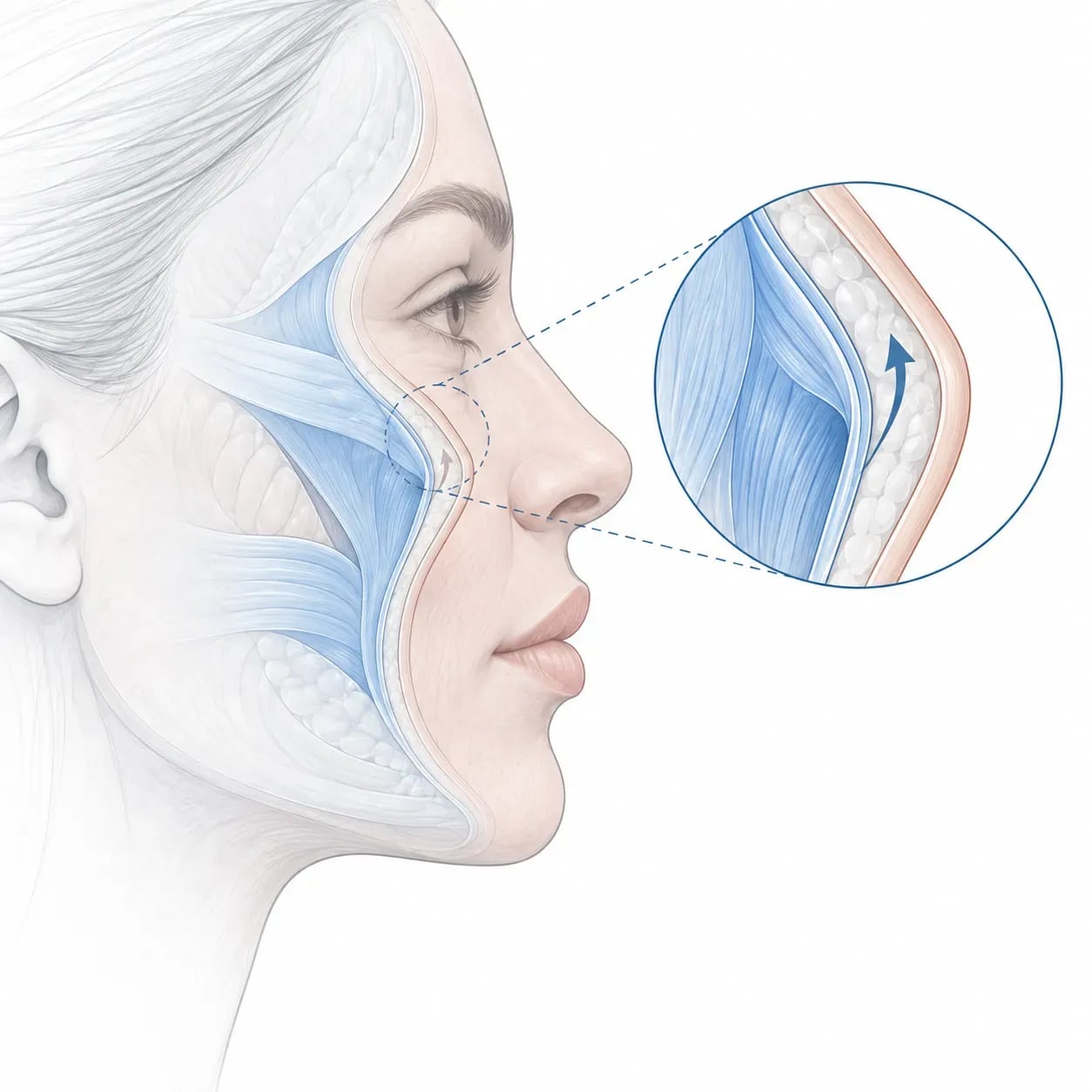
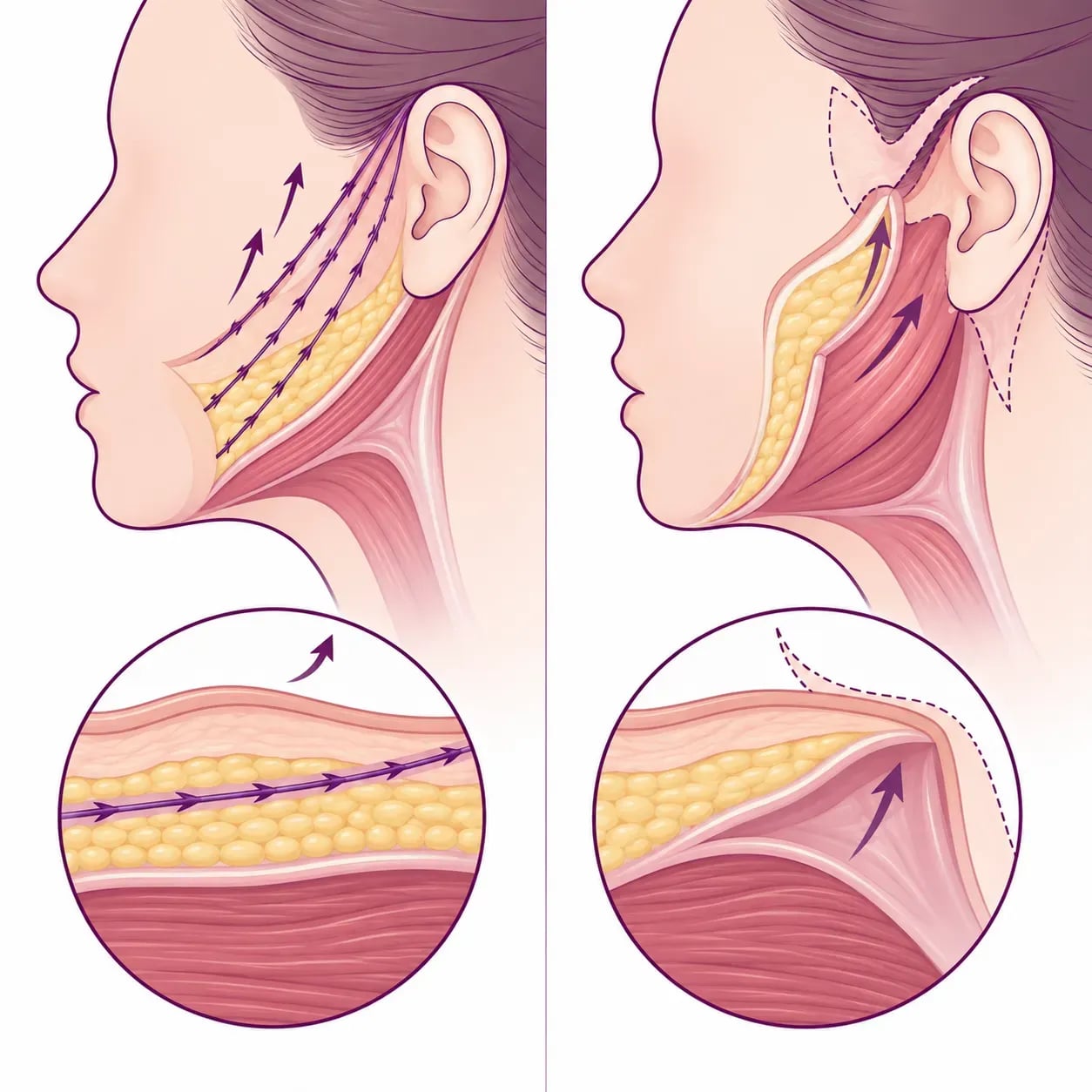
Under the skin of your face there is a layer of fibrous tissue and muscle called the SMAS. It is this layer, not the skin, that descends with age and produces jowls and a blurred jawline.
A modern facelift lifts the SMAS. The deep layer is repositioned upward and secured, and only then is the excess skin trimmed and closed without tension.
Why that distinction is the whole operation. Pulling the skin alone stretches something that was never the problem. It produces a tight, wind-blown appearance for a short time, and because skin stretches again, it does not last. That is the technique behind the facelift results everyone recognises from thirty years ago, and it is not what is done now.
If a surgeon cannot tell you what layer they are lifting, you are in the wrong consultation.
SMAS, deep plane, and the marketing around them
If you have researched this in English you will have met the term deep plane facelift, frequently presented as a generational leap over SMAS surgery. It is worth understanding what is actually being compared.
Both reposition the deep layer. They differ in how the SMAS is released and whether the skin and the SMAS are moved as one unit or separately. Both are established, both are performed by excellent surgeons, and the honest position is that the distinction is drawn far more sharply in marketing than the evidence supports.
What actually determines your result is whether the deep layer is properly repositioned, how much tension ends up on the skin closure, and the judgement of the person operating. A surgeon doing meticulous SMAS surgery produces a better result than one doing a deep plane badly.
So ask what technique is proposed and why for your face — here and anywhere. What you want is a specific answer about your anatomy. A clinic that leads with the name of a technique rather than with your face is selling the name.
What it treats, and what it does not
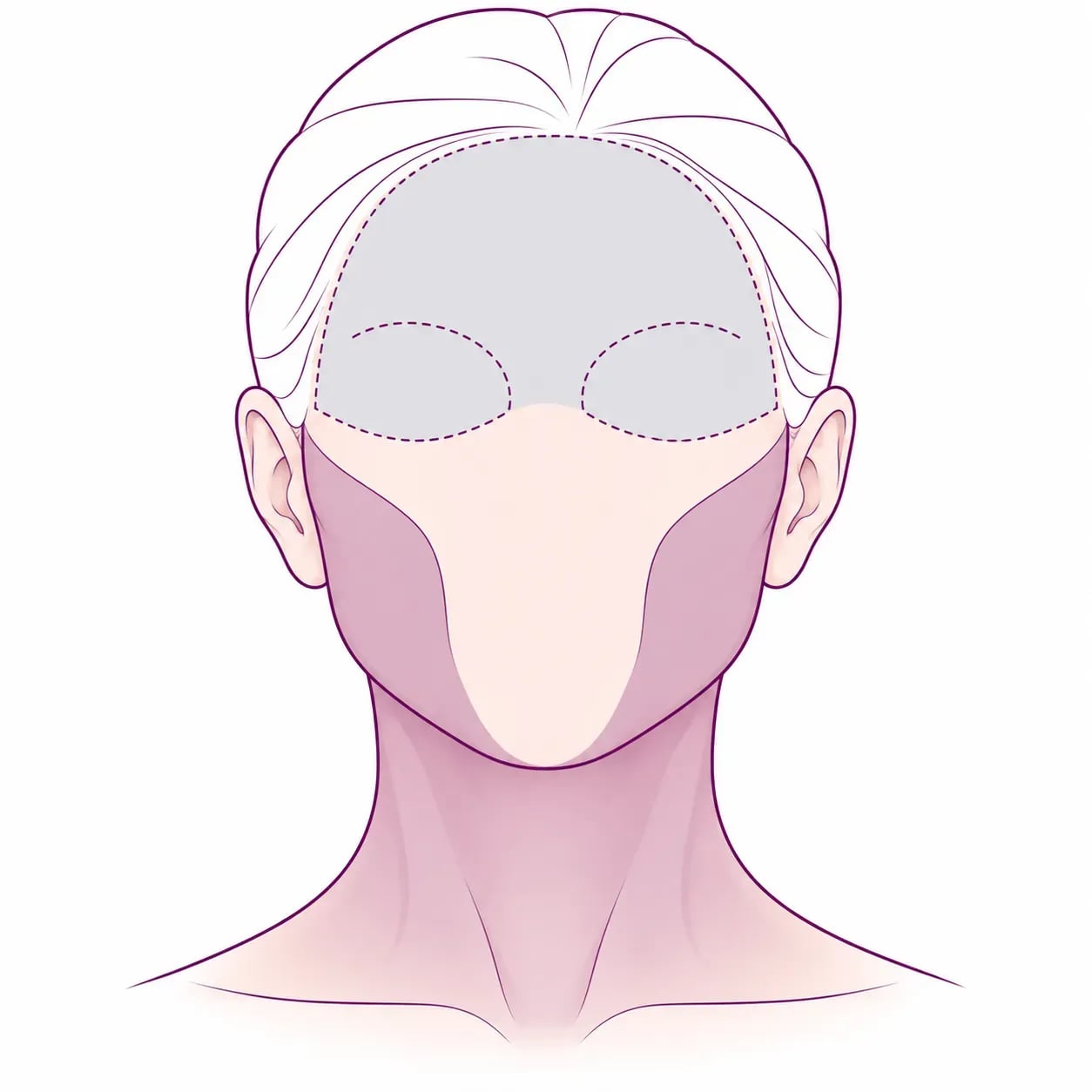
What a facelift treats: jowls, a jawline that has lost its line, deep nasolabial folds, and loose skin on the neck.
What it does not touch:
- Forehead lines and a heavy brow — a different operation entirely. Botulinum toxin softens movement lines.
- Hooded upper eyelids and under-eye bags — that is eyelid surgery, frequently combined with a facelift in the same operation.
- Lost volume. A lift repositions; it does not fill. A face that has hollowed needs volume adding, which is facial fat transfer or filler. Lifting a deflated face gives you a tighter deflated face.
- Skin quality — texture, pigmentation and fine lines are unchanged by moving tissue.
- A weak chin, which blurs the jawline independently of any sagging. See chin surgery.
Most faces need more than one thing. A consultation that proposes only a lift, on a face that has also lost volume, is proposing half an answer.
The neck: what actually happens to it
For most people over fifty the neck is the real complaint, more than the face, and it deserves more than the single line it usually gets.
The neck is treated as part of the cervicofacial lift — that is what the « cervico » means. It is not an optional extra and it is not a separate price.
What is addressed there: the loose skin, and the laxity of the platysma — the broad sheet of muscle running down the front of the neck. When the platysma slackens with age its edges become visible as two vertical bands, and skin tightening alone does not remove them. Tightening that muscle is what a surgeon means by a platysmaplasty, and it is part of a cervicofacial lift rather than an extra.
Which is why a lift that stops at the jawline disappoints. A sharp jawline above an untreated neck reads as odd, and the neck is what people notice in photographs of themselves.
Ask at the consultation what is planned for your neck specifically, and whether those vertical bands are being addressed. If the answer is only about skin, ask again.
A neck-only procedure is possible in some cases and is assessed on examination.
Mini lift or full lift?
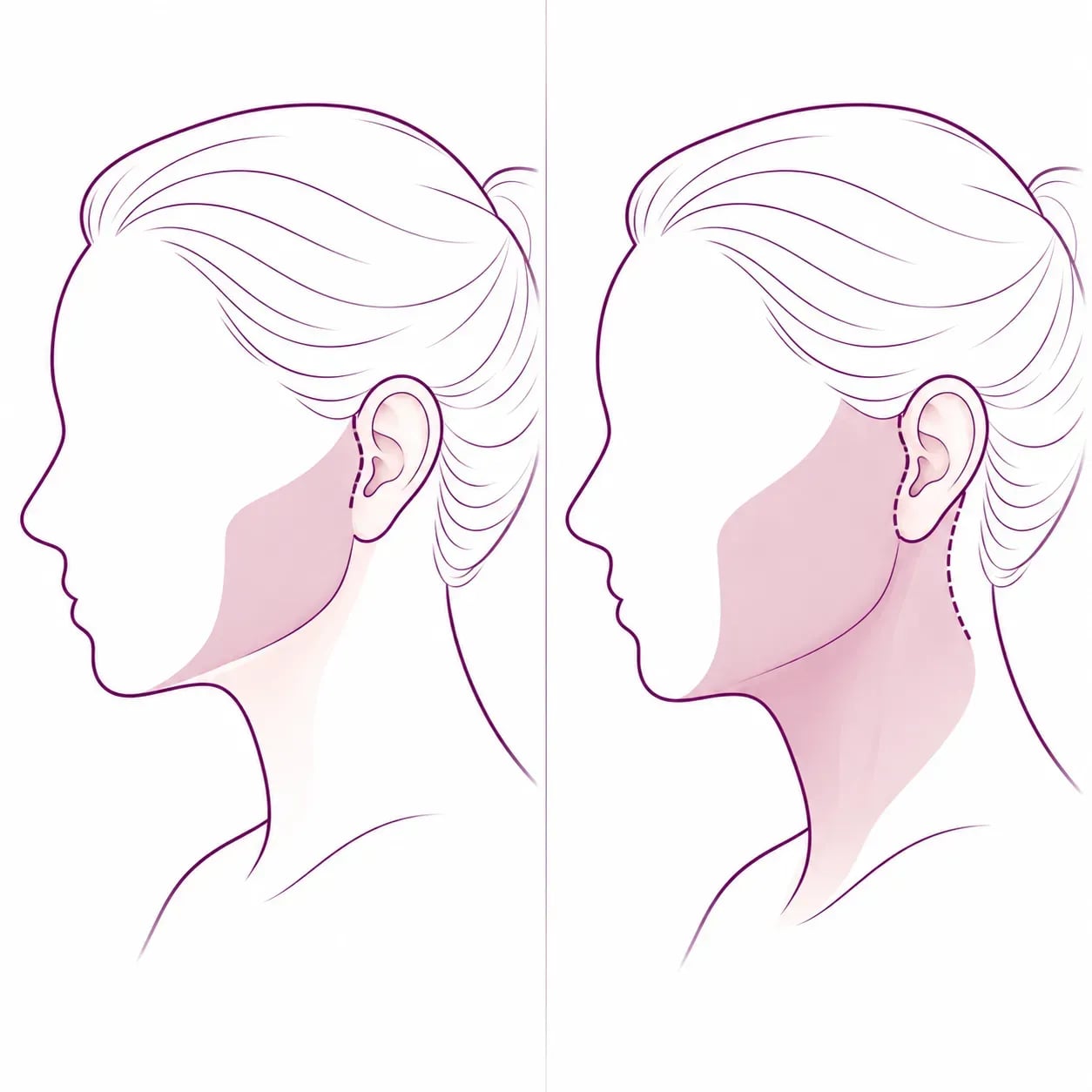
A mini lift — sometimes called a short-scar lift — suits moderate laxity. Shorter incisions, a quicker recovery, and a correction limited to the lower face.
A full cervicofacial lift covers more ground, including the neck, and suits more marked laxity.
The mini lift's results are generally less durable. That is the trade and it should be stated plainly: you are buying a shorter recovery and a smaller scar at the cost of a smaller and shorter-lived correction.
The choice is made on examination, not on age or on preference. A mini lift performed on a face that needed a full one is the most reliable way to be disappointed and to pay twice — and it is a common request, because it sounds less drastic.
A mini lift is quoted individually.
Will I look pulled?
This is the fear that stops most people, and it deserves a direct answer rather than reassurance.
The pulled, wind-blown look comes from tension on the skin. When the skin is what holds the lift, it has to be pulled tight, and a tight skin closure distorts the mouth corners, flattens the natural folds and produces the appearance everyone is afraid of.
When the SMAS carries the lift, the skin is simply re-draped and closed without tension. The face is repositioned rather than stretched, and the result reads as rested rather than altered.
The results that frightened you were mostly done decades ago, with a technique that no longer represents good practice. They are also, by definition, the ones you can identify — the facelifts you cannot see are the majority, and you walk past them constantly.
Say so at the consultation if a natural result matters more to you than the maximum correction. It is a legitimate instruction and it changes how much is done.
Where the scars go
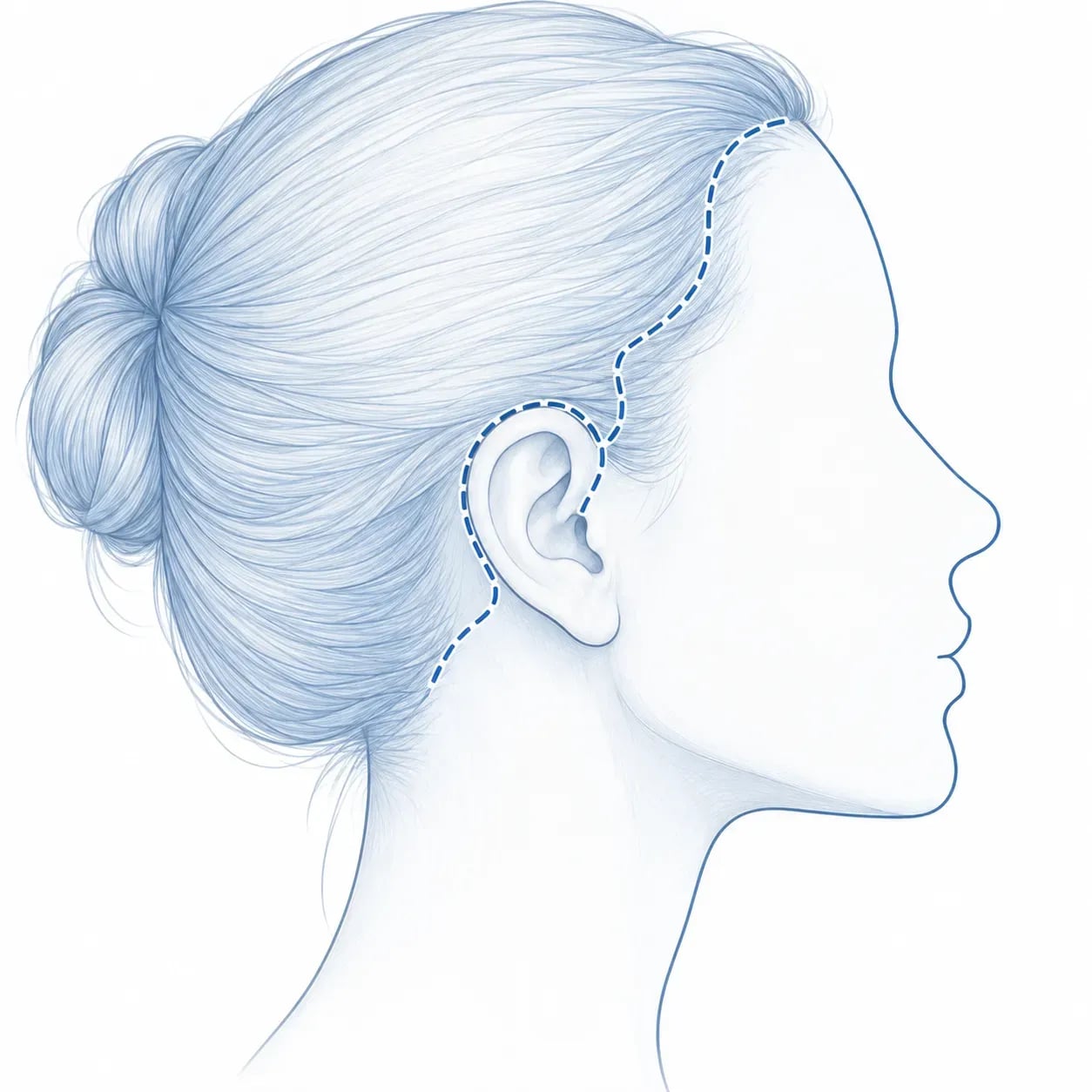
The incisions follow a discreet path, largely hidden within the hairline and around the contour of the ear, where the natural folds of the skin conceal them.
They are visible while healing and become progressively harder to see as they mature and as hair covers them.
For men, incision placement takes account of the beard and the sideburn, so that the hair-bearing skin is not moved into a position where you would be shaving somewhere new. Say at the consultation how you wear your hair and your beard — it affects the plan.
If you wear your hair very short or shaved, raise it specifically. It changes where the scars can realistically be hidden.
Are you a candidate?
There is no typical age. What matters is the degree of laxity, not your date of birth.
Too early — operating on mild laxity gives a limited benefit for a real operation, and spends a result you would rather have later.
Too late — a long-established laxity needs a more extensive correction, with a longer recovery.
Reasons to postpone or reconsider:
- Smoking that has not stopped. This is not a formality on this operation: smoking impairs blood supply to the elevated skin and is the principal cause of skin loss, which is the complication you least want on your face. Stop several weeks beforehand.
- Uncontrolled high blood pressure, which raises the risk of a haematoma
- Weight not yet stable
- A clotting disorder, or anticoagulant treatment
- Anything contraindicating general anaesthesia
And an expectation that a lift will make you look like a different person. It makes you look like yourself, rested, roughly as you did eight to ten years ago. If that is not what you want, say so before rather than after.
What it costs
€2,400, for a 5-day stay including 1 to 2 nights monitored at the clinic.
Included: the consultation with the surgeon and the anaesthetist, the operation, the anaesthetic, the hospital stay, airport transfers and post-operative follow-up.
Not included: flights, the pre-operative tests you have done at home, and accommodation.
Read that last point carefully when you compare. On a 5-day stay, hotel nights are a real cost and they are on you here. A quote that looks close to another one may not be comparable, in either direction. Ask any provider, here or elsewhere, exactly how many nights are covered.
A mini lift, or a lift combined with another procedure, is quoted individually from photographs.
All prices are on the prices page, and a personalised quote reaches you within 24 to 48 hours.
| Procedure | Price | Stay |
|---|---|---|
| Face and Neck Lift | €2,400 | 5 days |
Facelift or thread lift?
| Thread lift | Facelift | |
| Degree of laxity | Mild to moderate | Moderate to marked |
| Excess skin | Not removed | Removed |
| Deep tissue | Not repositioned | Repositioned |
| The neck | Mild laxity only | Treated properly |
| Anaesthetic | Local | General |
| Scars | None | Yes, concealed |
| Recovery | 2 to 3 days | 2 to 3 weeks |
| Lasts | 12 to 18 months | 8 to 10 years |
| Price | €600 to €1,800 | €2,400 |
They are not competing products. Threads suit a face with mild laxity and good skin; a lift suits a face with jowls, a slack neck or skin to remove. Threads on a face that needs a lift produce a modest result at real cost, and that is the most common disappointment with them.
On cost over time: a full-face thread treatment repeated every 12 to 18 months exceeds the price of a facelift within a few years. That is not an argument against threads — avoiding surgery is a legitimate reason — but it should be a decision taken with the arithmetic in front of you.
Combining it with other procedures
A facelift addresses position. Most faces that need one also need something else, and combining in a single operation means one anaesthetic and one recovery rather than two.
Commonly combined:
- Eyelid surgery — the most frequent pairing by a wide margin, because the lift does not touch the eyes and the eyes are what people read first.
- Facial fat transfer — restoring volume where the face has hollowed. A lift plus volume frequently looks better than either alone, and this is the pairing most often overlooked.
- A forehead lift, where the brow has descended.
Feasibility in one session depends on your general health and the total anaesthetic time the surgeon considers reasonable. Combined procedures are quoted individually.
Your pathway, step by step
- Get in touch from home. Photographs from the front, both three-quarter views and both profiles, in natural light without makeup, plus a photograph of yourself from ten years ago if you have one — it is more useful than people expect. Your medical history and blood pressure. A quote comes back within 24 to 48 hours.
- Preparation. Pre-operative tests around fifteen days before, blood pressure checked and controlled, and stop smoking several weeks beforehand. Our preparation guide covers what applies to every procedure.
- Arrival. You are met at Tunis-Carthage and transferred.
- Consultation with the surgeon and the anaesthetist, confirming mini or full, what is planned for the neck, and whether anything is being combined.
- The operation, 2 to 4 hours under general anaesthetic.
- One to two nights monitored at the clinic. The first night matters here: haematoma is the most common complication and it declares itself early.
- Convalescence in Tunisia, with dressings changed and a check before you fly.
- Home, with remote follow-up.
Risks
Haematoma — a collection of blood under the skin, and the most common complication of this operation. It usually appears in the first hours, which is the reason for monitored nights at the clinic rather than a same-day discharge. Controlled blood pressure reduces it significantly.
The facial nerve. Its branches control the muscles of expression and they run close to the planes being dissected. Injury is rare, usually temporary, and recovers over weeks to months. It is also the reason this operation belongs with an experienced surgeon rather than being chosen on price.
Skin loss. Elevated skin depends on its remaining blood supply. This is overwhelmingly a smoker's complication, and it is the single strongest reason the smoking instruction is not negotiable.
Also possible: widened or visible scarring, hair loss along an incision, asymmetry, and altered sensation in front of the ear, which is common early and usually settles.
What reduces them: stopping smoking, controlled blood pressure, meticulous closure without tension, and monitored nights after surgery.
Contact us without waiting if one side swells rapidly or becomes painful and tight, if you have a fever, spreading redness, or any weakness or asymmetry of movement in your face.
Recovery
Swelling and bruising are substantial in the first week and then fall away quickly. The face at day three is not informative about anything.
Tightness and numbness in front of the ears and along the neck, which is normal and settles over weeks to months. Most people find the numbness stranger than the discomfort.
Pain is less than people expect. Tightness is the dominant sensation and the prescribed painkillers are generally enough.
Sleep propped up for the first nights.
Hair washing resumes on your surgeon's instructions.
Back to work after 2 to 3 weeks, with residual bruising that makeup covers.
Hair colouring waits several weeks. If you colour your hair, do it two weeks before you travel — otherwise you face a long gap at exactly the point you want to look well. This is the single most useful practical tip on this page and nobody tells you.
The final result at 6 to 12 months, once all the swelling has resolved and the tissues have settled.

Going home, and being seen again
You will fly home looking operated on. Swollen, bruised, with visible incisions. Plan for that rather than being surprised by it.
For the journey: loose front-fastening clothing, a scarf if you want one, sunglasses, and a window seat if being looked at bothers you. Do not wear anything that goes over your head.
In the following weeks: no intense exercise, no sauna, and protect the scars from the sun. Sun on a fresh scar darkens it permanently.
On discretion. Most people resume normal social life at 2 to 3 weeks with makeup covering what is left. If you need a cover story, « I have been unwell » or a holiday explains an absence of two to three weeks perfectly adequately, and people are considerably less observant than you fear.
Do not plan anything that matters — a wedding, a reunion, a photographed event — within two months. Three is more comfortable.
Your surgeons
Dr Taher Djemal has practised as a plastic surgeon in Tunisia since the early 1990s, working with the SMAS technique and toward results that are not identifiable as surgery. He trained in Tunis, Paris and Nancy, with further experience at Foch Hospital in Paris and in Baltimore.
Dr Abir Ben Ouaghrem calibrates the extent of the correction — mini lift or full lift — to the degree of laxity.
Consultations are possible by video call before you travel. Four questions worth asking: mini or full and why; what exactly is planned for my neck; what layer are you lifting; and what will you not be able to improve. The last one tells you most.

Getting to Tunisia, and before you travel
From the UK and Ireland: around three hours from London, with connections from other UK and Irish airports. From the Gulf: daily flights from Dubai, around six and a half to seven hours, and from Doha, around six. From continental Europe: 1h30 to 3h from Paris, Brussels, Geneva, Lyon and Marseille, with no visa for EU and Swiss nationals. From West and Central Africa: regular connections from Dakar, Abidjan, Douala, Libreville and Casablanca.
Entry requirements follow your nationality, not your country of residence. A resident of Dubai or London holding an Indian, Pakistani, Nigerian or Filipino passport does not have the same conditions as a British or Emirati national, and a residence permit changes nothing. Check with the Tunisian embassy for your country of citizenship before booking.
Your checklist:
- Documents: a passport valid well beyond your return date, and a visa if your nationality requires one.
- Book your accommodation. It is not included in the price of this procedure, and the stay is five days.
- Photographs: front, both three-quarter views, both profiles, natural light, no makeup. And one of yourself from ten years ago.
- Pre-operative tests done at home around fifteen days before.
- Your blood pressure, checked and controlled. Bring recent readings if you are treated for it.
- A written list of your medication, supplements and allergies.
- Stop smoking several weeks beforehand. On this operation it genuinely changes the risk.
- Colour your hair two weeks before you travel if you colour it.
- Front-fastening tops for the journey home.
- Sunglasses and a scarf.
- Book 2 to 3 weeks off work, and keep two months clear of anything you will be photographed at.
How long each procedure needs is in our guide to lengths of stay. Request a quote and you will have an answer within 24 to 48 hours.








Frequently asked questions about Facelift in Tunisia
€2,400 for a 5-day stay including 1 to 2 nights monitored at the clinic. That covers the consultation with the surgeon and the anaesthetist, the operation, the anaesthetic, the hospital stay, transfers and post-operative follow-up. Flights, pre-operative tests and accommodation are not included — check that last point when comparing quotes, because five hotel nights are a real cost.
The SMAS is a layer of fibrous tissue and muscle under the skin of the face, and it is that layer rather than the skin which descends with age. A modern facelift repositions the SMAS and secures it, then trims and closes the skin without tension. Pulling the skin alone stretches something that was never the problem, which is why it looks tight and does not last.
Both SMAS and deep plane techniques reposition the deep layer; they differ in how it is released and whether skin and SMAS are moved together or separately. Both are established and both are performed by excellent surgeons, and the distinction is drawn far more sharply in marketing than the evidence supports. What determines your result is whether the deep layer is properly repositioned, how much tension is on the skin closure, and the judgement of the surgeon. Ask what is proposed for your face and why.
That appearance comes from tension on the skin, which happens when the skin is what holds the lift. When the SMAS carries it, the skin is re-draped and closed without tension and the face is repositioned rather than stretched. The results that frightened you were mostly done decades ago with a technique that no longer represents good practice — and they are, by definition, the ones you can identify. Say at the consultation if a natural result matters more to you than maximum correction.
No. It treats the lower face and the neck. Forehead lines and a heavy brow are a different operation; hooded eyelids and under-eye bags are eyelid surgery, which is the most frequent thing combined with a lift in the same session.
The neck is treated as part of the cervicofacial lift — that is what the word means — and it is not an optional extra or a separate price. Both the loose skin and the laxity of the platysma, the broad muscle at the front of the neck, are addressed; tightening that muscle is what is meant by a platysmaplasty. When the platysma slackens its edges show as two vertical bands, and tightening skin alone does not remove them. Ask specifically what is planned for your neck, and whether those bands are being addressed.
Possibly. It is assessed on examination. In most cases the neck is treated within the cervicofacial lift rather than alone, because a sharp jawline above an untreated neck, or the reverse, reads as odd.
A mini lift suits moderate laxity, with shorter incisions, quicker recovery and a correction limited to the lower face. A full cervicofacial lift covers more ground including the neck and suits more marked laxity. The mini lift's results are generally less durable: you are buying a shorter recovery and a smaller scar at the cost of a smaller and shorter-lived correction. It is decided on examination, not on preference — a mini lift on a face that needed a full one is the reliable way to pay twice.
Following a discreet path largely hidden within the hairline and around the contour of the ear. They are visible while healing and become progressively harder to see as they mature and hair covers them. If you wear your hair very short or shaved, raise it specifically — it changes where they can realistically be hidden.
Yes. Incision placement takes account of the beard and the sideburn so that hair-bearing skin is not moved somewhere you would be shaving anew. Tell the surgeon how you wear your hair and your beard, because it affects the plan.
Around 8 to 10 years. Ageing continues afterwards from the new starting point — a lift sets the clock back rather than stopping it.
It carries the risks of any surgery under general anaesthetic. Haematoma is the most common complication and usually appears in the first hours, which is why nights are monitored at the clinic. Facial nerve injury is rare and usually temporary. Skin loss is overwhelmingly a smoker's complication, which is why stopping is not negotiable. Widened scarring, hair loss along an incision, asymmetry and altered sensation in front of the ear are also possible.
Because the skin that is lifted depends on its remaining blood supply, and smoking impairs it. Skin loss on the face is the complication you least want, and it is overwhelmingly seen in smokers. Stop several weeks beforehand, and stay stopped through the recovery.
Less than most people expect. Tightness and numbness dominate rather than pain, and prescribed painkillers are generally enough. Many patients find the numbness in front of the ears stranger than any discomfort.
Five days, including one to two nights monitored at the clinic. Accommodation for the remaining nights is not included in the price.
Most people resume normal social life at 2 to 3 weeks, with makeup covering residual bruising. You will fly home looking operated on — swollen, bruised, with visible incisions — so plan for that. Keep two months clear of anything that matters or that you will be photographed at; three is more comfortable.
Several weeks after surgery. Colour it two weeks before you travel instead — otherwise you face a long gap at exactly the point you want to look well. It is the most useful practical tip on this page and almost nobody mentions it.
At 6 to 12 months, once all swelling has resolved and the tissues have settled. Swelling and bruising are substantial in the first week and fall away quickly after that, but the face at day three tells you nothing.
There is no typical age: the degree of laxity matters, not your date of birth. Too early means a real operation for a limited benefit; too late means a more extensive correction and a longer recovery.
Threads suit mild to moderate laxity with good skin: local anaesthetic, no scars, 2 to 3 days of recovery, lasting 12 to 18 months. A facelift removes excess skin, repositions deep tissue, treats the neck properly and lasts 8 to 10 years. Threads on a face that needs a lift produce a modest result at real cost. And a full-face thread treatment repeated every 12 to 18 months exceeds the price of a facelift within a few years.
Yes, and it is the most frequent combination by a wide margin, because the lift does not touch the eyes and the eyes are what people read first. Facial fat transfer is the other common pairing and the one most often overlooked — lifting a face that has also hollowed gives you a tighter hollow face. Combined procedures are quoted individually.
No. A facelift makes you look like yourself, rested, roughly as you did eight to ten years ago. If what you want is a different face, say so before rather than after — this is not the operation for it.