

Rhinoplasty in Tunisia: primary, ethnic and revision surgery

Rhinoplasty in Tunisia: the essentials
A dorsal hump you notice in every photograph taken from the side. A tip that spreads when you smile. A nostril that has never let air through properly. Rhinoplasty reshapes the nose so that it sits in proportion with the rest of your face — not towards one template, but towards a nose that still reads as yours.
At ServiHealth the operation is carried out by Dr Taher Djemal and Dr Abir Ben Ouaghrem at the Clinique Internationale Myron in Tunis, with a coordinator who follows you from the first photographs to the last review. What your surgeon can do is set by your anatomy: the thickness of your skin, the strength of your cartilage and the state of your septum. Those three things are assessed by examination, not from a photograph — which is why a remote opinion is a starting point and never a plan.
| Operating time | 1 hour 30 to 3 hours, depending on complexity |
| Anaesthetic | General |
| Recommended stay in Tunisia | 5 days |
| Splint removed | Around one week after surgery |
| Back to desk work | 1 to 2 weeks |
| Final result | Progressive over about 12 months, longer for the tip |
Everything below is written for patients travelling from the Gulf, the UK and Ireland, anglophone Africa and northern Europe. Where a point matters more for one of those routes — insurance, glasses, prayer, climate, the flight home — it is said where it comes up rather than buried in a footnote.
Is yours a reduction nose or a structure nose?
Surgeons do not really divide rhinoplasty into "normal" and "ethnic". They divide it into two engineering problems, and which one you have decides the technique, the operating time and how long you wait to see the result.
A reduction nose
There is more structure than you want. The work is subtractive: lower the bony and cartilaginous hump, narrow the bones, refine a bulbous tip. This suits thin to medium skin over firm cartilage, where the skin shrinks down neatly onto the new framework. Definition appears relatively early.
A structure nose
There is less support than the shape needs. The work is additive: build projection at the bridge, give the tip a defined point, support a base that widens under thick skin. This is the pattern most often seen in patients of African, Afro-Caribbean, Middle Eastern, North African, South Asian and East Asian heritage, and it is what the term ethnic rhinoplasty is shorthand for. It is a technique, not a different operation, and its purpose is not to erase the features of a face.
A structure nose almost always needs graft material. The first source is your own septal cartilage; if the septum has already been operated on or does not yield enough, the surgeon may take cartilage from the ear. This is one of the reasons a surgeon asks early whether you have ever had nasal surgery — including an operation done purely for breathing.
The honest trade-off with thicker skin is time and sharpness. Skin that is thick and sebaceous does not drape tightly over a new framework, so the tip stays swollen for longer and the final definition is softer than on thin skin. A surgeon who promises you a sharp, narrow tip on thick skin within a few months is promising something skin does not do.
Breathing and appearance are the same operation
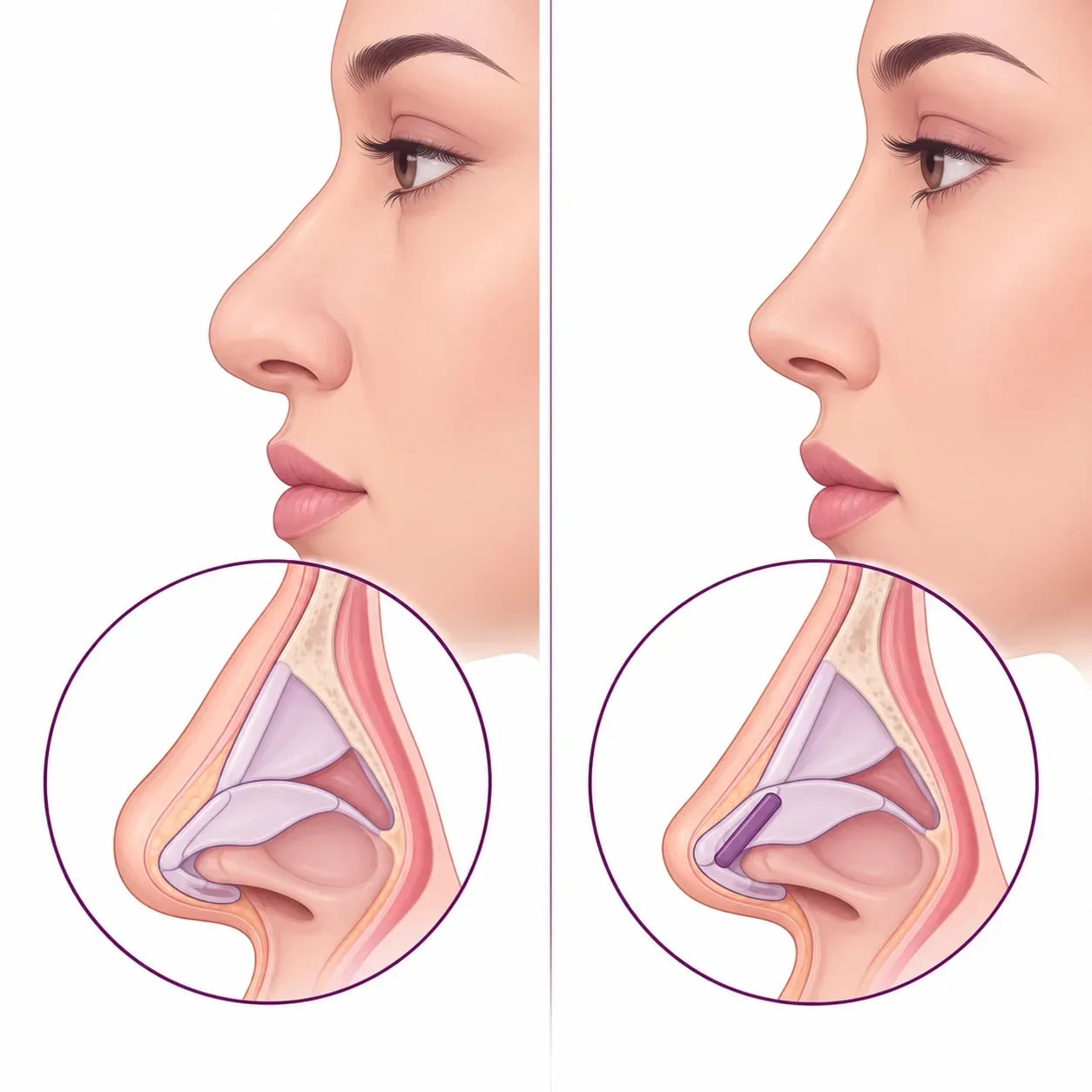
In most noses, how it looks and how it breathes are the same anatomy seen from two sides. A deviated septum pushes the nose off centre and blocks one side. Enlarged turbinates narrow the airway behind an otherwise straight nose. Collapse of the nasal valve on breathing in can follow an injury — or a previous operation that removed too much support.
Where there is a functional problem, the septum and the turbinates are addressed in the same operation, under the same anaesthetic, at no extra stay. There is no sense in separating them: the septum is both the wall that obstructs you and the main reservoir of graft cartilage the surgeon needs for the shape.
What this means if you are weighing up the NHS or an insurer
If you are in the UK or Ireland, nasal surgery is funded through the public system only where there is documented functional obstruction, and the thresholds are set locally and vary from one area to another. Reshaping for appearance is not funded. Private medical insurance, in the UK, Ireland and the Gulf alike, generally works the same way and excludes the cosmetic component, so a combined operation is usually self-funded in full.
There is a consequence of that worth knowing before you choose a route. A septoplasty obtained on functional grounds alone leaves the outside of the nose exactly as it was, and it uses up septal cartilage. If you later decide you want the shape changed, your surgeon starts with a harder operation and less material to work with. If you already know you want both, say so at the consultation and have the plan made once.
Whichever route you take, gather the paperwork while it exists: your GP or ENT letters, any imaging, and a note of how long the obstruction has been there. It is far easier to hand that over than to reconstruct it afterwards.
Closed or open: how the surgeon reaches the framework
Every rhinoplasty changes the framework of bone and cartilage underneath. The only question here is how the surgeon reaches it.
Closed rhinoplasty
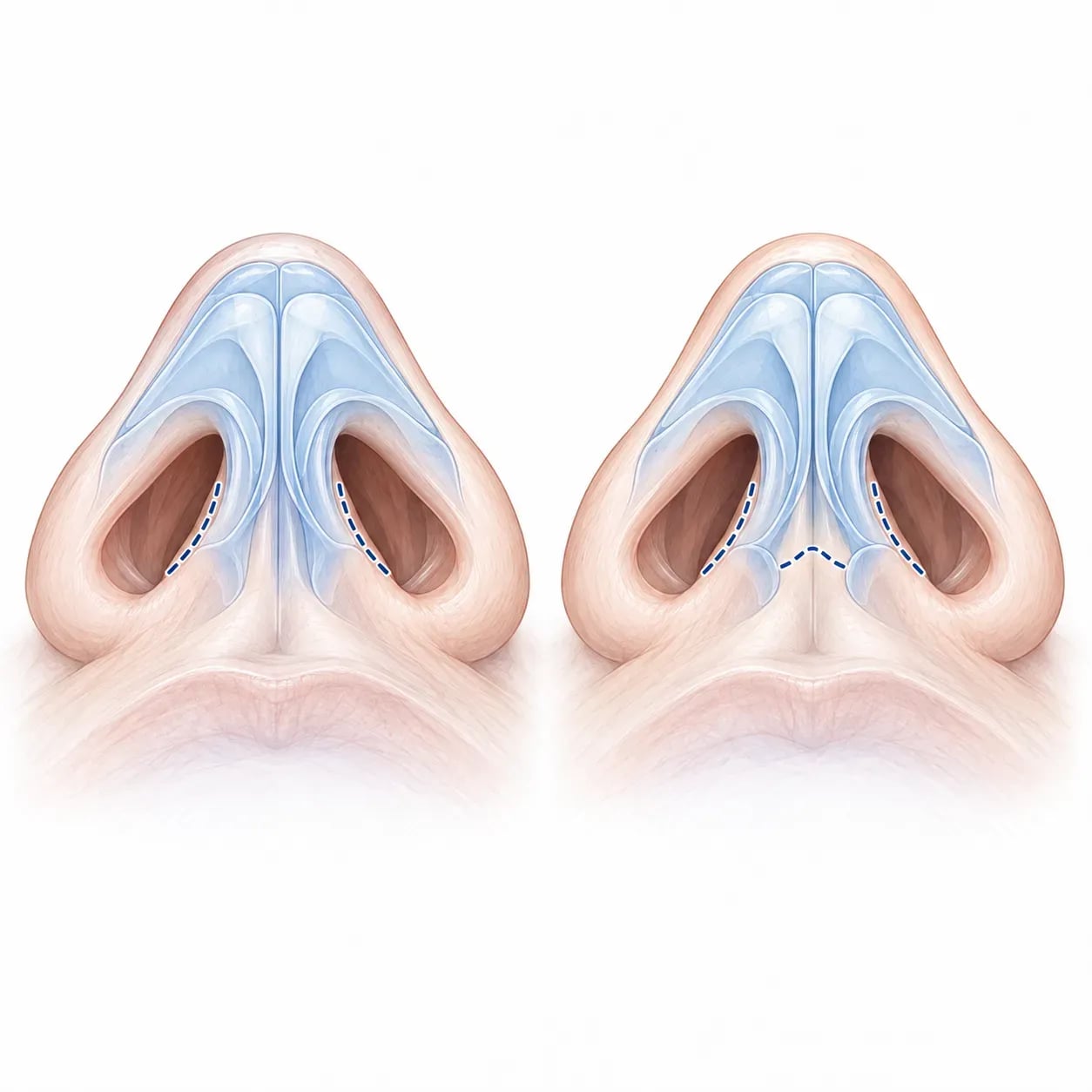
All the incisions are made inside the nostrils. Nothing is visible afterwards, and the early swelling tends to settle a little faster. The surgeon works through a narrower window, which suits a straightforward hump reduction, a narrowing of the bones, or a modest change to the tip.
Open rhinoplasty
A short incision is added across the columella — the strip of skin between the nostrils. The skin is lifted and the whole framework is exposed, so grafts can be placed and stitched under direct vision. The scar sits in a natural shadow and in most patients settles into a fine pale line, but it is permanent and visible on close inspection. On deeper skin tones it can stay darker than the surrounding skin for several months, which is one more reason to keep it out of the sun while it matures.
Which one you have is a consequence of what needs doing, not a style preference and not a measure of the surgeon. Cartilage grafting, a markedly asymmetric or very soft tip, and almost all revision work need the exposure an open approach gives. A surgeon who commits to one approach before examining you is deciding the wrong thing first.
Are you a candidate for rhinoplasty?
Rhinoplasty is open to more people than most expect, and ruled out for a few for reasons that have nothing to do with the nose.
Generally suitable
- Facial growth has finished. Surgeons wait for this rather than working to a fixed birthday, and the timing differs between individuals.
- You are in good general health, with any long-term condition under control and known to the surgeon and the anaesthetist.
- You can describe what bothers you about your nose in terms of your own face — the profile, the width, the way the tip behaves — rather than only in terms of someone else’s.
- There is no upper age limit. Skin that has lost elasticity redrapes more slowly, and your surgeon will factor that into what is realistic.
Postponed or declined
- Active smoking or vaping. Nicotine narrows the very small vessels that supply the skin of the nasal tip — the exact tissue most at risk during this operation. Cigarettes, vapes, heated tobacco and nicotine pouches all count, and stopping has to start weeks before, not the night before.
- A clotting disorder, or medication that affects clotting, until it has been reviewed by the treating doctor and the anaesthetist.
- Distress about the nose that is out of proportion to what others see. Surgery rarely resolves it, and often moves it onto the next feature. A surgeon who says so is protecting you, not refusing you.
- An expectation of a specific other person’s nose. Skin thickness, cartilage strength and the bone beneath are yours; they set the ceiling, and no technique overrides them.
Your eligibility is confirmed by the surgeon and the anaesthetist at the consultation in Tunis, after examination and your pre-operative tests. Nothing written here, and no remote opinion, replaces that.
How much does rhinoplasty cost in Tunisia?
Three prices, because rhinoplasty is three different amounts of work. They are quoted per procedure and cover the five-day stay.
Each price includes the consultation with the surgeon and the anaesthetist, the operation, the anaesthetic, the night in the clinic, the external splint, your accommodation, airport and clinic transfers, and the follow-up after you fly home. It does not include your flights or the pre-operative tests, which are carried out where you live around fifteen days before you travel, under the protocol we send you.
Revision costs more for a plain reason: the tissue planes are scarred, the anatomy is no longer predictable, the operation takes longer and it almost always needs graft material. Ethnic rhinoplasty sits in between for the same kind of reason — building structure takes longer than removing it.
Your own quote is issued after the surgeon has seen your photographs and your history, and it holds what was agreed. If anything about your case changes the plan, you are told before you travel, not after you arrive. And a word of caution that applies to every clinic, in every country: price is the easiest thing to compare and the least useful on its own. What matters more is who operates, what happens if the result needs adjusting, and whether anyone answers you in month four.
| Procedure | Price | Stay |
|---|---|---|
| Primary rhinoplasty | €2,200 | 5 days |
| Ethnic rhinoplasty | €2,400 | 5 days |
| Revision rhinoplasty | €2,600 | 5 days |
Your journey, step by step
- Your enquiry and a first opinion. Send recent photographs of your face — front, both profiles and both three-quarter views — together with what bothers you and, if it applies, how you breathe through each nostril. You receive a first opinion and a personalised quote within 24 to 48 hours. This is not a diagnosis: skin thickness, cartilage strength and the state of the septum are assessed by examination, and they are the three things that decide what is possible.
- Preparation. We help you organise the trip and your accommodation. Pre-operative tests are done where you live, about fifteen days before, following the protocol we send. Stopping nicotine needs to begin several weeks ahead. Avoid aspirin and anti-inflammatories in the days before surgery unless your own doctor has told you otherwise, as they increase bleeding.
- Arriving in Tunis. A member of the team meets you in the arrivals hall at Tunis-Carthage with a board showing your name, and takes you to your accommodation. Tell us straight away about a delayed flight, a missed connection or delayed baggage — the schedule is rebuilt around you rather than the other way round.
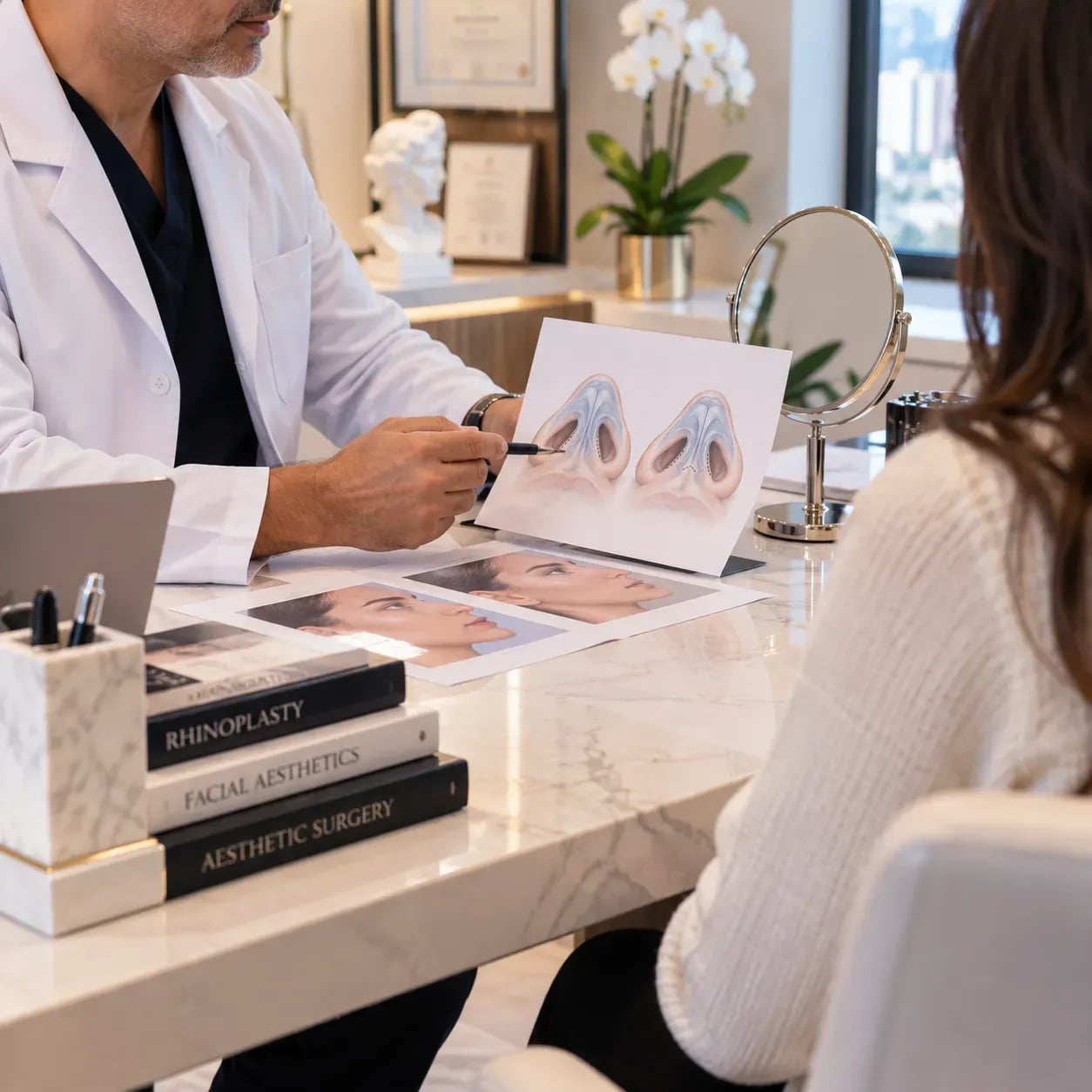
- Consultations. You meet the surgeon and the anaesthetist. The surgeon carries out a full facial analysis: the proportions of the nose against the forehead, the lips and the chin, the thickness of your skin, the strength of the cartilage, the state of the septum and the quality of your breathing. The technique is then decided — closed or open, with or without cartilage grafts. Bring your reference photographs and say precisely what you want; this is the conversation that sets the plan.
- The operation. Under general anaesthetic, 1 hour 30 to 3 hours depending on complexity. The surgeon reshapes bone and cartilage, corrects the septum if needed, and fits an external splint to hold the new shape. Internal splints or packing may be used for the first few days.
- One night in the clinic. Sleeping with your head raised from that first night limits the swelling more than anything you will be given.
- Recovery in Tunis. The rest of the stay is spent resting, with reviews at the clinic. The splint comes off around a week after surgery, which for most patients is shortly after they land back home.
- Going home, and the long part. You travel back once the surgeon confirms you are fit to fly. The follow-up then runs for months rather than weeks, because that is how long the nose takes to settle. Keep sending photographs at the intervals you are given, even when nothing seems to be changing — especially then.
If your plan also involves the chin, that is decided at the same consultation rather than later: see chin surgery in Tunisia.
Is rhinoplasty safe? Risks and precautions
Rhinoplasty is a well-established operation, carried out under general anaesthetic in an accredited clinic with a dedicated anaesthetist, after pre-operative tests and a night of monitoring. It is not a risk-free one, and a page that told you otherwise would not be worth reading.
Risks common to any operation
Reaction to the anaesthetic, bleeding, infection, and healing that does not go to plan. Your tests and the anaesthetist’s assessment exist to find the people for whom these matter more.
Risks specific to the nose
- Asymmetry. No face is symmetrical to start with, and a nose can settle slightly off the midline as the swelling resolves unevenly.
- Swelling of the tip that outlasts everything else, particularly under thick skin.
- Numbness of the tip and the upper lip, usually temporary but measured in months rather than weeks.
- A change in your sense of smell, almost always temporary.
- Breathing that is worse rather than better, if support is reduced too far. This is the risk that structure-preserving technique and grafting exist to avoid.
- Irregularities that appear later, as thin skin tightens down onto the framework and starts to show what is underneath.
- Perforation of the septum. Rare, and more likely where the septum has already been operated on.
Revision happens more often here than elsewhere
Revision is more common after rhinoplasty than after most cosmetic operations. Surgical societies publish rates and they vary from one series to another, but the direction is consistent, and the reason is structural rather than a matter of competence: the surgeon is shaping living tissue through swelling, then handing it over to a year of healing that no one controls. Any surgeon who tells you revision is not a possibility is telling you something the literature does not support.
The risk that is specific to travelling
You will fly home while the nose is still swollen. If something goes wrong, it is likely to declare itself when you are several thousand kilometres away. That is handled in advance, not improvised: you leave with a named contact who answers, written instructions on what is normal and what is not, and a clear threshold for when to be seen locally rather than wait for a reply. Bleeding that will not stop, a fever, or spreading redness and pain are reasons to be seen where you are, that day, and to tell us at the same time.
On the flight itself, move around the cabin, keep your fluids up, and follow whatever your surgeon has told you about compression stockings. Ask before you book a long-haul connection in the first week.
How long is the recovery?
Recovery from rhinoplasty is short in the way that matters socially and long in the way that matters to the result. The two get confused constantly.
- The first night. An external splint, sometimes internal splints or packing, and the single most effective thing you can do — sleep with your head raised.
- Days 2 to 7. Bruising around the eyes peaks in the first two or three days and then fades. Most of it has gone within one to two weeks, and it is the part that frightens people most and matters least.
- Around one week. The splint comes off. The nose underneath looks swollen, often wider and more turned up than it will stay. This is normal and it is not your result.
- One to two weeks. Back to desk work for most people. Anything that raises your blood pressure sharply, including heavy lifting and hot saunas, waits longer.
The practical questions people actually ask
- Glasses. Weight resting on the bridge while the bones are knitting can move them. Your surgeon will tell you how long to keep glasses off the nose and will suggest a workaround — taping the frames to the forehead, or contact lenses if you wear them. Ask before you travel if you depend on glasses to work.
- Blowing your nose. Not until you are told you can. Sneeze with your mouth open.
- Prayer. Prostration puts direct pressure on the nose and the forehead. Ask your surgeon how long to adapt sujud; many patients pray seated for the first weeks. It is a routine question here and no one will be surprised by it.
- Sun and heat. Strong sun slows the fading of bruising and darkens a fresh columellar scar, and heat makes swelling worse. If you are going home to the Gulf or to an African summer, plan for shade, and use a high-factor sunscreen on the scar as soon as your surgeon allows it.
- Sport. Light activity returns well before contact sport does. Anything that could take a ball or an elbow to the face waits for the period your surgeon sets, and that period is longer than you will want it to be.

When do you see the final result?
This is the part of rhinoplasty that patients are least prepared for, and it is the reason the operation is judged at twelve months rather than at twelve days.
What happens, and roughly when
- Splint off, around a week. Swollen, usually wider and more upturned than the final shape. Almost nobody likes their nose at this point.
- Weeks 2 to 6. The obvious swelling goes. You look normal to other people and strangers notice nothing. You, looking in a mirror every morning, notice everything.
- Months 3 to 6. The bridge settles and the profile you will keep becomes readable.
- Months 6 to 12, and beyond on thick skin. The tip is always last. Definition continues to arrive long after the rest of the nose has stopped changing.
The window that catches people out
Weeks two to eight are the hard part. The nose is recognisably yours and visibly unfinished, and that combination makes people certain something has gone wrong. Very little goes wrong in that window. It is simply the part of the timeline nobody photographs.
How to judge it fairly
Take your progress photographs at the same distance, in the same light and from the same angles each time, and send them at the intervals your surgeon asks for. A phone held at arm’s length uses a short lens that exaggerates whatever is closest to it — which, on a face, is your nose. Half the panic we see in month two is a lens, not a nose.
No surgeon anywhere discusses a revision before twelve months, because until then the nose has not finished deciding what it is.
Revision rhinoplasty: correcting a first operation
A revision, or secondary, rhinoplasty corrects the result of a previous operation — most often one carried out elsewhere. It is the same anatomy and a genuinely harder operation.
Why it is harder
- The tissue planes are scarred, so the dissection is slower and less predictable.
- Cartilage has usually been removed, weakened or reshaped, so there is less of a framework to work with and less material to rebuild it from. If the septum has already been harvested, graft cartilage may have to come from an ear.
- The skin has already been lifted once and redrapes more slowly, so the result takes longer to appear than it did the first time.
- Expectations are higher and patience is lower, which is understandable and still has to be managed.
What a revision can and cannot do
It can usually improve a residual hump, an over-resected or pinched bridge, a tip that has dropped or lost definition, visible asymmetry, and breathing that was made worse. What it cannot do is return the nose to a state before any surgery, because the material that was taken out is gone. A surgeon who sets that out at the consultation is being accurate, not pessimistic.
Before you book a revision
Bring whatever you have from the first operation — the operative note, the technique used, whether grafts were placed and where they came from. If you have no paperwork at all, say so; the surgeon will plan for uncertainty rather than assume. And wait out the twelve months. A nose revised too early is often revised twice.
Revision rhinoplasty is quoted separately, at €2,600 for a five-day stay, for the reasons above. An opinion on a revision case is given on photographs and history like any other, and that opinion will sometimes be that the nose is better left alone.
Liquid rhinoplasty: what fillers can and cannot do
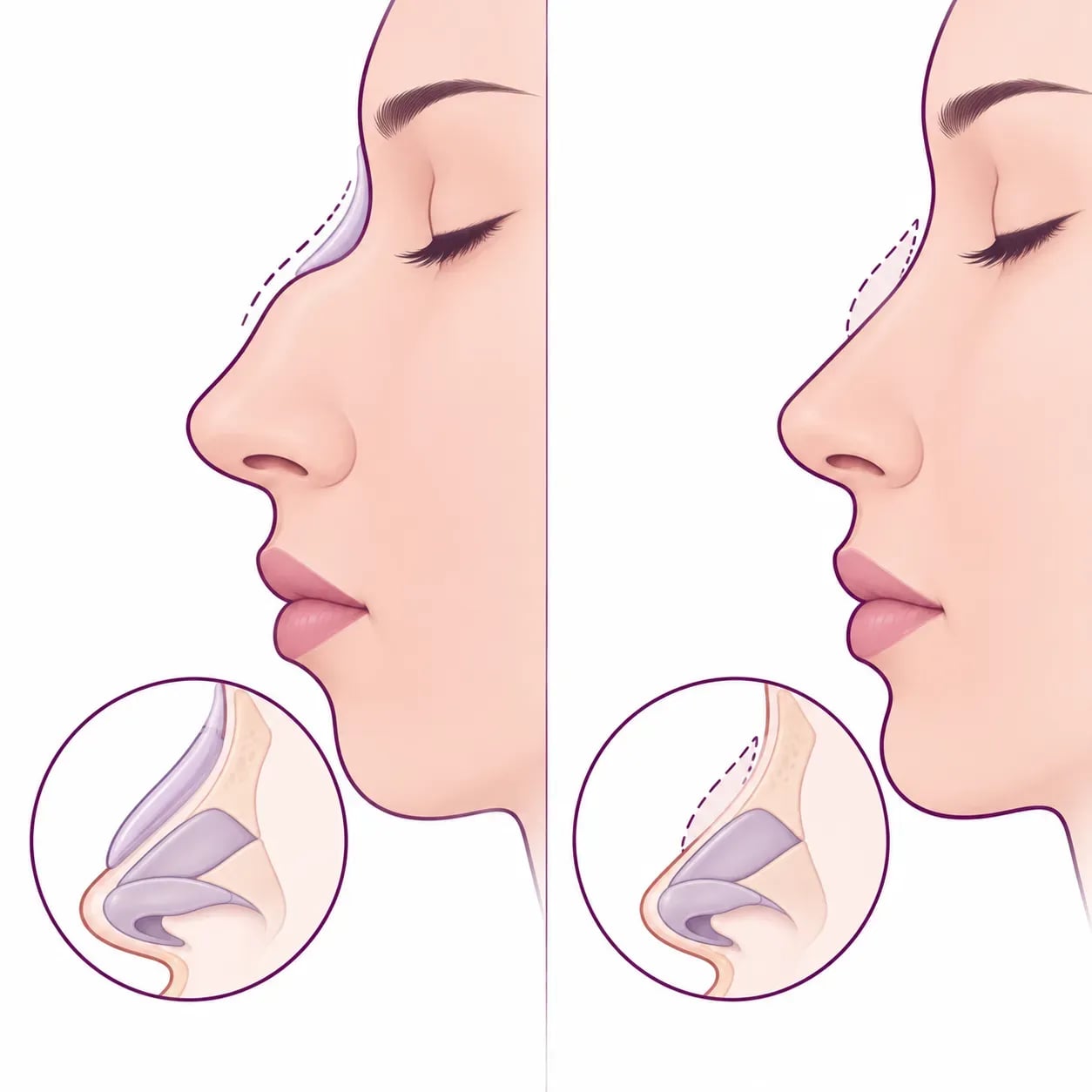
Non-surgical rhinoplasty — a nose job with filler, sometimes sold as a fifteen-minute nose job — is a different procedure wearing the same name. It is worth understanding exactly where the line falls, because the two are not alternatives for most people.
What filler can do
Filler only adds volume. Placed above and below a small dorsal hump, it can make the profile read as straight. It can give a little projection to a flat bridge, lift a tip that droops slightly, or camouflage a minor irregularity. The effect is immediate and, on this page’s figures, lasts around 12 to 18 months.
What filler cannot do
It cannot make a nose smaller. It cannot narrow bone, reduce a wide or bulbous tip, correct a deviated septum or improve your breathing. A large hump filled rather than removed gives you a straight profile on a bigger nose. If what you want is less nose, filler is the wrong tool and no injector can make it the right one.
Two things to know before you book it anywhere
First, the nose is one of the highest-risk sites on the face for filler. Its blood supply runs through small end arteries that connect to the circulation around the eye, and filler placed into or pressing on one of those vessels can cause skin loss and, rarely, damage to vision. It should be done only by an experienced injector who keeps hyaluronidase — the enzyme that dissolves hyaluronic acid — immediately to hand. This is not an argument for being nervous; it is an argument for being selective.
Second, filler in the nose makes later surgery harder. Repeated treatments leave fibrous tissue in exactly the plane a surgeon needs to lift. If you have ever had filler in your nose, tell your surgeon, even if it was years ago and even if it has visibly gone.
For filler used elsewhere on the face, see dermal fillers in Tunisia.
Nose and chin: the profile works as one
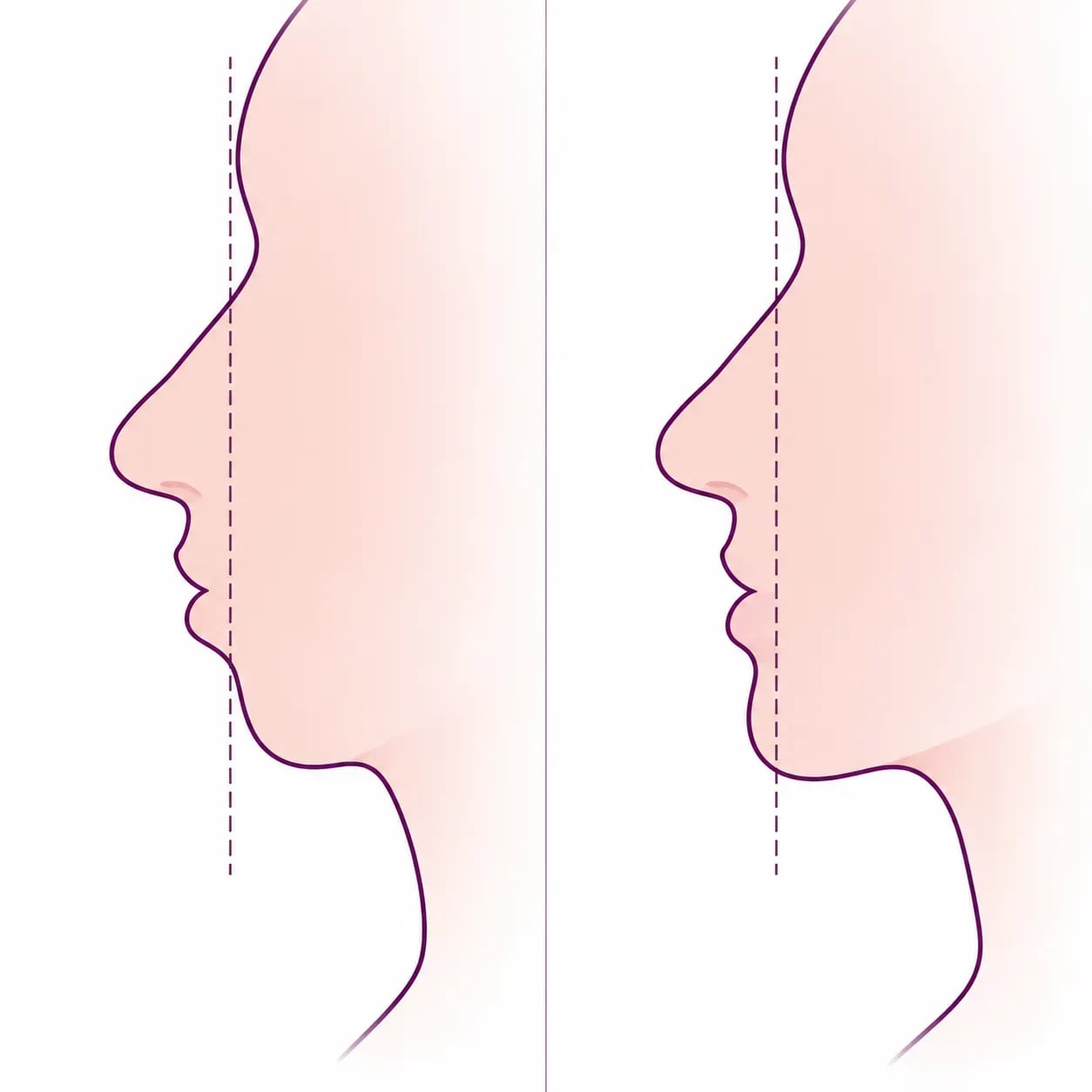
Ask ten people what is wrong with a profile and most will point at the nose. On a side view the eye is not reading the nose on its own — it is reading the relationship between the brow, the nose, the lips and the chin. A chin that sits back makes the same nose look larger and the jawline look softer.
This is why the consultation begins with a full facial analysis rather than with the nose. Sometimes the finding is that the profile would be better served by bringing the chin forward than by taking more off the bridge — and that taking more off would leave a nose that looks over-operated on that particular face. Addressing both in the same trip is a common plan, decided at the consultation and never sold to you in advance.
Two routes are used, and they answer different problems:
- Projection. Where the chin is genuinely set back, moving the bone or placing an implant changes the profile. See chin surgery in Tunisia.
- Contour. Where the issue is volume and definition rather than bony position, the surgeon’s own fat can be used to refine the transition. See facial fat transfer in Tunisia.
Which one applies to you, or whether neither does, is a surgical judgement made after examination. The point of raising it here is simpler: if you have been unhappy with your profile for years and the nose alone has never quite explained why, this is often the missing half.
The partner surgeons
Rhinoplasty at ServiHealth is carried out by Dr Taher Djemal and Dr Abir Ben Ouaghrem, plastic and aesthetic surgeons at the Clinique Internationale Myron in Tunis.
You meet your surgeon in person before the operation. That consultation is where the technique is chosen, where you say what you want in your own words and with your own reference photographs, and where you are told what your anatomy will and will not allow. The decision on indication, approach and technique belongs to the surgeon; the decision on whether to go ahead belongs to you, and it is taken after that conversation rather than before it.
Consultations and the clinic stay are supported in English and French throughout, including the pre-operative discussion with the anaesthetist.
Why have rhinoplasty in Tunisia?
The price difference between rhinoplasty in Tunisia and private surgery in the UK, Ireland or the Gulf is real, and it is why most people start looking. It is also the least interesting reason to choose a clinic, so here is what actually differs in practice.
- One trip, organised as one thing. Consultations, the operation, the clinic night, accommodation and transfers are arranged together, with a coordinator who knows your file rather than a switchboard.
- English and French throughout, including with the anaesthetist — the conversation where misunderstanding costs most.
- Follow-up that does not stop at the airport. Rhinoplasty is judged at twelve months. A clinic that is reachable in month eight is worth more than one that is cheaper in week one.
- Short, practical travel. Tunis is a short flight from western Europe and is reachable directly from several hubs further east, which matters when the stay is five days and you may need a review trip later.
Two honest cautions
Entry requirements for Tunisia depend on your nationality and they change. Check them against your own passport before you book anything, and tell us early if you need supporting documentation for a visa application — we can provide what we hold, and we cannot influence a decision.
And compare clinics on the questions that are hard to answer rather than the ones that are easy. Who operates. What the plan is if the result needs adjusting at twelve months, and who pays for what. Who replies when you send a photograph at month four and you are worried. Any clinic can quote a price.
Before you travel: a checklist
Send with your enquiry
- Photographs: front, both profiles, both three-quarter views, and one smiling — the tip behaves differently when you smile and the surgeon needs to see it.
- Any previous nasal surgery or injury: dates, what was done, the operative note if you have it, and whether grafts were used and where they came from.
- Any filler ever placed in your nose, however long ago.
- Whether one side blocks, and whether it is constant or changes with position.
Tell the surgeon about
- Every medication, including anticoagulants and anything taken for a long-term condition.
- Supplements. Fish oil, vitamin E and ginkgo all increase bleeding and are easy to forget because they are not thought of as medicines.
- Isotretinoin for acne, whether you are taking it now or stopped recently.
- Any bleeding or clotting problem in you or your family.
Before you fly
- Stop nicotine in every form, starting weeks ahead rather than days.
- Have the pre-operative tests done at home, around fifteen days before, following the protocol we send.
- Arrange travel insurance that covers you abroad, and read what it says about planned surgery.
- Book a return flight you can move. If the surgeon wants you for one more day, you want that to cost nothing.
- Sort out glasses or contact lenses now. Working out how you will read for the first few weeks is easier on the ground than in a hotel room in Tunis.
- Book one to two weeks away from work, and tell whoever needs to know before you go rather than afterwards.
- If you are thinking of combining this with another facial procedure in the same trip — eyelid surgery or a facelift, for instance — raise it at the enquiry stage, not on arrival. It changes the operating time, the anaesthetic and the stay.
Four questions worth asking at the consultation
- Open or closed, and why mine?
- Will I need grafts, and where would the cartilage come from?
- What will this look like at one week, at three months and at a year — and what will still be swollen at each point?
- If something needs adjusting at twelve months, what happens, who does it and what does it cost?
One last thing. Bring several reference photographs rather than one, and say what you like about each of them. A single picture of someone else’s nose tells a surgeon almost nothing about your face. Four pictures and a sentence each tells them exactly what you are after.








Frequently asked questions about Rhinoplasty in Tunisia
It is a shorthand for a technique rather than a separate operation. The term describes noses that need structure built rather than reduced — typically thicker skin, softer lower lateral cartilage and a lower bridge, patterns common in patients of African, Afro-Caribbean, Middle Eastern, North African, South Asian and East Asian heritage. The surgeon usually grafts cartilage to add projection and define the tip. The aim is a nose in proportion with your own face, not a nose borrowed from another one.
At ServiHealth, €2,200 for a primary rhinoplasty, €2,400 for ethnic rhinoplasty and €2,600 for a revision, each with a five-day stay. The price covers the consultations with the surgeon and the anaesthetist, the operation, the anaesthetic, the night in the clinic, the splint, accommodation, transfers and follow-up. It does not cover your flights or the pre-operative tests, which are done where you live about fifteen days beforehand. Your own quote is confirmed after the surgeon has seen your photographs and history.
Around twelve months, and longer for the tip on thick skin. The bruising goes within one to two weeks and you look normal to other people well before the nose has finished changing. The bridge settles over three to six months; the tip is always last. No surgeon assesses a rhinoplasty, or discusses a revision, before twelve months.
Only how the surgeon reaches the framework. In a closed rhinoplasty every incision is inside the nostrils and nothing is visible afterwards. In an open rhinoplasty a short incision is added across the columella, the skin between the nostrils, so the whole framework can be seen and grafts placed under direct vision; the scar settles into a fine line but is permanent. Cartilage grafting, a very soft or asymmetric tip and almost all revision work need the open approach. It is decided by what needs doing, not by preference.
Yes, when the obstruction is structural. A deviated septum, enlarged turbinates or a collapsing nasal valve can be corrected in the same operation, under the same anaesthetic, without extending the stay. It will not help breathing that is caused by allergy or infection. Tell the surgeon which side blocks and whether it changes when you lie down — it narrows the diagnosis considerably.
It is a well-established operation, carried out under general anaesthetic with a dedicated anaesthetist after pre-operative tests and a night of monitoring — but it is not risk-free. Alongside the general risks of surgery, the nose-specific ones are asymmetry, prolonged swelling of the tip, temporary numbness or change in smell, irregularities that show as the skin tightens, breathing that is worse rather than better, and rarely a perforation of the septum. Your surgeon goes through the ones that apply to your anatomy at the consultation.
Sometimes, yes. Revision is more common after rhinoplasty than after most cosmetic operations, because the surgeon shapes living tissue through swelling and then hands it to a year of healing that nobody controls. It is never considered before twelve months, since much of what worries patients at two or three months resolves on its own. Ask your surgeon at the consultation what happens if an adjustment is needed, who performs it and what it costs — that answer tells you more about a clinic than its price list.
Please do — but bring several rather than one, and say what you like about each. Reference photographs are useful because they show the surgeon what you mean by words like refined or straight, which mean different things to different people. What they cannot do is transfer: skin thickness, cartilage strength and the bone beneath are yours, and they set the ceiling. The honest use of a reference photo is to agree on a direction, not to order a result.
Five days. That covers the consultations with the surgeon and the anaesthetist, the operation, one night in the clinic and the first reviews. The splint usually comes off around a week after surgery, which for most patients is shortly after they get home, and the follow-up then continues remotely for months.
Less painful than most people expect. What patients describe is pressure and a completely blocked nose rather than pain, and it is managed with ordinary prescribed painkillers. The genuinely unpleasant part is breathing through your mouth for the first few days, especially at night. Sleeping with your head raised helps more than anything else you will be offered.
€2,600 with a five-day stay, for a revision of an operation carried out elsewhere. It costs more than a primary rhinoplasty because the tissue planes are scarred, the anatomy is less predictable, the operation takes longer and it almost always needs graft cartilage. A quote is issued after the surgeon has seen your photographs and whatever records you have from the first operation.
Routinely. The technique is the same; the targets are not. A male nose is generally left with a straighter bridge, less rotation at the tip and more projection, because over-refining it reads as feminising rather than as improved. Say at the consultation whether you want the character of your nose kept and only the specific problem addressed — for most men that is exactly the brief, and it is worth stating out loud.
Not for several weeks. The arms of a pair of glasses rest directly on bone that has just been reshaped, and sustained weight there can move it. Plan for contact lenses during that period, or ask the surgeon about ways of supporting the frames off the nose. If you depend on glasses for work, raise it before you travel rather than after the splint comes off.
Light activity returns well before sport does. Intense exertion is avoided for several weeks, and anything that risks a knock to the nose — football, basketball, martial arts, racket sports, swimming in a crowded pool — for several months. The nose stays fragile long after the visible swelling has gone, which is the part people underestimate. Your surgeon sets the dates for your case.
Wait, and say so. A rhinoplasty cannot be judged before twelve months, and a great deal of the disappointment felt at two or three months disappears as the swelling resolves — particularly at the tip. Keep sending your progress photographs and raise what is bothering you at each review rather than waiting until the end. If the dissatisfaction is still there once the nose has fully settled, a revision can be discussed; it is discussed after stabilisation, never before.