

Hair transplant: when can you go back to work?
This is the question that holds up the decision for most working patients, long before the price does: how long will it show? A hair transplant isn't something you announce to your employer, and nobody wants the subject coming up in a meeting. Here is what is visible, for how long, and what that means in practice depending on your job.
How many days should you plan before going back to work?
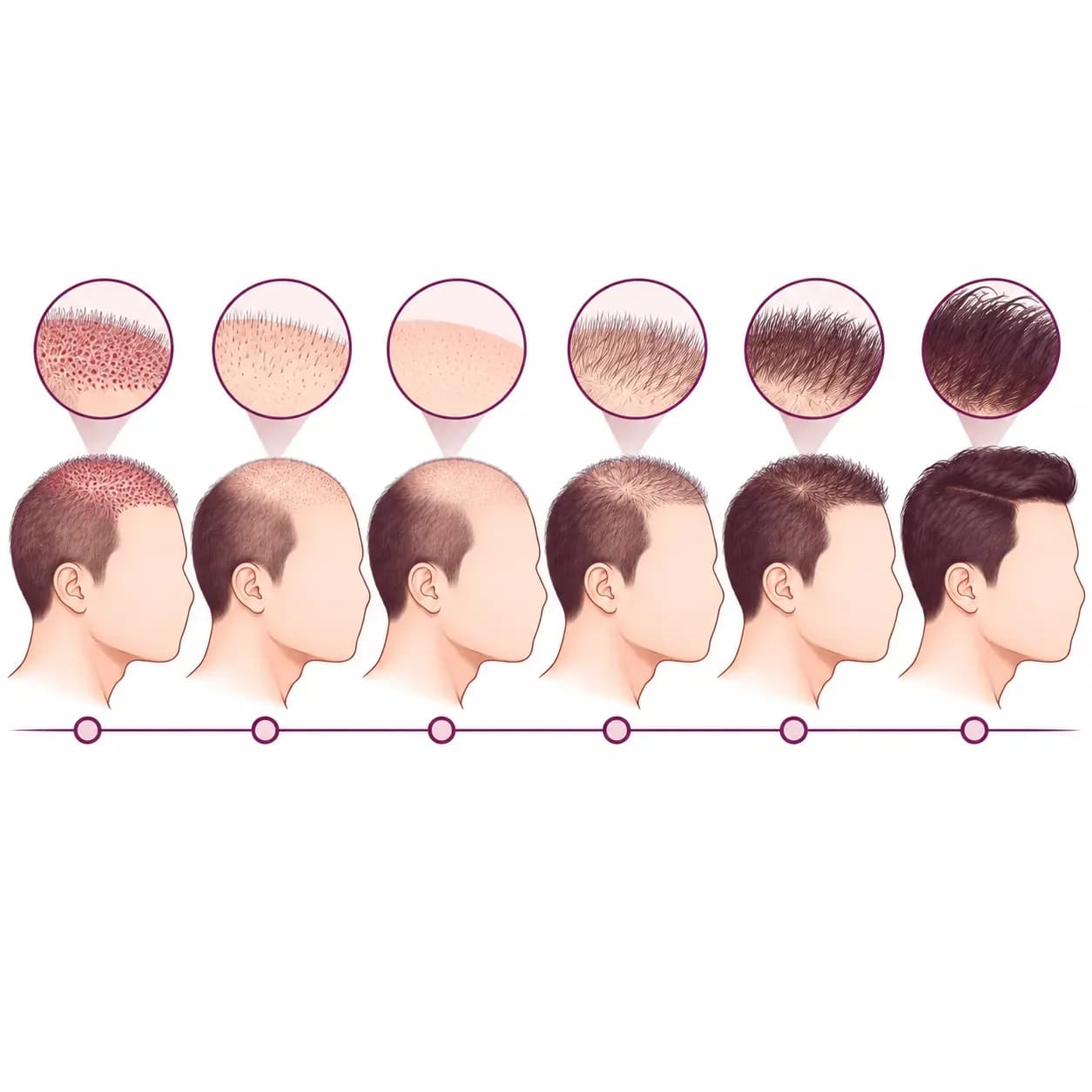
For a desk job, the practical marker is about ten days. It doesn't come from a medical rule but from a simple fact: the crusts come away on their own between day seven and day ten. Before that point, the transplanted area is recognisable up close and from a distance.
Physically, nothing stops you working the very next day if your job is sedentary. The real constraint is visibility, not capability.
What exactly shows, and for how long?
Four things follow one another, and none of them lasts.
- The crusts. They form from the second day over the transplanted area and come away on their own between day seven and day ten, helped by the daily washes. This is the most visible marker, and the one that sets the calendar.
- The swelling. It often appears on day two or three, on the forehead and sometimes around the eyes, then goes down over a few days. Sleeping with your head raised and applying cold to the forehead — never to the transplanted area — limits it noticeably.
- The itching. Common around day five, it signals healing. It doesn't show, but you feel it, and you must not scratch.
- The shaved donor area. At the back of the head, it grows back like normal hair. If you already wear your hair short, it goes unnoticed within a few days.
Beyond day ten, what remains visible is mainly a redness that fades gradually, and varies from one skin to another.
Can you work from home during this period?
Yes, and it is the simplest solution when it's available. The first ten days don't call for any particular rest: they call for not touching the area, keeping to the washes and avoiding knocks. All of that is compatible with a day in front of a screen.
Two points deserve attention on video calls: overhead lighting accentuates the crusts, and a front-facing camera shows the forehead, so the swelling of the first few days. Moving video meetings out of the first week settles the question.
What if your job is physical, or highly exposed?
The picture changes for three profiles.
Physical jobs. Sweating, knocks and carrying loads are to be avoided while the grafts are taking. Allow a wider margin than ten days and raise it at your consultation: the timeline that fits your case is set by the doctor.
Jobs in contact with the public. Retail, reception, field sales: visibility matters as much as healing. The second week is generally more comfortable than the first.
Jobs requiring a helmet or head covering. Construction, kitchens, security. Anything that rubs or presses on the transplanted area is a problem in the early days. That is a point to raise before setting the date of the procedure, not after.
Can you wear a cap to cover it?
Not freely, and this is counter-intuitive. Anything rubbing the transplanted area while the grafts are taking risks displacing them. If you want to cover up, ask the team from what point and with what kind of head covering: the answer depends on the technique used and how large an area was treated.
Why the result doesn't show straight away
This is the part many patients discover too late, and it is better known before booking time off in the hope of coming back transformed.
The transplanted follicles fall out within two to four weeks of the procedure. This phenomenon, called effluvium, is normal and expected: it is not a failure. The follicle stays in place under the skin, goes dormant, then starts a new cycle. The first visible regrowth generally appears from the third month, improving gradually week by week.
In other words, your colleagues will see no change when you return. They will see one several months later, gradually enough that the question never arises.
How long do you need to stay in Tunisia?
The length of stay depends on the number of grafts.
- Up to 2,500 grafts: €2,400, 3 days on site.
- Above 2,500 grafts: €2,800, 5 days on site.
- Beard transplant: €1,800, 3 days on site.
- Eyebrow transplant: €1,400, no overnight stay.
Many patients arrange their stay over a weekend to reduce the number of days they take off. The number of grafts needed, however, isn't decided in advance: it is assessed by the doctor according to your donor area and the extent to be covered.
Frequently asked questions
Can I go back to sport at the same time as work?
No, the two timelines are different. Exertion and sweating call for a longer pause than the return to the office. The exact interval will be given to you according to your procedure.
Will the people around me necessarily notice?
During the first ten days, the transplanted area is recognisable to anyone looking. After that, it depends mainly on the residual redness and the length of your hair. Patients who already wear their hair short get through it more discreetly.
Can I dye or cut my hair after a transplant?
Not immediately, and not without advice. Colouring, clippers and short cuts over the transplanted area follow a precise calendar that the team will give you.
How long before the result is final?
The first regrowth appears from the third month and the result continues to develop gradually after that. The pace varies from one person to another.
What to take away
Ten days before it stops showing in a sedentary job, longer for physical or highly exposed work, and three months before the first regrowth. Those are the three markers that let you organise a transplant rather than be caught out by it.
Within the ServiHealth team, Dr Guesmi Marouen is the doctor responsible for hair surgery: it is at the consultation that the number of grafts, the technique and the timelines that apply to you are decided. If you want to set a date around your working calendar, the team organises the stay around your constraints. Full details of hair transplants in Tunisia, or request an assessment with a few photos attached.