

Breast Implant Replacement and Removal in Tunisia: Rupture, Capsulectomy and Price

Breast implant replacement and removal in Tunisia: the essentials
Implants are replaced because they have aged, because one has ruptured, because a capsule has tightened, because you want a different size — or they are taken out and not replaced at all.
All of those are handled here, including implants placed by another surgeon in another country. Removal without replacement is a request we get often, and it is priced and planned as a procedure in its own right rather than treated as a failure.
Having implants for the first time? See breast augmentation. Wanting a lift rather than a change of implant? See breast lift.
It is carried out by Dr Taher Djemal and Dr Abir Ben Ouaghrem at Myron International Clinic in Tunis, with English-speaking support throughout.
| Operating time | 1 hour to 2h30 |
| Anaesthetic | General |
| Stay in Tunisia | 5 days, or 3 for removal alone |
| Back to work | 1 to 2 weeks |
| Replacement | From €2,600 |
| Removal without replacement | From €2,300 |
Why implants get replaced
Five reasons, and they are not equally urgent.
- Age. Preventive replacement is generally suggested around 10 to 15 years, with or without symptoms.
- A suspected or confirmed rupture.
- Capsular contracture that is progressing — the breast firmer, more painful, or changed in shape.
- You want a different size. A perfectly good reason, and it needs no further justification.
- Your body has changed — pregnancy, weight loss or gain, or the natural settling of the breast over the years.
On the ten-year rule. It is a guideline rather than a law. Implants do not expire on a date, and an implant at twelve years with normal imaging and no symptoms is not an emergency. The decision is made with your surgeon and with recent imaging, not with a calendar. Equally, no imaging for fifteen years is not a plan either.
Silent rupture: the reason imaging matters
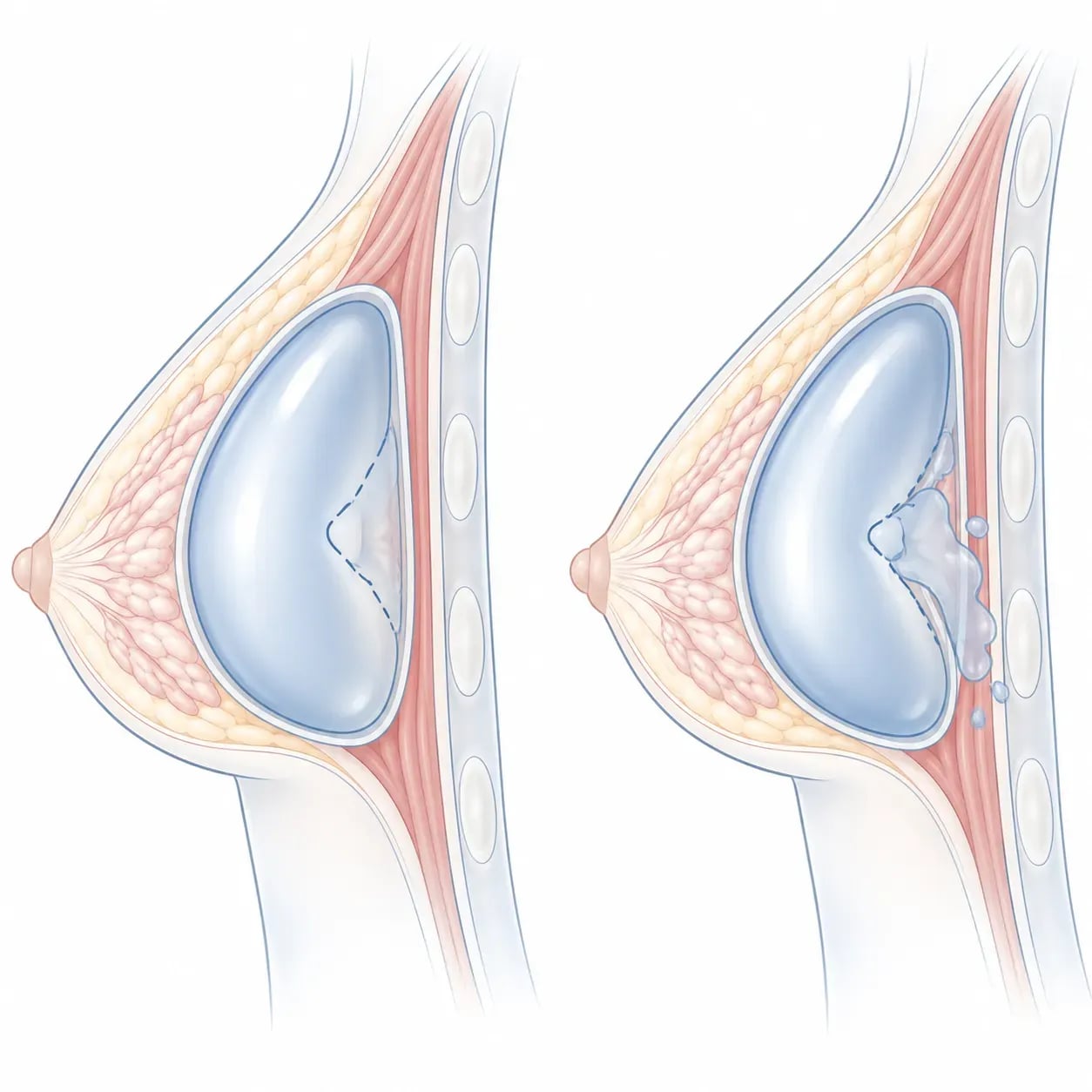
A silicone gel implant can rupture without you noticing anything at all.
Modern cohesive gel does not leak away like a liquid. When the shell fails, the gel usually stays contained inside the scar capsule your body formed around it. The breast can look and feel entirely normal.
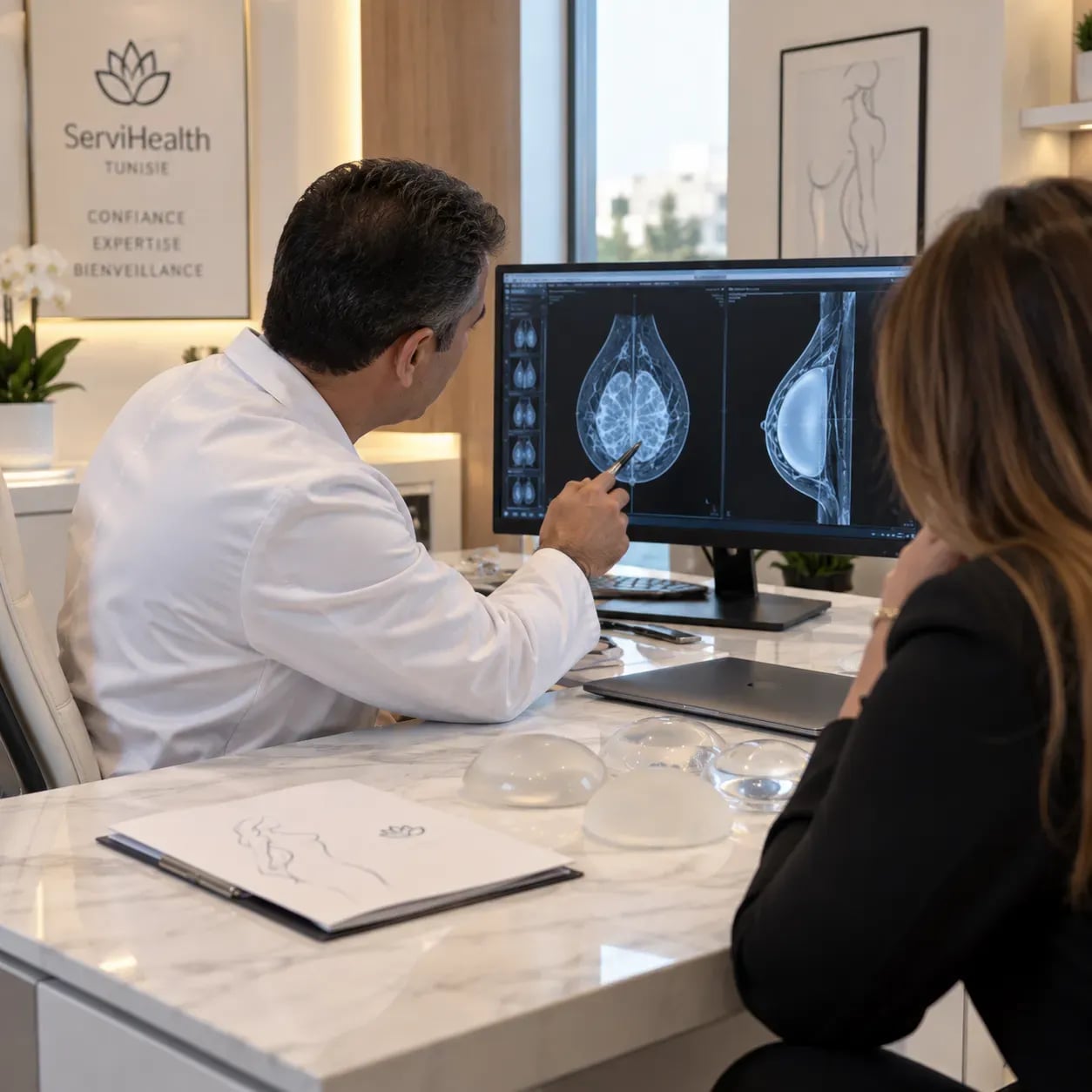
That is why imaging matters even when nothing seems wrong. Ultrasound detects many ruptures; MRI is the most reliable. If your implants are over ten years old and have never been imaged, that is the place to start — before deciding anything.
This is also one of the practical reasons to keep your implant card and operative report: they tell a radiologist what they are looking at.
Signs worth getting checked
None of these automatically mean something serious. All of them mean an examination rather than waiting.
- A change in shape, or new asymmetry between the two sides
- Pain
- Swelling, particularly on one side only and particularly years after surgery
- Heat, or redness
- A change in texture, or new rippling
- Anything flagged on imaging, even with no symptoms at all
New swelling in one breast, years after surgery, is the one to act on quickly. It is usually something benign. It is also how BIA-ALCL presents, and that needs ruling out rather than assuming.
Capsulectomy: partial, total, and what « en bloc » means
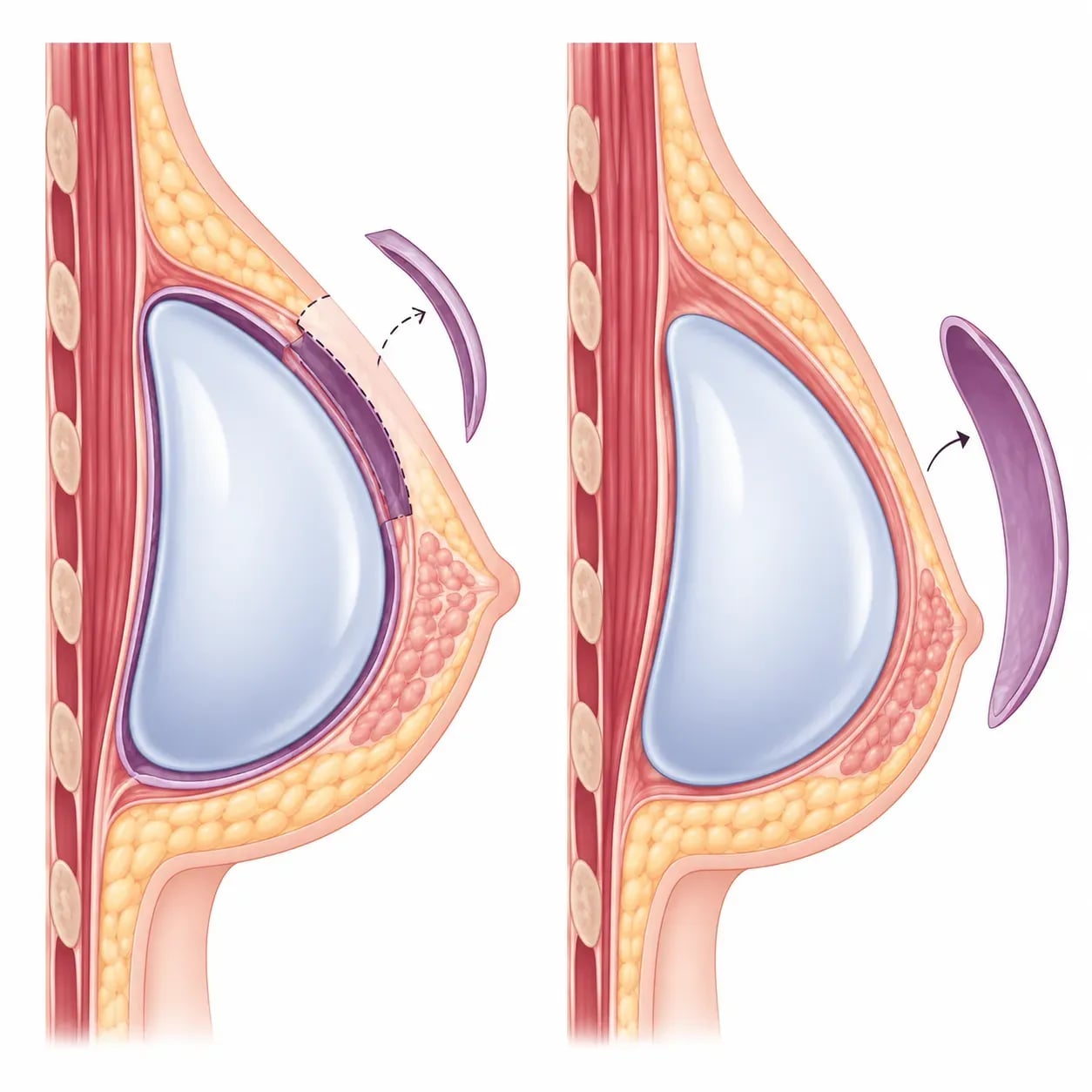
Your body forms a thin capsule of scar tissue around any implant. That is normal and happens to everyone. When implants are changed or removed, the question is what to do with it.
Partial capsulectomy — part of the capsule is removed.
Total capsulectomy — the whole capsule is removed. Generally advised where there is a confirmed rupture or calcification in the capsule.
« En bloc » — a term you will have come across if you have been reading about explant. It means removing the capsule and the implant together as one sealed unit, without opening the capsule. It is the appropriate approach where BIA-ALCL is confirmed or suspected. Outside that situation, it is a more extensive operation with more dissection and more risk, and the evidence that it is necessary for other reasons is not established. It is also not always technically possible, depending on where the capsule sits against the chest wall and the ribs.
If you have read about en bloc and want it, raise it directly at the consultation and say why. You should get a specific answer about your case rather than a yes to keep you happy or a dismissal. A surgeon who explains when it is indicated, when it is not, and what is feasible for your anatomy is giving you the real answer.
The extent is confirmed during the operation, according to what the surgeon finds, and a wider capsulectomy adds operating time.
BIA-ALCL: what has to be ruled out first
BIA-ALCL — breast implant-associated anaplastic large cell lymphoma — is a rare cancer of the immune system, not a breast cancer. It has been associated overwhelmingly with textured implant surfaces rather than smooth ones. Caught early it is generally treated successfully.
It typically presents as swelling of one breast, often years after the original surgery, caused by fluid collecting around the implant.
If that is what brought you here, the order of events matters. A suspicion of BIA-ALCL that has not been investigated has to be worked up oncologically before any revision surgery is planned. Removing the implant first, without the right analysis, can destroy the information needed to make the diagnosis.
So tell us at the first contact if you have one-sided swelling, if a doctor has mentioned BIA-ALCL, or if your implants are textured and something has changed. The assessment is different and the sequence is different. Where it is justified, tissue is sent for pathology analysis during the operation.
Breast implant illness, honestly
Many women report systemic symptoms they attribute to their implants: fatigue, joint pain, brain fog, and others. Online it is called breast implant illness.
Where the science is: there is no scientific consensus on it and no causal link has been demonstrated. That is the honest state of the evidence, and we are not going to overstate it in either direction.
What that does not mean is that your symptoms are imagined or that you should be dismissed. Two things follow from it instead.
First, get a proper medical workup. Several of the symptoms attributed to implants have other causes that are treatable, and some of them are serious. Having your implants removed instead of being investigated means not finding those. Do both, in that order.
Second, removal is your decision and it needs no medical justification. You do not have to prove anything or win an argument to have your own implants taken out. If that is what you want, it can be arranged.
What we will not do is promise you that your symptoms will go. Some women report improvement after removal. Others do not. Anyone guaranteeing you an outcome here is selling something, and you should treat that as a warning about them.
Removing implants without replacing them
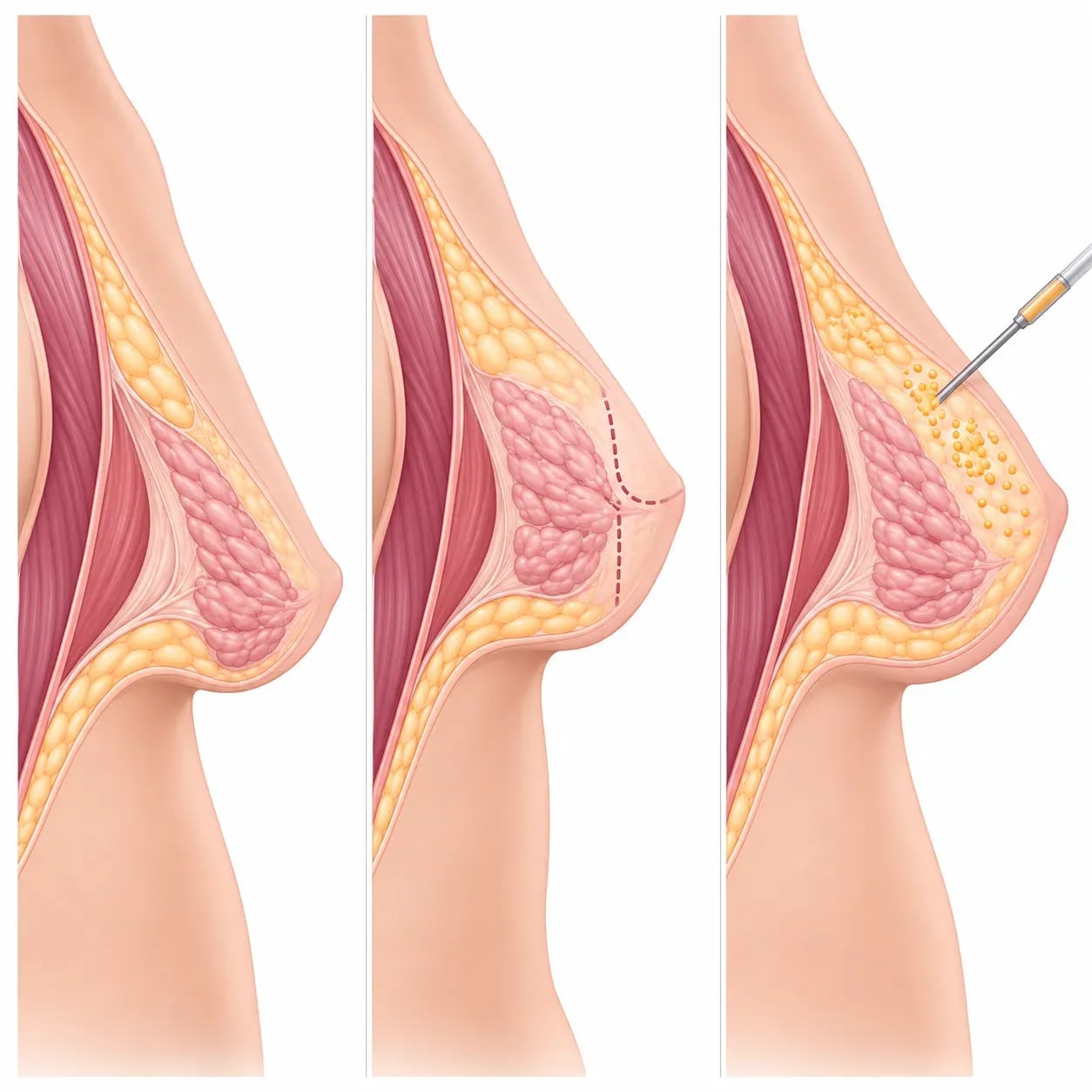
Explant — removal with no new implant — is an increasingly common request, and it is a planned procedure here rather than an exception.
Three ways to do it:
| Option | Price | Stay |
| Removal alone | €2,300 | 3 days |
| Removal with a breast lift | €2,550 | 5 days |
| Removal with fat transfer | €2,850 | 5 days |
They can also be staged. Removal first, then a lift or fat transfer months later once the tissues have settled and you can see what you are actually working with. For some women that is the better sequence, and it is worth discussing rather than deciding everything at once.
Say at the first contact that you want removal rather than replacement. The assessment is genuinely different, and so are the questions we need to ask.
What your breasts will look like after removal
This is the part to be clear-eyed about, and it is why the consultation matters more here than for a straight replacement.
Your breasts will not go back to how they were before the implants. They have carried volume for years, the skin has adapted, and your body has aged in the meantime.
Expect them to be smaller and softer than before your first operation, with a degree of sagging that varies enormously between people — depending on how long the implants were in, how large they were, your skin quality, and whether you have had children since.
The surgeon's job at the consultation is to tell you specifically what yours will look like, based on examining your tissues, and to say whether a lift or fat transfer would change that materially. Ask for that assessment directly, and ask what the result would be with removal alone.
Women who go into explant with an accurate picture are overwhelmingly happier afterwards than those who hoped for something else. That is the whole argument for a careful consultation.
Changing size or shape
Going larger, going smaller, or changing shape are all possible at a replacement, and going smaller is now at least as common a request as going larger.
What is achievable depends on the condition of the capsule, the quality of your tissues, and how much skin you have. Large implants held in place for years stretch the overlying tissue, so dropping to a much smaller implant sometimes leaves skin that needs a lift to look right — €2,850 for the two together.
The position of the implant can sometimes be changed too, in front of or behind the muscle, where that would improve the result.
Our guide to choosing volume, shape and technique covers the choices in more detail, and a sizing session is part of the consultation here as it is for a first augmentation.
Implants placed by another surgeon, in another country
Entirely routine here, and a large part of what this page is for.
If your original surgery was in the UK, Ireland, Turkey, elsewhere in Europe or anywhere else, the surgeons assess your current implants and your tissues as they find them. Where the first operation happened makes no difference to the assessment.
Bring what you have: your implant card, the operative report, and any imaging. If the original clinic has closed or will not respond, say so — it is a common situation and not a blocker.
And if you have no documents at all, the surgeon identifies the implants during the operation and issues you a new card for the new ones. It is better to know beforehand, but it does not stop anything.
What it costs
| Procedure | Price | Stay |
| Implant replacement | €2,600 | 5 days |
| Replacement with a lift | €2,850 | 5 days |
| Removal without replacement | €2,300 | 3 days |
| Removal with a lift | €2,550 | 5 days |
| Removal with fat transfer | €2,850 | 5 days |
Included: the surgeon's and anaesthetist's fees, the consultation, the operation including capsulectomy where it is needed, the anaesthetic, the hospital stay, your new CE-marked implants where there are any, your support bra, hotel accommodation, airport transfers and follow-up.
Not included: flights, and the imaging and pre-operative tests you have done at home.
The capsulectomy is not a surcharge. Its extent is decided by what the surgeon finds during the operation, and it is inside the price rather than billed afterwards. Check that specifically against any other quote you are comparing — it is a common place for a cheaper headline figure to come apart.
All prices are on the prices page, and a personalised quote reaches you within 24 to 48 hours.
Risks
Revision surgery carries the risks of any operation under general anaesthetic, plus some of its own.
Common to any surgery: haematoma, infection, healing problems, and the risks of general anaesthesia.
Related to the implants: malposition, asymmetry, rippling where the implant edge shows through thin tissue, changes in nipple sensation that are usually temporary, and recurrence of capsular contracture, which can return after being treated.
Related to the capsulectomy itself. Removing a capsule means dissecting tissue that is stuck to the chest wall. A more extensive capsulectomy means a longer operation, more bleeding, more swelling afterwards, and a small risk of entering the chest cavity. This is the main reason a total or en bloc capsulectomy is not simply the default — more removal is not automatically safer.
Related to removal without replacement: the final shape is less predictable than with a replacement, because it depends on how your tissues behave once the volume is gone.
What reduces all of it: recent imaging before you travel, an accurate history, qualified surgeons, and an operation planned around what is actually there rather than around what was requested.
The facility. Myron International Clinic is a private multidisciplinary hospital with 7 operating theatres and a 20-bed intensive care unit.
Contact us without waiting if you have a fever, increasing pain, one breast suddenly larger or firmer than the other, spreading redness, or discharge from the wound.
Your pathway, step by step
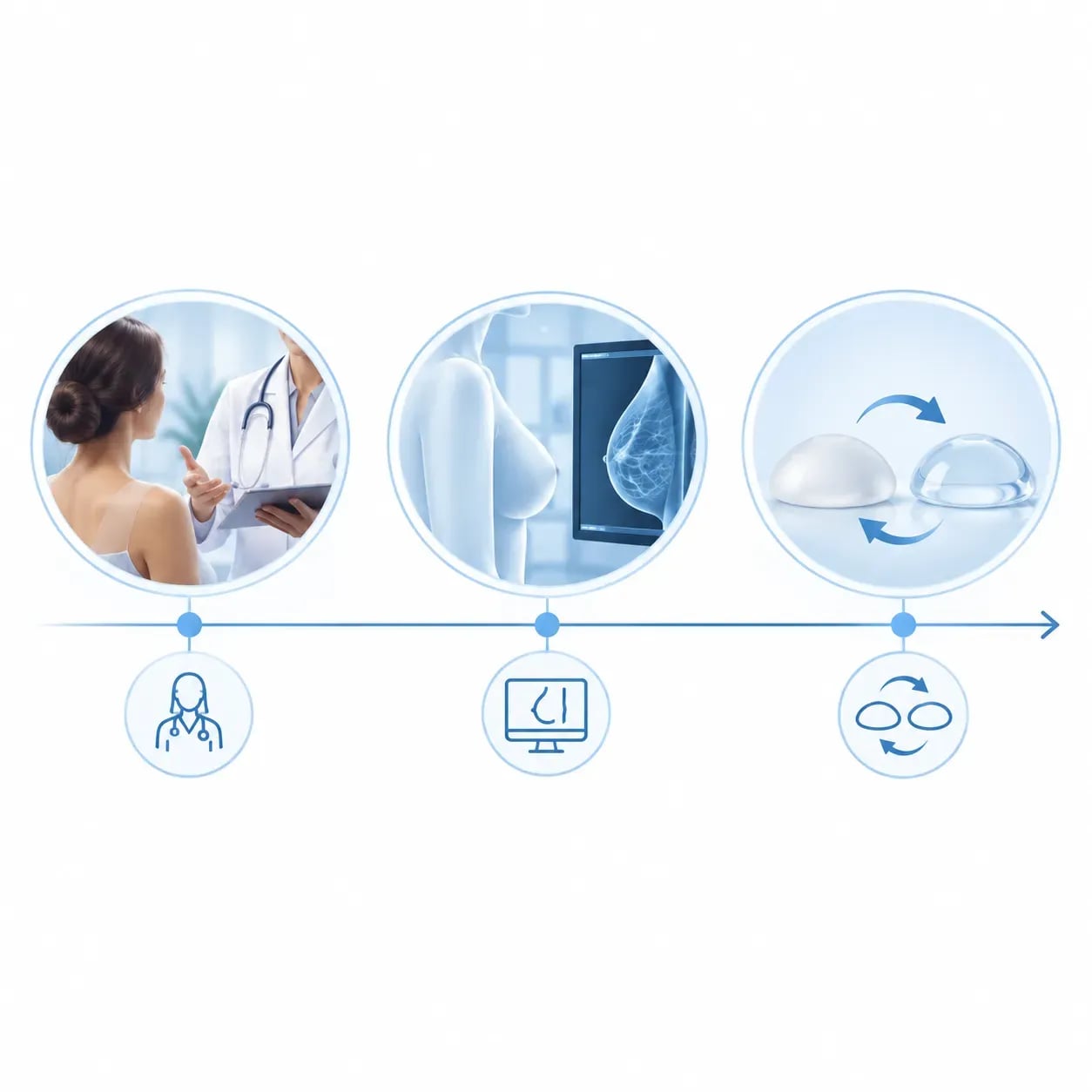
- Get in touch from home. Tell us when your implants were placed, what they are if you know, what has changed, and whether you want them replaced or removed. Send photographs and any imaging. An opinion and a quote come back within 24 to 48 hours.
- Get recent imaging if your implants are over ten years old or anything has been flagged. Ultrasound, and MRI where the surgeon asks for it.
- Preparation. Pre-operative tests around fifteen days before, and stop smoking. Our preparation guide covers what applies to every procedure.
- Arrival. You are met at Tunis-Carthage and transferred.
- Consultation with the surgeon and the anaesthetist, confirming the plan, the capsulectomy and whether a lift is needed.
- The operation, 1 hour to 2h30.
- One night in hospital, then your accommodation.
- Convalescence in Tunisia, with checks and the support bra fitted.
- Home, with your new implant card where applicable, your operative report and remote follow-up.
Recovery
Broadly similar to a first augmentation, with one difference: a wide capsulectomy means noticeably more swelling and tenderness in the first days, because more tissue has been dissected. If you have had one, expect a slower first week than someone who has simply had implants swapped.
The support bra is worn continuously for several weeks.
Volume is immediate where implants have been replaced, and the shape settles over the following weeks.
After removal without replacement, give it longer. The tissues retract gradually and the shape at three weeks is not the shape at three months. This is the point at which some women panic unnecessarily.
Light work after 1 to 2 weeks.
No lifting and no upper-body exercise for the period your surgeon specifies, which is longer after an extensive capsulectomy.

Your implant card and documents
Keep your implant card. It identifies the manufacturer, model, reference and serial numbers, and it is asked for at every imaging appointment and at any future surgery, sometimes decades later. Photograph it and store the photograph somewhere you will still have it in fifteen years.
If you have lost it, ask the original clinic for a copy of your operative report. Most will provide it on request, and it carries the same information.
If neither is available — the clinic has closed, or will not reply — it is not a blocker. The surgeon identifies the implants during the operation.
After your procedure you are issued a new card for any new implants. Treat it the same way, and give a copy to your GP this time.
Your surgeons
Dr Taher Djemal has practised as a plastic surgeon in Tunisia since the early 1990s and handles revision surgery, including on implants placed elsewhere. He trained in Tunis, Paris and Nancy, with further experience at Foch Hospital in Paris and in Baltimore.
Dr Abir Ben Ouaghrem decides the extent of the capsulectomy and whether a lift is needed, case by case.
Revision is harder than a first operation, because the surgeon is working with tissue that has already been operated on and a capsule that may be adherent. Experience matters more here than it does for a straightforward augmentation.
Consultations are possible by video call before you travel. Ask what they expect to find, what they will do about the capsule, and what your breasts will look like if you choose removal alone.
Getting to Tunisia, and before you travel
From the UK and Ireland: around three hours from London, with connections from other UK and Irish airports. From the Gulf: daily flights from Dubai, around six and a half to seven hours, and from Doha, around six. From continental Europe: 1h30 to 3h from Paris, Brussels, Geneva, Lyon and Marseille, with no visa for EU and Swiss nationals. From West and Central Africa: regular connections from Dakar, Abidjan, Douala, Libreville and Casablanca.
Entry requirements follow your nationality, not your country of residence. A resident of Dubai or London holding an Indian, Pakistani, Nigerian or Filipino passport does not have the same conditions as a British or Emirati national, and a residence permit changes nothing. Check with the Tunisian embassy for your country of citizenship before booking.
Your checklist:
- Your implant card, or the operative report from your original surgery. Request it now rather than the week before.
- The date of your first operation, even approximately.
- Recent imaging — ultrasound or MRI — particularly if your implants are over ten years old.
- Documents: a passport valid well beyond your return date, and a visa if your nationality requires one.
- Photographs from the front and both sides, in natural light.
- Any personal or family history of breast cancer, and any breast imaging you have had.
- Pre-operative tests done at home around fifteen days before.
- A written list of your medication, supplements and allergies.
- Stop smoking.
- Be clear about what you want — replacement, a different size, or removal. Write it down before the consultation; it is easy to be talked around in the room.
- Two support bras, non-underwired.
- Tops that fasten at the front.
- Book 1 to 2 weeks off work, and arrange for someone else to do any lifting.
How long each procedure needs is in our guide to lengths of stay. Request a quote and you will have an answer within 24 to 48 hours.









Frequently asked questions about Breast Implant Replacement and Removal in Tunisia
€2,600 for a replacement over a 5-day stay, or €2,850 combined with a breast lift. Removal without replacement is €2,300 over 3 days, €2,550 with a lift, or €2,850 with fat transfer. All include the surgeon's and anaesthetist's fees, the operation with capsulectomy where needed, the anaesthetic, the hospital stay, new CE-marked implants where applicable, the support bra, hotel accommodation, transfers and follow-up.
No. Preventive replacement is generally suggested at 10 to 15 years, but it is a guideline rather than a rule. Implants do not expire on a date, and an implant at twelve years with normal imaging and no symptoms is not an emergency. Equally, fifteen years with no imaging at all is not a plan. The decision is made with your surgeon on the basis of recent imaging.
Usually you do not, which is the point. A silicone gel implant can rupture with no visible symptoms, because modern cohesive gel stays contained inside the scar capsule. Only imaging detects it reliably — ultrasound finds many ruptures and MRI is the most reliable. If your implants are over ten years old and have never been imaged, start there.
Removal of the scar capsule your body forms around an implant, either partially or completely. A total capsulectomy is generally advised where there is a confirmed rupture or calcification. The extent is confirmed during the operation according to what the surgeon finds, and a wider capsulectomy adds operating time.
En bloc means removing the capsule and implant together as one sealed unit without opening the capsule. It is the appropriate approach where BIA-ALCL is confirmed or suspected. Outside that situation it is a more extensive operation with more dissection and more risk, and the evidence that it is necessary for other reasons is not established; it is also not always technically possible depending on where the capsule sits against the chest wall. If you want it, raise it directly at the consultation and expect a specific answer about your case.
No. Its extent is decided by what the surgeon finds during the operation and it is inside the price rather than billed afterwards. Check that specifically against any other quote you compare — it is a common place for a cheaper headline figure to come apart.
A rare cancer of the immune system, not a breast cancer, associated overwhelmingly with textured implant surfaces. It typically presents as swelling of one breast, often years after the original surgery. Caught early it is generally treated successfully. If you have one-sided swelling, tell us at first contact: a suspicion that has not been investigated must be worked up oncologically before any revision is planned, because removing the implant first can destroy the information needed to make the diagnosis.
Two things, in this order. First get a proper medical workup: several of the symptoms attributed to implants have other causes that are treatable, and having implants removed instead of being investigated means not finding those. Second, know that removal is your decision and needs no medical justification. What we will not do is promise your symptoms will go — some women report improvement after removal and others do not, and anyone guaranteeing you an outcome is selling something.
There is no scientific consensus on it and no causal link has been demonstrated. That is the honest state of the evidence. It does not mean your symptoms are imagined or that you should be dismissed, and it does not prevent you having your implants removed if that is what you want.
Yes, and it is an increasingly common request that is planned as a procedure in its own right. Removal alone is €2,300 over 3 days, €2,550 with a lift, or €2,850 with fat transfer, both over 5 days. It can also be staged: removal first, then a lift or fat transfer months later once the tissues have settled. Say at first contact that you want removal rather than replacement, because the assessment is different.
Not as they were before you had them. They have carried volume for years and your body has aged in the meantime. Expect them to be smaller and softer than before your first operation, with a degree of sagging that varies enormously depending on how long the implants were in, how large they were, your skin quality and whether you have had children since. The surgeon should tell you specifically what yours will look like after examining your tissues — ask for that directly.
Yes, and going smaller is now at least as common a request as going larger. Large implants held for years stretch the overlying tissue, so dropping to a much smaller implant sometimes leaves skin that needs a lift to look right, which is €2,850 for the two together. What is achievable depends on your capsule, your tissue quality and how much skin you have.
Yes, routinely. Whether your original surgery was in the UK, Ireland, Turkey or anywhere else makes no difference to the assessment. Bring your implant card, the operative report and any imaging. If the original clinic has closed or will not respond, say so — it is common and it is not a blocker.
Not a blocker. Ask the original clinic for a copy of your operative report, which carries the same information and is usually provided on request. If neither is available, the surgeon identifies the implants during the operation. You are issued a new card for any new implants afterwards.
Recent imaging helps, particularly for implants over ten years old or where something has already been flagged. Ultrasound detects many ruptures and MRI is the most reliable. The surgeon decides whether further imaging is needed in your case.
Broadly similar, with one difference: a wide capsulectomy means noticeably more swelling and tenderness in the first days, because more tissue has been dissected. Prescribed painkillers cover it. Expect a slower first week than someone who has simply had implants swapped.
Five days for a replacement, with or without a lift. Three days for removal alone. That covers the consultation with the surgeon and the anaesthetist, the operation, one night in hospital and a check before you fly.
Yes. Treating it does not guarantee it will not recur, and recurrence is one of the recognised risks of revision surgery. It is worth knowing before rather than after.
Removing a capsule means dissecting tissue adherent to the chest wall, so a more extensive capsulectomy means a longer operation, more bleeding, more swelling afterwards and a small risk of entering the chest cavity. This is why a total or en bloc capsulectomy is not simply the default: more removal is not automatically safer.
Yes, and it is frequently the right answer where the breast has also dropped. €2,850 for the two together over a 5-day stay, against €2,600 for the replacement alone. An implant adds volume but does not lift, so where there is sagging, changing the implant on its own will not address it.
Light work after 1 to 2 weeks. No lifting and no upper-body exercise for the period your surgeon specifies, which is longer after an extensive capsulectomy.
Where implants have been replaced, the volume is immediate and the shape settles over the following weeks. After removal without replacement, allow longer: the tissues retract gradually, and the shape at three weeks is not the shape at three months.