

BBL in Tunisia: Gluteal Fat Grafting, Safety and Recovery
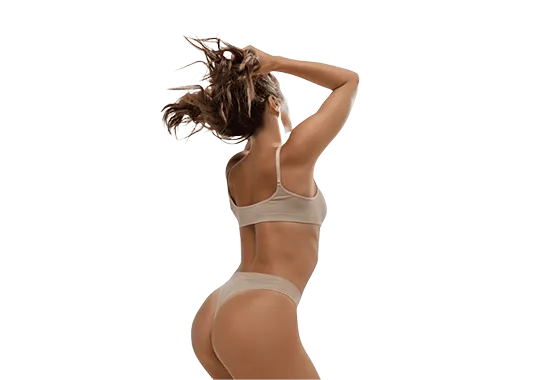
BBL in Tunisia: the essentials
A BBL — a Brazilian butt lift, or gluteal fat grafting — takes fat from where you do not want it by liposuction, and reinjects it into the buttocks. Nothing synthetic is used. The result is soft because it is your own tissue, and part of the transferred fat is always reabsorbed.
Only want the fat removed, without the transfer? See our page on liposuction. Loose abdominal skin rather than fat? See the tummy tuck.
The procedure is performed by Dr Taher Djemal and Dr Abir Ben Ouaghrem at Myron International Clinic in Tunis, with English-speaking support throughout.
| Operating time | 2 to 4 hours |
| Anaesthetic | General |
| Stay in Tunisia | 5 days, including 3 nights in hospital |
| Back to work | 10 to 15 days, nothing strenuous |
| Intense exercise | After 6 to 8 weeks |
| Final result | 6 to 12 months |
| Price | €2,950 |
Is a BBL safe? Read this before anything else
A BBL has the highest reported mortality of any cosmetic operation. That is not a reason to avoid it, but it is a reason to understand exactly what makes it dangerous and what makes it safe — before you look at prices.
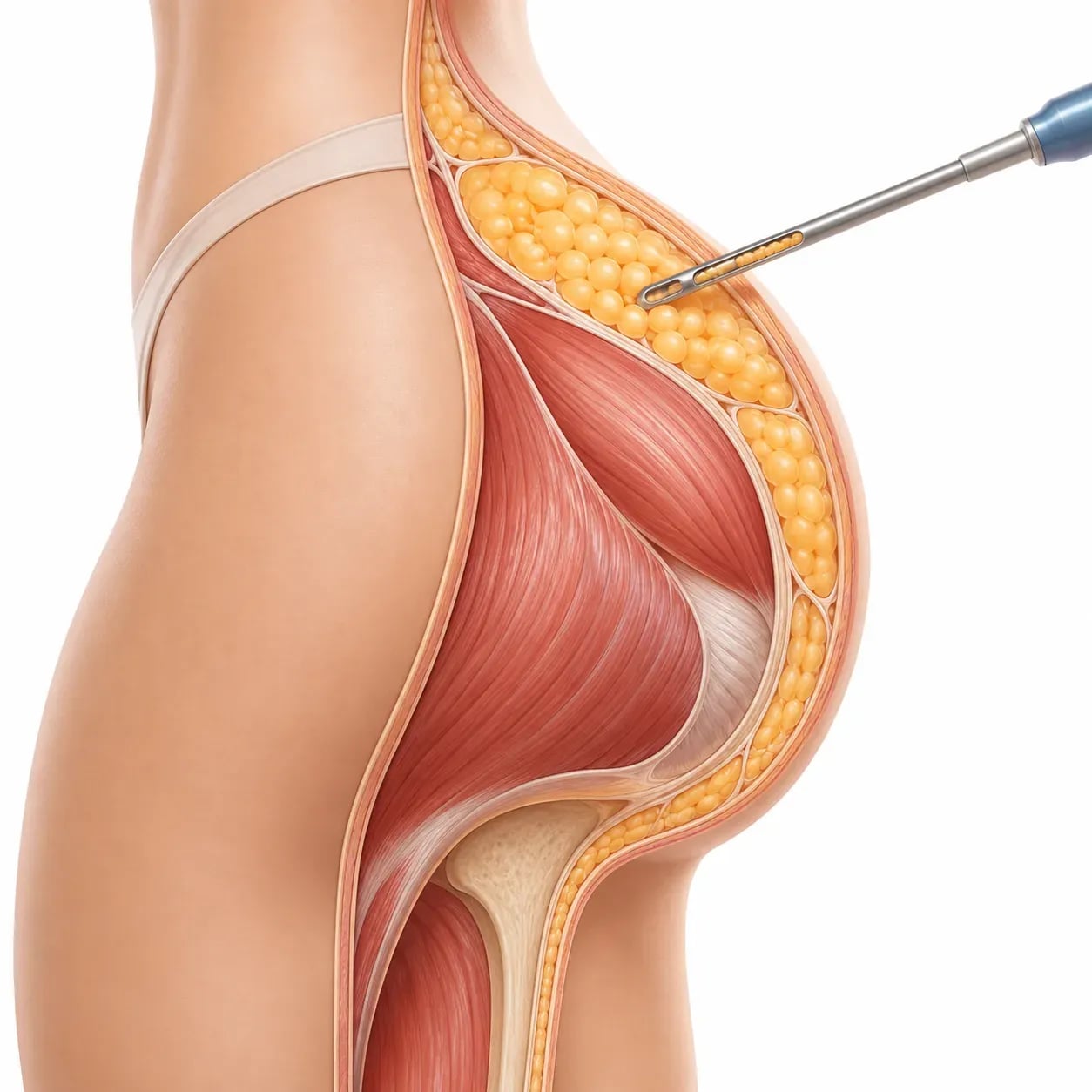
What causes the deaths. Almost all of them come from one thing: fat injected into the gluteal muscle. The large veins that run through that muscle can take fat directly into the bloodstream and on to the lungs. This is a fat embolism, and it can happen on the operating table.
What prevents it. Placing the fat only in the layer under the skin, never into the muscle. This single point is the whole of BBL safety, and it is the international consensus.
What is done here. The fat is injected only into the subcutaneous plane, above the muscle. Nothing is placed intramuscularly. A full pre-operative assessment is carried out to identify contraindications, and you stay three nights in hospital — longer than for most procedures on this site, and deliberately so, because the hours after a BBL are when problems appear.
The facility. Myron International Clinic is a private multidisciplinary hospital with 7 operating theatres and a 20-bed intensive care unit.
The question to ask any surgeon, in any country: « Will the fat be placed only in the subcutaneous layer, and never in the muscle? » If the answer is anything other than an immediate and unambiguous yes, do not book. That applies here as much as anywhere else.
Our detailed guide to BBL risks goes through the rest.
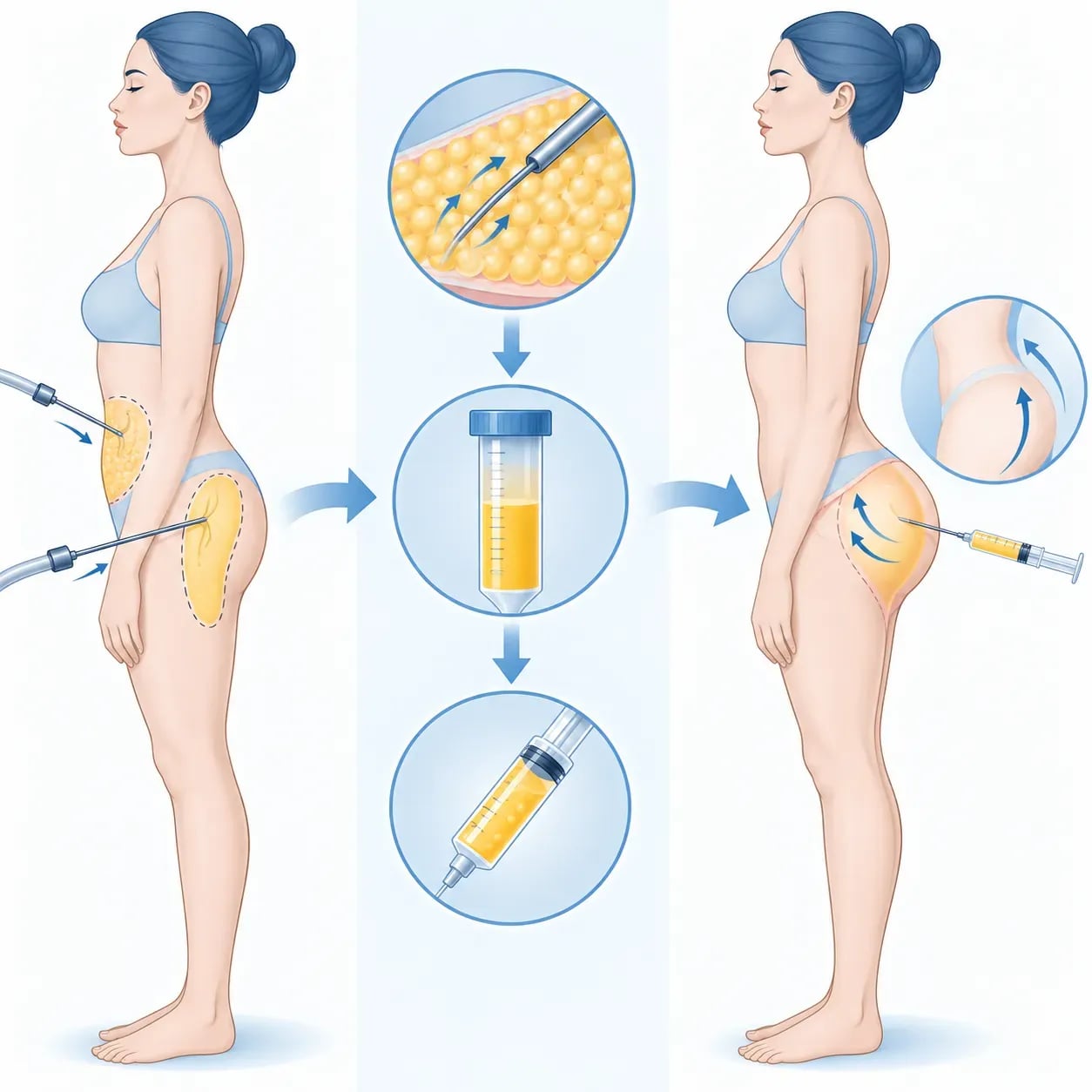
What a BBL actually involves
Three stages, in one operation.
Harvesting. Fat is removed by liposuction from the abdomen, waist, flanks, back or thighs — wherever you have it and want less of it. This is why a BBL reshapes your whole silhouette, not just the buttocks.
Preparation. The fat is processed to separate what can be transferred from blood and fluid.
Reinjection. The prepared fat is placed into the subcutaneous layer of the buttocks, in small amounts and multiple passes, to shape the projection and the curve.
Some of the fat will not survive, and that is normal. A proportion is reabsorbed over the first months; what remains after that is stable and behaves like the rest of your body fat — it goes up and down with your weight. No surgeon can tell you in advance what proportion will take, and anyone who gives you a precise figure is guessing.
On the liposuction side, VASER and J-Plasma are available depending on the areas treated and your skin. Which is used is a decision for the surgeon at the consultation, and our guide to areas treated by liposuction covers what each does.
Tunisia or Turkey?
If you are in the UK or Ireland, you have seen the news stories. British women have died after BBL surgery abroad, and the reporting has centred on Turkey because that is where most of them travelled. The concern is legitimate and we are not going to talk you out of it.
But the country is the wrong variable. What killed those patients was fat injected into muscle. That can happen in Istanbul, in Tunis, in London or anywhere else, and avoiding it is a matter of technique and of the surgeon, not of geography.
In 2018 BAAPS, the British Association of Aesthetic Plastic Surgeons, advised its members to stop performing the procedure entirely because of the mortality reported at the time. It published revised safety recommendations in 2022 rather than keeping a permanent ban. If you are in the UK, read them. They are public, and they will tell you what to ask a surgeon better than any clinic's own page can.
What Tunisia offers specifically: a short flight from Europe and a direct one from the Gulf, support in English, Arabic and French, and a stay organised around one clinic rather than assembled from separate providers.
What matters more than any of that: who operates, in what facility, with what technique. Ask for the surgeon's name and the hospital's name before you ask about the price — in Tunisia, in Turkey, and here.
Lipo 360 with BBL: the most requested combination
Most people having a BBL have it with a lipo 360 — abdomen, waist, flanks and back treated in the same operation, with the fat removed going straight into the transfer.
It is the combination that produces the change people actually want, because narrowing the waist does as much for the silhouette as adding to the buttocks.
It is also a longer operation and a harder recovery. More areas treated means more swelling, more bruising and more restriction in how you can lie, sit and sleep. The first week is genuinely demanding, and that should be part of your planning rather than a surprise.
Whether it is feasible for you in one session depends on your general health and the total anaesthetic time the surgeon considers reasonable. That is decided at the consultation.
Are you a candidate?
A BBL suits someone in good general health, with enough fat available to harvest, whose weight has been stable, who does not smoke, and whose expectations match what fat transfer can actually do.
Enough fat is the practical limit. This operation needs a donor supply. If you are very slim, there may not be enough to produce a visible change, and the honest answer is sometimes that the procedure is not worth having. That assessment is made on examination, not from a photograph.
Reasons to postpone, or to decline:
- Weight still moving significantly
- Smoking, if you have not stopped
- Not enough fat available to harvest
- A clotting disorder, or anything contraindicating a general anaesthetic
- Expectations that fat transfer cannot meet
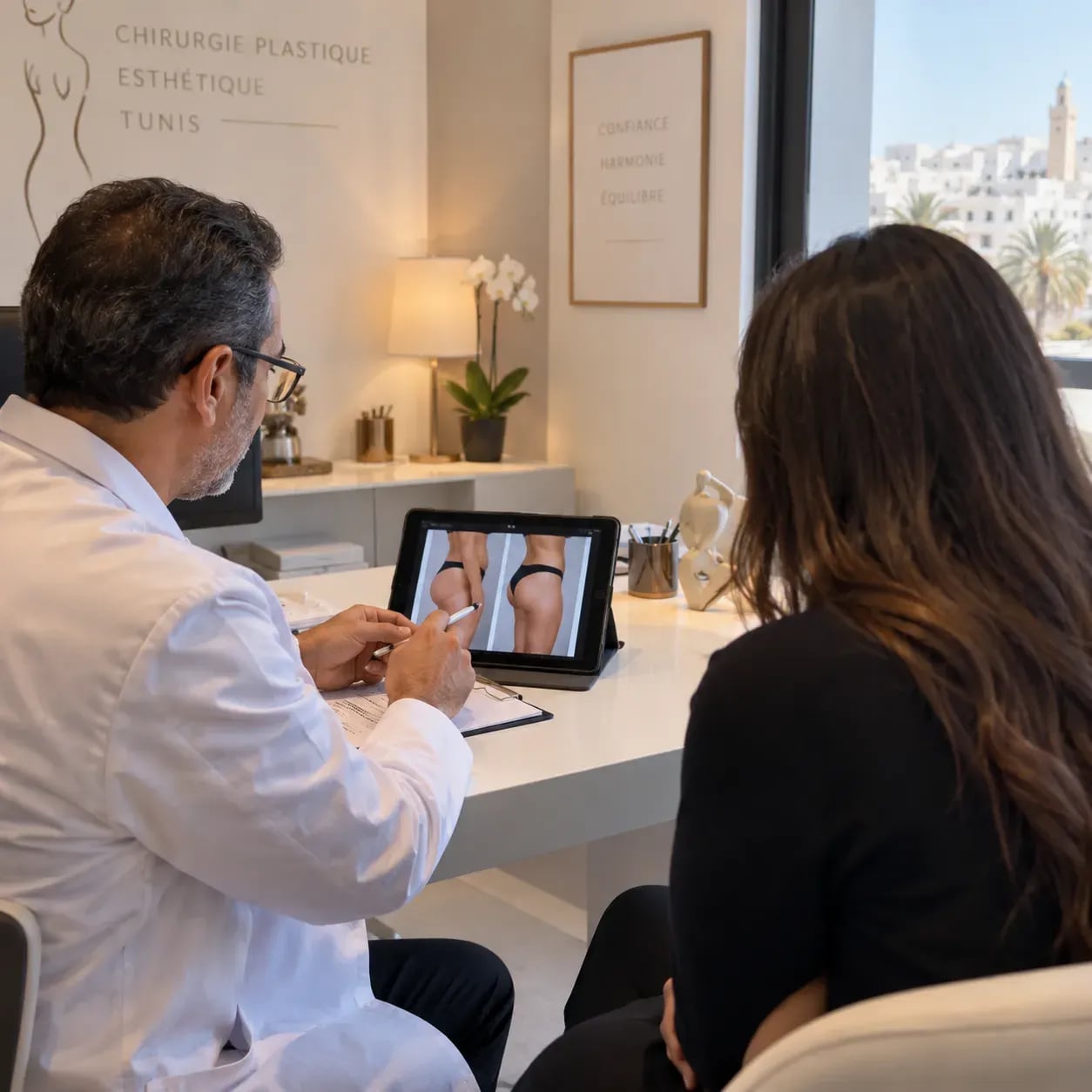
You can send photographs for an initial opinion before travelling. That opinion is not a diagnosis, and it can be revised at the in-person examination. If it is, that is the system working.
How much volume can be transferred?
There is no standard figure in cc, and you should be wary of any clinic that offers you one before examining you.
Three things set the limit: how much fat is available to harvest, how elastic your skin is, and how much the subcutaneous layer can physically hold. That last one is a safety limit, not a style preference — fat has to go where there is room for it in the layer above the muscle, and forcing more in is exactly what the technique is designed to avoid.
If you want more volume than can safely be placed in one session, the right answer is a second procedure later, not a bigger one now.
And a proportion of whatever is transferred will be reabsorbed. The surgeon accounts for that, but the final volume cannot be promised.
What a BBL costs in Tunisia
€2,950, for a 5-day stay.
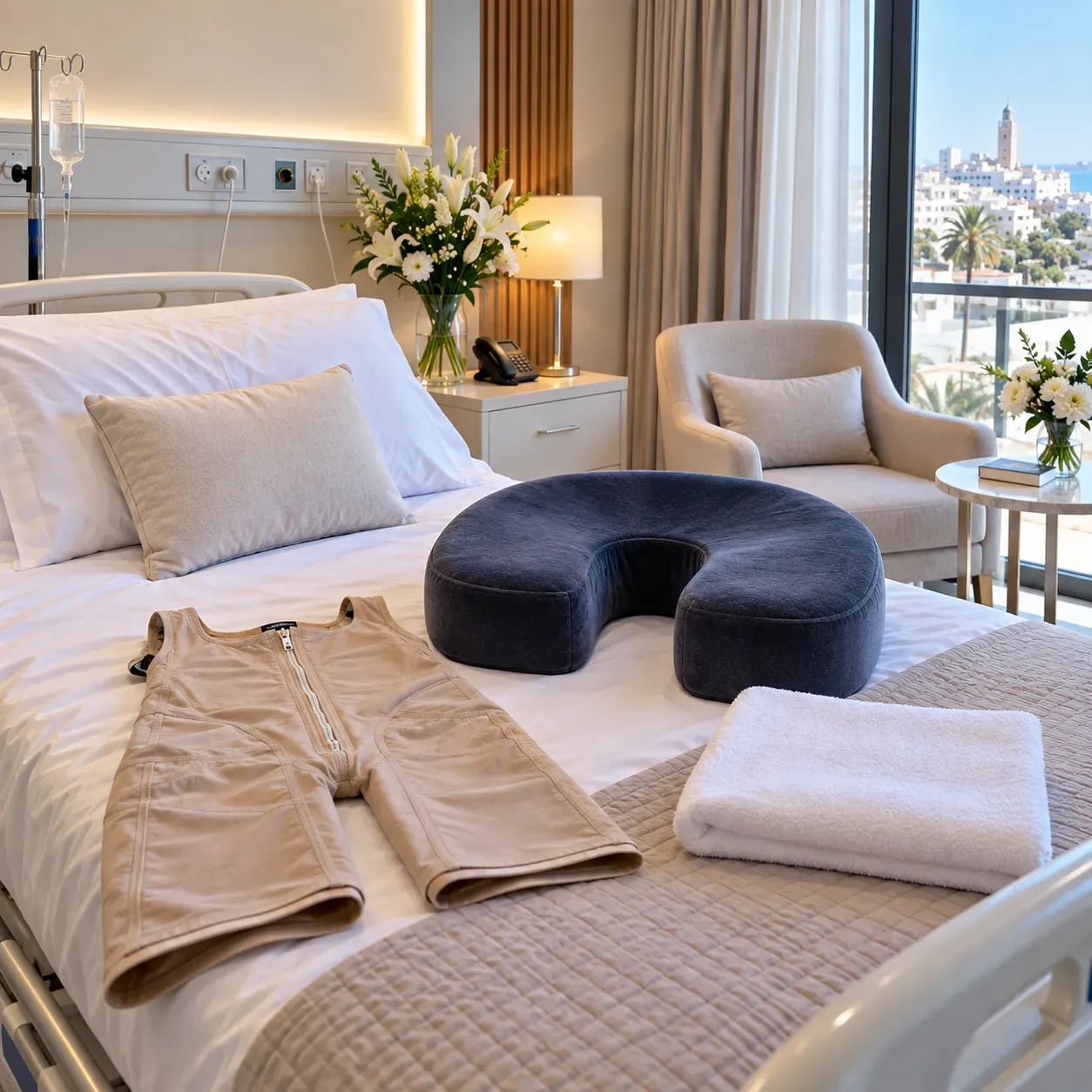
Included: the surgeon's and anaesthetist's fees, the operation, the anaesthetic, three nights in hospital, your compression garment, your BBL cushion, airport pickup and transfers, and assistance throughout.
Not included: flights and the pre-operative tests you have done at home.
| Procedure | Price |
| BBL | €2,950 |
| Liposuction, 1 area | €1,700 |
| Liposuction, 2 to 3 areas | €2,250 |
| Liposuction 360 | €2,350 |
| Full-body liposuction | €2,500 |
| Tummy tuck with liposuction | €2,950 |
For comparison, a BBL in France, Belgium or Switzerland is generally quoted between €5,000 and €10,000, before the extras that are often billed separately. In the UK the procedure is offered by relatively few surgeons, and those who do it tend to price it at the top of that range or above.
A warning about cheap BBLs. This is the one procedure where price-shopping is genuinely dangerous. A quote far below everyone else usually means something has been removed — the length of the hospital stay, the assessment, the time taken over the operation, or the number of patients the surgeon sees that day. On this operation, those are the things keeping you safe.
All prices are on the prices page, and a personalised quote reaches you within 24 to 48 hours.
| Procedure | Price | Stay |
|---|---|---|
| BBL (buttock fat transfer) | 2950 € | 5 days |
Your pathway, step by step
- Get in touch from home. Photographs, your height and weight, your medical history and what you are hoping for. An opinion and a quote come back within 24 to 48 hours.
- Preparation. Pre-operative tests around fifteen days before, and stop smoking several weeks beforehand. Our preparation guide covers what applies to every procedure.
- Arrival. You are met at Tunis-Carthage and transferred.
- Consultation with the surgeon and the anaesthetist, and the marking.
- The operation, 2 to 4 hours under general anaesthetic.
- Three nights in hospital. Longer than most procedures here, and that is the point.
- Convalescence in Tunisia, with check-ups, the compression garment and the cushion.
- Home around day five, with remote follow-up.
Recovery: sitting, the garment, the first weeks
The pain is not where you expect. The buttocks are uncomfortable, but it is the liposuctioned areas that ache — a deep, bruised, burning soreness across the abdomen, waist and back. Prescribed painkillers handle it.
Sitting. Avoid sitting directly on your buttocks for the first weeks. Pressure on freshly transferred fat reduces how much of it survives. You are given a BBL cushion, you sit on your thighs rather than your seat, and you stand up more than you are used to. This is the restriction people underestimate, and it is the one that affects the result.
Sleeping. On your front or your side, not your back, for several weeks. If you have had a lipo 360 as well, you will need pillows to find any position at all in the first nights.
The compression garment is worn for several weeks, then eased off on your surgeon's instructions. It is for the liposuctioned areas, and it does real work.
Back to work after 10 to 15 days, provided the job is not physical.
Intense exercise after 6 to 8 weeks. Walking from the first days, and it is encouraged.
Our week-by-week recovery guide sets out what to expect and when.
Flying home after a BBL
You fly home around five days after surgery, once the surgeon confirms it.
What you need: your BBL cushion, your compression garment, compression stockings, and an aisle seat.
What you do on the flight: sit on the cushion, get up and walk every hour, keep drinking water. A long flight immediately after major surgery carries a clotting risk, and moving is what reduces it.
Book a flexible return. Your surgeon decides when you can travel, not your booking confirmation.
From the Gulf the flight is six to seven hours, which is a long time in one position after this operation in particular. Plan for it, and allow a quiet few days at the other end.
| BBL (fat transfer) | Buttock implants | |
|---|---|---|
| Principle | Your own fat is injected | Silicone implant |
| Candidate | Patient with enough fat to harvest | Possible in a slim patient |
| Effect on the silhouette | Also slims the donor areas | Works only on the buttocks |
| Feel | Generally soft and natural | Firmer, sometimes palpable |
| Evolution | Part of the fat is reabsorbed; volume follows weight | Risks specific to the implant (displacement, palpability); monitoring required |
Lymphatic drainage: never on the buttocks
Lymphatic drainage is often recommended after a BBL — for the liposuctioned areas only.
It must never be performed on the buttocks. Pressure and manipulation over freshly transferred fat damages it and reduces how much survives. This is not a matter of preference.
Tell your therapist you have had a BBL before the first session, every time, and make sure they understand the restriction. Not all therapists know it, and the responsibility for saying so ends up being yours.
Our guide to what lymphatic drainage actually does covers the rest.
When is the result final?
Between 6 and 12 months.
The first weeks show you swelling, not the outcome. Part of the transferred fat is reabsorbed over the first months, so the volume you see at week two is not the volume you will keep. Judging the result before six months tells you very little.
And it moves with your weight afterwards. The transferred fat behaves like the rest of your body fat: lose a significant amount of weight and the volume reduces, gain it and the volume increases. If you are planning to lose weight, do it before the operation, not after.
BBL or buttock implants?
| BBL | Buttock implants | |
| What is used | Your own fat | A silicone implant |
| Who it suits | Anyone with enough fat to harvest | Those with too little fat available |
| Second benefit | Reshapes the areas the fat came from | None — volume only |
| Feel | Soft, your own tissue | Firmer, varies with placement |
| Over time | Partly reabsorbed, then moves with your weight | Stable volume; a device with its own long-term risks |
Fat transfer is the first option wherever there is enough fat to harvest, both because the result feels like your own body and because it improves the donor areas at the same time. The surgeon assesses which applies to you.
Your surgeons
Dr Taher Djemal has practised as a plastic surgeon in Tunisia since the early 1990s, with a particular focus on body contouring. He trained in Tunis, Paris and Nancy, with further experience at Foch Hospital in Paris and in Baltimore.
Dr Abir Ben Ouaghrem also performs this procedure, and consultations with either are possible by video call before you travel.
Use that consultation properly. Ask where the fat will be placed. Ask what happens if there is not enough fat to achieve what you want. Ask what they would refuse to do. A surgeon who answers those three questions directly is the one you want operating on you.
Getting to Tunisia
From the UK and Ireland: around three hours from London, with connections from other UK and Irish airports. British and Irish passport holders do not currently need a visa for a short tourist stay — but see the note below.
From the Gulf: daily flights from Dubai with Emirates, around six and a half to seven hours, and from Doha with Qatar Airways, around six. Tunisia is two to three hours behind the Gulf, so follow-up calls fall inside the working day at both ends.
From continental Europe: direct flights of 1h30 to 3h from Paris, Brussels, Geneva, Lyon and Marseille, with no visa for EU and Swiss nationals.
From West and Central Africa: regular connections from Dakar, Abidjan, Douala, Libreville and Bamako, with help on visa formalities where needed.
Entry requirements follow your nationality, not your country of residence. A resident of Dubai or London holding an Indian, Pakistani, Nigerian or Filipino passport does not have the same conditions as a British or Emirati national, and a residence permit changes nothing. Check with the Tunisian embassy for your country of citizenship before booking.
How long each procedure needs is in our guide to lengths of stay.
Before you travel: a checklist
- Documents: a passport valid well beyond your return date, a visa if your nationality requires one, and photographs from the front, side and back.
- Pre-operative tests done at home around fifteen days before.
- A written list of your medication, supplements and allergies. Supplements and herbal products are the ones people forget, and some affect bleeding.
- Stop smoking several weeks beforehand. On a fat transfer this affects how much of the graft survives, not just how you heal.
- Do not try to lose weight in the weeks before. You need the fat, and a stable weight gives a better result.
- Loose clothing, nothing tight at the waist, and shoes you do not have to bend down to fasten.
- Think about where you will sit for the next few weeks — at home, in the car, at work. Sort it out before you go.
- Arrange for someone else to do any lifting, children included.
- Book at least two weeks off work.
- On the flight home: cushion, garment, compression stockings, aisle seat, and get up every hour.
Request a quote and you will have an answer within 24 to 48 hours.








Frequently asked questions about BBL in Tunisia
A BBL has the highest reported mortality of any cosmetic operation, and almost all of those deaths come from one cause: fat injected into the gluteal muscle, where large veins can carry it into the bloodstream and on to the lungs. Placing the fat only in the layer under the skin, never into the muscle, is what prevents that, and it is the international consensus. Ask any surgeon in any country to confirm they do this before you book.
It is fat entering the bloodstream and travelling to the lungs, and it is the complication that makes a BBL more dangerous than other cosmetic surgery. It happens when fat is injected into the gluteal muscle, where the large veins are. Injecting only into the subcutaneous layer, above the muscle, is what avoids it.
Only into the subcutaneous plane, above the muscle. Nothing is placed intramuscularly. This is the single most important safety point of the whole procedure.
€2,950 with ServiHealth for a 5-day stay, including three nights in hospital. That covers the surgeon's and anaesthetist's fees, the operation, the anaesthetic, the hospital stay, the compression garment, the BBL cushion, transfers and assistance. Flights and the pre-operative tests you have at home are not included.
Because on this procedure, the things that get removed to reach a low price are the things keeping you safe: the length of the hospital stay, the pre-operative assessment, the time taken over the operation, and how many patients the surgeon sees in a day. A quote far below everyone else is information, not a bargain.
Five days, including three nights in hospital. That is longer in hospital than for most procedures here, and it is deliberate: the hours after a BBL are when problems appear. You fly home around day five, once the surgeon confirms it.
The discomfort comes mainly from the liposuctioned areas rather than the buttocks — a deep, bruised, burning soreness across the abdomen, waist and back. Prescribed painkillers handle it. The buttocks themselves are uncomfortable rather than painful.
Not directly on your buttocks for the first weeks. Pressure on freshly transferred fat reduces how much of it survives. You are given a BBL cushion, you sit on your thighs rather than your seat, and you stand up more than you are used to. This restriction is the one that most affects the result.
Part of it is reabsorbed over the first months. What remains after that is stable and behaves like the rest of your body fat: it increases if you gain weight and reduces if you lose it. No surgeon can tell you in advance what proportion will survive, and a precise figure is a guess.
There is no standard figure. The limit is set by how much fat is available to harvest, how elastic your skin is, and how much the subcutaneous layer can physically hold. That last one is a safety limit rather than a style choice. If you want more volume than can be placed safely in one session, the answer is a second procedure later, not a bigger one now.
Only if there is enough fat available to harvest. A BBL needs a donor supply, and if there is too little the change will not be visible enough to be worth the operation. That is assessed at the examination. Where there is genuinely not enough fat, buttock implants may be discussed instead.
Yes, and it is the most requested combination, because narrowing the waist does as much for the silhouette as adding to the buttocks. It is a longer operation with a harder recovery — more swelling, more bruising, more restriction on how you sit and sleep. Whether it is feasible in one session depends on your health and the total anaesthetic time the surgeon considers reasonable.
Fat transfer is the first option wherever there is enough fat to harvest: the result is soft because it is your own tissue, and it reshapes the donor areas at the same time. Implants are considered where there is too little fat available. They give a stable volume but are a device, with their own long-term risks.
Between 6 and 12 months. The first weeks show swelling, not the outcome, and part of the transferred fat is reabsorbed over the first months. Judging the result before six months tells you very little.
On the liposuctioned areas, yes, and it is often recommended. On the buttocks, never. Pressure and manipulation over freshly transferred fat damages it and reduces how much survives. Tell your therapist you have had a BBL before the first session — not all of them know this restriction.
Around five days after surgery, once the surgeon confirms it. Take your cushion, your compression garment and compression stockings, book an aisle seat, get up and walk every hour, and keep drinking water. Book a flexible return: your surgeon decides when you travel, not your booking.
Several weeks, then eased off on your surgeon's instructions. It is for the liposuctioned areas and it does real work on the final contour.
Not for several weeks. You sleep on your front or your side. If you have had a lipo 360 as well, you will need pillows to find a workable position in the first nights.
Walking from the first days, and it is encouraged. Intense exercise after 6 to 8 weeks, on your surgeon's advice.
After 10 to 15 days, provided your job is not physical and you can avoid sitting directly on your buttocks. Think about your chair before you go back.
Yes, generally from six months onwards, provided there is still fat available to harvest. Staging is also the correct answer when more volume is wanted than can be placed safely in one session.
Pregnancy changes how fat is distributed, which can alter the result. If you are planning a pregnancy in the near future, say so at the consultation — it may be worth waiting.