

FUE vs DHI: what actually changes, and what does not
Two quotes land in your inbox. One says FUE, the other says DHI and costs more. Which one gives the better result? The honest answer disappoints anyone hoping for a winner, because the two methods share almost the entire surgical procedure.
The exact difference between FUE and DHI
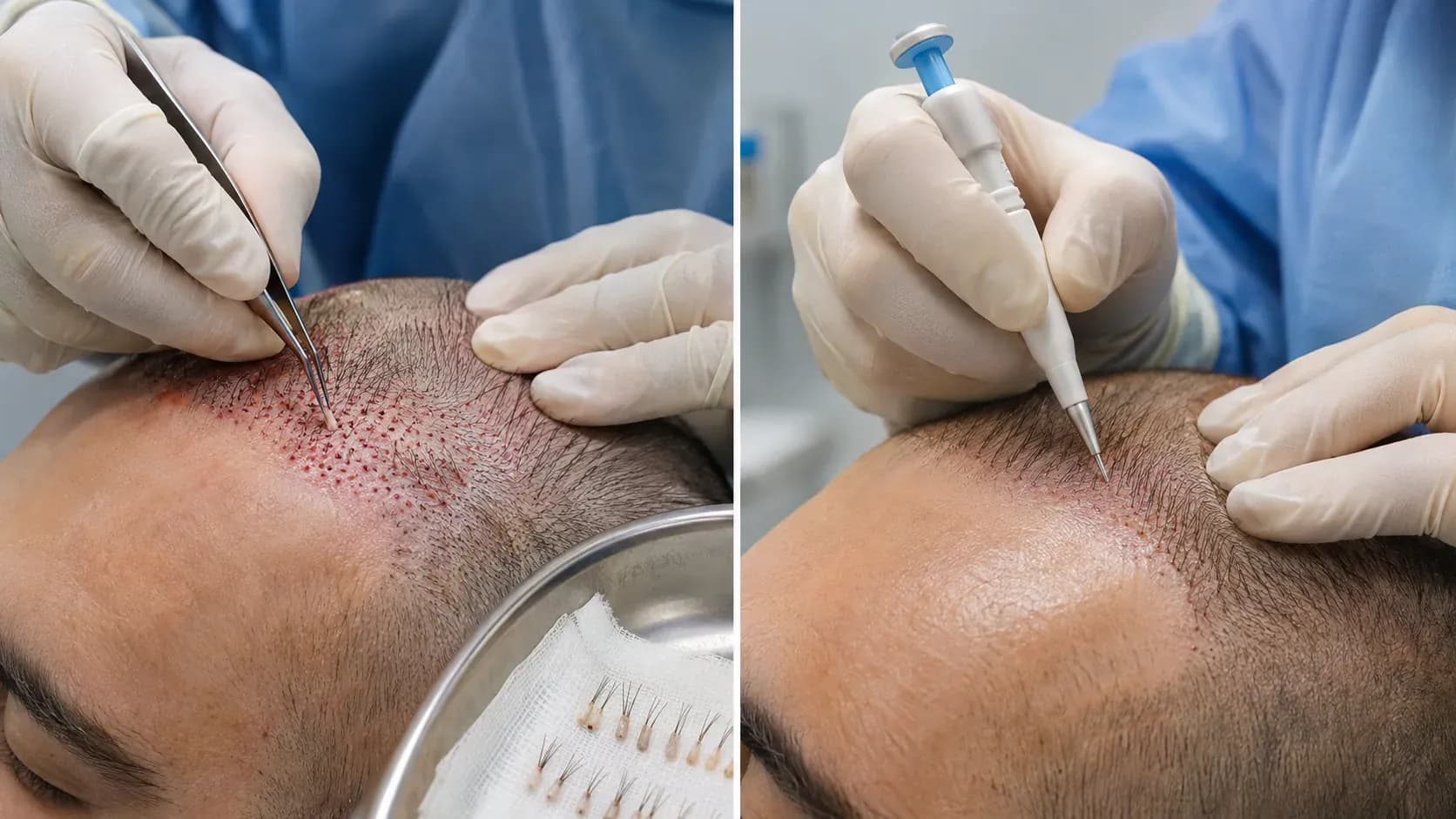
Both techniques harvest grafts the same way, one follicular unit at a time, with a small-diameter punch. What separates them is the next step: placement.
In FUE, the surgeon first creates the recipient sites, then the grafts are placed into them with forceps. With an implanter, a hollow-needle pen opens the site and delivers the graft in a single movement. That is what the letters DHI describe, and nothing else.
Worth knowing early: DHI is a commercial name, not a surgical category. The same step is called implanter-pen placement, sharp implanter or DHT elsewhere. Recognising that keeps you from paying a premium for an acronym rather than for a procedure.
Harvesting itself faces identical constraints either way. The reference review on FUE describes punches of 0.7 to 1 mm and points out a structural limitation of the method: unlike strip harvesting, FUE is a blind procedure, so injury to grafts during punching is common. Punch diameter, the state of its edge, and the force and angle applied therefore shape the outcome regardless of how the grafts are later placed.
Does the implanter pen produce better grafts?
Nothing demonstrates that it does. Nor does anything suggest the opposite: the implanter does not damage grafts more.
A study published in the ISHRS Hair Transplant Forum International photographed 482 grafts under a microscope before and after implanter placement, across procedures totalling more than 15,000 grafts. The result: 8.1% of hairs already showed damage before implantation, 8.6% afterwards, and only 6 hairs out of 1,292 (0.5%) showed new damage. The statistical analysis found no significant effect of implanter use on graft quality.
The authors state the two limits of their own work, and both matter. The study measured damage visible at 10× magnification, not graft survival or regrowth. And it did not compare implanters with forceps. So it shows that in experienced hands the implanter does not harm grafts. It does not show that it does better.
That conclusion echoes what the same review says about FUE versus strip harvesting: neither technique is superior to the other. A placement method is not a result. It is a tool, and the outcome depends on who is holding it.
Three things that matter more than FUE or DHI
Documented factors that influence the outcome more than the name of the technique:
- Time out of the body. Graft viability falls by roughly 1% per hour outside the scalp. Up to two hours, the review cites survival in the region of 95 to 98%, provided grafts are kept moist in a suitable storage medium. A badly organised session costs more grafts than any choice of instrument.
- The donor area. The review stresses that identifying the safe donor area before surgery is crucial, because grafts taken from a zone that will itself thin later will eventually fall out. Over-harvesting also produces visible thinning of the donor area, described as a moth-eaten appearance.
- Who actually performs the surgery. The ISHRS advises asking two questions before committing: will you meet a physician before the procedure, and who will physically perform the surgery, a doctor or a technician? The society notes that only a licensed physician should give surgical advice, and warns about procedures carried out by unlicensed operators. Our partner surgeons are named individually, precisely so that this question has a verifiable answer.
Will your head be shaved?
This is usually the selling point for the implanter, and the one that matters most to anyone who has to be back at a desk. The honest answer: how much is shaved depends on the team's protocol and the area being treated, not on the acronym written on the quote. It is settled at the consultation, and it is worth asking before booking dates, because it determines how discreet the first weeks will be. Our article on going back to work after a hair transplant covers that timeline.
Who decides, and on what basis
The surgeon, after examining your scalp. That is not a hedge: the choice depends on findings no remote exchange can replace.
The review describes the FOX test, performed on the first harvested grafts and scored from 1 to 5: a score of 1 or 2 points towards FUE, a score of 4 or 5 towards strip harvesting. Hair calibre, hair direction, scalp density and elasticity feed into the same assessment. For an extensive area, the literature considers two sessions the preferable option, which allows the donor area to be reassessed in between.
In other words, the indication, the harvesting technique, the placement method and the number of grafts belong to the surgeon and will be confirmed at the consultation, based on your case. ServiHealth organises the stay, the coordination and the follow-up; medical decisions rest with the doctor.
What neither FUE nor DHI can do
Four limits apply to both methods, and a quote that mentions none of them deserves one more question.
- Donor supply does not regenerate. The ISHRS puts it plainly: the supply of donor hair is finite and non-renewable. A hair that is moved is not replaced at the back.
- Hair loss continues elsewhere. Pattern loss is progressive. The ISHRS notes that a single procedure in a young man can produce a result that deteriorates as native hair keeps thinning, making a revision necessary.
- Neither is "scarless". The review calls that description a misnomer: hypopigmented scars of 1.5 to 1.6 mm often remain visible in the donor area after FUE.
- Neither guarantees that loss will stop. Medical treatments exist, but prescribing and monitoring them is a doctor's role, and there is no guarantee that hair loss will stop completely.
Frequently asked questions
Can the two approaches be combined?
They are not technically opposed, since harvesting is identical; some teams reserve the implanter for particular areas. What that would mean in your case is a discussion with the surgeon, based on the examination.
Is one of them more painful?
We found no sound comparative data on this, and we would rather say so than pick a side. Both are performed under local anaesthesia, and intra-operative pain management is among the topics to raise with the anaesthetist and the surgeon.
Is a more expensive DHI justified?
The premium pays for operating time and a consumable, not for a demonstrated better outcome. The useful question is therefore not the acronym but what the quote contains: number of grafts, who operates, session length, planned follow-up.
How long before the result shows?
The review states that grafted hair usually takes 6 to 12 months to grow, varying from person to person. The first few weeks say nothing about the final result.
Before you choose
If your quote names a technique without specifying the number of grafts, the operator and the session length, those three missing details weigh more than FUE versus DHI. The hair transplant in Tunisia page sets out how the stay works, and a quote request with photographs lets the surgeon give a first opinion on your case before anything is booked.
Read next
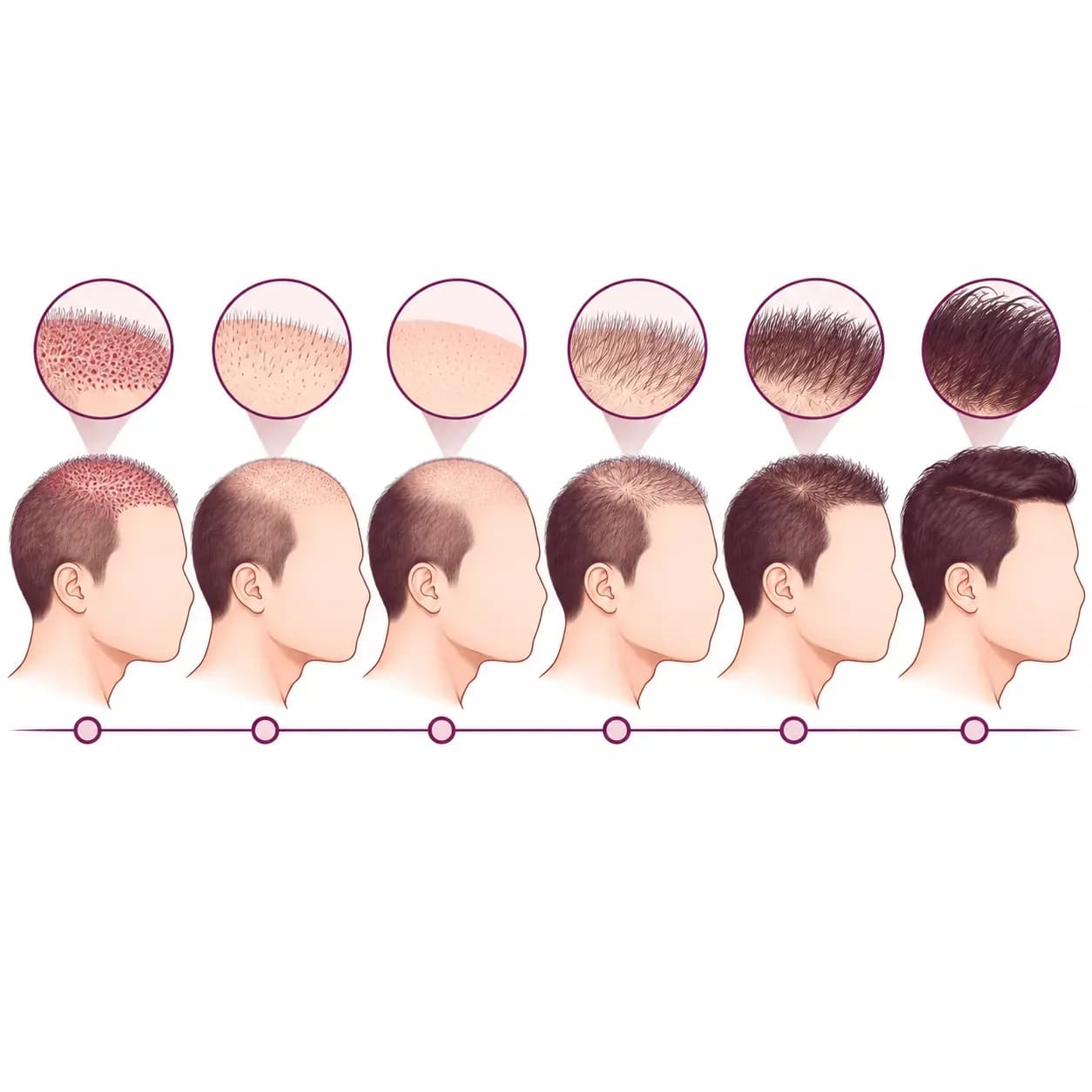
Hair transplant in Tunisia: when can you go back to work?
Crusts, swelling, a shaved donor area: what shows after a hair transplant and for how long, with return-to-work timelines by type of job.

BBL recovery: what the days and weeks after actually look like
Sitting, sleeping, the compression garment, drainage, why the volume drops in the first weeks and when the result is final. BBL recovery answered question by question.
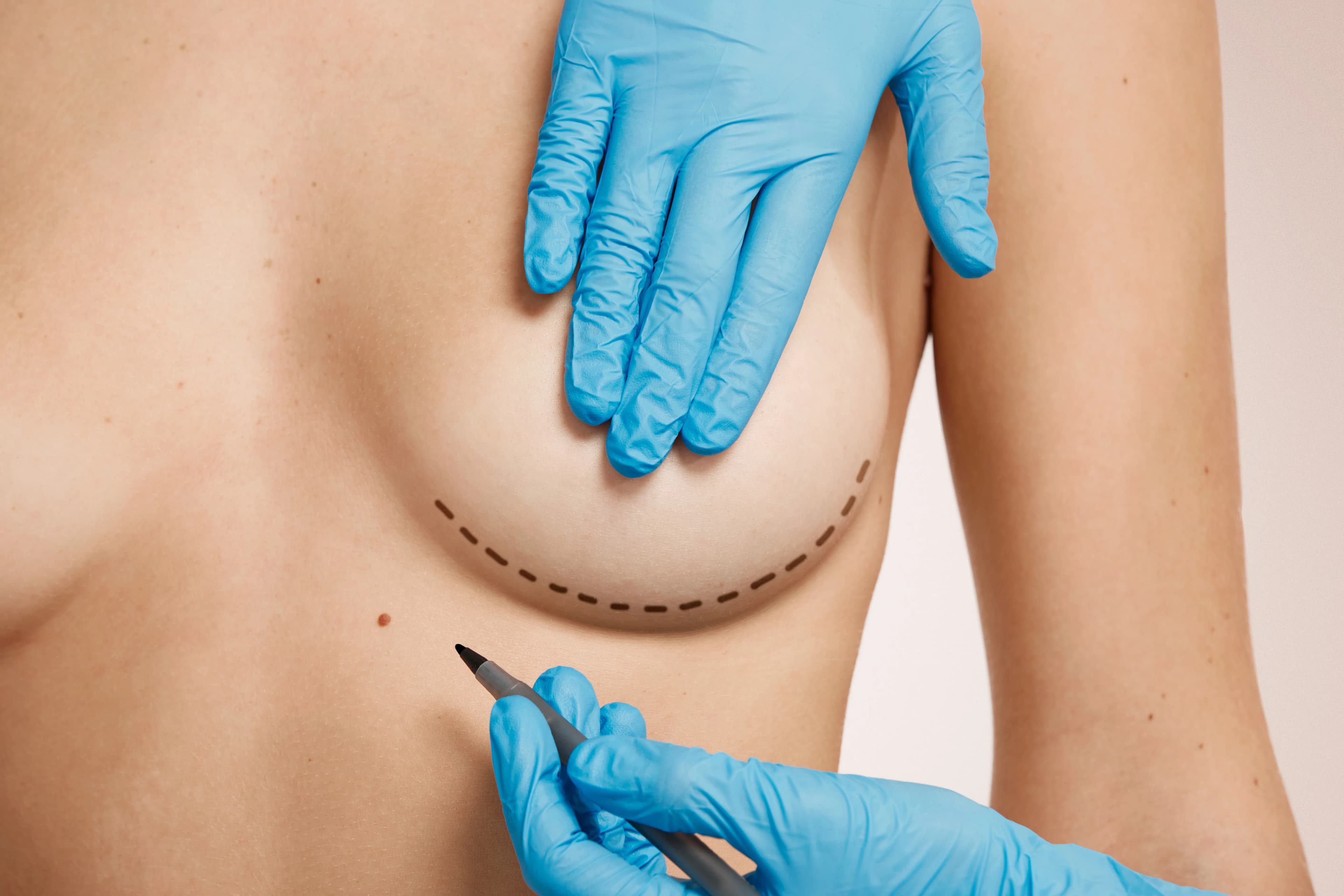
Breast lift in Tunisia: the procedure, scar care and recovery time
A breast lift repositions what is already there; it does not add volume. The three scar patterns and what decides which one you get, how long recovery takes, breastfeeding afterwards, and when the result can be judged.