

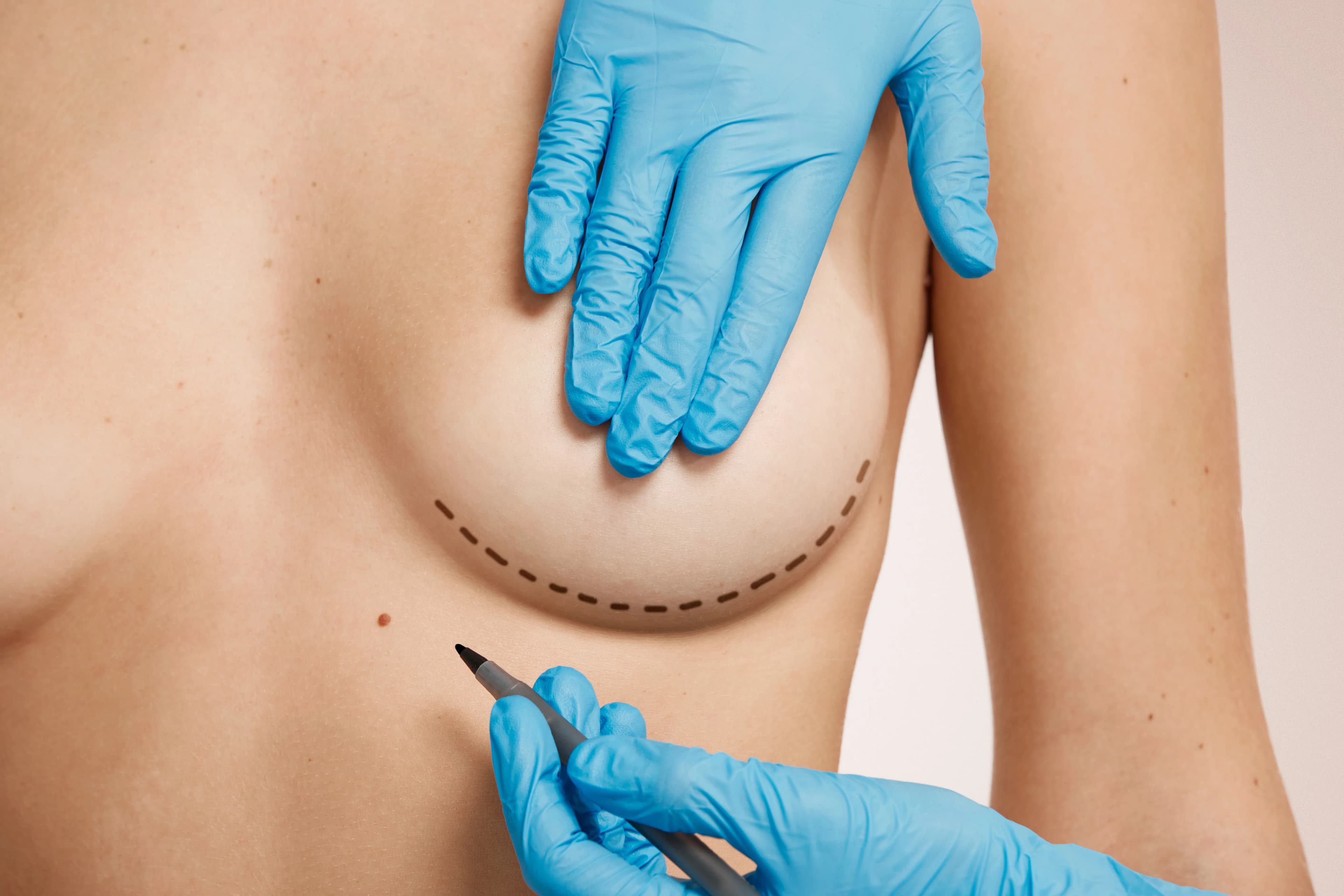
Breast lift in Tunisia: the procedure, scar care and recovery time
A breast lift repositions what is already there. It raises the gland, removes slack skin and brings the areola back to where it sits on an unsagging breast. What it does not do is add volume — that requires something else, and knowing the difference is most of the decision.
Here is how the procedure works, what the scars look like and how they evolve, how long the recovery actually takes, and what the result does over the following year.
One thing first. This is general information. Your surgeon's instructions take precedence over everything on this page, and the technique appropriate for you is decided after a clinical examination.
Understanding breast ptosis: is your breast sagging?
Ptosis means the gland has descended and the areola has dropped below the inframammary fold — the crease under the breast. It is graded:
- Grade 1: mild. The areola is level with the fold.
- Grade 2: moderate. The areola sits below the fold.
- Grade 3: severe. The areola points downwards.
- Pseudo-ptosis: the gland has dropped but the areola has not, which calls for a different approach.
The aim of a breast lift is to redrape the skin, raise the gland and place the areola at roughly 18 to 21 cm below the collarbone — a surgical landmark, not something to measure at home.
Lift alone, with implants, or with fat transfer?
1. Breast lift alone
Appropriate when there is enough breast tissue. It repositions and reshapes without changing your cup size. If your complaint is position rather than volume, this is the operation.
2. Breast lift with implants
Silicone implants placed during the same operation, mainly to restore fullness in the upper pole, which a lift alone does not create. See our breast augmentation page for how implants are chosen.
3. Breast lift with fat transfer
Fat is harvested by liposuction from the abdomen, thighs or hips, then reinjected. It uses your own tissue and leaves no implant, and the volume gain is moderate rather than dramatic. Part of the transferred fat is always reabsorbed, which is why the result is judged months later. More on our breast lipofilling page.
The scars: what to expect
Which scar you end up with depends on how much skin has to be removed, not on preference.
| Technique | Scar | Used for |
|---|---|---|
| Peri-areolar (round block) | Around the areola only | Very mild ptosis |
| Vertical | Around the areola and down to the fold | Moderate ptosis |
| Inverted T (anchor) | Around the areola, vertical, and along the fold | Severe ptosis, or with a reduction |
A smaller scar that fails to lift adequately is not the better outcome. The surgeon chooses the least invasive technique that will actually correct the problem.
How to help the scars heal well
Scar maturation takes twelve to eighteen months. For the first two months the scar looks pink, then goes through a slightly inflamed phase, then gradually pales.
Two things make a real difference: daily massage with a silicone gel or cream, started once the wound is fully closed and your surgeon has agreed, and sun protection at SPF 50 or higher for at least a year.
We go through scar care in more detail in our guide to how surgical scars evolve and how to care for them — the principles are the same wherever the scar is.
Preparation, hospital stay and pain
The consultation and pre-operative assessment
Blood tests, a recent mammogram or ultrasound, and a consultation with the anaesthetist the day before the procedure. The imaging matters: a breast lift is not performed without knowing what is in the breast.
The operation and the pain afterwards
General anaesthetic, one and a half to three hours of surgery, and one to two nights under observation.
A lift on its own is not especially painful. With implants placed under the pectoral muscle, the first three days are more uncomfortable, and the pain is controlled with the prescribed painkillers. Take them on schedule rather than waiting.
Recovery and what you can do when
- Days 1 to 5: rest at the hotel, with daily nursing care.
- Support bra: worn 24 hours a day for four to six weeks.
- Back to work: seven to fourteen days off, depending on what your job involves.
- Sleeping on your back: for three to four weeks.
- Gentle walking: encouraged from the first days.
- Upper-body exercise, running, swimming: avoided for six to eight weeks.
Our guide to how long to allow in Tunisia sets out the total stay by procedure.
Pregnancy, breastfeeding and a breast lift
Breastfeeding remains theoretically possible in most cases, because the nipple-areola complex and its blood and duct supply are preserved. The chance of difficulty is higher with some techniques, particularly where a significant reduction is carried out at the same time.
If you are planning to have children, the usual advice is to wait. A pregnancy, and the weight changes that come with it, can stretch the skin again and undo part of what the operation achieved.
Risks and possible complications
Every surgical procedure carries risks. For a breast lift these include:
- Haematoma.
- Infection, which is why sterile technique and preventive antibiotics are used.
- Delayed healing or wound separation, more frequent in smokers — which is why stopping is usually asked for one month before and one month after.
- A temporary reduction in nipple sensation.
- Asymmetry, or a hypertrophic scar, which can sometimes be revised under local anaesthetic.
These are uncommon, but they are not theoretical, and they should be discussed with you before you consent rather than mentioned afterwards.
Results: when can you judge them?
At one month: the bruising has gone and the swelling is subsiding. The breasts often sit high and feel firm, which is not the final shape.
At three months: the tissue softens and settles slightly into a more natural drape. This settling is expected and is part of the result rather than a loss of it.
At one year: the scars have matured and the shape is stable.
Stable is not the same as permanent. Ageing, weight changes and pregnancy continue to act on the breast afterwards, as they did before, which is why the timing of the operation in your life matters.
Your pathway, stage by stage
| Stage | When |
|---|---|
| Pre-operative assessment | Around 15 days before you travel |
| Procedure and stay | Days 1 to 5 |
| Early convalescence | Weeks 1 to 3 |
| Progressive return to normal activity | Weeks 4 to 6 |
| Final result | 6 to 12 months |
In conclusion
A breast lift is a reshaping operation rather than a volume one, and the scar you accept is determined by how much skin has to come out. The result at one month is not the result, and the year that follows does most of the work on the scars.
ServiHealth organises and coordinates medical stays in Tunisia. We arrange the stay at Myron International Clinic and put you in contact with our partner surgeons, who decide which technique is appropriate for you and whether the procedure should go ahead at all.
You can see our prices or request a quote, with an answer within 24 to 48 hours.