

Scars and complications after cosmetic surgery
Almost every cosmetic procedure leaves a scar. The question is not whether you will have one, but what it will look like in a year — and what you can do, in practical terms, to give it the best chance.
This guide applies to every operation that leaves a mark: liposuction, tummy tuck, breast augmentation, breast lift, rhinoplasty, arm lift, hair transplant or weight-loss surgery. It also covers the half of the subject that gets talked about less: the complications that can occur, how to recognise them, and who to call for each one.
One rule before we start: nothing here replaces the opinion of the surgeon who operated on you. This text is there to help you understand and describe what you are seeing — not to decide, and not to treat yourself.
Where the scar sits, procedure by procedure
What changes from one operation to another is not whether there is a scar: it is its length, its position, and the tension the skin places on it while it heals. Those three things decide most of the result.
A short incision, placed in a fold and under no tension, often becomes almost invisible. A long incision, on a mobile area under tension, stays visible even when everything has gone well. That is why the surgeon chooses the line before operating, and why two patients who had the same procedure do not have the same scar.
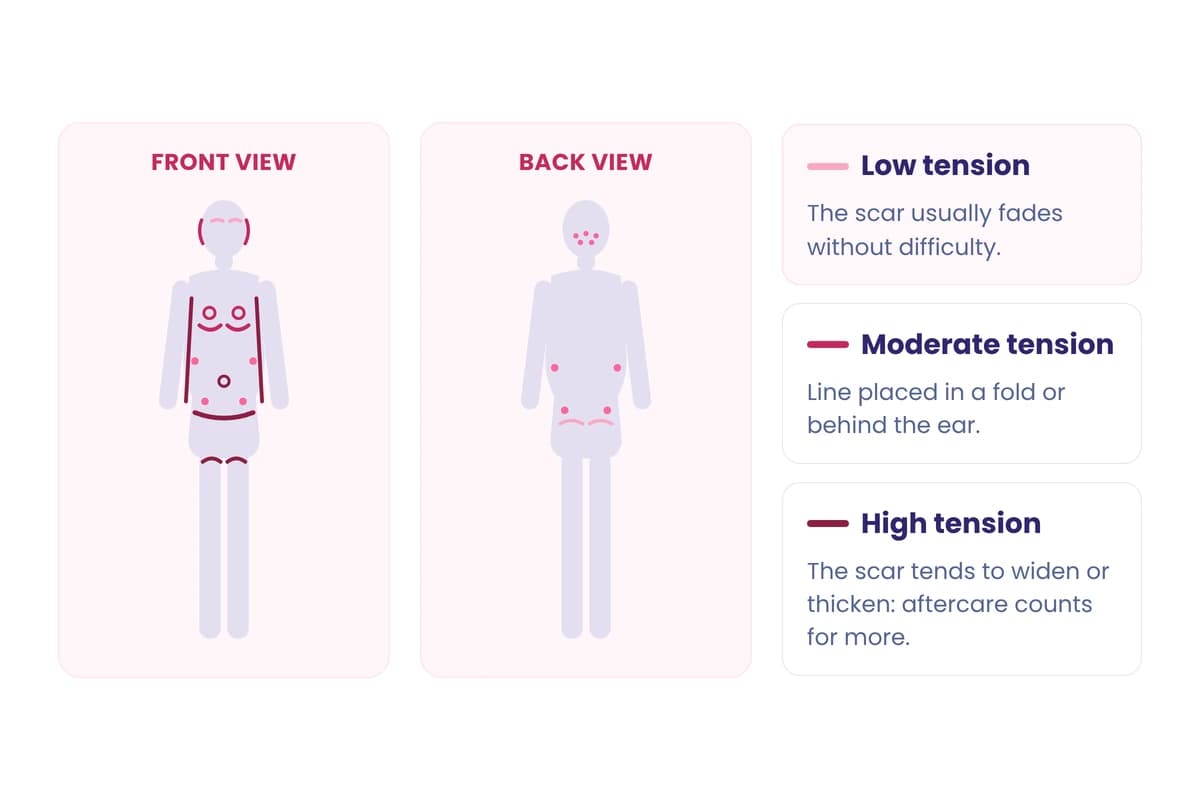
Low tension. Liposuction and BBL need only a few 3 to 5 mm incisions placed in the folds. Weight-loss surgery is done laparoscopically, through 5 to 12 mm incisions on the abdomen. Rhinoplasty leaves no visible scar by the closed approach, and a very fine line under the columella by the open approach. Eyelid surgery hides in the fold of the eyelid. Hair transplant leaves pinpoint donor marks at the back of the head. In all these cases the scar usually fades without difficulty.
Moderate tension. Breast augmentation goes under the breast, around the areola or through the armpit depending on the approach chosen; gynaecomastia surgery follows the edge of the areola. A facelift places its incisions in front of and behind the ear, running up into the hairline.
High tension. A tummy tuck leaves a low horizontal line from one hip to the other, plus the rim of the navel. A breast lift and a breast reduction draw a line around the areola, vertically, sometimes horizontally under the breast. An arm lift follows the inner arm, a thigh lift sits in the groin. On these areas the scar tends to widen or thicken, and the aftercare counts for more.
How a scar changes, month by month
A scar takes twelve to eighteen months to reach its final appearance. That is the answer to the question nearly every patient asks around the second month, when the mark is red and they start to worry: this is not the result, it is a normal stage.
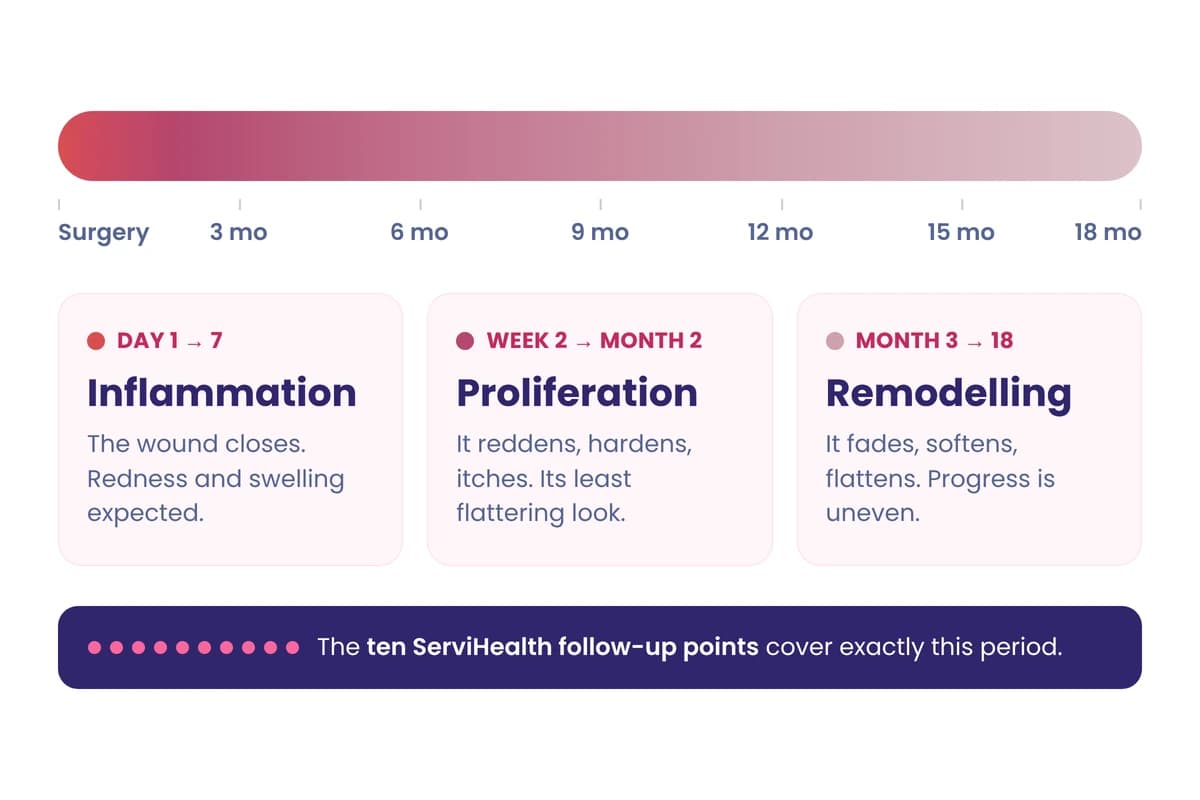
Day 0 to day 7, inflammation. The wound closes. Redness, slight swelling and tenderness around the line are expected. Scabs form: they protect the skin rebuilding underneath. Stitches, when they are not dissolvable, come out on the schedule given by the surgeon, which varies with the area.
Week 2 to month 2, proliferation. The body makes collagen in excess to fill the gap. The scar turns redder, sometimes purplish, slightly hard and slightly raised. Itching and a pulling sensation often appear. This is when it looks at its worst, and also when aftercare has the most effect.
Month 3 to month 12-18, remodelling. The excess collagen is reabsorbed. The scar fades, softens, flattens and gradually moves towards the colour of the surrounding skin. It takes time, and progress is uneven: it is common to see nothing change for several weeks and then notice a clear improvement.
Two things stretch this timetable without anything being wrong: darker skin often stays red or pigmented for longer, and high-tension areas flatten more slowly.
The aftercare that actually makes a difference
A great many products are sold for scars; few have a demonstrated effect. Four things genuinely count, and none of them is expensive.
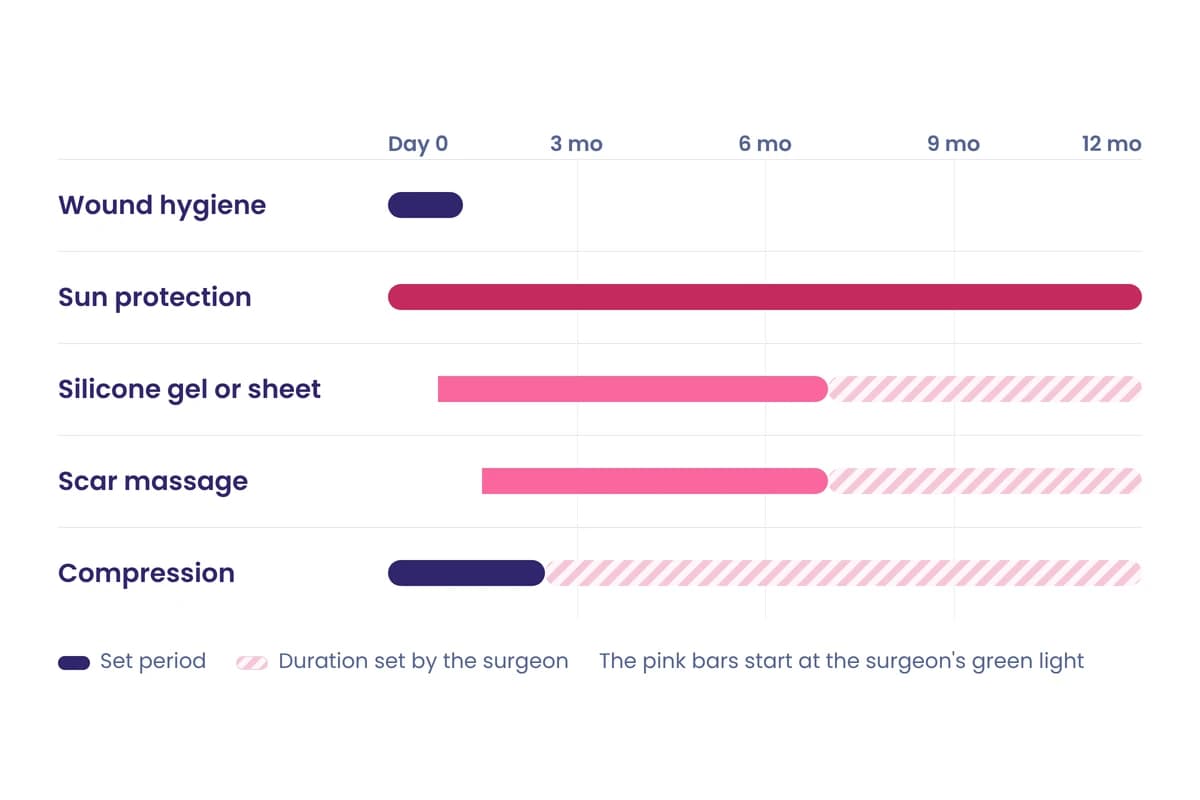
Cleanliness, while the wound is closing. Wash gently following the protocol given on discharge, dry by patting rather than rubbing, do not pull off the scabs. Nothing else: no antiseptic added on your own initiative, no alcohol, no product that « dries it out ».
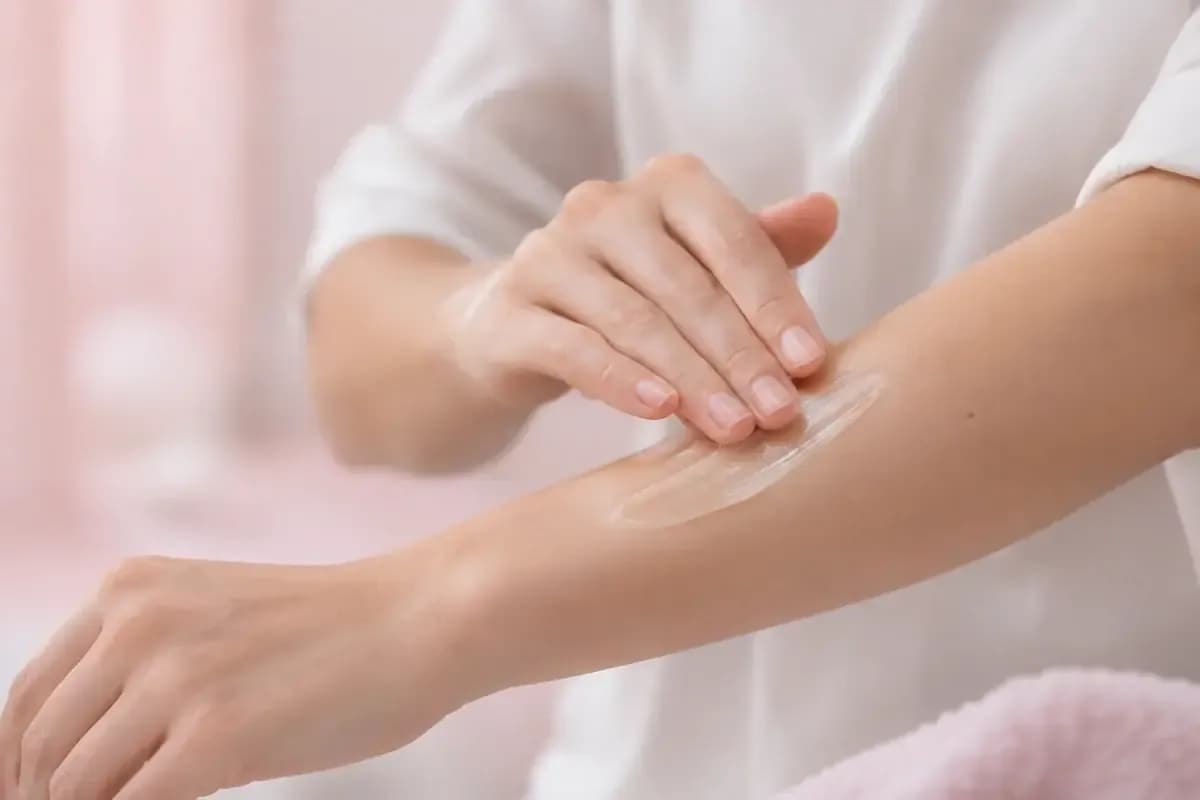
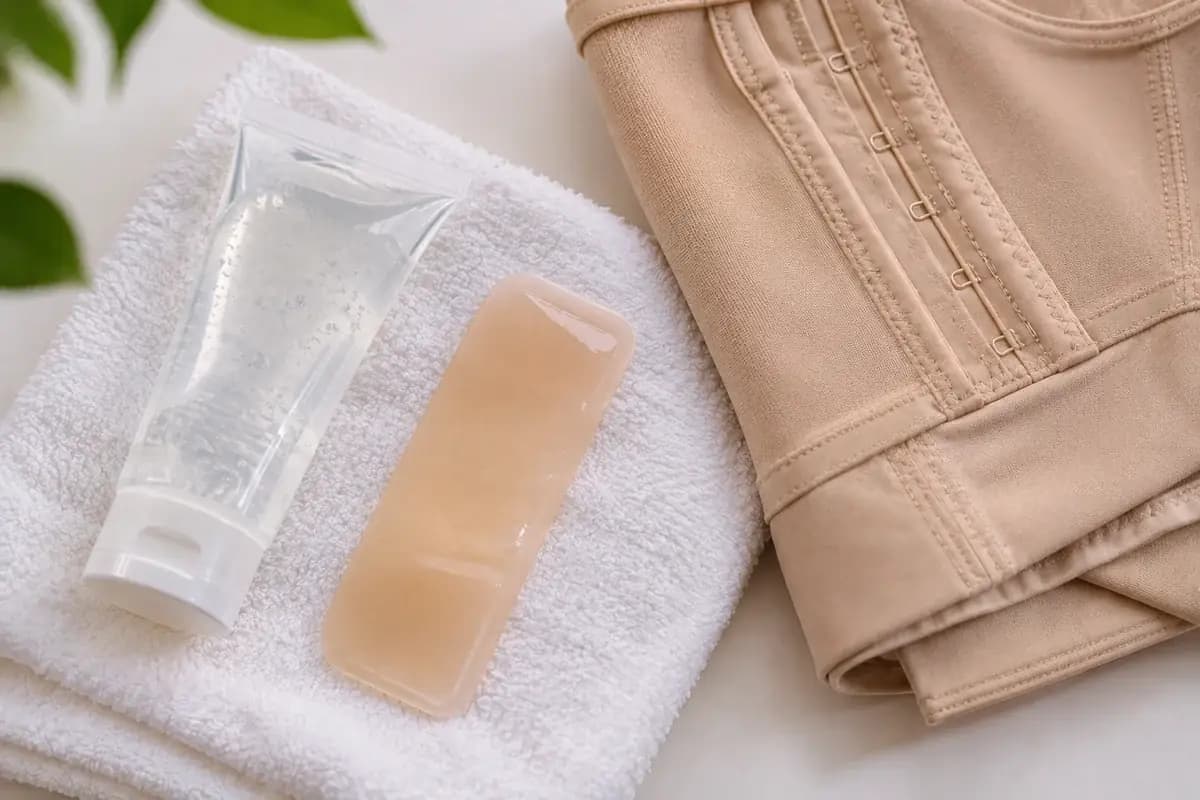
Silicone, once the wound is completely closed. As a gel or a sheet, this is the treatment whose benefit on thickness and colour is best established. It is used continuously over several months, not for a few days. When you can start depends on the state of the wound: the surgeon decides that, not the calendar.
Massage, from the surgeon’s green light onwards. It softens the scar and limits adhesions. A few minutes a day, firm pressure but no pain, on a closed scar. A painful massage on tissue that is still fragile does more harm than good. Where it is prescribed, lymphatic drainage complements this work on the swelling.
Compression, where it is prescribed. The garment or support bra is not only about shape: it limits swelling and the tension on the scar. It is one of the least well followed instructions and one of the most useful. The duration is set by the surgeon and varies a great deal from one procedure to another.
What this page will not do: name a brand, a dose or an exact duration. Protocols differ from one surgeon to another and from one procedure to another; the surgeon who operated on you gave you yours, and it takes precedence over anything you read elsewhere.
The sun: the one rule with no exception
A recent scar exposed to the sun turns brown, and that pigmentation may never go away. It is the only damage on this list that is permanent, and it is also the easiest to avoid.
Skin that is still healing does not yet have its normal protection. Under UV it makes pigment in excess at the exact site of the scar, which turns brown and then shows far more than it did before.
In practice, for at least the first twelve months: the scar covered by clothing whenever possible, total sunblock reapplied on anything that cannot be covered, no sunbeds. The rule holds on overcast days and behind glass too.
The point that surprises patients operated on in Tunisia the most: the sun after you get home counts as much as the sun during the stay. A scar protected for ten days and then exposed all summer at home is an exposed scar.
The mistakes that damage a scar
These six come up constantly, and all of them are avoidable.
Picking off the scabs. They protect the new skin underneath. Removing them creates fresh micro-injuries and clearly increases the risk of a sunken or widened mark.
Smoking during recovery. Nicotine narrows the small vessels, so it reduces the oxygen reaching tissue that is trying to heal. It is the heaviest modifiable risk factor for healing, and it applies to nicotine vapes as well.
Going back to sport or lifting too early. Tension on a young scar widens it, sometimes permanently. The intervals the surgeon gives you are not over-cautious advice.
Applying products that have not been approved. Scrubs, acids, essential oils, remedies found online: on a young scar the risk of irritation or allergy outweighs the hoped-for benefit.
Changing a prescribed treatment on your own. Stopping, doubling or substituting what was prescribed changes how you heal, and deprives the follow-up team of information it needs to interpret what it is seeing.
Comparing your scar with one seen on social media. Two patients who had the same procedure do not have the same skin, the same skin tension or the same extent of surgery. A comparison at three weeks tells you nothing about your result at a year.
When a scar does not behave as expected
Four developments fall outside the normal range. None is an emergency; all are easier to treat early than late — which is exactly what the follow-up points are for.
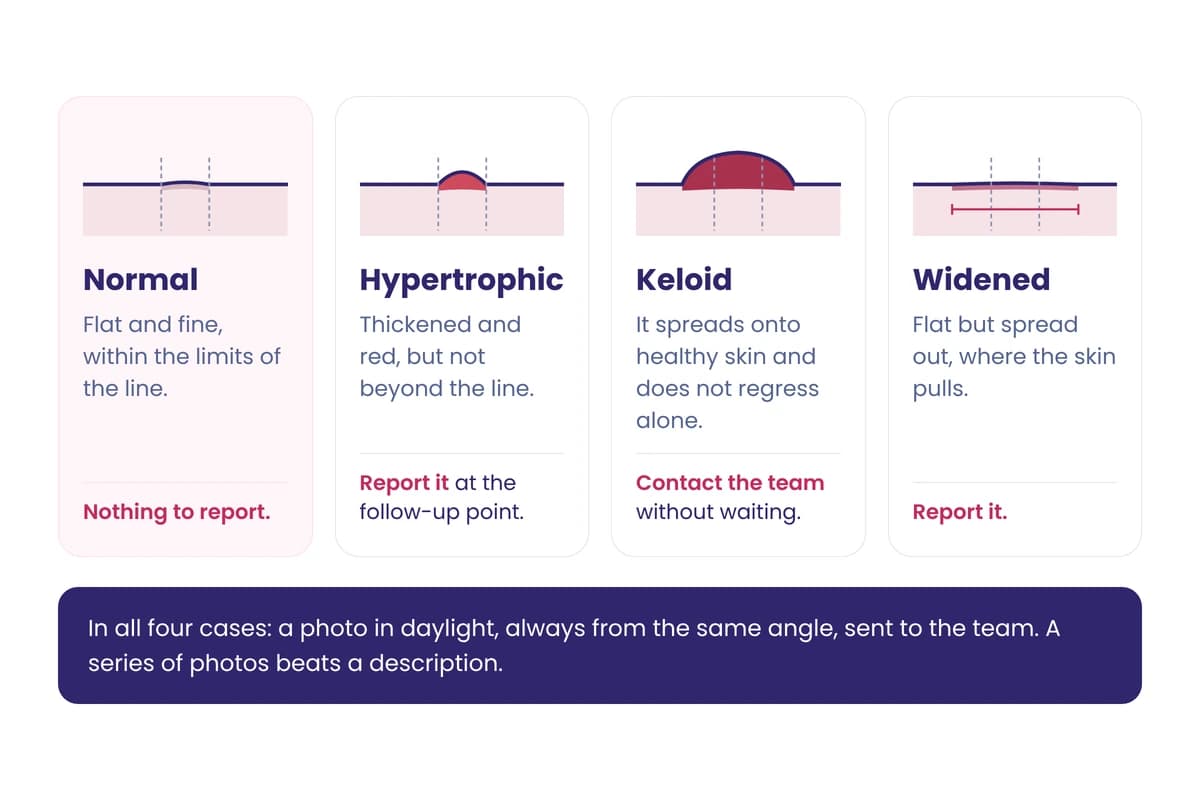
The hypertrophic scar. It thickens, reddens and becomes raised, but stays within the limits of the original line. It generally appears between the first and the third month, often on a high-tension area, and improves on its own in many cases. What to do: report it at the next follow-up point, with a photo. The surgeon will decide whether to step up the aftercare or propose a treatment.
The keloid scar. It spreads beyond the line and invades healthy skin, stays hard, often red or dark, and can itch or hurt. It does not go away on its own. Darker skin and a personal or family history of keloids increase the risk. What to do: contact the team without waiting for the scheduled point. Treatments exist and work better the earlier they are started; they are the surgeon’s decision.
The widened scar. The line stays flat but spreads sideways, typically where the skin pulls — tummy tuck, arm lift or thigh lift. It sets in over the first few months, often after going back to activity too soon. What to do: report it; surgical revision is sometimes possible, but not before the scar is mature, which means after twelve to eighteen months.
The adherent or contracted scar. It sticks to the deeper layers, forms a band or a dip, and can restrict movement. What to do: report it; massage, once it is allowed, is often the first answer, sometimes along with physiotherapy sessions.
In all four cases the useful reflex is the same: a photo taken in daylight, always from the same angle, sent to the team. A series of photos is worth more than a description, and shows whether the situation is improving or getting worse.
For two areas, more detailed pages already exist: scars after facial surgery and breast lift scars.
The possible complications, and what to do about each
The great majority of procedures go without complication. But a complication that happens early and is reported early is almost always sorted out well; the same one, kept to yourself for a week, becomes a problem. That is what this chapter is about.
Haematoma. Blood collects under the skin. The area swells, becomes tight, hard and painful, and the skin turns bluish then yellowish. A small haematoma resolves on its own; a large one, especially if it appears suddenly in the first few days, may need to be drained. What to do: contact the team the same day. Pain that clearly increases instead of easing, with rapid and asymmetrical swelling, is the sign that should make you call without waiting.
Seroma. Clear fluid collects in the space left by the operation, above all after a tummy tuck and extensive liposuction. It gives a soft, fluctuant area that ripples under the finger, often without sharp pain. It generally appears between the second and the fourth week. What to do: report it. Compression is often reinforced; a needle aspiration may be needed, sometimes several, and it is a simple procedure. A neglected seroma can organise and become harder to treat.
Infection. Spreading redness, local heat, increasing pain, cloudy or foul-smelling discharge, fever. What to do: contact the team the same day, with a photo and your temperature. Do not apply anything to the wound on your own initiative and do not start an antibiotic left over in the medicine cabinet: an antibiotic taken at random muddies the diagnosis. A high fever together with feeling generally unwell warrants an urgent consultation.
Delayed healing or wound breakdown. The edges of the wound do not hold or pull apart, sometimes after the stitches come out. More common in smokers, in diabetes, and on high-tension areas. What to do: photograph it, cover it cleanly without tightening, contact the team the same day. Do not try to pull the edges back together yourself.
Skin compromise or necrosis. An area of skin turns white, grey, purplish or blackish, often on an edge or a corner of the scar. It is rare, and it is one of the few situations where every day counts. What to do: contact the team immediately, with a photo. Do not cut anything, do not scrape anything.
Persistent swelling. Swelling that lasts several weeks is normal, especially after liposuction: it can mask the result for three to six months. What is not normal is swelling that comes back suddenly after going down, or that affects one side only. What to do: keep the compression on, and report any sudden return or any clear asymmetry.
Changes in sensation. Numb patches, pins and needles, hypersensitivity, shooting sensations. Very common, and due to small skin nerves being cut. Sensation usually comes back gradually over several months, sometimes incompletely. What to do: mention it at the follow-up points; an area that stays completely numb beyond six months is worth examining.
Irregularities and asymmetry. Dips, bumps, sides that do not match. During the first months these are often down to swelling, which does not resolve at the same rate everywhere. What to do: draw no conclusion before six months, and report them so they are followed. Any touch-up is not discussed before the result has settled. Perfect symmetry cannot be guaranteed: the two sides of a body are not identical before surgery and will not be after it.
Deep vein thrombosis and pulmonary embolism. Rare, but the most serious complication of body surgery. Pain or swelling in one calf, with local warmth, suggests a thrombosis. Breathlessness, chest pain, a racing heart or feeling faint suggest a pulmonary embolism. What to do: call the emergency services immediately, without going through the team first and without waiting until the next day. This applies during the stay and after you get home, including several weeks after the operation.
The BBL aftercare guide goes into these points for one procedure in particular, with the positioning instructions specific to it.
The signs that mean calling straight away
Two levels, and the difference matters.
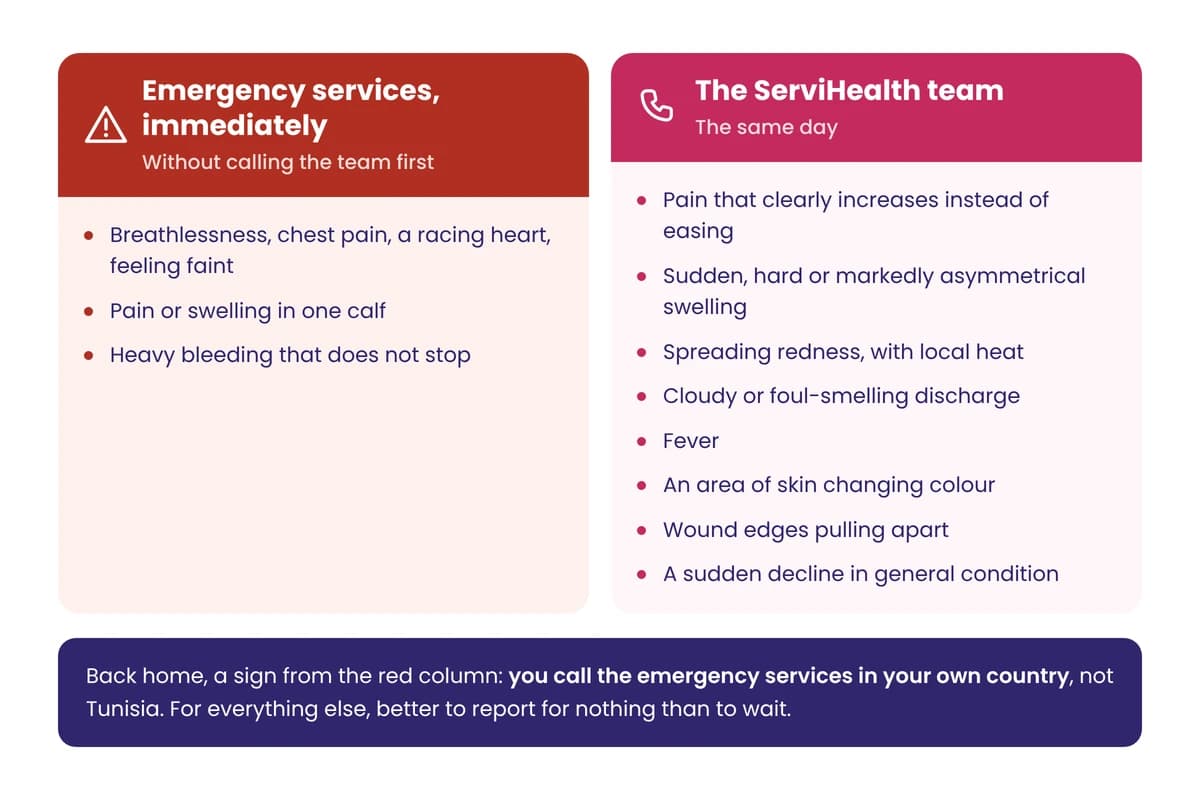
The emergency services, immediately, without calling the team first: breathlessness, chest pain, a racing heart, feeling faint; pain or swelling in one calf; heavy bleeding that does not stop.
The ServiHealth team, the same day: pain that clearly increases instead of easing; sudden, hard or markedly asymmetrical swelling; spreading redness with local heat; cloudy or foul-smelling discharge; fever; an area of skin changing colour; wound edges pulling apart; a sudden decline in how you feel overall.
These instructions apply during the stay in Tunisia and after you get home. Distance changes nothing about an emergency: if you are at home and one of the signs on the first list appears, you call the emergency services in your own country, not Tunisia.
And the rule that covers everything else: after surgery, it is better to report something for nothing than to wait several days hoping it will pass. Nobody on the team will think a patient called for nothing.
How ServiHealth follows your scars

The follow-up is the same for every procedure: ten points spread over the six months after the operation — weekly for the first month, fortnightly for the second, then monthly up to the sixth. These points are run by the ServiHealth team in coordination with the surgeon.
That calendar is not decoration: it falls precisely at the moments when a scar can go off course. The four points in the first month cover the closing phase, when haematoma, infection and wound breakdown occur. The two in the second month cover a hypertrophy or a seroma setting in. The last four accompany the remodelling, while there is still time to act on a scar that is thickening.
During the stay. Check-up consultations on site, dressings monitored, drains removed where the procedure involved them, positioning and compression instructions given before departure.
After you get home. At each point the team asks for photos of the scar and for concrete news: pain, swelling, whether the compression is being worn, return to activity. The photos are kept in the file, which makes it possible to compare one point with the next rather than judge on an impression.
When something is reported. What you send is passed to the surgeon who operated on you. He is the one who makes the diagnosis and decides what should be done; the team relays his answer, arranges a closer check if needed and, where the surgeon judges it useful, a return to Tunisia.
Between two points. You do not have to wait for the scheduled date to report something. The timings in this guide — « the same day », « immediately » — take precedence over the calendar.
One limit to state plainly: ServiHealth organises and accompanies, it is neither a clinic nor a medical practice. Every medical decision — diagnosis, care, treatment, return to activity, further surgery — rests with the surgeon who carried out the procedure.
Frequently asked questions about scars
How long does it take for a scar to turn white? Between twelve and eighteen months in most cases. It goes through a red then a pink phase before fading. Darker skin often keeps pigmentation for longer.
Can a scar be made to disappear completely? No. A scar can become very discreet; it never disappears entirely. Any promise to the contrary should put you on your guard.
When can I start massaging my scar? When the surgeon says so, not before. The interval depends on the procedure and on the state of the wound.
Can I swim? Not before the surgeon agrees: a wound that is not completely closed is exposed to infection. The sea, the swimming pool and the hammam each have their own interval.
My scar itches, is that normal? Yes, it is common during the proliferation phase. What is not normal is itching together with a thickening that spreads beyond the line.
What if I have already had a keloid? Say so at the consultation, before the operation. It changes the line chosen, the aftercare proposed and sometimes the indication itself.
I am back home and something is worrying me, who do I call? The ServiHealth team, without waiting for the scheduled follow-up point. Unless it is a sign of a life-threatening emergency: in that case, the emergency services in your own country first.
Preparing for surgery is also preparing your scar
Three things are decided before the operation and weigh on the result: stopping smoking, flagging a history of keloids, and the surgeon’s choice of line to suit your anatomy. They are discussed at the consultation, not afterwards.
If you are planning a procedure in Tunisia, send us your file: you will receive a detailed quote within 24 to 48 hours, and the six-month follow-up schedule comes with it.
Read next
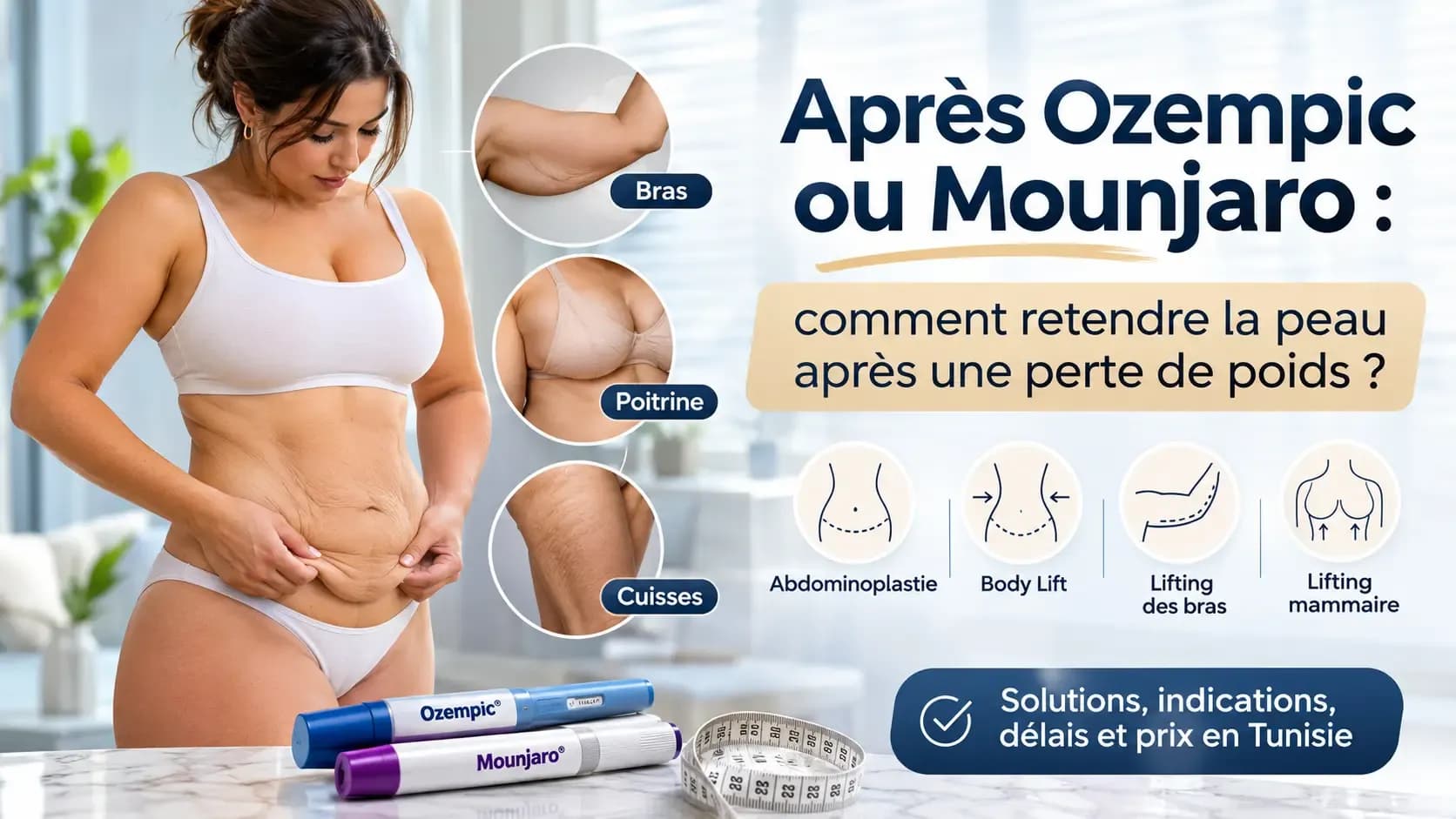
Loose Skin After Ozempic or Mounjaro: How Can You Tighten It?
Lost weight with Ozempic or Mounjaro but struggling with loose skin? Discover why sagging occurs, whether skin can tighten naturally, and which body contouring procedures may help.
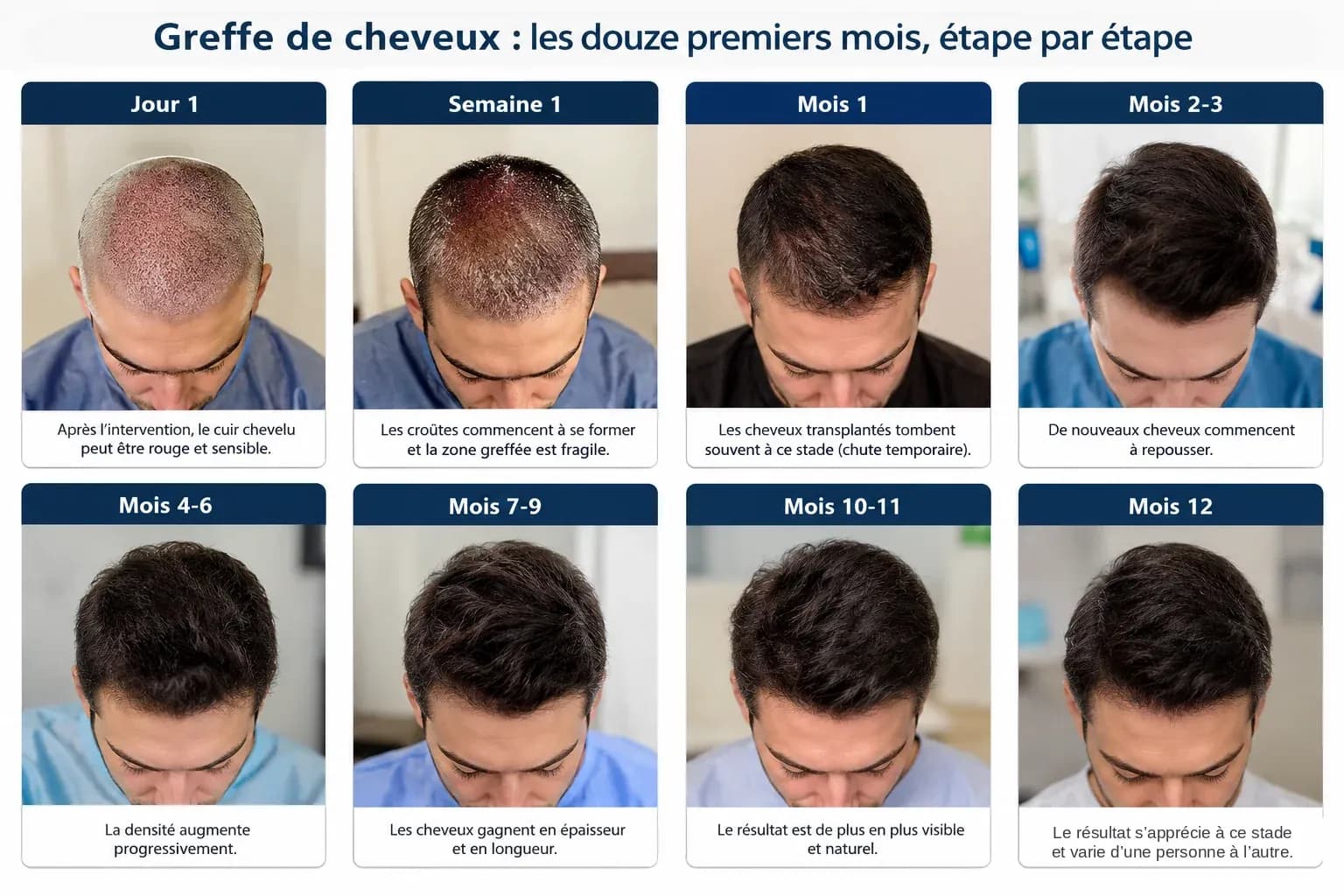
Hair transplant: the first twelve months, step by step
The shedding in the first month worries almost everyone and is not a failure. Here is what is documented about year one, and what is not.
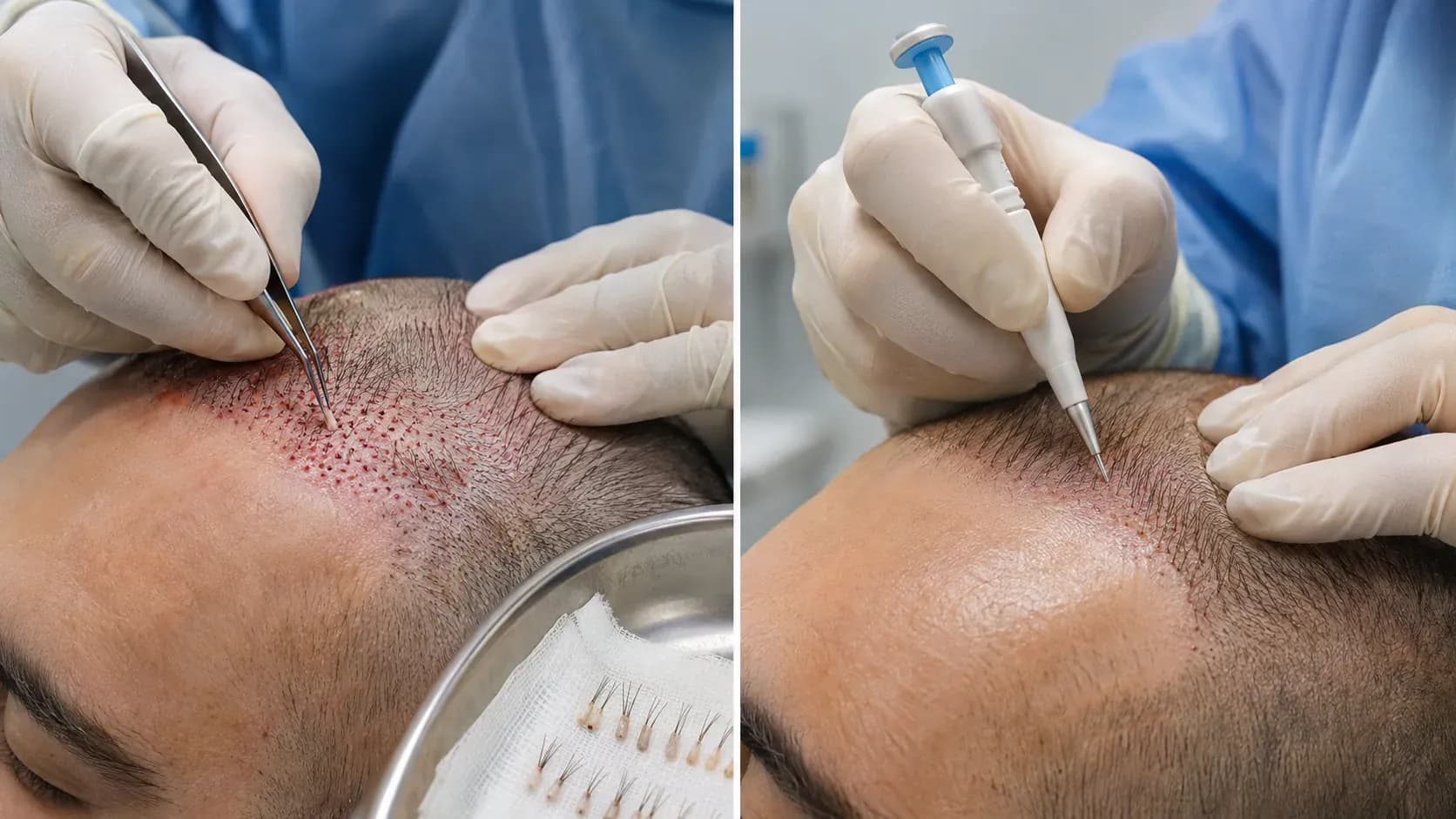
FUE vs DHI: what actually changes, and what does not
Both methods harvest the same follicular units. What separates them is the placement step, and three other factors matter more.